
A buyer searching for v03 pro smart glasses battery life wants a single number: how many hours the glasses run on one charge. The published product table does not give a single number. It gives a range, and it gives that range in a row that also carries a lens configuration the power figure says nothing about. Reading only the battery row is how a procurement team ends up holding a specification that does not match how the product behaves on a delivery shift, a trade-show floor, or a retail demo bench.
This piece works through the published row for the V03 Pro, sets out what a five-to-eight-hour range does and does not tell you, lists the rows the catalogue does not publish at all, and then addresses the lens question, because for the V03 Pro the lens is not a cosmetic add-on and it is not a separate model family. It is the same camera product, published as the photochromic configuration of the V03 Pro, sitting in a row of its own.
If you are still comparing camera models rather than evaluating one of them, the AI Camera Glasses category page is the faster route. This article is for the buyer who has already settled on the V03 Pro and now needs the published row to survive contact with a purchase order.
The published battery row for the V03 Pro
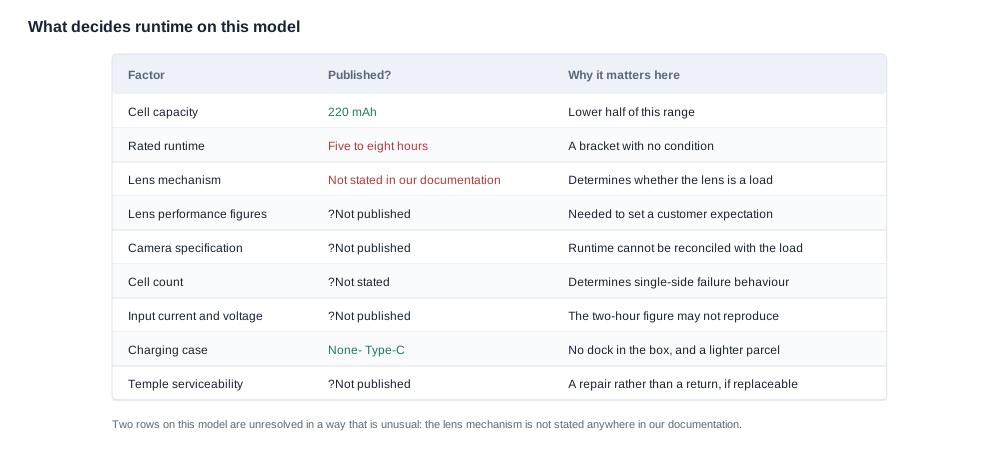
The V03 Pro appears in the published table under the name that carries its lens configuration: V03 Pro AI 智能拍照眼镜(变色镜片配置). Six fields are populated for that row, and they are the whole of what is on the record.
- Cell capacity — 220 mAh.
- Runtime — 5~8 h.
- Charging time — ≤2 h.
- Charging method — Type C.
- Bluetooth — not published.
- Lens configuration — photochromic.
Four of those six cells carry a figure, one names an interface, one names a lens, and one is deliberately blank. The blank one deserves a sentence of its own, because an empty cell in a product table is often read as "standard" or "same as the row above". In the camera group, the Bluetooth field is blank for every model in the range, so it is blank for the V03 Pro as well. Nothing in the published table supports a radio version for this model, and no version should be quoted back to a customer as though the table supplied it.
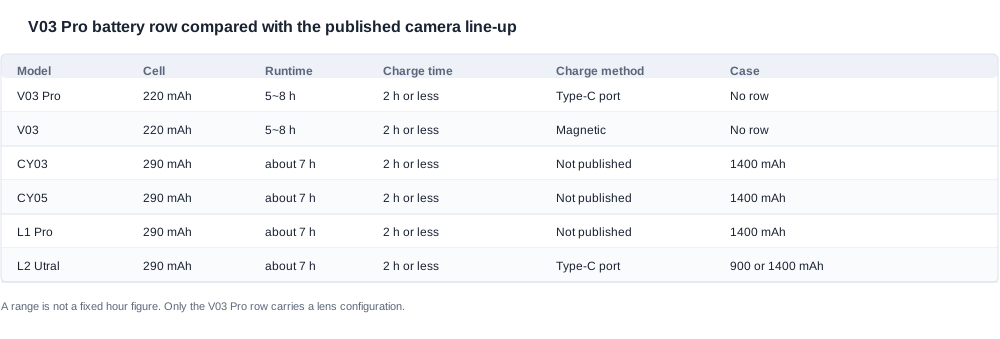
The V03 Pro is not an isolated entry. It sits in a camera table where the battery picture is tighter than a first glance suggests:
- V03 Pro — 220 mAh, 5~8 h, ≤2 h, Type C, photochromic lens configuration, no charging-case row.
- V03 — 220 mAh, 5~8 h, ≤2 h, magnetic charging, no lens configuration, no charging-case row.
- CY03 — 290 mAh, ~7 h, ≤2 h, charging method not published, case 1400 mAh.
- CY05 — 290 mAh, ~7 h, ≤2 h, charging method not published, case 1400 mAh.
- L1 Pro — 290 mAh, ~7 h, ≤2 h, charging method not published, case 1400 mAh.
- L2 Utral — 290 mAh, ~7 h, ≤2 h, Type C, case 900 or 1400 mAh.
Two readings follow from that grouping, and both matter for how you evaluate the V03 Pro.
The first is that the V03 Pro and the V03 are the same power platform. Same cell, same runtime band, same charge ceiling. What separates the two published rows is the charging interface — Type C against magnetic — and the lens configuration, photochromic against none published. For anyone whose channel expectation is a magnetic dock on the counter or in the case, that interface difference is the more visible of the two, and it changes what accessories have to exist in the box or beside it.
The second is that neither the V03 Pro nor the V03 carries a charging-case row anywhere in the table. The CY-series, the L1 Pro and the L2 Utral all do, expressed as a second capacity alongside the glasses cell. That absence is commercially load-bearing: a buyer planning to ship a case alongside the V03 Pro is not buying a documented accessory. The case, its capacity, its charge logic, its lead time and its price all become questions for the supplier rather than a specification to plan against. If a demonstration or evaluation unit needs the case included, that belongs in a scoped sample order agreed in writing, not in an assumption carried into a bulk order.

Reading a five-to-eight-hour range without over-reading it
The runtime figure for the V03 Pro is written as 5~8 h. That notation is doing specific work. It is a span, not an estimate of a midpoint and not a rounded point value. Elsewhere in the same table other camera models are written as ~7 h, which is an approximation marked with a tilde, and no camera row in the table states a single exact hour figure. Both notations are honest about the same underlying fact: the runtime depends on something the table does not name.
The temptation, particularly inside a comparison spreadsheet that needs a value in a single cell, is to compress the band into a headline number. Take the midpoint and quote six and a half hours as the runtime. Or quote the top of the band, because eight hours is the friendlier figure to put on a retail listing and on a channel sell sheet. Both conversions manufacture precision the source never claimed, and both of them survive longer than the buyer who made them, because they end up in the quotation a customer signs against and in the copy that a distributor repeats.
We will not convert a published range into a fixed hour figure, so a buyer planning a shift should treat the row as a range and confirm the test condition in writing.
What a range cannot tell you, and what a fixed hour figure would silently invent:
- Whether the band describes continuous camera recording, intermittent capture, or standby with the camera ready to shoot.
- Whether the lower end assumes a particular ambient light level, which matters directly once a photochromic lens is part of the configuration.
- Whether the upper end describes a first cycle from a full charge or the same glasses late in their service cycle.
- Whether screen-on time, radio connectivity and storage writing sit inside the band or on top of it.
- Whether the ≤2 h charge ceiling describes a full charge from empty on mains power, from a partial level, or under some other condition.
- How much of the band survives once the cell has aged through a normal service cycle.
None of that is a criticism of the table. It is a short table with six fields, written as a comparison aid rather than a test report. The problem starts only when a range is compressed into a fixed figure and the compressed number is carried into a purchase order, a product listing or a channel promise, where it stops being a summary of a published row and becomes a commitment the supplier never made.
The practical reading of 5~8 h for the V03 Pro is therefore a planning band rather than a number. Design the use case against the lower end, treat the upper end as the best case under whatever condition the supplier names, and keep a written note of which end of the band any internal claim was based on. Where a plan genuinely requires one figure — a shift rota, a rental agreement, a store opening schedule — that figure has to arrive from the supplier as a defined test condition, in writing, attached to the purchase order. It cannot be derived from this table, and no responsible supplier will expect a buyer to derive it.

What the catalogue does not publish about the V03 Pro
The published row is short, and the rest of the published material is short with it. A buyer building a business case for the V03 Pro will hit a wall of blanks, and the cheapest way through that wall is to know exactly where it stands, so the gaps go into the first round of questions instead of the fourth.
Here is the list of what is not on the record for this model, and how to handle each gap.
Bluetooth version. The Bluetooth column is empty for every camera model in the published table. No version number for the V03 Pro appears anywhere, so the correct internal wording is "Bluetooth version not published" — not a version number borrowed from another row, and not an assumption that an empty cell means the latest release. If a customer specification needs a radio version, that has to come from the supplier in writing.
Ingress rating. An IP code appears in the published library against only two models, V06 and S7, where it reads IP54. The V03 Pro row carries no IP code at all. The distinction matters: a missing rating is not a low rating and not a high rating, it is an absence of data. Selling into a market where ingress marking is expected, or shipping to a channel that stores product outdoors, requires a written answer and, if needed, a defined test condition of your own. Until that exists, the accurate description for the V03 Pro is that the catalogue does not publish an ingress rating.
Weight. The only published weight in the entire library is for the MT6, at 158 g for the glasses body, excluding a 1200 mAh folding case. The V03 Pro has no published weight of its own. That single figure cannot be transferred across models, because the V03 Pro is a different product with a different lens configuration. Weight also drives shipping cost per unit, the carton dimensions your warehouse has to hold, and the wearer's sense of whether the glasses are a tool or a gadget — three consequences that all need the same number, which only the supplier can give.
Control method, audio and language rows. The published library contains no capacitive-touch row for any camera model, no translation row, and no surround-sound annotation for the V03 Pro. The audio annotation appears against the D11 only. In other words, the interaction scheme, the audio topology and the language set for the V03 Pro are not table rows; they are questions.
Commercial rows. Price, MOQ, lead time, warranty period and terms, incoterms, payment terms, deposit structure, tooling cost and amortisation, bulk order price tiers, quality control and acceptance criteria, shipment options, factory capacity, private label minimums, and the contract templates a supplier is willing to work from — none of these appear in the published material for the V03 Pro. Every one of them is a normal part of an order, and every one of them has to be requested.
Certification and compliance. This one needs precision, because it is the easiest to get wrong in both directions. The body text of the published catalogue does not contain the terms FCC, CE, RoHS or RED. The export certification page is an image page, and it carries no per-model certification row that names this product against a specific standard. So the published position for the V03 Pro is: no certification claim is published for this model. That is not a statement that the product lacks certification — it is a statement that the catalogue does not publish it. A buyer who needs a specific market approval should request the technical file, the test reports and any declaration of conformity for the destination country, then verify them against the model, the factory and the production batch rather than accepting a file that names no model at all. Where a declaration is issued per shipment rather than per model, that arrangement needs to be written down, because it changes what your own file looks like at customs.
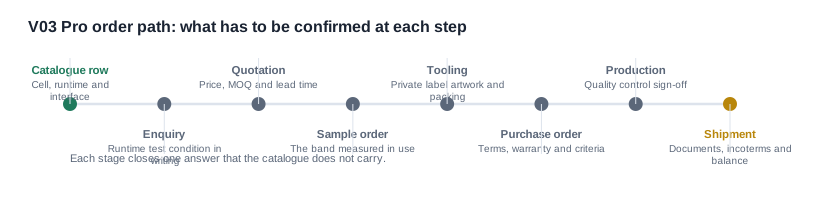
The sequence below is the order path for this product, with the point at which each missing row has to be closed. The discipline is simple: every question that will change the price, the schedule or the compliance file is asked before the purchase order, not after it.
- Enquiry — confirm the configuration, the lens colour option, and the intended market.
- Quotation — ask for the runtime test condition, the weight, and the itemised unit price at your volume.
- Sample order — verify the runtime band in your own lighting and workflow, and check the lens in the conditions the product will actually be used in.
- Tooling and private label — confirm artwork, packaging, and the per-SKU minimums for each lens colour.
- Purchase order — attach the test condition, the acceptance criteria, the warranty and the certification scope to the order.
- Production and quality control — agree the inspection points and the pre-shipment sample.
- Shipment — fix incoterms, payment terms and the deposit balance trigger before the balance falls due.
- Documentation — collect the technical file, the declaration and the batch records you need for due diligence.

The lens configuration and the second question a buyer has to ask
The V03 Pro row is named for its lens, and that is not a marketing flourish applied to a catalogue entry. In the published camera table, the V03 Pro is the only camera model that carries a photochromic lens configuration, and it is the only camera model offering a set of three lens colour options. Every other camera row in the table is published without a lens configuration attached. The lens is therefore one of only two things that distinguish this published row from the V03 row next to it, the other being Type C charging instead of magnetic.
That has three consequences for a buyer, and none of them are visible in the battery column.
The first is about who buys it. A photochromic lens is a field and outdoor proposition: the lens adapts to changing light, which is why the configuration is interesting for outdoor capture, sports and site work, and for outdoor-facing retail where the product is demonstrated on the pavement rather than under showroom lighting. A buyer whose channel is entirely indoor, or whose content is captured in controlled conditions, gets less from the differentiator than the price of the colour story implies. That is the trade-off to weigh before the lens is chosen as the reason to specify this model over the plain one.
The second is about the battery band, and this is where the two questions in this article finally meet. A photochromic lens changes light transmission as the ambient light changes. The lower end of a 5~8 h band is, in most engineering experience, reached under the harder condition, and lighting is one of the variables that drives power draw through a camera and display. The catalogue does not name the condition, so nobody can say from the table which end of the band corresponds to which environment. A buyer who quotes the top of the band for outdoor field use, and the bottom of the band for an indoor retail demo bench, has not described one product accurately. Ask the supplier which end of the band corresponds to which lighting condition, and whether the lens response speed and depth affect the figure.
The third is about your own inventory. Three lens colour options is a merchandising asset for a channel buyer, because it lets a retailer build a colour story on the shelf and it gives your private label packaging something to name. It is also three stock-keeping units instead of one, each with its own packaging artwork, its own minimum, and its own demand curve that you will forecast badly at first. So the questions to ask about the lens are commercial as much as optical: what is the MOQ per lens colour, does a mixed-colour order count against one MOQ or several, how does the lead time run per colour, and can the bulk order be split across colours in one shipment or does each colour ship separately.
Because none of this is published, the V03 Pro evaluation has to be built around asking rather than reading. The following is the working checklist to take into a supplier conversation, and the questions to ask in the order that unblocks the most downstream decisions first.
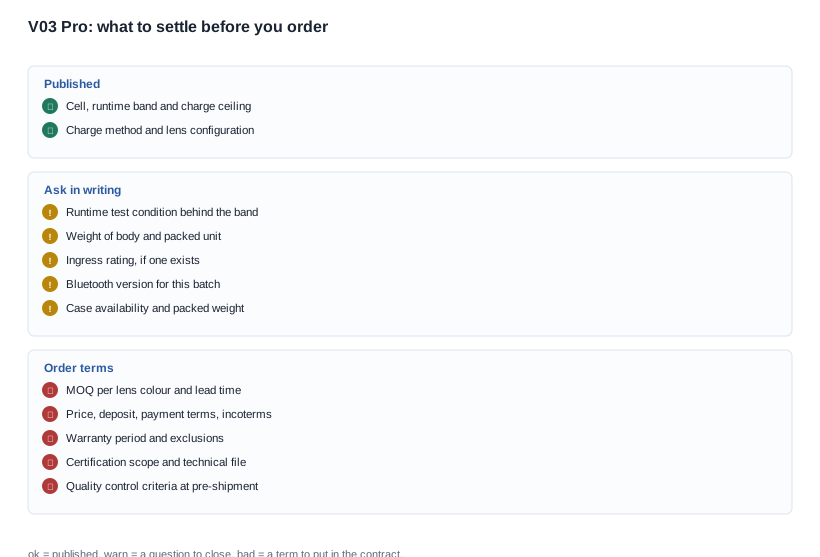
- Which runtime condition does the 5~8 h band describe, and can it be written into the quotation?
- What is the measured weight of the glasses body, and the packed weight per retail unit?
- Is an ingress rating available for this model, and under which test condition?
- Which Bluetooth version is fitted, and is it confirmed for this production batch?
- Is a charging case available for the V03 Pro, and what does it add to the packed weight and the MOQ?
- What are the MOQ, the lead time, and the private label minimum per lens colour?
- Which certifications and test reports cover this model for our destination market, and can we see the technical file?
- What warranty period and coverage apply, and which exclusions are written into the contract?
- What quality control criteria are used at the pre-shipment inspection, and who signs them off?
- What are the incoterms, the payment terms, and the deposit schedule for the first order?
- Does the factory support an audit or a factory visit, and what is the due diligence pack?
The commercial risk is not dramatic, but it is real and it is cheap to remove. A range quoted as a number, a weight assumed from a neighbouring model, an ingress rating borrowed from another row, or a certification claim read off a general export page all produce the same outcome: a customer promise the product may not support when it is tested. Each of those is a negotiation you can settle now, at quotation stage, while the cost of changing the terms is one line in an email. Each of them becomes expensive later, when the error surfaces as a returned unit, a delayed launch, or a compliance question raised at the border rather than in a sample review. The order of work matters more than the effort: negotiate the specification before the tooling, negotiate the tooling before the deposit, and never negotiate the acceptance criteria after production has finished. A buyer who has written the runtime test condition, the weight, the certification scope and the warranty into the purchase order, the technical file and the quality control criteria has already made the V03 Pro row defensible, and everything left on the list becomes a detail rather than a dispute.
Run the checklist against the sample order rather than against the catalogue, and record the answers in the same place you keep the purchase order. A buyer who has measured the runtime band on a sample under their own lighting conditions has replaced an assumption with a fact; a buyer who has only copied the band has carried a range into a commitment and called it a specification.
Two habits separate the buyers who are comfortable with this product from the ones who are not. The first is refusing to convert a published range into a fixed hour figure. The second is treating every unpublished row — weight, ingress, radio version, certification scope, price, MOQ, lead time, warranty, incoterms, payment terms, deposit, tooling, quality control, shipment — as something to be asked for in writing, and then written into the contract and the technical file. Do that, and the V03 Pro row stops being a marketing line and starts being a specification you can defend to your customer, your logistics team and your regulator.


