

Three things make this model's catalogue page different from every other camera page in the range, and all three of them have to be handled in the order rather than in the copy. The page names a Type-C charging port. The page names a flexible temple and a photochromic lens, and the lens appears nowhere else on it. The page publishes three colours. And the page prints no charging-case row at all, which puts it in the same position as the V03, the V06 and the S7: the case is an open item on this model rather than a published fact.
That last point is the one buyers most often get wrong in both directions. Four camera models in this range have no case row on their page at all — the V03 and the V06, and the S7 and the V03 Pro — and a blank row is an unanswered question, not a statement. On those four the case has to be requested in writing before it can be costed into the box and written into the packing list.
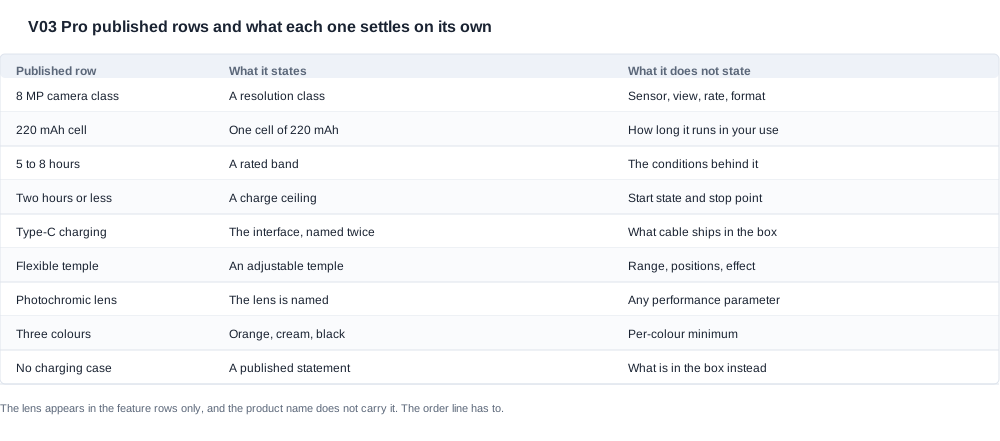
The way to evaluate a page of this shape is to split it in two before reading it as a whole, because the split tells a buyer how much of the work is already done and how much is still a request. The published half is short — a camera class, a cell, an endurance band, a charge ceiling, a named interface, a lens name, a temple description, three colours, and nothing at all about the case. Everything else a procurement team needs for this model is open. A page like this is neither a specification nor a gap; it answers the questions a factory can answer from a catalogue and leaves the ones that need a document, a sample or a conversation with the supplier. The criteria for judging anything that comes back are simple. It has to name the build it applies to, and it has to be written down. A reply that covers the model in general leaves the order line exactly where it started, and a buyer who has seen how often that happens learns to treat it as an unanswered item rather than a partial one.
What to check before ordering to know about V03 Pro smart glasses: the model with no charging-case row
The published specification for this model runs as follows: a 220 milliampere-hour cell, five to eight hours of running time published as a band, a ceiling of two hours or less for charging, Type-C charging, and an eight megapixel camera class. The feature rows add a flexible temple, a photochromic lens and a Type-C charging port, and the page publishes three colours — orange, cream white and black.
Read carefully, that set of rows contains an internal tension that a buyer has to resolve before anything else, and it is a tension between the physical product and its photograph. The catalogue provides no photochromic performance parameter of any kind: no transition behaviour, no light conditions, no figure for how quickly the lens changes, no specification of what range of light it is designed for. The lens is named and that is all. A product page that shows a lens changing colour in a photograph is showing something the catalogue does not document, and a channel that repeats that impression has created a claim it cannot evidence against a competitor, a distributor or a customer.
That is the background to the checks below. Three of them are ordinary specification checks, one of them is a naming problem, and the whole set has to be closed in one exchange with the supplier rather than across three rounds of correspondence.
The camera class here is one of the two resolution classes the camera models use, and this model sits in the eight megapixel one, alongside the CY05 and the V03, the V06 and the CY03, and the MT5 and the MT6, and the KY06. The class counts pixels and settles nothing else. The imaging chain is not named and the angle the camera covers is not given; the frame rate, the container the footage is written into and the storage behind it are absent as well — for this model and for every other camera model in the range.
The cell is 220 milliampere-hour, and it is the same cell value the V03 and the MT5 publish — this is the third of the three camera models on that figure. The three share a cell and not a charge method: the V03 charges magnetically, this one charges over Type-C, and the MT5's page records a case instead of naming an interface. Same cell, three different accessory trails, and a buyer who is comparing the three on capacity alone is comparing one of three axes and missing the other two.
The endurance is a band of five to eight hours, the same band several camera models publish, and a band cannot be quoted without the conditions that produced it — which are not published for this model.
The charge ceiling is two hours or less, and what it covers is not stated — neither the state the cell starts in nor the point at which the charge is called complete.
The interface is Type-C, and it is named twice on the page — once in the charging column and once as a feature row — which is unusual and useful. A named interface is one of the few things a buyer can use to plan a packing list, because it determines that a cable is in the box, that a specific cable is needed, and that the accessory is replaceable in a way a dock is not.
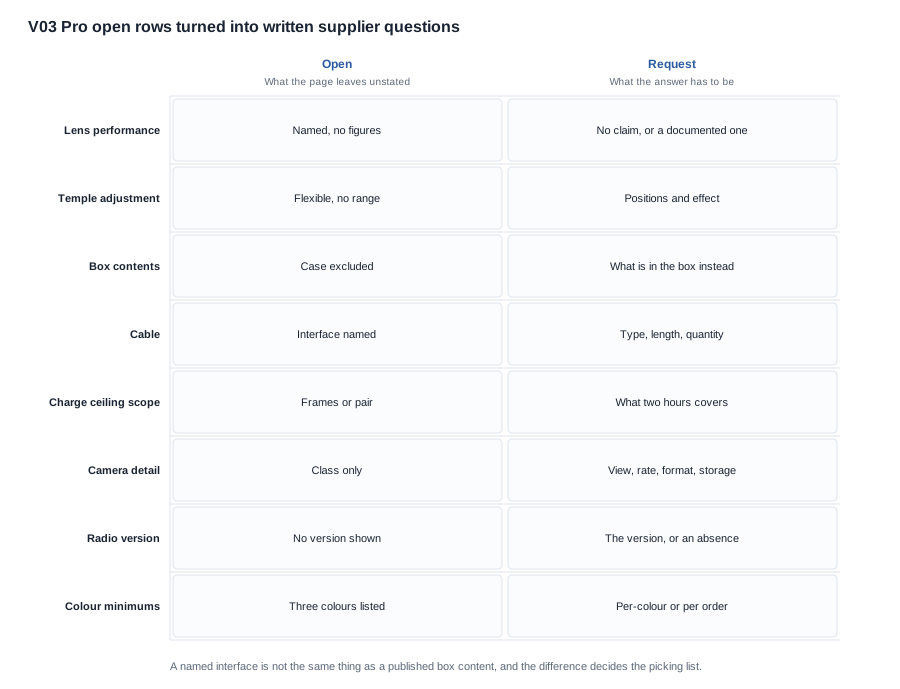
And the case is where the page is silent. This model publishes no charging-case row, and that is an omission rather than a statement, so the commercial consequences have to be established in writing before they can be acted on. The box contents are not published, so the bill of materials for this configuration is an open line rather than a settled one. The accessory line is a cable and whatever else the box holds, and whether a case is among them is an item to confirm, price, stock and replace only once the answer is in hand. A customer whose unit is returned has one fewer item to account for if the answer is no case, and one more if it is not. And a channel that had assumed every camera model in the range arrived with a case has to put this model on its list to confirm, because the catalogue does not settle it.
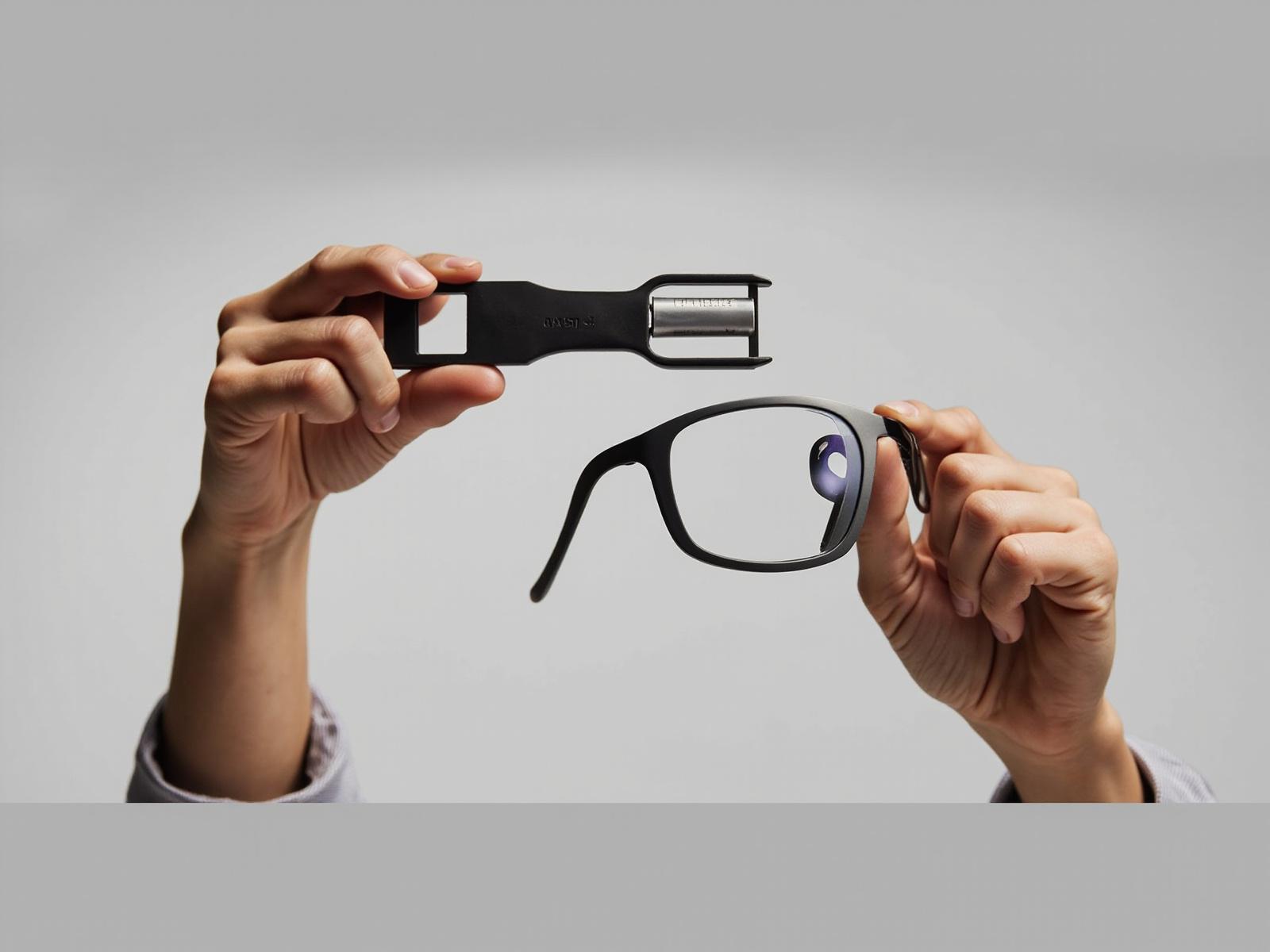
The 220 milliampere-hour cell and the Type-C interface, stated side by side
These two fields belong in the same conversation, because for this model the interface is published and the accessory is not, and that combination is unusual.
The cell is 220 milliampere-hour and the endurance is five to eight hours. The cell is one of three camera models in the range publishing that figure, and the endurance band is shared with several others. What a buyer can do with the pair is limited but real: a 220 milliampere-hour cell with a five-to-eight-hour band is a configuration that has to be checked against the intended working session, because the top of the band is roughly three times the bottom of it and the catalogue does not say which end applies when.
The interface is Type-C, and this is where the published rows are unusually helpful. A camera model that names its interface lets a buyer answer three questions without asking anyone. What ships in the box: a cable, of a type the buyer can name. What the customer replaces when it is lost: a cable, which is easy, cheap and universal enough that a customer can solve it themselves. And what a returns inspection looks like: the unit and the cable, with no second powered component to test.
What the interface does not answer is whether the cable is in the box, or what length it is, or whether the unit accepts a charge from any Type-C source or only from a supplied one. The discipline here is to write the interface as one narrow question with one expected answer, because an interface is a binary fact and a buyer who asks it loosely receives a paragraph. What to ask is: which connector does the unit use, and what length of cable is supplied. The second half is the one that gets skipped, because a channel assumes that a Type-C product ships with a Type-C cable of a standard length, and the assumption fails the first time a customer's own cable turns out to be too short to reach the unit. Before you order, record the expected answer in the factory's own words rather than as a generic description, so that the packing bench, the quality control check and the after-sales desk are all working from the same statement.
The charge ceiling needs the same treatment. Two hours or less is published, and the question of what it covers — the frames alone, or a frames-and-case cycle — is answered on a different page in this range by the case question, and on this page by nothing, because this page publishes no charging-case row at all and the question has to go to the supplier. The frame's own charge time is the sensible reading, and it is a reading rather than a statement, which is why it should be confirmed in writing with the start state and the completion point attached.

The comparison worth making is not with another manufacturer but with the sibling in the same family. The V03 publishes a 220 milliampere-hour cell, the same five-to-eight-hour band, and magnetic charging, and its page carries no case row at all. So the two models present a buyer with the same cell and the same endurance figure, and completely different accessory questions: one names an interface, the other names a case in its place, and neither of the two pages publishes a charging-case row. A buyer who has been working from a general assumption about camera models in this range will get one of the two wrong, and the error will surface at the packing bench.
There is one more field this page does not publish and that the camera models in this range do not publish for any model: a radio version. So the question of what this product connects to is a question rather than an answer, and it belongs on the list next to the camera questions rather than being assumed from the audio models.

The colour-changing lens, which appears only in the feature rows
Three separate things are happening with the lens on this page, and they need to be kept apart.
The first is where the lens appears. It appears in the feature rows and nowhere else on the page. The product name carries the camera class and the product type, and it does not carry the lens — which means that a buyer who refers to the product by its name is referring to something less specific than the page describes. If two builds of this model exist, one with the lens and one without, the name alone does not tell them apart, and the order line has to.
The second is what the catalogue says about the lens, which is the name and nothing else. No transition behaviour, no light range, no figure for response, no statement about what the lens does in an interior or at night, and no comparison against a non-changing lens. This is the part of the page that constrains what a channel may write. A listing can state that the model is published with a photochromic lens, because the catalogue publishes that. A listing cannot state how quickly it changes, how dark it gets, how it performs under a particular sky, or that it removes the need for a separate pair of glasses, because none of that is published for this model or for any other.
The third is what happens if the lens is not named. This is the practical failure, and it is the reason the lens belongs on the order line rather than in the copy. A purchase order that says "the V03 Pro" and nothing else can be filled with a build whose lens configuration differs from the one the buyer photographed and wrote the listing against. The listing then describes a product the customer does not have, and the discovery happens at the customer's end rather than at the warehouse. Naming the lens on the order line costs one line of text and removes the most likely version of that error.
The questions to ask about the lens therefore have to be precise, because a general question about the lens will be answered with a general answer about lenses. Ask for the behaviour rather than the name: what changes, under which light, and how quickly. Ask whether the lens configuration is fixed for a build or selectable, and whether the choice is recorded somewhere a warehouse can read it. Ask what the factory's own sample unit carried, since that sample is the unit the channel will photograph. The pitfalls here are ordinary and specific: an order that names the model but not the lens, a sample approved in one configuration and shipped in another, and a listing that describes a lens performance nobody in the factory has measured. Those are red flags rather than disputes, and each one is cheap to prevent at the order line and expensive to discover after the customer has the unit in a parcel.
The same reasoning applies to the flexible temple, which is the other physical row on the page. What a flexible temple changes is that the adjustment is variable rather than fixed, and that has consequences in both directions: a customer can adjust the product to their own head, and a channel cannot describe a fixed geometry at all. The published row tells a channel that the temple is flexible and nothing about the adjustment range, the positions available, or whether the adjustment changes anything about the product's other characteristics. A listing can state that the model is published with a flexible temple; it cannot state a range, a comfort outcome, or a stability outcome.
There is a fourth question that belongs with these two, and it is the one that connects the physical rows to the evidence rows. If the temple is flexible and the lens is a stated feature of the build, then the physical configuration of the unit that the factory tested is a configuration with two adjustable elements. For a model with an ingress marking, that would matter — this model has no such marking, and the two camera models in the range that carry one are not this one, so no condition claim may be written for it in any case. But the question still deserves an answer for a different reason: what the factory's own sample unit looked like, and whether what arrives is the same object. A buyer should ask what the sample configuration is and what the production configuration will be, and the answer belongs on the order line next to the lens and the colour.

The three colours, and why the order line has to name the lens
The page publishes three colours for this model: orange, cream white and black. That is a genuine published specification, and it is the reason a channel can build three listings for this model rather than one, provided the listings are built on something other than a colour change.
Three questions sit behind the colour row. Do all three colours run as standard, and are there colour-specific minimum order quantities? Is the colour consistent with the lens, or can a colour be paired with a different lens? And is the colour a property of the frame, the temple, or the whole assembly, which matters for a model whose temple is adjustable? None of these is published, and all three are questions that determine how a multi-colour order is actually structured, whether the colours share a production line or sit on separate ones, and what the packaging cost looks like per colour.
The packing consequence is the one that catches people out. A model offered in three colours, with no charging-case row on its page, has a box whose contents vary by colour and cannot be read from the catalogue, and the variation is in the visible part of the product. A warehouse that picks by model name alone has to pick the colour from somewhere, and the somewhere has to be a printed instruction that names it. That is a printing cost, a picking step and a returns question, all of which come from the colour row and none of which appear on the catalogue page.
The order line is therefore the place where several of these checks converge, and it is worth writing down what it has to carry for this model:
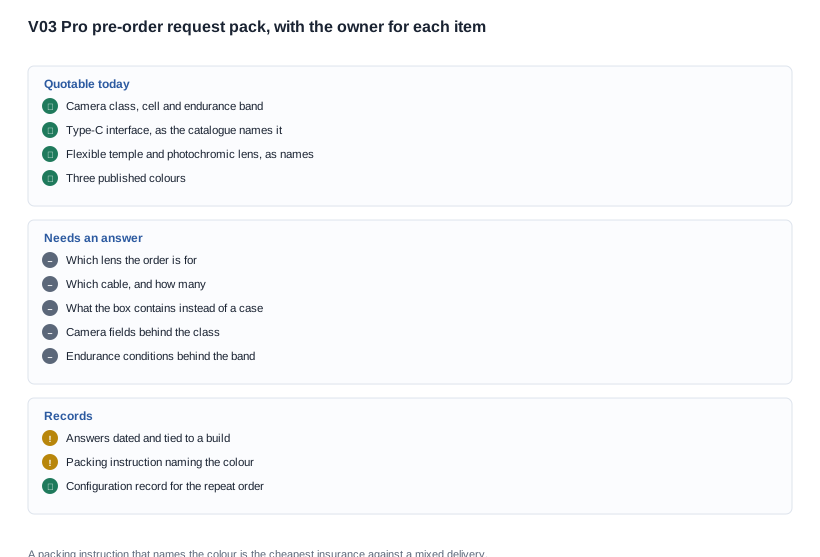
- Identity and build. The model marking as it appears on the unit and on the carton, and the production build the answers apply to.
- The lens. Which lens configuration the order is for, in the same words the catalogue uses, so that the line names a feature rather than a photograph.
- The colour. Which of the three published colours, and whether a colour runs as a separate line with its own minimum.
- The case position. A written statement of whether the order is for a build with a charging case or without one, and, either way, a statement of what is in the box.
- The interface. Confirmation that the unit charges over Type-C, what cable is supplied, and of what length.
- The charge ceiling. Whether the two hours or less describes the frames on their own, with the start state and the completion point attached.
- The camera. What the eight megapixel figure does not say: how much of a scene the lens takes in, how many frames a second the unit writes, what format the file is written in, and where a recording is kept once it has been made.
- The radio. Whether this model carries one and which version.
- The endurance band. What was running during those five to eight hours, and what the figure comes out at when the work this channel actually does is the work being measured.
- The temple. What the flexible temple adjusts, over what range, and how the adjustment is marked for the packing bench.
- The market file. What certificates, declarations and test reports exist for this build, which destination markets they serve, and who issued them; the catalogue carries no per-model certification row for it.
There is a shortlist discipline in the eleven lines above, and it is worth stating because the order is not arbitrary. Two of the lines are commercial commitments rather than product facts: the lens and the colour, because both are configuration decisions a channel makes once and then lives with in every listing, every photograph and every complaint it handles. One line is documentary, and it is the market file, because it decides whether a shipment clears at a border. The rest are product facts that a sample settles in an afternoon. Trade-offs appear when the schedule is tight, and the trade-off is always the same: the lines that need a written answer from the factory take longer than the lines that need a unit in the hand. What should you send first, then, is not the longest list — it is the one whose answers the rest of the list depends on, and it is the one to send before you commit to a launch date.
The eleven items travel together, attached to the sample request, and what closes them is a written reply against every numbered line: one that states the build it applies to, lists the market paperwork for each destination the order will ship to, and ends with a configuration record that a second order can be reproduced from.
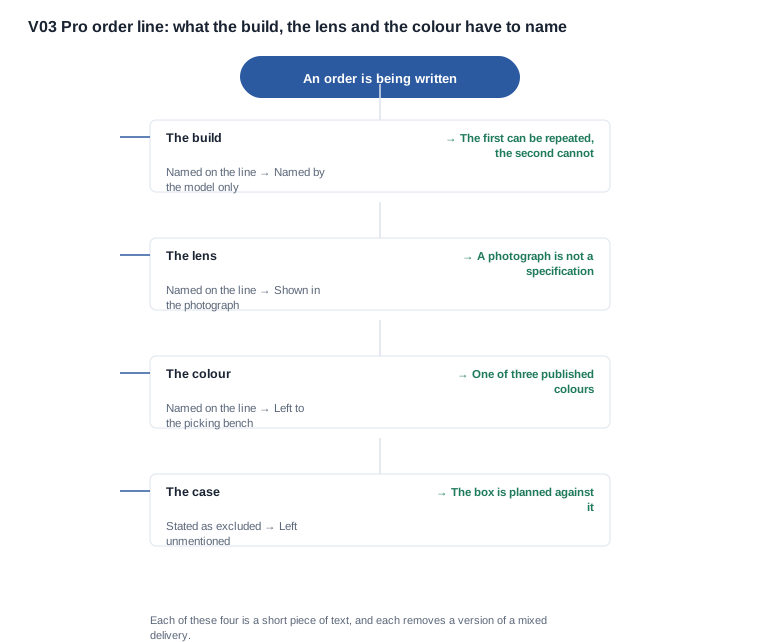
Two red flags are worth naming, because both are easy to produce and expensive to discover late. The first is a lens that was agreed in a meeting and never written on the order, which is exactly the kind of agreement that a second order loses. The second is a colour confirmed in a sample and never written on the order line either, which produces a mixed delivery that no one notices until the picking bench.
A closed file produces a short record: the unit that arrived is the unit the order line named; the lens and the colour are the ones that were ordered; the box contains what the packing instruction says it contains, including or excluding a case as the supplier has confirmed in writing; the capture behaves as observed; and the paperwork covers the build and the market. The first batch is judged against that record.
What this page will not do is rank the camera models, name a requirement this one is best suited to, or tell a buyer which programmes it fits. Nothing in the catalogue prices this model, dates a delivery, sets a minimum order quantity, or states a lens figure or a field of view, and a conclusion of that kind would be a judgement dressed up as a published fact. What it does publish is a cell, an interface, a lens, a temple and three colours, and the checks above are how a buyer turns those five published items plus the case answer into an order line that can be repeated. The criteria for closing the file are the ones written above, and the questions to ask are the ones that produce a written answer against each of the eleven lines.
On this model, our position is narrow and worth stating in our own words. We will publish the lens as a named feature because the catalogue names it, and we will not publish how it behaves, because the catalogue does not say. We will print the colours we hold, and we will not imply that a colour implies a lens configuration. We do not publish a price, a lead time or a minimum order quantity for this model, and we will not estimate them in a conversation to a buyer. What closes the file for this model is simple to state and simple to check: each of the eleven lines carries a written answer, that answer names the build it covers, and the configuration record held on the file matches the unit that arrived. Deciding when to close the file is a commercial judgement made against a schedule, but the criteria behind it are not negotiable, and they are the same eleven lines.
Tell us which of these six items your own order line is missing today, and we will turn that line into a request in the format our documentation team would file against a build.


