
Two catalogue entries, both of them AI camera glasses, both charged in two hours or less, and both quiet about several things a buyer would want to know. On the surface they resemble two trim levels of the same product. The published rows say otherwise, and they say it in a way that settles the comparison quickly: the V03 is a cable product with magnetic charging and no charging case in its row, and the CY03 is a case product with a 1400 mAh case and no published charging method at all.
That single structural difference settles the buying decision, and it settles it before any price is quoted. What follows is the comparison built only from the two published rows, then the questions that remain open on both.
We will not present a specification difference the catalogue does not publish, so a buyer choosing between the V03 and the CY03 should decide from the programme they are running and ask for the unpublished rows in writing.
What the catalogue publishes for the V03 and the CY03
The catalogue carries both models as separate rows, and each row prints the same set of fields. Reading them side by side is the whole comparison.
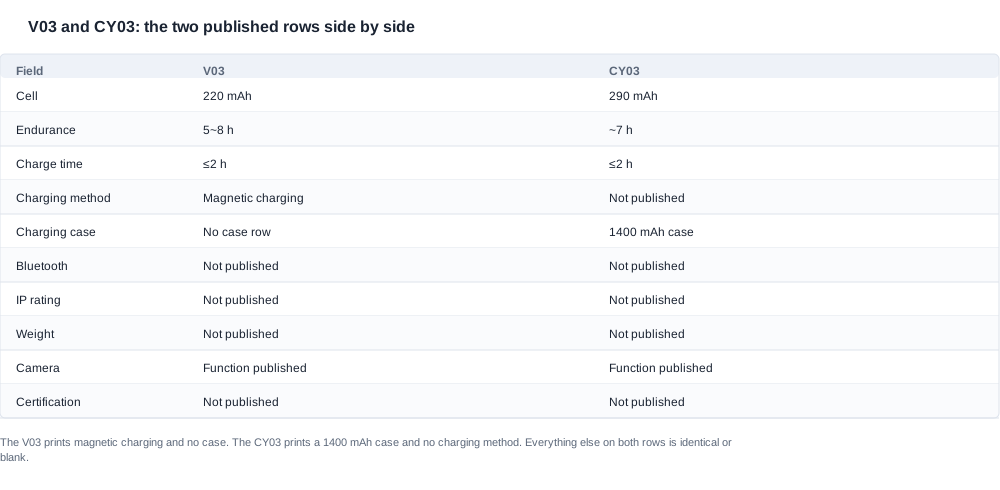
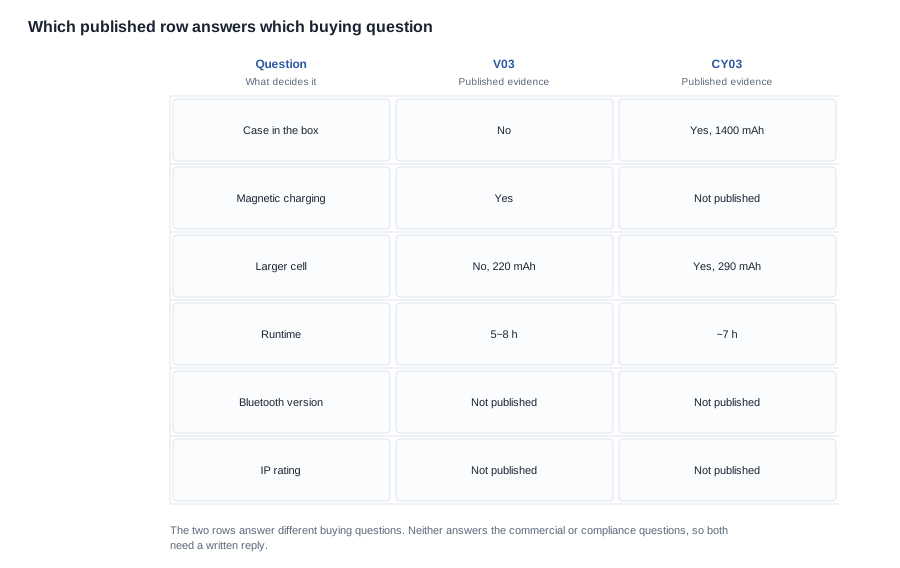
V03. The name field reads V03 AI smart camera glasses. The cell is printed as 220 mAh. The runtime is printed as 5~8 h, a band rather than a single figure. The charging time is printed as ≤2 h, an upper bound. The charging method reads magnetic charging. The charging case field is absent. The Bluetooth field is blank.
CY03. The name field reads CY03 AI camera glasses. The cell is printed as 290 mAh, seventy milliampere-hours larger than the V03. The runtime is printed as ~7 h, an approximation rather than a band. The charging time is printed as ≤2 h, the same upper bound as the V03. The charging method is not published at all. The charging case field reads a 1400 mAh case. The Bluetooth field is blank.

Read those two paragraphs and the comparison is already decided. The V03 publishes how it charges and publishes no case; the CY03 publishes a case and publishes no charging method. Every other published difference is secondary, because the charging method determines the cable in the box, the instruction sheet, the packaging artwork, the accessory list and the compliance file.
The published fields that are the same on both rows
Two fields are identical, and it is worth being precise about which two, because "identical" is often stretched to cover fields that are merely blank on both sides.
The charging time is identical in the only sense that matters commercially: both rows print ≤2 h, so neither model can be positioned as the faster charge. A buyer promising a charge time on either product is promising a ceiling that both share. The camera function is common to both rows, which is why the two models sit in the same family at all.
Everything else that appears similar is blank on both. The Bluetooth field is blank on the V03 and blank on the CY03, and the camera series does not publish a Bluetooth version for any of its rows. Neither row carries an IP rating, a weight, a certification line, a price, a MOQ, a lead time, a sample order policy or a warranty term. The absence of an ingress rating on both rows is a gap in the catalogue rather than a shared rating of any value, and the IP ratings reference explains what a declared rating would and would not let a seller claim.
V03 smart glasses vs CY03: where the rows differ and where they match
Three published fields differ and one is shared. That is the entire factual difference, and it is enough to build a decision on.
Difference one: cell capacity and what it produces
The V03 prints 220 mAh. The CY03 prints 290 mAh. That difference is real, and it is the only capacity difference the catalogue publishes between the two rows.
The runtime follows the cell, but not in a way the catalogue lets a buyer calculate. The V03 prints a band of 5~8 h and the CY03 prints an approximation of ~7 h, and neither figure carries test conditions, sample size or a defined usage profile, so the two cannot be compared as precise numbers. What can be said is that the CY03 carries a larger cell, that its published runtime sits inside the V03's published band, and that the band means the V03's runtime could be at either end depending on use.
For a programme whose selling point is a full working day of intermittent capture, the larger cell and the narrower claim on the CY03 are the stronger combination. For a programme that treats the glasses as a secondary device used in short blocks, the V03's smaller cell is a smaller problem than the missing case is a risk.
Difference two: the charging method, which only one row publishes
The V03 row prints magnetic charging. That is a positive, usable fact: it tells a buyer the interface, tells a packaging designer what the accessory is, and tells an instruction writer what the user does.
The CY03 row prints no charging method. Its case field reads a 1400 mAh case, but how the glasses reach that case is not published. This is the most consequential blank in either row, because a charging method is not a detail that can be deferred: it determines the connector on the device, the cable in the box, the charge cycle, the carton claim and the wording of the instructions.
Difference three: the charging case, which only one row publishes
The V03 row carries no charging case field. The CY03 row carries a 1400 mAh case. In practice this makes the two products a cable product and a case product, and that single difference propagates into everything a brand has to decide.
A case product ships with a second object that has to be manufactured, packed, protected in transit, described on the carton and explained in the manual. It also carries a cell, which means a second set of compliance obligations and a second failure mode in the field. The 1400 mAh case is a large number against the 290 mAh cell it charges, and it is the reason the case product makes sense for a buyer whose users work away from a socket — and also why it carries more launch risk: two cells, two declarations, two parts to inspect, and a charging method the row does not contain.
Where the rows are identical, and why that is useful
Beyond the shared charge ceiling and camera function, the two rows are identical in every field they leave empty: Bluetooth version, ingress rating, unit weight, camera sensor specification, certification position, price, MOQ, lead time, sample order policy, warranty and production capacity. That shared blank space defines the diligence list exactly once, because a buyer running both models through the same sourcing process can ask one question set and get two answers instead of two separate investigations.
One shared gap is easy to misread: a V03 is not a lower-specification IP-rated product compared with an IP-rated CY03. They are two products with two identical gaps. The OEM and customisation options page covers how the configurable parts of a programme are typically scoped, and the pricing and procurement terms reference sets out how those parts usually get quoted.

Two different buying decisions behind two similar devices
The reason the two products seem interchangeable on a shelf and are not interchangeable in a supply chain is that they ask different questions of the buyer. Choosing between them is not a search for the better specification; it is a decision about what kind of product the brand is launching, and every downstream artefact follows from that answer.
The V03 decision: one object, one interface, one claim
If the brand launches the V03, it is launching a cable product. The published row gives it a 220 mAh cell, a runtime band of 5~8 h, a charge ceiling of ≤2 h, and magnetic charging. There is no case to design for, no case cell to declare, and no second object to protect in a shipment. The packaging is one box with one product and one cable, the instructions describe one charge cycle, and the quality control plan inspects one powered unit.
That simplicity has a price, and the price is on the runtime. A 220 mAh cell with a band running from 5 to 8 hours needs its endurance story written honestly rather than optimistically. A brand that markets a full working day on the V03 is making a claim the row does not support at the bottom of its own band; a brand that markets it for short capture blocks, with a magnetic charge between them, is describing the product accurately. The V03 is the right choice when the brand wants a small, simple, single-object product and is willing to keep the runtime claim modest.
The CY03 decision: two objects, one unknown
If the brand launches the CY03, it is launching a case product with a 1400 mAh case and a 290 mAh cell, and it is accepting a scope it cannot yet describe. The case is published; the charging method is not. So the accessory is a known object in the spec and an unknown object in the compliance file, which is an unusual position to sign a purchase order from.
The CY03 is the right choice when the brand's users genuinely work away from a socket and the 1400 mAh case is the feature the programme is built around. It carries more work in return: two cells to declare, a larger packing carton, a second inspection point, and a second failure mode in the field, since a case that fails is a support case a cable product does not generate.
The trade-off, stated plainly
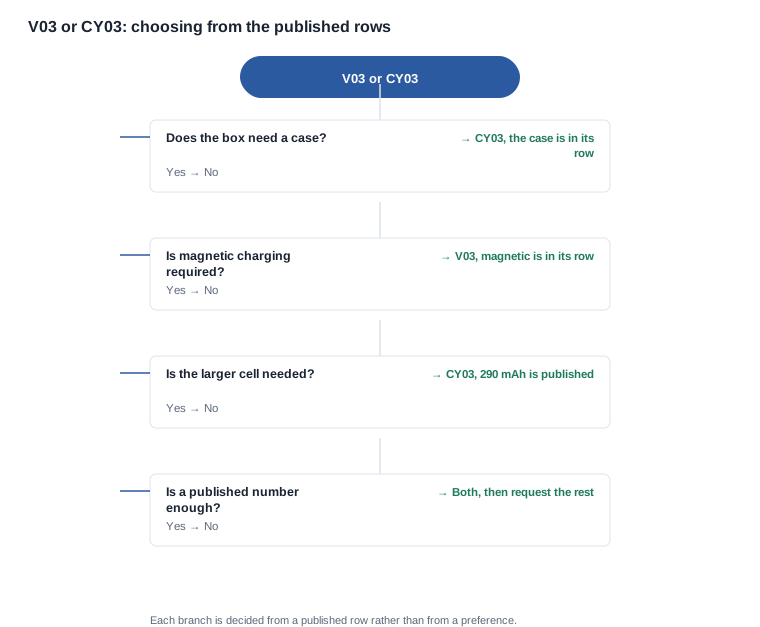
Here is the honest framing of the choice. The V03 publishes the charging method and hides the case. The CY03 publishes the case and hides the charging method. Neither row publishes both, and neither publishes neither, so a buyer chooses which unknown they are willing to manage before the artwork is approved.
That is not a small point, because the unknown on the CY03 is the more expensive one to discover late. A missing case is discovered by the packaging designer and handled by changing the artwork. A missing charging method is discovered by the compliance engineer, the instruction writer, the carton copywriter and the accessory buyer, and it is handled by re-opening artwork and re-issuing declarations. The asymmetry shows up in the quotation too: the V03 is quoted as one purchased object, while the CY03 is quoted as two, and the second line is the one most likely to move once the factory confirms how the glasses reach the case.
The questions to ask, whichever row you choose
Because the two rows leave the same fields blank, the same list closes both. Sending it as one document, with the model name as the only difference between sections, is faster and produces clearer answers than two enquiries.
- What is the charging method for this model, in writing, and does it apply to the case as well as the glasses?
- Is a charging case part of the delivered configuration, and what is its cell capacity?
- What is the glasses-only weight in grams, excluding every accessory?
- What camera sensor, lens, and video format does this configuration use?
- Is any ingress protection rating declared, and for which model designation?
- Which Bluetooth protocol version and profiles are implemented?
- Which regulatory regime applies to our destination market, and what declarations and test reports support it?
- What is the MOQ, the tooling requirement and cost, and the lead time for the quoted configuration?
- What does a sample order cost, and how long from sample to production?
- What is the warranty period, how is a defect defined, and what remedy applies?
- What are the payment terms, the deposit percentage, and the incoterms for the quoted route?
- What is the production capacity for this configuration, and what happens to lead time at a bulk order volume?
How to evaluate the answers
How to evaluate a supplier that has published only a partial row is simple: score the evidence, not the brochure. Nothing in the list above asks a factory to invent a specification, only to confirm one in writing.
- Specification fidelity. Does the written answer match the published row exactly, with nothing added and nothing quietly changed?
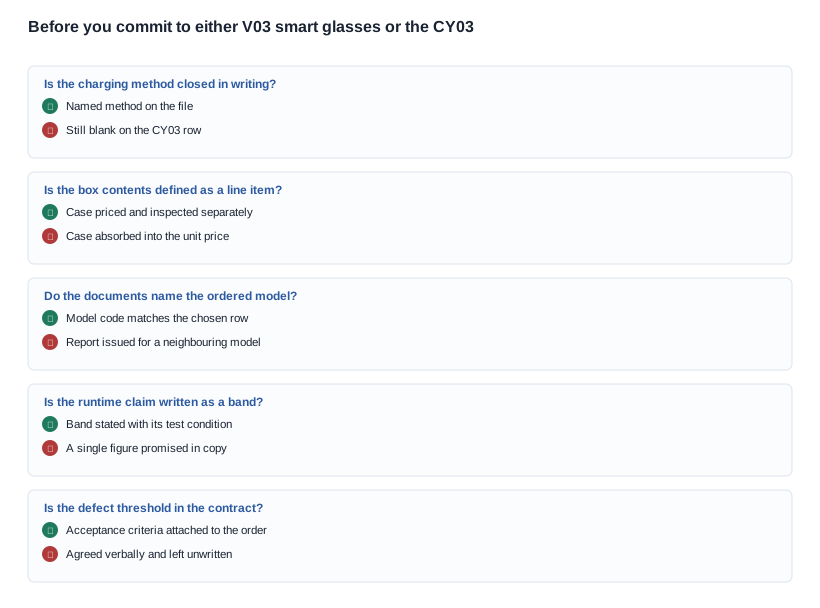
- Evidence quality. Do the declarations and test reports name this model designation, or a neighbouring one?
- Completeness on the two critical gaps. For the CY03, is the charging method answered explicitly? For both, is the case situation answered explicitly?
- Sample behaviour. Does a sample order behave as the written specification describes, including the charge cycle and the runtime claim?
- Process discipline. Does the supplier run a repeatable quality control plan, and will they write the defect thresholds into the contract?
A supplier who answers all twelve questions in writing, with documents attached, has given a buyer far more than one who returns a glossy page and a certification for a different product. A supplier who cannot answer the charging method for the CY03 has, in effect, said not to launch the CY03 yet, which is a legitimate answer and a useful one.
Negotiating the remainder
Once the answers arrive, what is left to negotiate is commercial rather than technical, and the two models negotiate differently. For the V03, the negotiable items are unit price at volume, tooling cost and its amortisation over the first order, the warranty period, and the shape of the bulk order schedule. For the CY03, the accessory changes the arithmetic: the case is a second purchased item with its own cost, packing volume and failure rate, and it should be priced and inspected as a line item rather than absorbed into a unit price.
On both models, payment terms, the deposit percentage and the incoterms are usually movable in exchange for volume, a longer commitment or a faster first payment. Certification evidence, defect thresholds and the written specification should be treated as close to fixed, because changing them later costs a redesign and a new compliance cycle.
Diligence before the order
Before you order, audit the evidence rather than the promises: request the documents, read them, and check the model designation on each one. Confirm that the sample order matches the written specification on the points that decide the choice, which for the CY03 means the charge cycle and the case, and for the V03 means the magnetic charge and the runtime band. Then put the specification, the quality thresholds, the delivery date, the incoterm, the warranty and the payment terms into the purchase order and its annexes, with a named signature on both sides.

Where CYNRIN places the V03 and the CY03 in a camera range
Neither product sits alone, and knowing where changes how a buyer reads the comparison. The camera entries are organised around a small number of platforms, and the V03 and the CY03 are the two most different entry points of the two most common ones.
The 220 mAh magnetic branch and the V03
The V03 sits on a 220 mAh platform with a 5~8 h runtime band, a ≤2 h charge ceiling, and magnetic charging. The other entry on that platform in the catalogue is the V03 Pro, and it is not a trim level of the V03: its cell and runtime band are the same, but its charging method reads Type C rather than magnetic, and its name field carries the note about a colour-changing lens configuration. The V03 Pro is the only camera model in the catalogue whose name field mentions a colour-changing lens, and the only one offering that lens in three colour options, which makes it the relevant entry if lens tint is a programme requirement rather than a preference. So the branch has a cable option with magnetic charging and a cable option with Type C and a photochromic lens, and the V03 is the plainest expression of the platform: one cell, one interface, one product.
The 290 mAh case branch and the CY03
The CY03 sits on a 290 mAh platform with a ~7 h runtime, a ≤2 h charge ceiling, and a 1400 mAh case with no published charging method. Two other entries share that row almost exactly: the CY05 and the L1 Pro both print 290 mAh, ~7 h, ≤2 h, and the same case with the same unpublished charging method. For a buyer choosing between the CY03 and the CY05, the catalogue offers no published technical difference at all, so the choice has to be made on commercial terms, on branding, or on a specification that has to be requested in writing and may turn out to be identical.
The L2 Utral is the more direct branch point for this platform. It prints the same 290 mAh cell, the same ~7 h runtime and the same ≤2 h charge ceiling, but its charging method is Type C, which is published, and its case is published at 900 mAh or 1400 mAh. A buyer who needs a case product and also needs a published charging method should be reading the L2 Utral rather than the CY03. A buyer who has confirmed the CY03's charging method in writing and found it acceptable has a cheaper-appearing path to the same platform.
The KY06 is a third shape: a 260 mAh cell, a 6~8 h runtime band, magnetic charging, and a charging case whose capacity is not published. It is the closest thing in the catalogue to a product that combines both of the V03's and the CY03's strengths, and it is also the one whose case capacity a buyer has to request.
Where the published evidence in the range stops
Two catalogue-wide facts bound everything above. The range is selective about evidence: an ingress protection rating appears on only two models, the V06 and the S7, and a published weight appears for only one, the MT6, at 158 g for the glasses body alone and excluding its folding case. Neither product in this comparison is one of them. The range also publishes features by exception rather than by rule: there is no capacitive-touch row and no translation row anywhere, exactly one model carries a surround-sound annotation, and no row names a certification regime; the export certification material is presented as image pages without a per-model certification line. Any certification or compliance claim has to come from a document that names the model, and that is a due diligence task, not a catalogue search.
Reading the range as a buyer
Read this way, the catalogue is a map of platforms rather than a list of finished products. For a private label brand, that map works as a decision tree: choose a branch, choose a row inside it, then write the specification. The V03 and the CY03 are the two cheapest doors into the range in different directions: one leads to a simple cable product with a documented interface, the other to a higher-capacity product with a documented case and an undocumented interface. The decision between them is a decision about which single unknown a brand is willing to manage, and it should be made against a programme rather than against a feature checklist.
Once the choice is made, the sequence is the same in both cases: put the published row into a written specification, send the question list, request the evidence, order a sample, and write the technical file before the artwork and the purchase order. The camera glasses catalogue page under AI camera glasses lists the rest of the range, and each row carries the same combination of a confirmed baseline and a set of blanks a buyer has to close.


