

Comparing the V03 and the KY06 on form factor returns nothing usable: no frame dimensions, no temple length, no bridge or nose pad specification, no frame weight and no temple design descriptor is published for either model. The only model in this entire catalogue with a published weight is the MT6 at 158 grams. So this article compares the rows that do exist and explains why the ones you asked about do not.
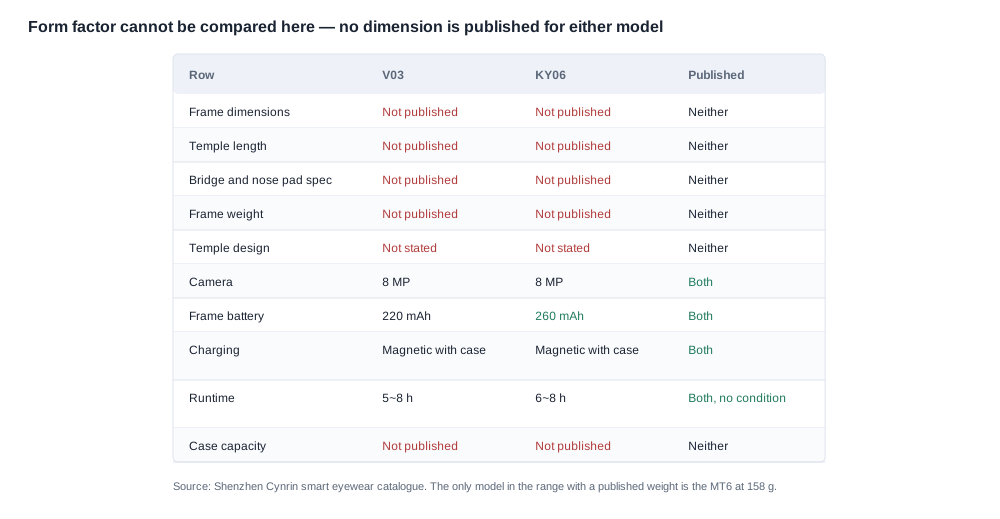
That answer is less satisfying than a table of dimensions, and it is the right one. A buyer who is told "these are roughly comparable in size" learns nothing they can act on, while a buyer who is told "no dimension is published for either model, so size must be established by sample" knows exactly what to do next and can plan the cost and the calendar for doing it.
Why a form factor comparison is unavailable here
A form factor comparison normally rests on dimensions, temple length, lens shape, bridge width and weight. None of those exists for these two models in the source documentation.
This is not unusual for this catalogue — the absence extends across all 28 model designations except the single MT6 weight figure. But it has a direct consequence for a buyer: two models that read as different sizes on a shelf cannot be compared on paper, so size and shape have to be established by sample.
That is worth stating plainly rather than filling the table with plausible dimensions. The temptation in this category is to estimate a temple length from a product photograph and present it as a specification, and the cost of doing that is not a wrong number on a comparison sheet. It is a number that reaches a product page, then a carton, then a customer who measures the frame and finds it does not match, which converts a purchasing decision into a returns problem. See materials and ergonomics.
There is a second reason to refuse the estimate, and it is about defensibility rather than accuracy. A buyer who can explain where a number came from can defend it to a channel partner, a compliance reviewer or a customer. A number inferred from a photograph cannot be defended at all, and the person who has to defend it is usually not the person who wrote it.
It is worth being precise about how wide the gap is. The catalogue carries 28 model designations in this range, and exactly one of them carries a published weight: the MT6, at 158 grams for the body alone and excluding its folding case. That single figure is frequently quoted as though it described a category rather than a model, and it is worth noting that even it excludes the accessory — which means the packed weight of the only model with a published figure is still unknown. A buyer who uses the MT6 number as a proxy for the V03 or the KY06 is not reading a specification; they are reading a different product's measurement and calling it an estimate.
There is a commercial cost to the absence as well as a technical one. Dimensions and weight drive carton size, and carton size drives both the packing material cost and the freight band. A programme that cannot model either is committing to a landed cost estimate with an unknown term in it, and unknown terms in landed cost are usually resolved after the quotation is signed rather than before.
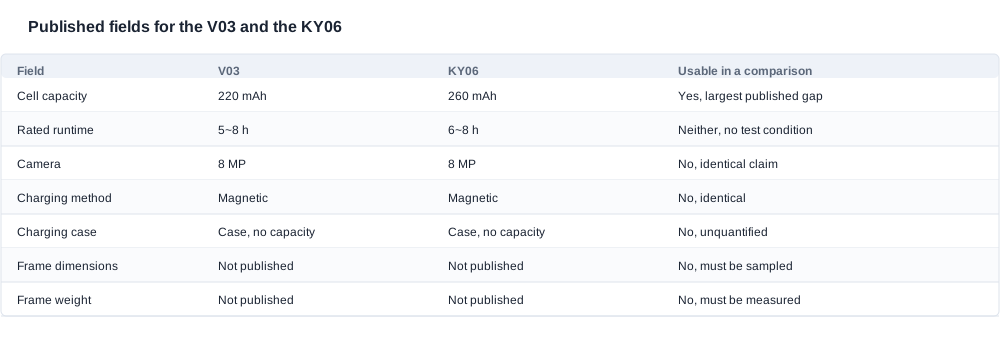
What a buyer can legitimately do instead is convert the absence into a structured question. Frame dimensions in millimetres, temple length, bridge width, the material and thickness of the frame and temples, the weight of the glasses alone and the weight of the packed unit including the case — those are all answerable fields that a factory holds and that a catalogue summary does not print. Asking for them as named fields, with the destination market and a date attached, produces an answer in a single reply, whereas asking for form factor data produces a photograph.
What the published rows do separate
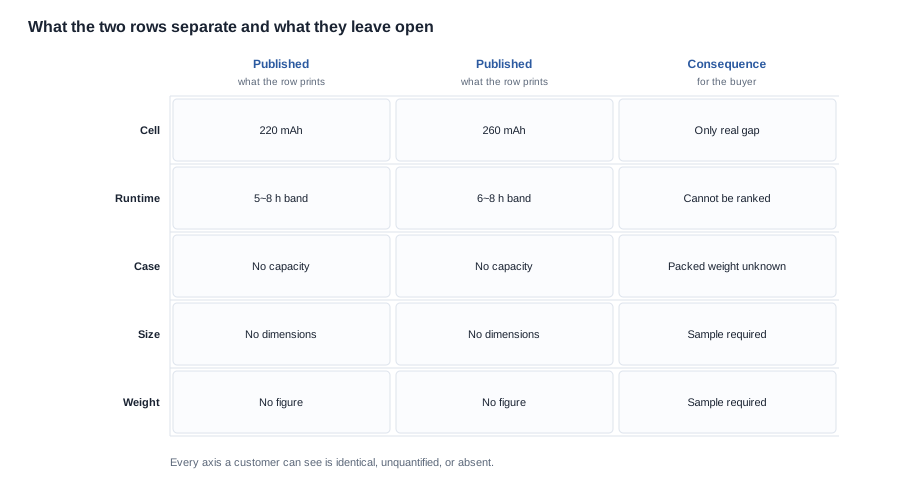
Cell capacity. 220 mAh on the V03 against 260 mAh on the KY06. That is a real 40 mAh difference and it is the largest published gap between these two models.
Runtime. The V03 rates 5 to 8 hours and the KY06 rates 6 to 8 hours. Neither carries a test condition, and across this range the published runtimes do not track cell capacity, so treat both as untested figures of similar magnitude. See smart glasses battery life.
There is a second, quieter signal in the same two rows. The V03's row carries no case capacity field at all, while the KY06's row carries a case without a stated capacity. That difference in how the two rows are written matters more than it first appears: one row is silent about the accessory, the other acknowledges it and leaves the figure open. A buyer reading both should treat the silent field as an open question rather than as an absence of the accessory.
That mismatch is worth pausing on, because it is the clearest evidence in this comparison that the published runtime is not a function of the published cell. The KY06 carries forty milliamp hours more than the V03 and publishes a band that is narrower at the bottom and identical at the top. If capacity were the driver, the band would have shifted; it did not. What that suggests is that both figures are dominated by workload and test method, and both are therefore weak evidence for a purchasing decision.
The disciplined reading is that the cell difference is real and the runtime difference is not, and that a buyer wanting to act on the capacity gap should act on it as a bill-of-materials fact rather than as an endurance claim. If the channel sells on endurance, neither row supports a claim that the other does not also support.
Camera. Both 8 MP. This row carries no weight in the comparison at all.
Charging. Both magnetic with a case. Neither states a case capacity, so shipping weight cannot be modelled for either. See charging solutions.
That last line is the one with the most commercial consequence, and it is easy to read past. A case is a second object with its own cell, its own packing volume and its own mass, and neither row prints its capacity or its weight. For a buyer modelling freight, the packed unit weight of both models is therefore unknown, and a landed-cost comparison between them cannot be completed from the published rows. The V03's row does not even carry a case field, so the difference between the two is not that one has a lighter case — it is that the question of the case is unanswered for one model and unquantified for the other.
V03 smart glasses vs KY06: what actually decides the choice
If your brief is a camera model at the entry tier, these two are close enough that the choice rests on cell capacity and on commercial terms — MOQ, lead time, colour, packing — none of which is published. If a user's usage is heavy, the KY06's larger cell is the better-published argument.
That last sentence needs a qualifier, because "better-published" is doing quiet work in it. The KY06's cell is larger, which is a fact. Whether that fact reaches a customer as an advantage depends on two things neither row publishes: whether the case is the same capacity on both, and whether the runtime was measured with the case in circuit. A buyer who acts on the capacity gap without those two answers is positioning on a component difference rather than on a product difference.
Two of these are about what your programme has to promise rather than about what the factory can supply, and it is worth separating the two questions early, because a programme that has already decided to promise a single runtime figure cannot be rescued by a better answer from a supplier.
The third is the only one that turns on external rules rather than on internal decisions, and it is the one that should be asked first in practice. A destination market with an ingress requirement, or a channel partner with its own certification condition, can disqualify both models before any other question is worth asking. Asking it early is cheap; asking it after the sample order and the artwork approval is not.
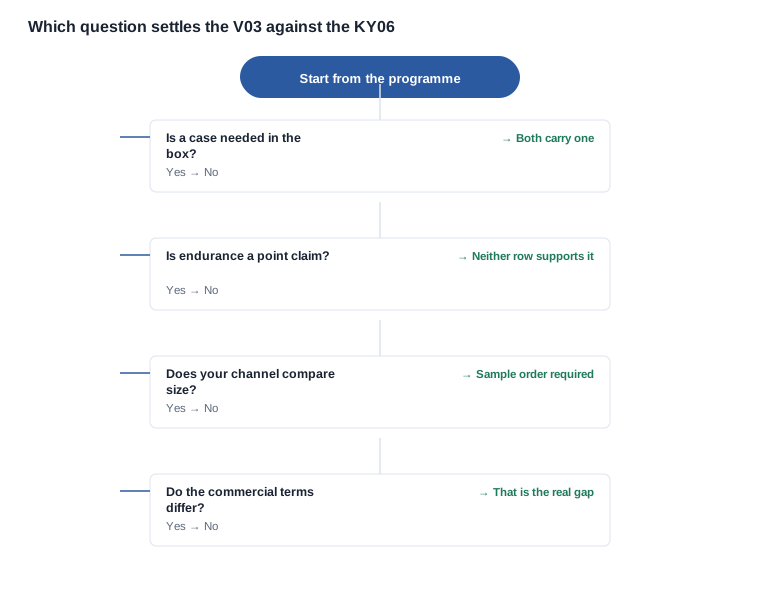
Three questions decide this comparison in practice, and all three are answerable before a purchase order.
Does your programme need the case in the box? Both rows carry a case, so on this axis they are the same. If your channel depends on a case as part of the demonstration, neither model is at a disadvantage, and the comparison moves to the fields below. If your programme is a lightweight travel SKU where a case is dead weight, the V03's slightly smaller cell is a smaller cost than the KY06's slightly larger one, and the packed-weight question has to be answered before that saving can be banked.
Is your endurance claim band-shaped or point-shaped? If the claim in your copy is a single number, neither row supports it and the choice should be made on something else entirely. If the claim is a band with a stated test condition, the KY06's narrower floor is the marginally easier claim to write, because a band that starts at six hours leaves more room than one that starts at five.
What is the destination market and what does it require? Neither row publishes an ingress rating, a certification line or a compliance position, so this question is identical for both models and does not separate them — but it does determine whether either is orderable, and it should be asked before either is shortlisted.
Those three questions reduce the decision to a smaller thing than it first appears. The two models are close enough that the published rows do not separate them on any axis a customer can see, which means the decision is really about commercial terms, sample results and programme suitability rather than about specification.
What both models share as absences
No sensor model, no field of view, no video specification, no frame weight, no ingress rating, no certification numbers, no colours and no stated interface. So neither supports an image quality claim, a sizing claim or a compliance file.
Two of those absences deserve more attention than the others, because buyers usually discover them late.
The absence of frame weight and dimensions is the one that makes size and shape unanswerable, and it is the absence that turns this comparison into a sample-order test. Two units of the same nominal model can differ measurably, and a supplier answering a weight question with a single number is quoting a sample rather than a specification unless they state the tolerance. Asking for the weight with the tolerance attached is the difference between a number you can print and a number you can use.
The absence of sensor and video specification is the one that blocks a whole class of marketing claim. Both rows publish 8 MP, and 8 MP on its own describes a number rather than an outcome. Without a sensor model, a field of view and a frame rate, two products with identical resolution figures can produce materially different images, and a channel that compares on resolution is comparing on the one field that carries no information. For a programme that competes on camera quality, neither model is the right basis for a decision until those figures arrive in writing.
There is also a practical point about the case, which both rows carry and neither quantifies. A case is a second cell, so it carries its own declaration for the destination market and its own inspection point in the quality control plan. If the case capacity and the case cell chemistry are unknown at the point the compliance file is assembled, the file is assembled around an assumption, and an assumption in a compliance file is a finding waiting to happen.

How to establish what the rows do not, and the judgement behind it
The practical method for a comparison where one axis cannot be compared at all is to run the missing axis as a separate, short project rather than trying to fold it into the specification work.
The same discipline applies to the second sample. One unit tells you whether the model is acceptable; two units of the same model tell you whether the production line is consistent. In a category where the form factor data is unpublished, that second unit is the only available substitute for a tolerance figure, and it is the difference between a sample you approve and a specification you can repeat.
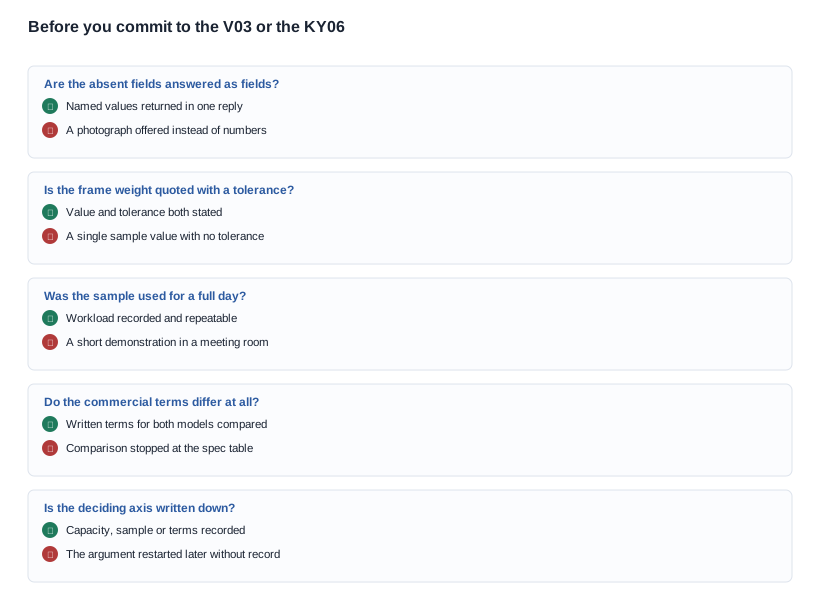
Step one: send the absent fields as fields. Frame dimensions, temple length, bridge width, frame and temple material, weight of the glasses alone with the tolerance stated, weight of the packed unit, case capacity, case cell type, ingress position, sensor model, field of view, frame rate, storage arrangement. Thirteen named fields, one model name per section, one reply. A supplier can answer that in a day, and the answer becomes the first page of the technical file.
Step two: order samples of both before deciding. The shortlist is not a shortlist until this step is scheduled, because a comparison without a date attached drifts, and the programme moves on without it. This is the only route that settles size, shape and the packed-weight question, and it costs two sample orders rather than one. Use both units under the same conditions for a full working day rather than five minutes in a meeting room, because the variable most correlated with returns in this category is not visible in a short demonstration. What you are testing is not a specification; it is whether the unit survives a day of actual use, which is the only form-factor test that predicts anything about returns.
Step three: measure rather than observe. Put each unit on a scale without its case, then with it, and record both. Measure the frame length and temple length with a ruler rather than judging by eye. If the two units differ by more than the tolerance the supplier stated, that is a data point about the production line, and it belongs in the quality control plan before the first bulk order rather than after it.
Step four: close the commercial terms in the same conversation. How to evaluate the two suppliers once the quotations arrive is a documentation test rather than a price test: the quotation that names the case as a priced line item, states the weight tolerance, and fixes the incoterm is worth more than a lower quotation that does none of those things. MOQ, lead time, unit price at volume, tooling cost and ownership, packaging and colour options, warranty period and remedy, payment terms, deposit percentage, incoterms, and the sample-to-production interval. Because the two models are so close on the published rows, these terms are most of the actual difference between them, and a comparison that stops at the specification table has not compared the thing the buyer is choosing.
Step five: write down which axis decided it. Red flags at this stage are narrow and worth naming: a supplier who will not state a tolerance, a supplier who declines to answer whether the case is in circuit for the runtime figure, and a supplier whose MOQ, lead time and price are all open at the same time. Any one of those is negotiable; all three together is a supplier who is quoting a capacity rather than a configuration. If the decision was made on cell capacity, record that and the reason. If it was made on the sample, record the measurements. If it was made on commercial terms, record the terms. A written record of the deciding axis is what lets a buyer defend the choice later, and in this comparison it is also what stops the same argument restarting six months later when a second model arrives.
We will not produce a form factor comparison from data that does not contain form factor data, and we will not infer dimensions from product photographs or from a competitor's listing. Where the honest answer is that two models cannot be compared on the axis you asked about, that is the answer you need before you commit.
That position costs something, and it is worth being clear about what it costs. A buyer who wanted a dimension table has to fund two sample orders and a short round of measurements instead, and has to accept that the result will not be a specification they can print. What they get in return is a decision they can defend, a specification whose numbers came from the factory rather than from an estimate, and a returns rate that reflects what the product actually is rather than what the shelf suggested.
The honest summary of this comparison is therefore short, and knowing how to evaluate it should stop here. On every field the catalogue publishes, the V03 and the KY06 are close, with a 40 mAh cell difference as the largest published gap and a runtime difference that the published data does not support. On the axis the buyer actually asked about, there is no published data at all. That makes this a sample-order decision dressed as a comparison, and the questions to ask are the same thirteen fields for both models. The checklist above is the shortest reliable version of them, and sending it unchanged for both models is usually faster than sending two separate enquiries.
One closing caution for the buyer who is comparing these two on specification. Because the published rows are so close, it is easy to let the comparison drift into arguing about figures that are identical, and the time spent there is time not spent on the fields that are actually open. The published comparison is finished: 40 mAh, two overlapping bands, two 8 MP claims, two magnetic cases with no stated capacity. Everything that decides the order is still unanswered, and it is all answerable in writing.
Related reading
- The camera range both models belong to — AI camera glasses
- Why sizing has to be established by sample — materials and ergonomics
- Why runtime figures do not compare — smart glasses battery life
Pass on the target market, the quantity and the required configuration, and we will report what is available and what is not.


