

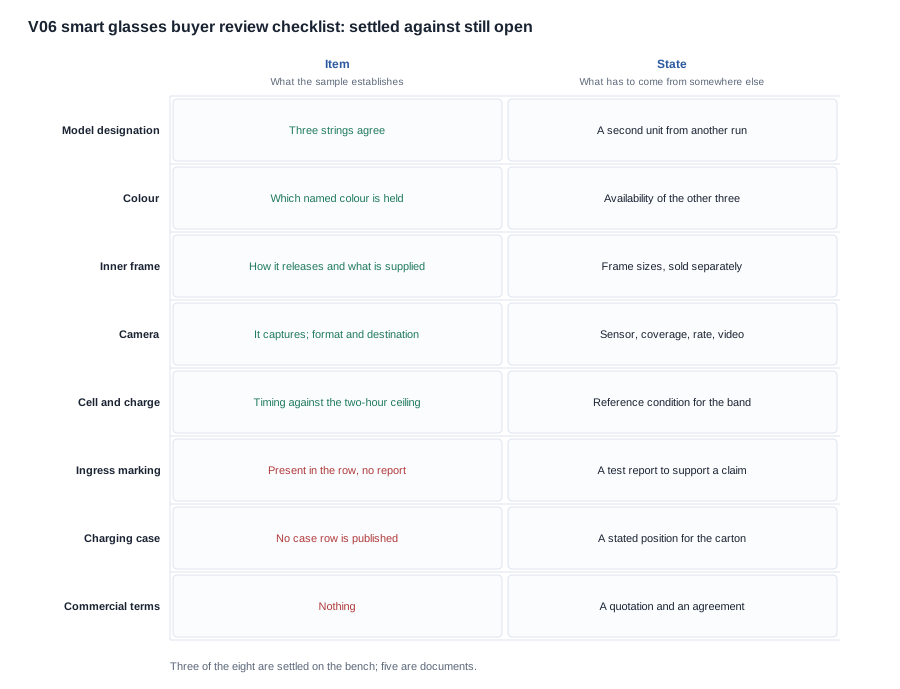
A sample of this product settles a great deal, and it settles none of the things that are hardest to buy. The published record for the V06 is short: an eight-megapixel camera, a 260 milliampere-hour cell, a rated endurance given as a five-to-eight-hour band, a charge ceiling of two hours, magnetic charging, four feature rows and four colour names. None of that describes the product in the hand, and every line a buyer is likely to argue about — the detachable inner frame, the colour a customer actually receives, the camera's real behaviour, the ingress marking — is settled by putting a unit on a bench and working through it.
What follows is the review as three stages, because a review conducted in one sitting produces a verdict rather than a diagnosis. A unit that fails at the packing bench after it has passed everything switched off is a different problem from a unit that fails on the bench, and the stage is what tells the two apart. The order also matters commercially: the checks that cannot be repeated cheaply come first, and the checks a supplier can simply send more units to satisfy come last.
The stages are, in order: the unit as it arrives, with nothing switched on; the unit under power; and the unit at the packing bench, where the record is produced. The sample quantity is worth deciding at the same time, because it is a commercial term rather than a technical one, and the number of units a review needs depends on how many stages have to be repeated after a failure. A single unit is enough to find out whether a review protocol works. It is rarely enough to establish a production baseline, and the difference between those two numbers is the difference between a review and a validation programme. What each stage can and cannot settle is set out below, along with the specific things to look at and the specific things to write down.
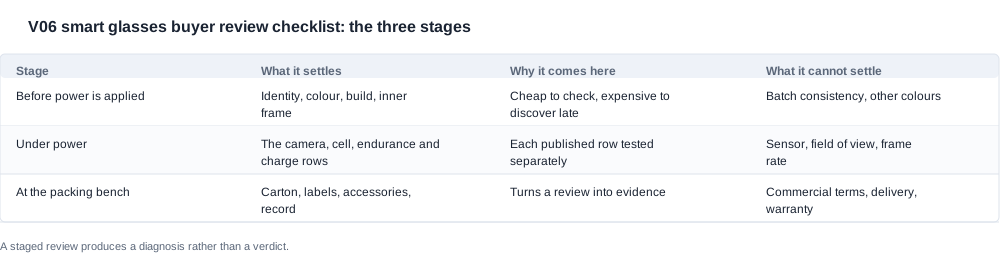
V06 smart glasses buyer review checklist: what a sample settles and what it cannot
The value of a staged review is that it separates three different questions, and each stage answers one of them. The order is not a matter of convenience. A unit that is opened and powered before its identity has been recorded produces results that cannot be attached to anything, and a unit that is packed before it has been run produces a carton that is documented but not tested. Each stage has to leave a record that the next stage can refer to, and the record is what makes the review cumulative rather than a series of impressions.
Stage one answers whether the unit is the thing that was ordered. Identity, build, the detachable inner frame, the colour, the state of the parts that can be examined without power. Everything in this stage is cheap to check and expensive to discover later, because a wrong unit or a wrong colour is discovered by a customer rather than by a buyer. It is also the stage where the two rows that are unique to this model can actually be looked at, because the inner frame is a part you can take out and the colour is visible the moment the box is open.
Stage two answers whether the published functions behave as described. The camera row, the cell, the endurance band, the charging interface, the ingress marking. This is the stage where a review either confirms a published row or shows that the row and the product disagree, and it is the stage most often run too quickly, because everything here looks like it works when it is working. A unit that charges, captures an image and shows a state indication has proved very little; the questions worth asking are about the conditions.
Stage three answers whether the unit can be packed, shipped, recorded and sold. The packaging, the labelling, the accessory set, the batch reference, the paperwork that travels with it, and the record a buyer will keep. This is the stage that turns a review into evidence, and it is the stage that is most often skipped because it feels administrative rather than technical.
There is one thing a sample cannot settle in any stage, and it is worth stating at the start because it is the source of most disappointment with sample-based buying. A sample is one unit. It cannot establish that a production run matches it, that a colour other than the sampled one is available in the same condition, that the accessory set is the same in every carton, or that the documentation supplied with the sample is the documentation that will be supplied with the goods. Those need a specification, an agreement and a second sample from a different production window.
There is a second limit, and it is specific to this model. The catalogue publishes no charging-case row for the V03, the V06 or the S7, so a case is not a published part of this product. A sample that arrives with a case is a fact about that sample; a sample that arrives without one is equally a fact about that sample. Neither observation establishes what the carton will contain in production, and the only way to settle it is to put the question in the purchase order.
The remaining limit is the one that applies to every row the catalogue leaves blank: the camera's sensor, its field of view, the video format, the frame rate, the storage arrangement, the product weight, the price, the minimum order quantity, the delivery schedule and the warranty terms are not published for this model. A sample cannot settle any of them, and a review that appears to settle them is a review that has confused a demonstration with a specification.
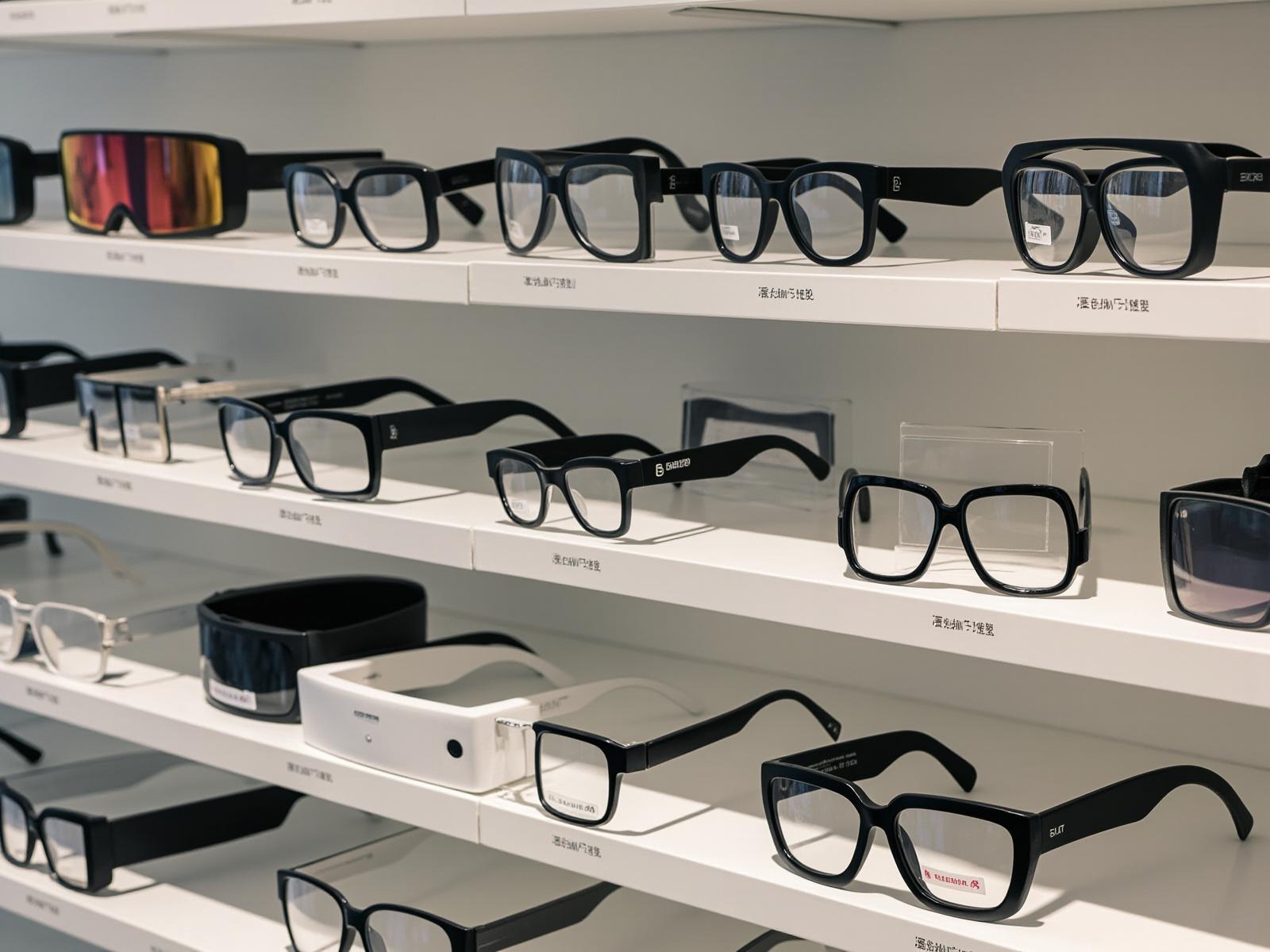
Identity, build and the inner frame, before anything is switched on
The first stage is a physical inspection, and it works from the outside in.
Identity. Three strings have to agree: the model designation on the unit, the designation on the packaging, and the designation on the paperwork. For this model that check is worth doing carefully, because the catalogue's page annotation for this product is positioned unusually and a buyer working from a page number rather than from a product name can end up comparing against the wrong entry. The V06 is a camera model, and the eight-megapixel resolution class is shared across eight models in the range, so a designation check is what separates this product from several near neighbours. The designation is also what the rest of the review attaches to; without it, a passing result cannot be filed against a product.
Colour. The catalogue names four colour options — orange, white ice blue, black and black ice blue. A sample establishes which one the supplier is holding and in what condition, and nothing about the other three. Each colour is a potential configuration rather than a cosmetic variant, because the supplier's ability to hold a colour consistently at volume is a separate question from its ability to produce one unit in that colour. The check is straightforward: compare the sample against the named colour in daylight rather than under showroom lighting, and record which named colour it corresponds to.
Build. The published feature rows give four things to examine, and each one is a design description rather than a measurable specification, so the check has to be about the build rather than about the claim. The ergonomic design row is a statement about how the product is put together, and what a reviewer can establish is whether the parts meet, whether the joints are even, and whether there are gaps, mismatched finishes or loose elements. The long battery life row is a summary of the endurance band, and what a reviewer can establish at the bench is only that a state indication exists and that the charging behaviour is consistent with the published ceiling. Neither row can be turned into a comfort, a durability or a performance claim by looking at it.
The detachable inner frame. This is the row that is most worth a close look, because it is the one that changes what the product is. The catalogue says the inner frame is removable, and it does not say how it is released, how many are supplied, whether they are interchangeable, what sizes exist, or whether one can be bought separately. All of that is observable on the bench or obtainable in writing. What a reviewer should record: the number of frames in the box; the release mechanism and how much force it takes; whether the frames are identical or differ; whether removal and refitting leaves the product in the same state; and what the supplier says the available sizes are, since the catalogue is silent on the point and a buyer whose customers need a different size has a configuration problem rather than a product problem.
There is one consequence of the frame that has to be checked at the same time as the frame itself. The product carries an IP54 marking in its feature rows, and that marking is a statement about the assembly. A reviewer who removes the inner frame and puts it back has changed the assembly, and the question of whether the product is still in the state the marking describes is a question for the supplier rather than for the bench. It is also the reason the marking is treated separately in the compliance work for this model, and a review that records "frame removed and refitted, product functioned afterwards" is a review that has produced a useful observation without producing a conclusion.

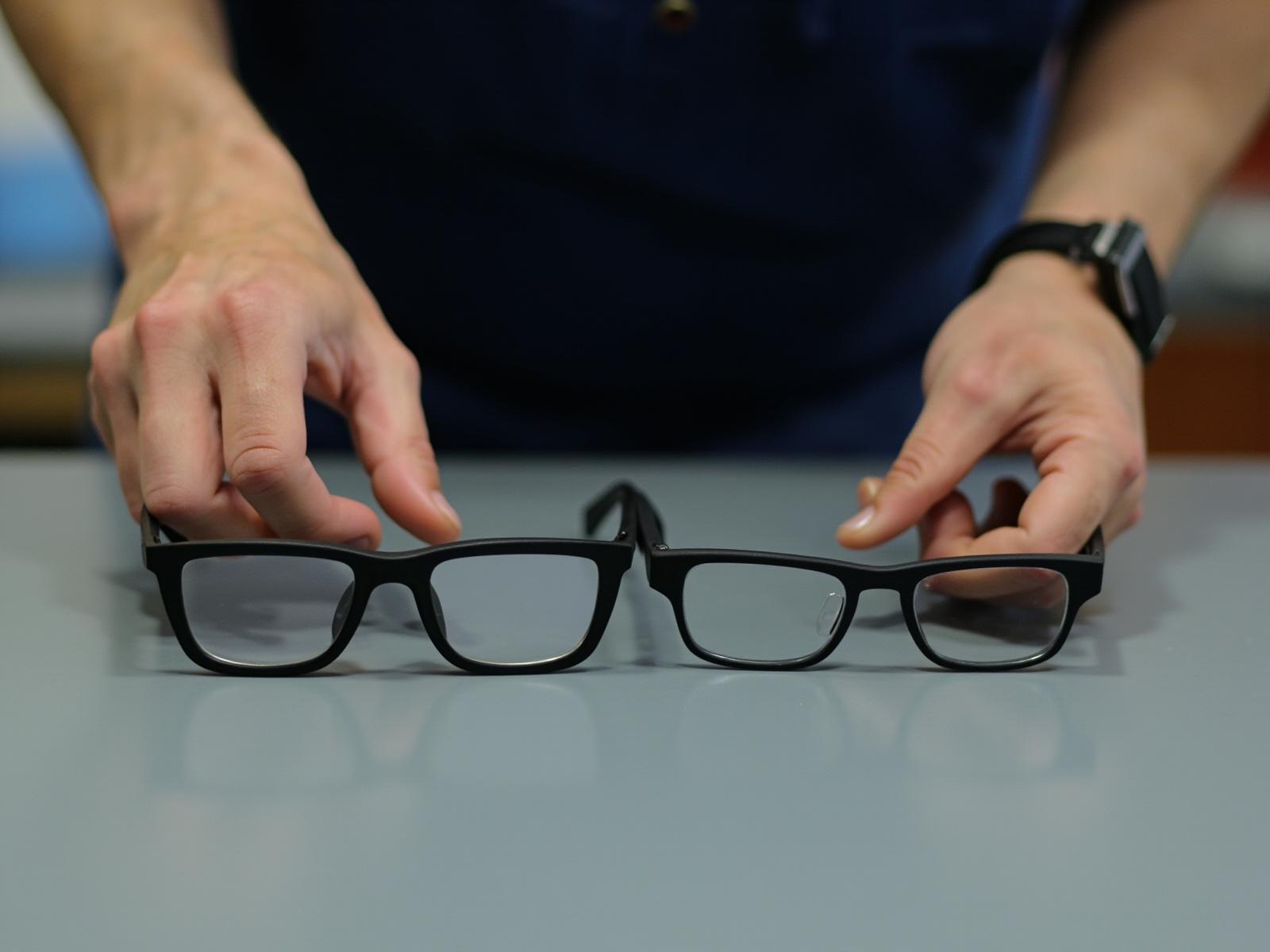
Function checks against the four published rows
Stage two is where the published rows are tested, and the discipline is to test each row separately and to record what was observed rather than what was concluded.
The camera row. The catalogue publishes an eight-megapixel resolution class for this model. That is a resolution class, not a camera specification, and the difference governs what a sample can establish. A reviewer can confirm that a camera is present, that it captures images, what format the files arrive in, where they are held, how many can be held, and how a capture is triggered. A reviewer cannot establish the sensor, the field of view, the frame rate, whether the product records video, how it behaves in low light, or whether it is stabilised, because none of those is published. The check that matters most is the file: its format, its size, its destination and its lifecycle, because that is what a buyer will be asked about by a channel and what a customer will assume.
The cell row. The published figure is 260 milliampere-hour. At the bench the check is the charge cycle against the published ceiling of two hours, the behaviour of the magnetic interface, and what the product displays about its own state. The magnetic interface deserves particular attention because it is the failure mode that does not announce itself: a contact that is slightly misaligned charges more slowly, and a buyer who times a single charge on a unit that happened to seat properly will record a figure that the production run does not reproduce.
The endurance row. The published endurance is a band of five to eight hours. A band is not a measurement, and a review must not convert it into one. What the bench can establish is that the product presents a charge state that a customer can read, that the state is consistent with what the documentation describes, and that the supplier will state the condition under which the rating was established. Timing one session and calling it the rating produces a number that has no standing in a specification, and it is the most common way a review goes wrong on this model.
The charging row. Magnetic charging is published for this product, and the related fact is that no charging-case row is published for the V03, the V06 or the S7. That is an absence of a published row rather than a published absence, and it has two practical consequences at the bench: a case in the carton is not a published part and has to be specified separately, and a case absent from the carton is not a missing accessory either. The bench check is on the interface itself — alignment, retention, the behaviour of a partially seated product, and the state of the contacts after repeated use.
The ingress row. The IP54 marking appears in the feature rows of this model. What a sample can record is the presence of the marking and the general arrangement of the seals and the frame. What it cannot do is support the marking as an external claim, because an ingress rating has to be carried by a test report and a marking in a catalogue row is not a report. A buyer who intends to print the rating on packaging needs the document behind it, and a review that notes the marking without the report has recorded the first half of the work.
The record a sample produces, and what it does not settle
The third stage is the one that decides whether the review was worth running, because a review that produces no record produces no evidence.
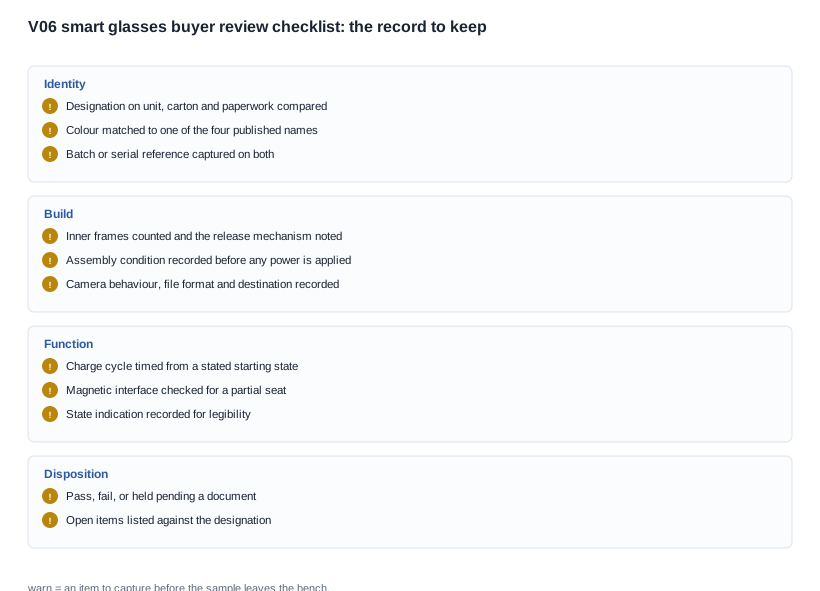
The record itself. Ten items, and the reason there are exactly ten is that each one corresponds to a published row or to a gap a buyer will have to close later.
- The model designation, as it appears on the unit, on the packaging and on the paperwork, with a note of whether all three agree.
- The colour, matched against the four published names in daylight.
- The number and type of inner frames supplied, and the release mechanism.
- The condition of the assembly with no power applied: joints, finishes, gaps, visible marks.
- The camera behaviour: that it captures, the file format, the destination and the available count.
- The charge cycle, timed from a stated starting state, against the published two-hour ceiling.
- The behaviour of the magnetic interface under a partial seat and after repeated cycling.
- The state indication, as a customer would read it, and whether it is legible in poor light.
- The accessory set actually in the carton, listed item by item, against the absence of a published case row.
- The batch or serial reference on the unit and on the paperwork, so the record can be attached to a specific unit.
The disposition. A review produces one of three outcomes, and the third is the one that is worth designing for. The unit passes, and the record is filed against the designation. The unit fails, and the failure is characterised by stage so that the supplier can act on it. Or the unit passes on what it can be tested for and is held pending a document — a test report behind the ingress marking, a camera specification, a statement on the inner frame sizes, a charging-case position for the carton. That third outcome is the common one on a model with this much unpublished, and a review process that only recognises pass and fail will force a buyer to either reject a sound unit or accept an unevidenced one.
What the record does not settle. A single unit cannot establish that a production run will match it, and it cannot establish anything about a second production window. It cannot establish the weight, the camera's detailed specification, the charging-case arrangement for production, the commercial terms, the delivery schedule or the warranty. It cannot turn the ingress marking into a claim, because a claim needs a report. And it cannot establish the availability of the other three colours, because a sample of one colour is evidence about one colour.
The practical consequence is that a sample review is a filter rather than a substitute. It tells a buyer whether the product is worth building a programme around, and it tells the supplier which parts of the record need to exist before an order can be placed. The parts that remain open are the parts that belong in a purchase specification and in a set of document requests, and a buyer who treats the sample as the end of the evaluation will find that the programme it starts is built on a number of assumptions it never made explicit.
One more practical point belongs in this section, and it concerns the supplier rather than the unit. A review that turns up a discrepancy in stage one is only useful if the supplier is asked about it in the language of the published record. A buyer who reports "the frame does not feel right" gets an opinion back; a buyer who reports "the supplied inner frame releases in a single action and no second frame is present in the carton, and the catalogue publishes no case row for this model" gets an answer. The discipline of describing what was observed against what the record says, in the record's own terms, is what turns a sample from a demonstration into a document that can be used to close a gap.
Our own position on this model is unchanged and it is the reason the stages are set the way they are. The catalogue publishes the rows listed at the top of this page, and it publishes nothing else for the V06: no weight, no camera specification beyond the resolution class, no charging-case row, no commercial terms, and no document behind the ingress marking. We will not fill those blanks with figures from elsewhere in the range, and we will not treat a marking in a feature row as a report. What the review can settle is the part that only a unit in the hand can settle, and it is worth doing in three stages, because the failures cluster and the stages are what make a failure diagnosable.
If you are setting up a review for this model, the three stages, the ten record items and the three dispositions above are the structure we would use, and the ten supplier questions that follow from them are the ones worth putting in the request that accompanies the sample.


