

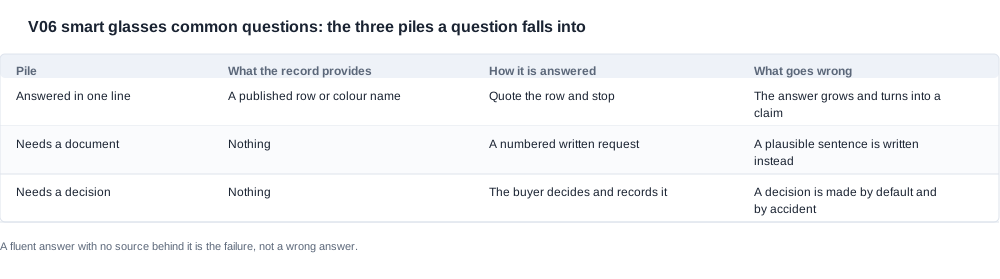
The questions buyers ask about this model divide into three distinct piles, and the reason the division holds is that the published record for it is short. A camera of the eight-megapixel class, a 260 milliampere-hour cell, a charge ceiling of two hours and a rated band of five to eight hours, together with magnetic charging, four descriptive rows and four colour names, answer a small number of questions exactly. Everything else about this product is open, and the open questions are where the trouble comes from.
The trouble has a mechanism, and it is worth naming before any list of questions. A question that the record cannot answer is asked in a conversation, and the conversation supplies an answer from one of four places: general knowledge about what this kind of product usually does, a row published against a different model, a marketing phrase that has drifted away from its evidence, or an inference drawn from the product's appearance. Each of those produces a fluent, confident and unsourced answer. The answer then travels — into a listing, a specification, a distributor's sheet — and by the time somebody asks where it came from, it has become a claim that a business is making on its own behalf.
So the practical purpose of this page is not to provide answers. It is to sort the questions by where their answer can come from, so that the ones with no published answer get asked in writing instead of answered in a corridor.
V06 smart glasses common questions: the ones that get answered loosely
A loose answer is one whose source cannot be named. The test is simple and it is worth applying to every sentence a business is about to print: does this sentence point at a published row, at a document, or at a decision somebody has made? If it points at none of the three, it is loose, and it will not survive the first customer who asks.
Three examples from this model show how easily that happens.
"How long does the battery last?" The published figure is a band of five to eight hours, published as a rating without a stated condition. The loose answers are "about eight hours" and "a full working day". The first takes the top of a range and presents it as a point; the second takes a rating and presents it as a behavioural promise. Either reads as perfectly reasonable in a listing and neither is what the record says.
"Is it waterproof?" The feature rows of this model carry an IP54 marking. The loose answer is "yes, IP54 waterproof". The marking is published, so the word is not invented, but an ingress marking is a summary of a test, and the test is what gives it meaning. A buyer who repeats the code externally is making a claim about a specific assembly, and the supporting report is not in the published record.
"Can I get these in prescription?" Nothing is published about prescription availability for this model. The loose answer is assembled from the fact that frames in this category are sometimes available in prescription, or from the sight of a product that resembles a frame. It is the most common source of a statement a business cannot support, and it is usually the statement a customer is most likely to act on.
There is a fourth source that is harder to spot, because it feels like knowledge rather than inference: the experience of a colleague who has handled a different model in the same range. The fact that no camera model in the catalogue publishes a radio version is a good example of a trap. A buyer who has read a radio version on an audio model has read a true fact about the wrong product, and the question "which Bluetooth does the V06 have?" invites exactly that transfer.
What all four sources have in common is that they produce an answer rather than a question, which is why they are hard to catch in a review. A reply that says "that depends" reads as unhelpful; a reply that says "about eight hours" reads as helpful. The first is the one that produces the file.
The practical consequence is a division of labour that a buyer can put in place without much ceremony. Every question with a published row goes to a one-line answer, and every question without one goes to the written request. The discipline required is not effort but consistency, because the failure happens in the gap between the two piles, where a question sits in nobody's list and gets answered in a corridor.
There is a third question worth separating out here, because it is the one buyers most often forget to ask themselves. It is not "what is the answer" but "who inside the business is going to say it". In a business where the product, the compliance function and the channel all touch the product, an unreferenced answer can come from any of them, and the answer that reaches the customer is whichever one was said first. A short list of the six or eight questions that get asked about this model, with the honest answer for each and the name of the person who owns it, removes most of the risk, and it costs an afternoon.
What all four sources have in common is that they produce an answer rather than a question, and that is why they are hard to catch in a review. A reply that says "that depends" seems unhelpful; a reply that says "about eight hours" seems helpful. Only the first of those produces a file.
The questions the catalogue answers in one line
These are the questions the published record settles, and the discipline for them is that the answer is given in one line and does not grow. A row that is quoted accurately is worth more than a paragraph that expands it.
What resolution is the camera? An eight-megapixel resolution class. That is a resolution class and not a camera specification, and the sentence should stop there.
What is the cell? 260 milliampere-hour.
What is the endurance figure? A rated band of five to eight hours, published without a stated condition. The answer names the band, the word "rated" and the absence of a condition, and it does not convert the band into a number.
How long does a charge take? Two hours or less. It is a ceiling, and the sentence should say so.
How does it charge? Magnetic.
What colours are published? Orange, white ice blue, black and black ice blue. Four names, and each of them is a configuration a file and a label have to be able to refer to.
What do the feature rows say? An ergonomic design, a long battery life, a removable inner frame and an IP54 marking. These are descriptions rather than measurements, and the honest line says so.
Is a radio version published for this model? No. Not one of the camera models in this catalogue publishes a radio version, so the version fitted has to be read out of an assessment rather than out of a published row.
Is there a charging case? No charging-case row is published for this model. The same is true of the V03 and of the S7, and that silence is an unpublished row rather than a published absence of a case.
Two questions sit on the boundary and are worth handling explicitly. The first is the one about the ingress marking, where the published part and the unpublished part have to be kept apart: the marking is in the feature rows, and no report is published with it, so the answer is one line about the marking and a second line about the document. The second is the question about the removable inner frame, where the row establishes that the frame comes out and establishes nothing about how many are supplied, what sizes exist or whether one can be bought separately.


The questions that only a written reply can close
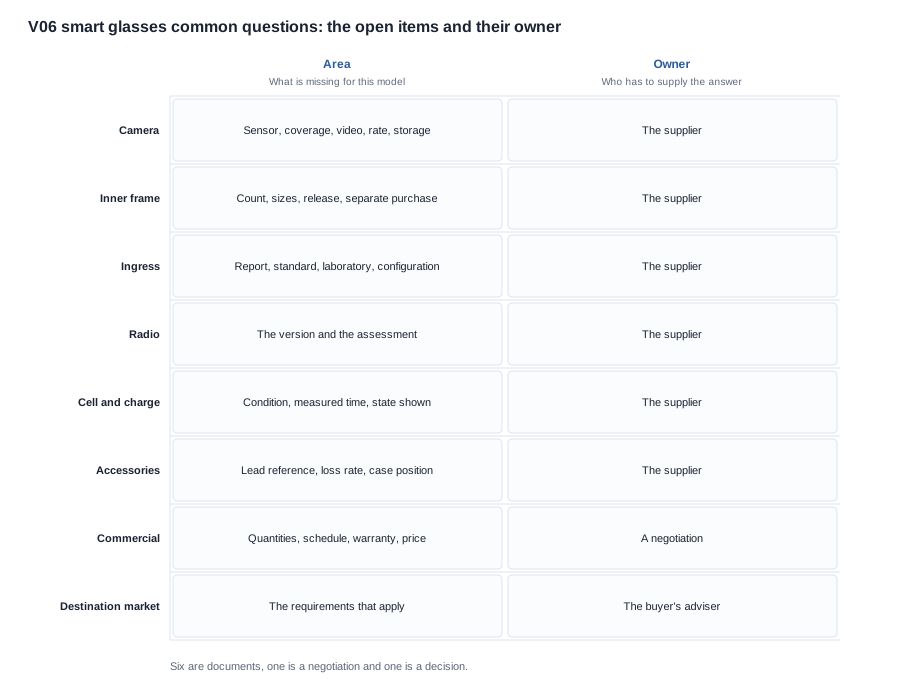
Everything below is unanswered in the published record, and each item is written the way it should be put to a supplier: as a question with a defined answer, because a question without a defined answer produces an assurance rather than a document.
On the camera. What sensor is fitted. What the field of view is. Whether the product records video as well as still images, and in what format. What the frame rate is for moving subjects. How many images can be held and where they go. How the product behaves in low light. Whether there is any stabilisation. None of this is published, and a camera described only by its resolution class is a camera nobody can write a listing about.
On the removable inner frame. How many frames are supplied. What sizes exist. How the frame is released. Whether frames are interchangeable between models, given that the same feature row appears more than once in the range. Whether a frame can be purchased separately. What changes when a frame is removed.
On the ingress marking. Whether a test report exists, its reference, the standard applied, the laboratory and the scope of its accreditation, how the sample was identified, which inner frame and which colour were fitted when it was tested, the conditions and the acceptance criteria, and any exclusions the laboratory recorded.
On the radio. Which version is fitted, and the assessment behind it with the standards cited. The catalogue does not publish a version for the camera models, so this has to be asked rather than read.
On the cell and the charge. The reference condition behind the five-to-eight-hour band. The measured charge time from a stated starting state. What the product shows about its own charge state, and whether that indication is legible in poor light. What the contact does when a product is placed on it slightly askew, and how the interface behaves over repeated use.
On the accessory chain. The part reference for the charging lead, whether it is supplied in the carton, the loss rate, and whether a case is part of the offer and whether it holds a cell.
On the commercial terms. The minimum order quantity, the sample order quantity, the delivery schedule, the warranty terms, the price for the configuration, the tooling and artwork quantities, and the position on certification documentation for this designation.
The criteria for deciding which of these questions to put first are worth stating, because they are not the same for every product. The questions that gate the launch come first: the camera specification, the ingress report and the colour configurations, because a listing cannot be written and a carton cannot be printed without them. The questions that gate the operation come second: the frame specification, the accessory references and the state indication. The commercial questions come last, because they are the easiest to settle and the easiest to settle wrongly if settled against an unresolved scope.
The form of the request is what makes it work. A numbered list, sent once, with a deadline, produces a numbered reply with visible gaps. A paragraph sent in an email produces a paragraph back, and the gaps in a paragraph are invisible. A status column turns the reply into a file, which is the only form in which a document request becomes something a business can rely on later.
What to say when the record has no answer
A buyer who is asked a question the record cannot answer has three truthful options, and choosing between them is a matter of what the business knows and when it will know it.
State the published row and stop. This is the right form for every question in the second group, and for parts of the first. It is short, it is accurate, and it survives being repeated.
State the gap and say when it will be closed. This is the right form when a request has been issued and a date is expected. It is honest, it gives the customer something, and it commits the business to a date it has to meet.
State the gap and make no claim. This is the right form when nothing has been requested yet, or when the answer is not going to arrive before the material has to be printed. It is the least satisfying of the three and it is usually the correct one, because the alternative is a claim nobody has checked.
The checklist below is the working version of that discipline, and the criteria behind it are worth naming. A question belongs on the one-line list when the record settles it. It belongs on the request list when a document can settle it, and the request has to say what the document is called and what it has to contain, because a request for "the camera details" produces a description and a request for "the sensor, the field of view, the capture format and the frame rate" produces a document. And it belongs on the decision list when no document will settle it, which is the case with the carton position and with the commercial terms.
The red flags to look for in a reply are worth stating once, because they are consistent across this category. A figure with no condition attached. A description where a specification was needed. A part with no reference. A claim that restates the catalogue in different words without adding anything. And a reply that answers a question nobody asked, which is the most common sign that the question was not understood.
What a business should not do is the fourth thing, which is to fill the gap with the nearest available answer, and the mechanism that produces it is always the same. Somebody asks, the answer is not to hand, and a plausible sentence is written into a document because the document needed a sentence. The damage of that sentence arrives later and in a form nobody can repair, because by then the sentence has been quoted, and the quotation is the evidence.
There is a discipline that catches most of it, and it is cheap. Keep a list of what has been said externally about this model, and check that list against the published record before anything is printed, before a listing goes live, and before a specification is signed. The check takes an hour and it is the only thing that reliably catches a sentence that was written in a hurry three weeks earlier. A related discipline is to keep a single list of the questions that have been asked and the status of each answer, because the gap list and the claim list are the same list viewed from two directions.
A buyer who is assembling a specification, a supplier file or a channel listing will find that a shortlist of the questions, a named owner against each one, and a status against each answer is worth more than a longer prose treatment of the same subject, because it can be handed to a supplier, a compliance adviser and a distributor without being rewritten three times. The supplier sees a request, the adviser sees a determination, and the channel sees a position, and all three are working from the same list.
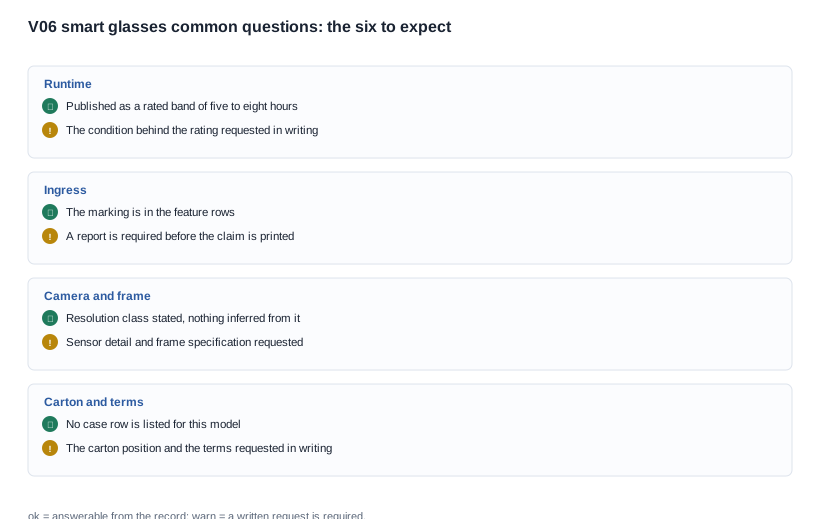
The six questions a buyer should expect to be asked about this model, and the form of the honest answer for each, are set out below.
- "How long does the battery last?" — the published figure is a rated band of five to eight hours, and the condition behind the rating is a question for the supplier.
- "Is it waterproof?" — the product carries an IP54 marking in its feature rows; a report has to stand behind the marking before it is claimed externally.
- "What camera is in it?" — the published figure is an eight-megapixel resolution class; the sensor and the rest of the specification are not published and have to be requested.
- "Can I take the frame out?" — the inner frame is published as removable; the count, the sizes, the release and the separate purchase are not published.
- "Is there a case?" — no charging-case row is published for this model, which is a gap in the record rather than a published absence of a case.
- "What colours do I get?" — four colour names are published, and each is a configuration that the documentation and the labels have to be able to refer to.
Our own position on this model is that the published rows are what the published rows are, and that the rest of these questions are answered by documents rather than by description. A question with a row behind it gets the row; a question without one gets a request; and a question that nobody has asked the supplier about gets neither until somebody asks. We will not fill an open question with a general statement about what this kind of product usually does, and we will not carry a figure from a neighbouring model onto this one. Where a question has a published answer we will give it in a single line, and where it does not, we will say so and tell the buyer which request closes it.
If the questions your own customers and your own compliance team are asking about this model are different from the six above, the pattern behind them is the one that matters: anything with a published row should be answerable in one line, and anything without one should be a written request rather than a conversation. We will work through a list against that pattern and mark each item as answered by the record, dependent on a document, or dependent on a decision, and the marking is what turns a set of questions into a piece of work that can be scheduled rather than a conversation that has to be had again.


