
What is the difference between your models is a question with two answers, and the honest answer is that one of them is well documented and the other is not documented at all. The range holds twenty-eight catalogue entries across seven categories, and they are not twenty-eight variations of one product: they differ on published electrical rows, published feature rows and published structural rows, and those differences are all readable from the catalogue. What is the difference between your models does not have a published answer for is everything about how the product presents itself in the hand — its geometry, its acoustics, its surface finish and its mass — and we publish exactly one weight in the entire range. This article sets out the axes that genuinely separate the entries, the rows that read like differentiators but are not, and how to build a shortlist out of the published set rather than out of the adjectives.
That split matters for a buyer more than it might appear. Half of the question is the half that decides your bill of materials, your documentation scope and your aftersales exposure, and it is settled by reading the entry pages. The other half decides whether the product sells when a customer puts it on, and it is settled by a sample, a test and a photograph — none of which a catalogue can substitute for. A buyer who asks the question expecting one kind of answer will be disappointed by the catalogue and will not know why, because the catalogue has answered half of it properly.
What is the difference between your models, and where the catalogue answers it
Six axes account for almost every difference between two entries in the range, and every one of them is published on the entry page. Two further things that buyers treat as axes are not, and section three covers them.
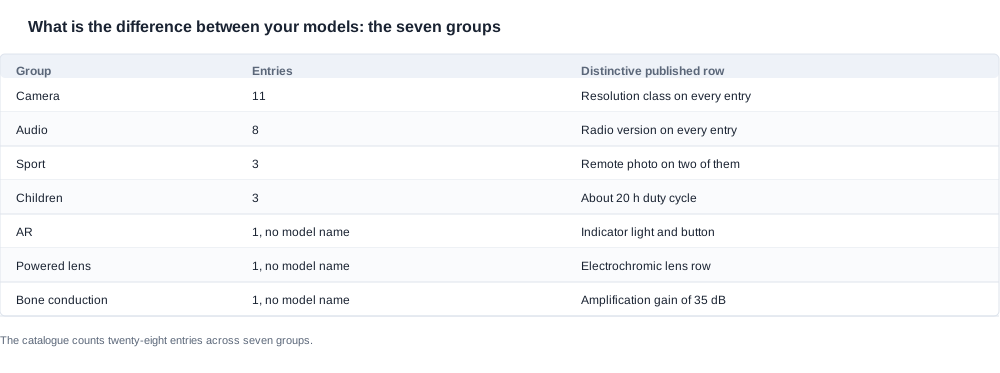
The seven groups are the first cut, and they are the level at which a range is coherent. The table below is the map of the whole catalogue in seven rows, and the group a buyer works at is normally the group they intend to sell.
Axis one: whether the entry carries an image sensor. This is the largest single difference in the range and it changes the bill of materials, the runtime, the privacy position and the conformity file all at once. Eleven entries carry a sensor, and the other seventeen do not. The eleven publish a resolution class: eight megapixels on the CY05 and the CY03, the MT6 and the MT5, and the V06 and the KY06, and the V03 and the V03 Pro, and thirteen megapixels on three entries — the L2 Utral and the S7, and the L1 Pro. That is the largest published group in the catalogue and it is the reason a camera product and an audio product cannot be compared on price without changing the question being asked.
Axis two: the charging method. Seventeen entries state magnetic charging, seven state Type-C — the D11 and the D12, the L2 Utral and the D17, and the ZH12 and the V03 Pro, plus the bone-conduction model — and four camera entries, the CY05 and the MT6, and the L1 Pro and the CY03, publish no charging method at all. This is a retail decision as much as a hardware one, because a magnetic product needs a cradle and the cradle is a second line item in the packaging plan and a second SKU in the warehouse.
Axis three: the charging-case row. Five camera entries publish a case capacity — 1400 mAh for the L1 Pro and the CY03, and the CY05, either 900 mAh or 1400 mAh for the L2 Utral, and a foldable 1200 mAh case for the MT6. Two further entries, the KY06 and the MT5, are published with a case but give no figure for it. Four camera entries — the V03 Pro and the V03, and the V06 and the S7 — carry no charging-case row on the page at all, so whether they are supplied with one is an open question to put to the supplier rather than a published fact.
Axis four: the radio version. Twelve entries publish V5.4, two publish V5.3 — the K01 and the K02 — and fourteen publish nothing at all. That fourteen includes all eleven camera entries, so for a camera product the radio configuration is a question to ask, and the answer decides the conformity scope.
Axis five: the feature rows. These are the distinguishing characteristics a catalogue page carries in addition to the standard electrical rows, and they are where the small commercial differences live. A surround-sound row appears on the YK12 and the YKC02, the ZH12 and the D11, and the D17. A remote-photo row appears on the D17 and the ZH12. A removable-part row appears on the G07, and an inner-frame row appears on the V06 and the S7. A colour range appears on two entries, the V03 Pro with three options and the V06 with four.
Axis six: the published markings. Two entries carry an ingress marking — the V06 and the S7, both at IP54 — and no other entry carries one. One entry publishes a weight, and it is worth being precise about that figure: the MT6 glasses body is recorded at 158 g, with its foldable charging case left out, and no other entry in the range publishes any mass at all.
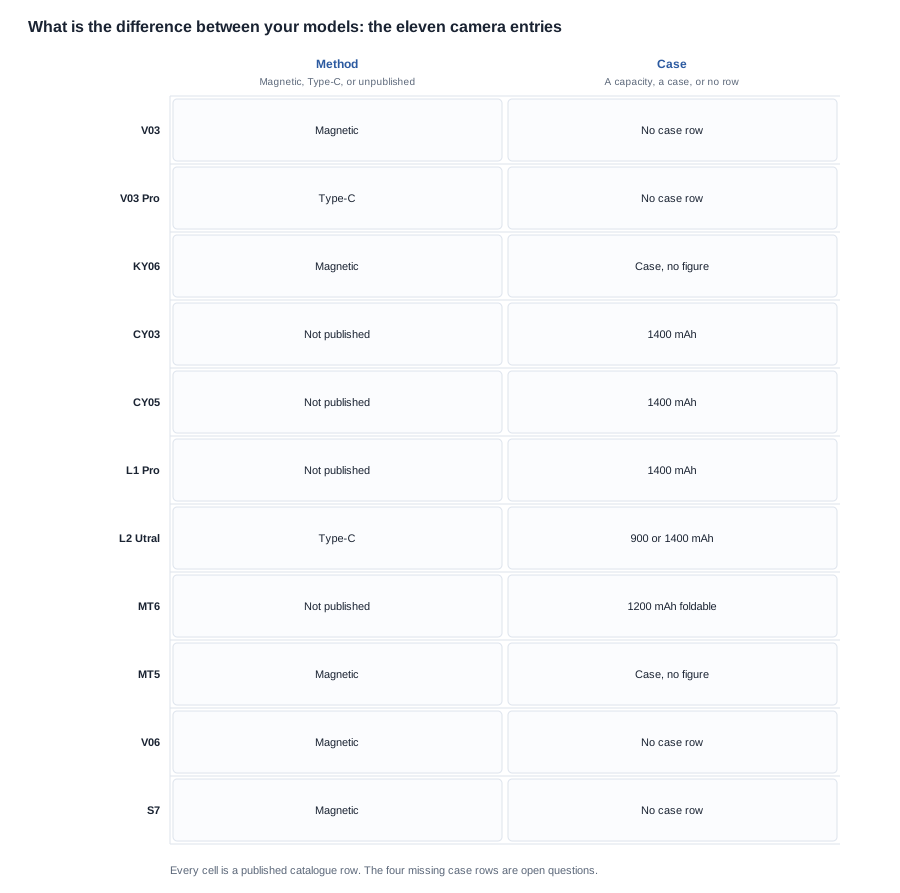
The matrix above takes the eleven camera entries and sets out the two axes on which they differ most often in practice. It is the clearest illustration of why a catalogue comparison works: every cell is a published row, and every cell can be checked against a supplier's claim.

The rows that read like differentiators and are not
Three things are commonly assumed to separate entries and do not, and a buyer who organises a shortlist around them will end up comparing entries that differ in ways that matter less.
The cell configuration. Seven entries publish a doubled cell — the K01 and the K02 at 90mAh2, the LC-105 pair, the G07 and the YK12 at 55mAh2, and the YKC02 at 70mAh2 — and everything else publishes a single cell. The doubled configuration is a genuine structural difference and it is worth asking about. What it is not is a proxy for capacity, because the totals derived from those published cell values land within a narrow band: 180 mAh for the K01 and the K02, 110 mAh for the four entries at 55mAh2, and 140 mAh for the YKC02. Those three figures are our own arithmetic on the catalogue rows rather than published capacity figures. A buyer comparing a 110 mAh entry against a 100 mAh single-cell entry is comparing two figures that differ by ten milliamp-hours and will feel no difference in the hand.
The runtime figure. Runtime is published for every entry, which makes it read like a strong differentiator. It is weaker than it appears, because the catalogue does not publish the test condition behind any of them, and a runtime that is a duty cycle is not comparable with one that is a continuous-use figure. The A05, the A06 and the A07 are marked at approximately twenty hours, and that figure describes a duty cycle rather than an unbroken period of operation. The same caution applies to the 5~8 h band on the S7, the V06 and the V03, and the V03 Pro, which is a range rather than a measurement.
The charge time. It is published on all twenty-eight entries, but it is a ceiling: two hours or less for twenty-six of them, and about one hour on the D17 and the ZH12. A ceiling tells you the worst case, not the typical case, and it does not tell you the starting state of the cell or the point at which the unit is judged full. It is a useful row for comparing what a supplier is willing to commit to and a poor row for planning a swap window.
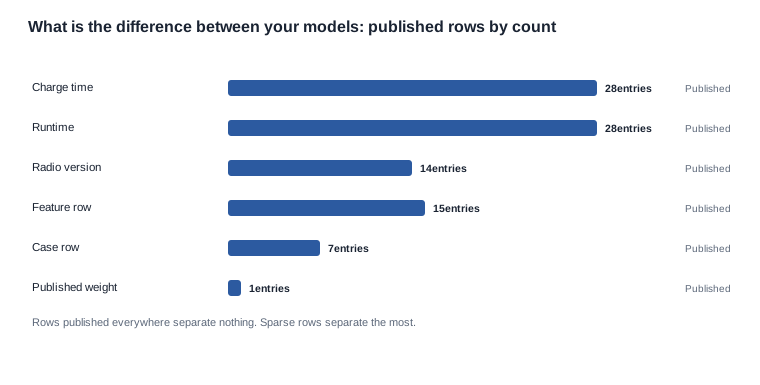
The counts above are worth reading together rather than separately. Two rows are published everywhere and therefore separate nothing. Two more are published on a handful of entries and are the strongest differentiators available. The middle of the distribution — the case row, the colour range, the ingress marking — is where a shortlist should be built, because that is where the published data is both dense enough to compare and sparse enough to discriminate.

How to turn the published rows into a shortlist
The technique is short, and it is the reason the published rows are worth having. Take the axes in the order above, and eliminate rather than score. An axis that removes half the range is doing useful work; an axis that removes none of it should be dropped from the comparison and not carried into the evaluation.
The first cut is the camera question, because it removes eleven entries from consideration or eliminates everything else. The second is the charging method, which splits the remainder into three rather than two — magnetic, Type-C, and unpublished — and the third is the case row, which splits the camera group into five states: a published capacity of 1400 mAh, a published choice of 900 or 1400 mAh, a foldable 1200 mAh case, a case mentioned without a figure, and no case row on the page. By this point a shortlist of two or three entries is usually reached, and from there the remaining axes are what finish the job.
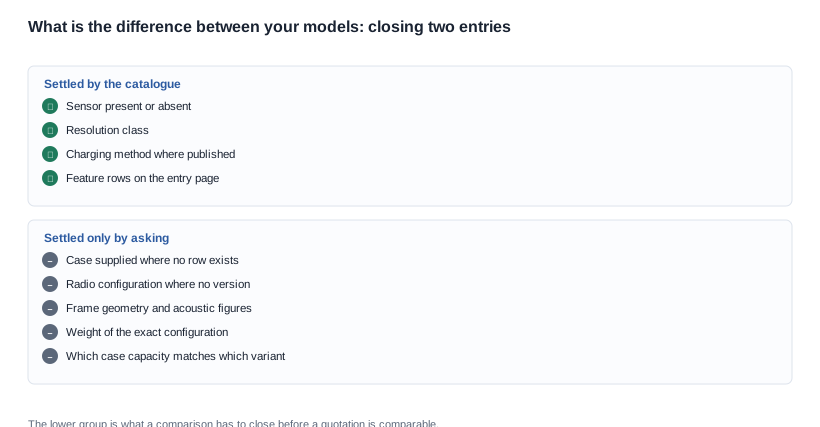
The checklist is the step that is usually skipped and that produces the disagreements later. Two entries that survive the same elimination path can still differ in ways the catalogue does not record, and the comparison has to close on those as well.
The four comparisons that finish the shortlist are the ones with no published row behind them, and each of them has to be handled by asking rather than by reading.
- The geometry, which covers how the product sits, whether a separate second device is involved and what the packaged footprint becomes. The materials and ergonomics section covers the part of this that can be described at all.
- The acoustics, which is a published surround row on five entries and a measured behaviour on none.
- The configuration count, which is the real number behind a range: the V06 alone publishes four colour options and the V03 Pro three, and a colour is a SKU in every system a buyer runs.
- The L2 Utral's naming, where the catalogue prints two variant names and two case capacities with no statement of which capacity belongs to which name — a question with a precise answer that has to be asked.
Running the elimination without wasting the comparison
The method above is quick, and the way it usually goes wrong is not in the elimination but in what happens afterwards. Four failures account for most of them, and each one is easy to avoid once it has been named.
Eliminating on an axis the supplier treats as variable. The axes above are published rows on fixed configurations, which means they do not move between units of the same model. An axis that moves — a colour, a market variant, a bundled accessory — is not an axis, it is a configuration dimension, and eliminating on it hides a real difference instead of a real match. The test is simple: if two units of the same entry can differ on it, it is a dimension and it has to be counted, not eliminated.
Stopping at two axes. Two axes usually produce four or five candidates, and a buyer who stops there has done half the work. The third and fourth axes are where the commercially meaningful separations sit, because they are the axes that change the packaging, the accessories and the documentation. The elimination is finished when each surviving candidate has a distinct combination on the axes that carry cost.
Treating a published silence as a negative. Four camera entries publish no charging method, four publish no case row and all eleven publish no radio version. A silence is an open question, not an answer, and it should be carried into the enquiry as a question rather than closed as a gap. The difference matters commercially: an entry with no published case row may or may not arrive with a case, and the buyer who assumes either has made a decision without a source.
Comparing before configuring. A comparison run on model names produces a shortlist; a comparison run on configurations produces a quotation. The published rows differ between configurations of the same model in ways the model name does not show — the V03 Pro's three colour options, the L2 Utral's two variant names and two case capacities, the seven entries that publish a doubled cell against the eleven that publish a single one. Every shortlist that has been built on model names has to be re-run on configurations before a purchase order is raised, and it is worth re-running it in writing so that the change is visible.
A worked illustration of the fourth failure is worth a moment, because it is the one that reaches a warehouse. Take an audio shortlist of three entries: the D11, the YK12 and the G07. On the radio axis they separate without any ambiguity — the D11 publishes V5.4 and a single 100 mAh cell with about seven hours, while the YK12 and the G07 both publish V5.4 with two 55 mAh cells and about six hours. The YK12 and the G07 then appear identical, and they are not: the YK12 publishes a surround-sound row and a slim-temple row, while the G07 publishes an ultra-thin and removable-temple row. The published rows alone do not settle which of the two is right for a programme, because the removable temple is a field-replaceable part and a different aftersales commitment from a slim temple that is not. That is the point at which the comparison has to stop and a sample has to decide.
The same illustration shows why the elimination order matters. If the first axis had been the feature row rather than the radio version, the D11 would have been separated by its surround-sound row and the other two would still have landed on the same published electrical rows, because they genuinely share them. Running the axes in the wrong order does not give a wrong answer here, but it does give one that is harder to explain to a colleague and impossible to repeat for a second programme, and a comparison method that cannot be repeated is not a method. Fixing the order in advance — camera, charging method, case, radio, features, markings — costs nothing and makes the elimination auditable, which matters when the shortlist is being defended to somebody who was not in the room when it was built.
The OEM-ready platforms page is where a comparison of this kind gets turned into a written specification, and the quote request route is where the open rows should be attached rather than left in an email thread. The point of the whole comparison is that the shortlist is defensible: each entry in it survived the same axes, in the same order, and the residual differences are named rather than assumed.

The published rows and the open items behind them
The position we take on this appears below in the arrangement used across this category.
Published. Seven categories hold twenty-eight entries between them, and each of the twenty-eight is described in the same way: the cell, the number of cells, the runtime, the charge time and the charging method. Eleven of them add a resolution class, five add a charging-case capacity, two add a case without a figure and four add no case row at all. Two carry an ingress marking, two a colour range, two a remote-photo row, three a removable part and five a surround-sound row. Fourteen publish a radio version; exactly one publishes a weight.
Not published. Every model in the range except the MT6 is published without a weight, and the MT6's figure covers the glasses body only, excluding its case. No acoustic measurement of any kind appears: no driver size, no frequency response, no sensitivity, no maximum output, no leakage figure, no microphone pickup. For the camera entries nothing further appears: the sensor model, the field of view, the frame rate, the video format and the storage capacity are all absent. There is no capacitive-touch row for any entry in the range. Unit price, price tier, minimum order quantity, lead time, warranty period, tooling fees, sample fees and certificate identifiers are all absent, and no CE, FCC or RoHS is named anywhere in the catalogue text, nor does any entry carry a certification row.
What to ask. Which charging method applies to the four camera entries that publish none. Whether a case is supplied with the four entries that carry no case row. The radio configuration for any entry that publishes no version. The correspondence between the L2 Utral's two variant names and its two published case capacities. The frame geometry and the acoustic measurements. The weight of each configuration, including the case where one is supplied. Which documentation exists for the model and the destination market.
The practical next step for a model comparison
Run the elimination in the order above on your own candidate list and see whether the same entries survive as last time. If they do, the published rows have done their job and the residual work is a sample, a test and a photograph. If they do not, the difference will usually be one axis that was applied inconsistently, and finding it is worth more than the next price comparison.
If you tell us which models are in scope, the destination markets, the quantity band and the configuration count you need to carry, we will reply with the catalogue rows for each of them, the rows we do not publish for them, and a note on which of the six axes actually separates your candidates.
| Comparison | Where it is published | Where to ask |
|---|---|---|
| Sensor present or absent | All eleven camera entries | Nothing to ask |
| Resolution class | All eleven camera entries | Nothing to ask |
| Charging method | Twenty-four of twenty-eight | MT6 and L1 Pro, and CY05 and the CY03 |
| Charging case | Seven of eleven camera entries | V03 Pro and V06, and S7 and the V03 |
| Radio version | Fourteen of twenty-eight | Every camera entry |
| Feature row | Fifteen of twenty-eight | The rest |
| Mass | The MT6 only | Every other configuration |


