The question is usually asked as if there were a name printed on the box, and the honest answer is that the name is the least useful part of it. A vendor assistant is a service relationship with a model provider behind it, and the brand on the front of the box tells you almost nothing about what the device will do, what it will depend on, or what it will cost you to promise. Buyers who are trying to close this question usually want three things that the brand name does not contain: the behaviour, the dependency, and the liability.
Our published position is specific, and it is worth putting on the table before the detail. The catalogue names an AI voice assistant among the key technologies across the camera tier and the audio tier. It references AI translation on the K01, which is an audio model, and that reference is recorded as an observation from our own site copy rather than as a published specification. Twenty of our twenty-eight catalogue entries carry the AI designation in the name, split across eleven camera models, eight audio models and one electrochromic entry with no camera. Beyond those statements we publish no architecture, no model list, no accuracy figure, no language list, no latency, no offline behaviour, no processing location, no subscription terms and no data jurisdiction. The AI features page is where that published position sits in full.
which ai assistant is supported: the direct answer
To state it in the order a buyer needs it: the category is named and the implementation is not published on this site.
What is published. An AI voice assistant appears as a listed key technology across the camera tier and the audio tier. The camera tier is eleven models — eight at 8 MP and three at 13 MP — and the audio tier is eight. The AI designation appears in the name of twenty of the twenty-eight entries. AI translation is referenced on the K01, and because that reference comes from our own marketing material rather than from the product catalogue, we record it as an observation rather than a specification.
What is not published. No vendor or model name for the assistant on any entry. No architecture and no division between what runs on the device and what runs in a service. No wake rate, no false activation rate, no command success rate, no latency figure, no recognition accuracy and no translation accuracy. No language list. No offline behaviour. No subscription terms, no application operator and no data jurisdiction. No certification reference for any AI capability.
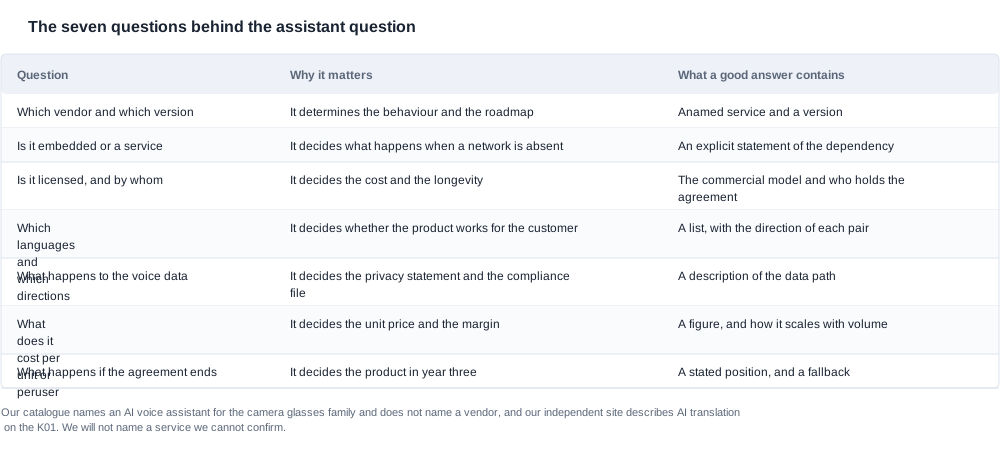
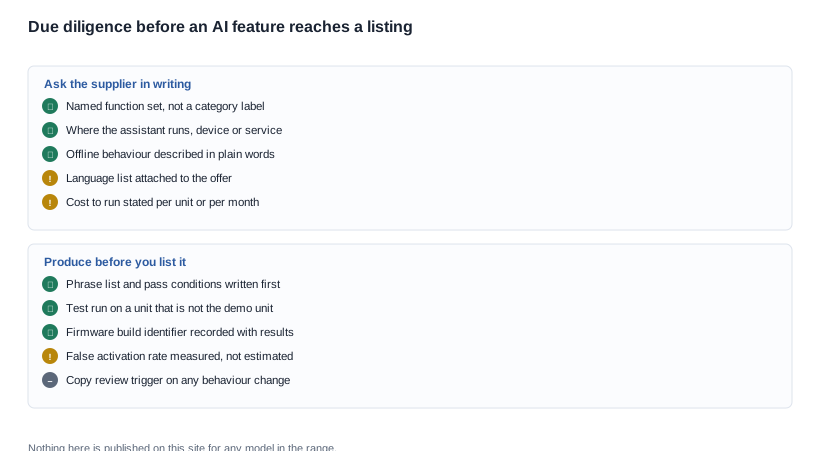
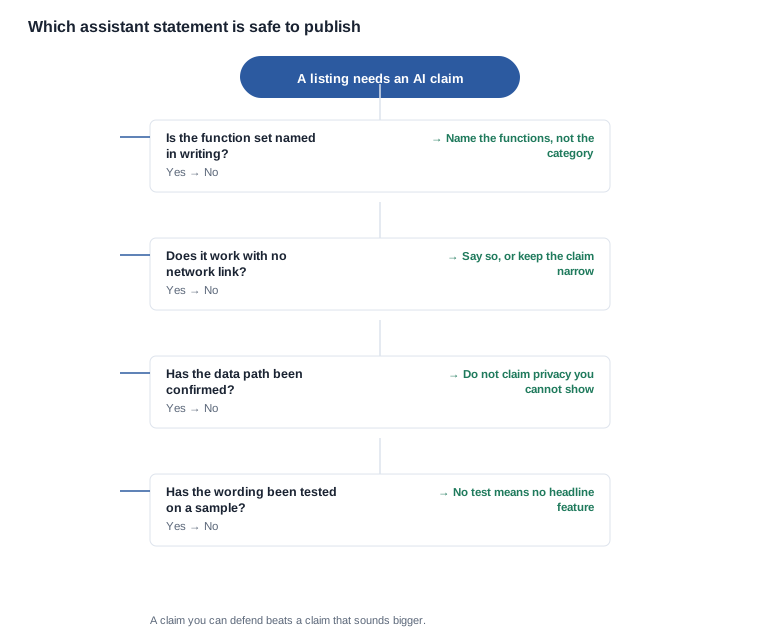
What that means for a listing. You cannot put a named assistant in your product copy on the strength of our catalogue, because our catalogue does not name one. What you can do is treat the AI designation as a statement that a feature set exists on that entry and nothing more, and then ask the supplier for the eight answers in the table below in writing. The distinction between an observation and a specification is small in a sentence and it is the whole exposure: a buyer who restates our observation carries exactly the exposure we carry, and a buyer who asks for the specification carries none of it.
The way to ask the question so that the answer is usable is to stop asking for a name and start asking for a behaviour. There is a specific form of the request that works better than the general one, and it names the function rather than the feature. Rather than asking which assistant is supported, ask which functions the unit performs without a companion application, which of them require a network connection, what happens to each of them when the connection drops, what the response language set is, and what the per-unit or per-month cost is. Five parts, and every part of them is something a supplier either answers with a document or cannot answer at all. A supplier who cannot answer the second part has told you something important: the feature is a service, the product is connected, and the channel has to be sold on that basis.
The practical test for the request is whether the answers can be compared between two suppliers without a call. That is the criteria that matters before a shortlist is drawn, and it is a stricter test than it sounds, because the answers are mostly behavioural rather than numeric. Two suppliers can quote identical hardware and completely different assistants, and the comparison fails at the first behavioural answer if the request is not written tightly enough to make the answers comparable.
There is one more piece of published context that changes how the question is framed. The AI designation and the camera hardware are independent of each other in our range. Twenty entries carry the AI designation, and one of them is an electrochromic entry with no camera at all. That is worth noticing because it confirms what the flag is: a marker that a feature set exists somewhere in the stack, not a description of a sensor, and not a promise about what the wearer can do with the product.
Why the phrase covers four different products
"AI assistant built in" is used across this category to describe at least four distinct products, and a buyer who has not separated them will accept a quotation against the wrong one.
The answerer. It answers questions, retrieves information and summarises. This is the product most people picture, and it is the one most dependent on a network and on a provider.
The controller. It operates the device: takes a photograph, starts a recording, adjusts a setting, plays something. This is the product that has to work reliably in a warehouse with no signal, and it is the one where the offline question decides whether it is usable at all.
The translator. It interprets speech and speaks back in another language. This is the capability referenced on the K01 in our own material, and it is a performance claim, which means it needs a measurement and a language list rather than a category name.
The recorder and summariser. It captures a session and produces a summary afterwards. This is a product with a data path and a retention policy, and it is the version with the largest compliance surface.
The reason the separation matters commercially is that the four have different suppliers, different cost structures, different failure modes and different evidence requirements. A quotation for the answerer does not cover the controller. A privacy statement that covers the answerer says nothing about the summariser.
Underneath all four is a dependency that changes how a buyer should evaluate a supplier. The behaviour of the assistant belongs to the model provider, not to the factory, and it changes with the build rather than with the hardware in the container. A factory can ship exactly the hardware you approved and the behaviour can still be different, because something upstream changed. That is why the answer to "which assistant" is not a name to be fixed in a purchase order, and why the change-control question in the table is not an administrative detail.

The eight answers that decide what the assistant does
The eight questions below are the ones that turn a category label into a specification. They are worth sending before the request for quotation goes out, because a specification written before the quotation arrives is a list of requirements, and a specification written after it is a negotiation about a number somebody else chose.
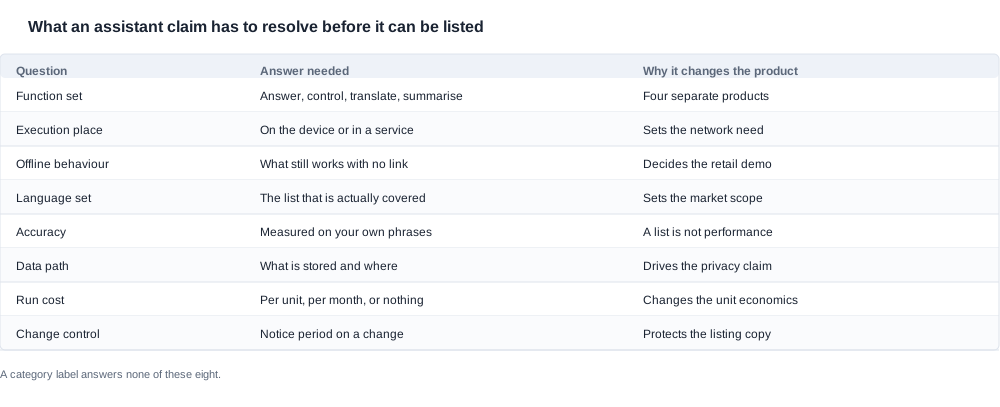
The function set and the execution place come first, because they decide the type of product. If the answer is a specific set of named functions, the buyer can test those functions. If the answer is "AI voice assistant", the buyer cannot test anything, because there is no defined pass condition. The execution place answers a related question: whether the device needs a network to deliver the feature at all. A product that delivers everything on-device and a product that delegates to a service have different cost structures, different dependency profiles and different failure modes, and they are sold to the same customer in the same channel.
Offline behaviour is the question that decides the channel. A retailer demonstrating the product in a shop with no connection needs to know what still works. A field deployment in a warehouse or on a site needs to know the same thing. If the answer is that the assistant degrades to nothing without a link, then the honest description of the product is a connected product, and the listing, the packaging and the field sales script all have to say so.
The language set and the accuracy figure decide the market scope. A translation capability without a language list is a capability with no market. An accuracy figure without a test condition, a phrase set and a build identifier is a number that cannot be reproduced, and the phrase "real-time translation" on a product page without either of those is a claim that a customer will test in the first minute of use.
The data path and the run cost decide whether the feature is commercially viable at all. What the device stores, where the audio goes, how long a recording is retained and whether any of it leaves the user's region determine whether the product can be sold into a channel with a data position at all. The cost per unit or per month determines whether the feature can sit in the headline of the listing or whether it has to be a cost line in the business case. Both of these are commercial questions, and both of them are answered by the supplier rather than by the catalogue.
Change control protects the copy. If the provider changes the behaviour, the listing has to change with it. A copy-review trigger and a notice period are what turns that from a customer complaint into a scheduled review.
The trade-off across the four functions is a commercial decision, not a technical one. The answerer is the cheapest to add and the most visible in a demo. The controller is the one that wins a field deployment. The translator is the one that opens a market but carries a performance claim. The summariser is the one that carries the compliance surface. A product that tries to do all four on one platform is doing something ambitious, and the quotation for it should be read against the quotation for a product that does two well. Buyers who have been shown the ambitious version rarely ask which two of the four were actually built, which is the question that separates the two prices.
The trade-off that matters most for a buyer with a channel rather than a product is usually the third one. A translation claim is the easiest thing to write into a listing and the easiest thing to disprove in a customer's first ten minutes, because the customer will say a phrase in their own language and compare it against what they expected to hear. A translation capability that is not measured on the buyer's own phrase set is a returns driver in exactly the markets where it looks most attractive.
Change control protects the copy. If the provider changes the behaviour, the listing has to change with it. A copy-review trigger and a notice period are what turns that from a customer complaint into a scheduled review. If the provider changes the behaviour, the listing has to change with it. A copy-review trigger and a notice period are what turns that from a customer complaint into a scheduled review.
The radio file, the data path and the change nobody announces
An assistant that talks to a service is not only a feature. It is also part of the conformity assessment of a radio-enabled product, and that is the part of this question that gets discovered late.
The route in the European Union is the Radio Equipment Directive (EU) 2014/53/EU, whose cybersecurity-related essential requirements are addressed through the EN 18031 series — EN 18031-1, EN 18031-2 and EN 18031-3 — cited with an application date of 1 August 2025. The requirement exists whether or not a supplier chooses to use the standards; the standards are a demonstrable route to showing the requirements are met, not an optional extra. A product that skips them still has to demonstrate conformity by another route, and the cost of skipping them is paid later rather than avoided.
This is where the assistant stops being a marketing item. Secure communication, encryption, secure storage, user consent and the process for handling identified vulnerabilities are all in scope, and a voice assistant with a data path is inside that scope in a way that a camera that stores files locally is not. The consequence for a buyer is a documentation requirement: you need to be able to describe what the device does with the data, and you need that description to be consistent with the file and with the privacy statement on the listing.
Our published position on documents is narrow and consistent with the rest of the range. The catalogue carries no per-model certification row, and its text contains no reference to CE, FCC or RoHS. The certification checklist page sets out the document set that exists and the order in which it is normally assembled, and it is the right starting point for this conversation rather than the catalogue.
The change nobody announces deserves its own paragraph, because it is the most reliable source of a dispute. A provider can change what the assistant does, how it responds, what it stores or what it costs, and none of those changes alters the hardware, the firmware build identifier or the model designation on the purchase order. The buyer's listing then says something the product no longer does, and the complaint arrives from a customer rather than from the supplier. Two clauses prevent it: a notice period on behaviour changes, and a copy-review trigger that obliges the brand to re-check the listing whenever a notice arrives. Neither is unusual, and both are much cheaper than rewriting every published claim in every language after a channel has already built a campaign around it.
Testing the assistant before the order rather than after it
The test plan is what turns a capability into a specification, and the plan has to be written before the sample arrives, not after it looks good in a demonstration.
Write the phrase list and the pass conditions first. Ten phrases a real customer of yours would use, and for each one what counts as success. Without a written pass condition the test produces an impression, and an impression cannot be compared between two suppliers or repeated on a second build.
Measure the false activation rate before the wake rate. The wake rate is the number a supplier will present, because it is the flattering one. The metric that decides whether the product is shippable is the rate at which the device interrupts a customer who was not talking to it, because a device that cuts into a conversation gets taken off and stays off. A device that never wakes is also a failure, but it fails visibly and can be diagnosed; a device that wakes in a meeting is the failure that ends the channel.
Run the plan on a unit that is not the demonstration unit. A factory will show the best unit it owns, and the best unit is usually the one that has been handled least. A plan that runs on a unit from the shipment batch tells you something about the product; a plan that runs on the demo unit tells you about the demo unit.
Record the firmware build identifier with every result. A result without a build identifier cannot be reproduced, and the number itself will change when the provider ships an update. If you cannot get a build identifier, a written description of the data path and a named offline behaviour, then the feature does not go in the headline of the listing, whatever the catalogue says.
The last part of the plan is the one buyers skip and then wish they had not: agreeing with the supplier, in writing, what happens to the feature if the provider changes it. The negotiation for that clause is short and specific — a notice period, a copy-review obligation, and a statement of what the supplier will tell you and when. A supplier who will not commit to a notice period is telling you that they do not control the layer that decides what the product does, and that is information you need before the launch rather than after it. It is also a reasonable thing to negotiate, because a supplier who does control it has no difficulty committing to it.
The sample request itself is a small transaction and it is the cheapest way to own a number in this category. The samples page covers how to ask for one; what matters is that the request states the configuration and the phrase list rather than asking for "a unit with AI". A supplier who can quote against a phrase list is a supplier who has to have thought about what the assistant actually does.
One last practical point about the plan, because it is the part that decides whether the results survive contact with a second supplier. A single sample produces a single result, and a single result cannot be compared with anything. The plan is worth running on two units from the shipment configuration rather than one, and the difference between the two units is more informative than either one on its own. If the false activation rate on one unit is low and on the other it is not, the problem is not the assistant, it is the build or the assembly, and that is a finding the supplier can act on. If both units behave the same way and the rate is high, the assistant is the problem, and the conversation becomes a negotiation about whether the function belongs in the product at all. Which one of those two conversations you end up in depends entirely on having taken the second unit, and a plan that specifies only one cannot tell them apart.
The position we take is that we name an AI voice assistant as a listed key technology across the camera tier and the audio tier, and we record AI translation on the K01 as an observation from our own site copy rather than as a published specification. We publish no accuracy figure, no language list, no latency, no offline behaviour, no processing location, no subscription terms, no data jurisdiction and no certification reference for any model, and we will not estimate any of them. We do not name a vendor assistant on any entry, and we do not estimate a performance figure we have not measured. We would rather a buyer test the feature than believe a description of it, and we will say plainly which model in the range carries the AI designation so that the shortlist starts from the published rows rather than from a guess.
Related reading
- The published AI position in full — AI features
- The document set behind the radio file — certification checklist
- Getting a unit to test — samples
Tell us the model and the functions you need the assistant to perform, and we will say what the published rows cover, what has to be answered in writing, and what you should test before it reaches a listing.