

This page is not going to tell you who should buy an A07, because that judgement only has force once it is set against a requirement, and a requirement is something a buyer brings, and our catalogue does not have it. What the catalogue can do is narrower and more useful: it can tell a buyer which of their requirements are already answered by a printed row, which are left open because the row is absent, and which cannot be answered from a catalogue at all. On the A07 that split is unusually clean, because the page carries five rows and nothing else. It is the only one of the three products in this line whose page prints a radio version, and it prints no further notes whatsoever. A buyer who needs the answer to "who should buy" gets it by testing their own requirement against those two facts.
Who should buy A07 smart glasses: the children's model with a radio row
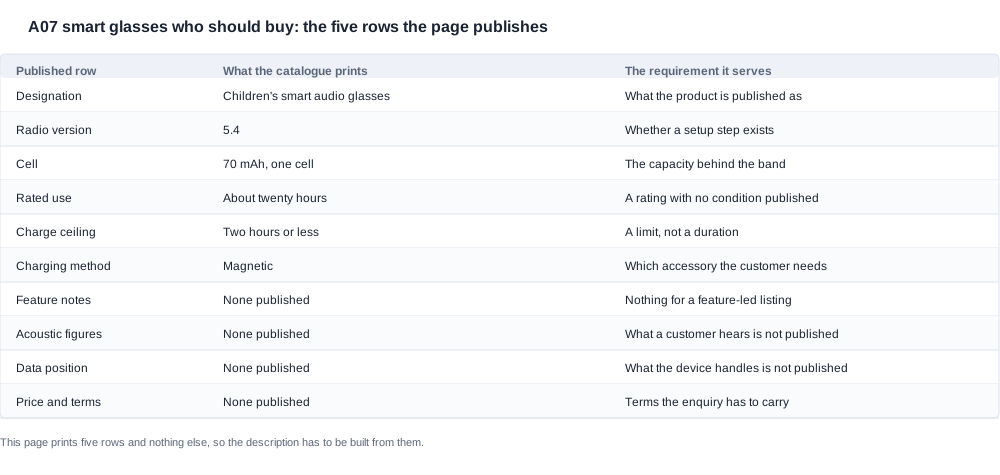
The A07 is published in our catalogue as a 儿童智能音频眼镜, and its page carries five rows: a radio version of 5.4, a cell of 70 mAh, a rated use of approximately twenty hours, a charge time of two hours or less, and magnetic charging. It carries no further notes. No element is listed, no indication is recorded, and no acoustic figure of any kind is published.
The radio version is the row that separates this product from the other two in this line, and a buyer should treat it as the most consequential of the five rather than the most technical. A published radio version means the connectivity position is documented, which means a setup step exists in the product's life, which means a requirement that involves a phone or an application is answerable from the row and a supplier's procedure. It also means that a requirement that does not involve connectivity is buying a documented feature it may not use, and the honest way to treat that in a business case is as a cost of the configuration rather than as a benefit of it.
A buyer who is evaluating this product against the other two in the same line is looking at a requirement that has a different shape here, and the shape is worth naming. Where the two protection models publish a set of elements and indications, this product publishes a connectivity position instead, and a connectivity position opens a class of questions that the other two do not open: what the device pairs with, what the customer is expected to do on the first day, whether an account is involved, and what happens to the connection when the product is passed on. None of that is published for any model in this line, and the absence is more noticeable on a product whose page does carry a radio version, because the version invites the assumption that everything around it is documented too. What to ask is therefore the pairing procedure, the application requirement and the account question, and they belong at the top of the request list rather than in the middle of it.
The absence of further notes is the other half, and it is the half a channel is most likely to discover late. A product page with notes gives a copywriter material: the elements that are fitted and the conditions that are indicated. A product page without notes gives the electrical profile and the designation, and nothing else. That is not a defect in the product; it is the shape of what the catalogue publishes, and a buyer who has planned a listing around feature-led copy has planned around something this product's page does not carry.
So the framework for this product is a three-way split, and it is different enough from the one that applies elsewhere in this line to be worth stating on its own. The first class is a requirement about connectivity, the radio version or the setup, and it is answered by a printed row plus a supplier procedure. The second class is a requirement about the electrical profile — the cell, the band, the charge ceiling, the charging method — and it is answered by the rows themselves, provided the conditions are attached. The third class is a requirement about what the product contains, what it sounds like, what it does for a child, or what it does with the information a connected device handles, and none of it is answered by our catalogue.
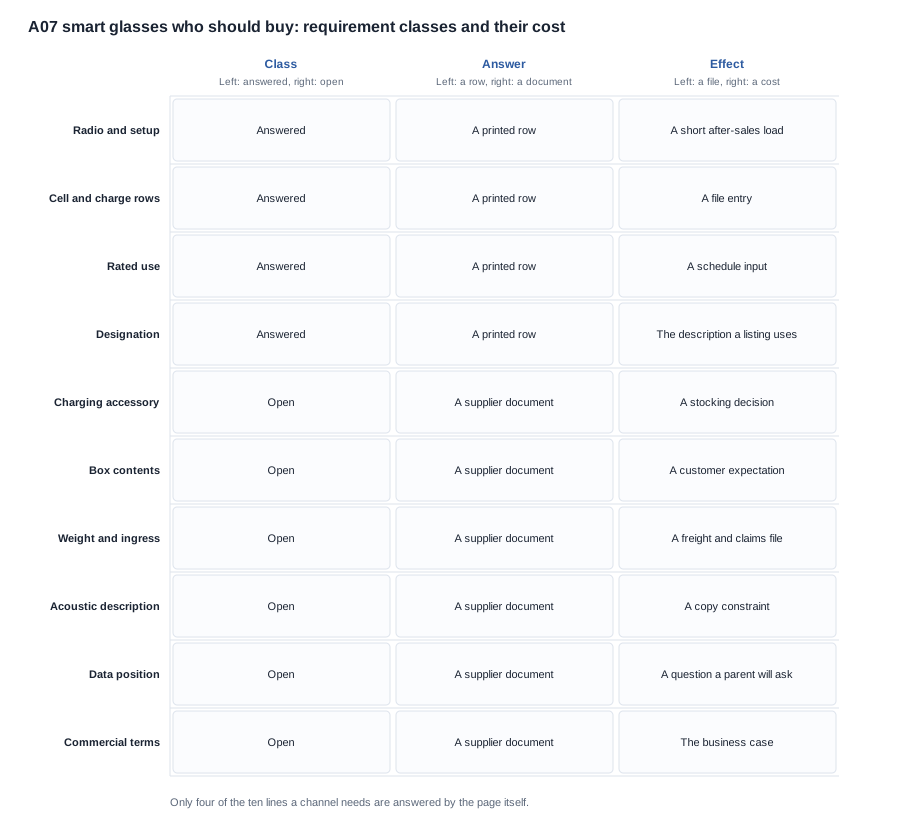
The matrix above is the working form of that split, and the right-hand column is what a buyer actually does with it. Where a row exists, the buyer states it, attaches the condition that goes with it, and moves on. Where a row is absent, the buyer asks, and leaves the line out of the copy until the answer arrives. Where no row can answer the requirement, the buyer has to decide whether the requirement is one they can source evidence for elsewhere or one they have to decline, and that decision belongs to a compliance function rather than to a catalogue.
It is also worth noting what a buyer can do with the published rows while the questions are outstanding, because the answer is more than nothing. The electrical profile can be written today, accurately, with its conditions attached, and the connectivity row can be written today. What cannot be written today is the description of what the product contains, what it sounds like, and what it does with the information it handles — and a copywriter who knows that in advance will write a different page from one who discovers it at launch. A procurement team that separates the two kinds of line before the artwork is commissioned is also protecting the launch schedule, because the questions that block artwork are the ones with the longest lead time, and the questions that do not block artwork can be answered in parallel with the design work. That sequencing is the practical value of the split, and it is what a buyer should evaluate the catalogue against.
There is a practical reason to run the split before the first enquiry rather than after it, and it is a commercial one rather than a drafting one. A buyer's question list, a buyer's sample order, a buyer's artwork and a buyer's warranty position all change depending on which class the requirement falls into. A programme whose requirement is in the first class can often be run on a single document and a single sample. A programme whose requirement is in the second class needs a request, a reply, a review and a file. A programme whose requirement is in the third class needs evidence the supplier may not hold at all, which is a sourcing conversation with a lead time that a brochure request does not capture.

The 70 milliampere-hour cell and the twenty-hour band
The two figures on this page that a buyer will quote are the 70 mAh cell and the approximately twenty-hour rated use, and the treatment they need is the treatment every published rating needs. Nothing in our material defines the workload behind the band, states where the measurement started or marks where it ended, and a band in that condition cannot be converted into a session length, cannot be read as a promise about how long a child will use the product before a charge, and cannot be put beside a figure published for a different model unless that figure carries conditions as well. The cell value does not repair this, and the temptation to treat a cell and a band as a pair that explains itself should be resisted: they are two separate printed rows, and the relationship between them is a question for the supplier.
There is one respect in which this product's rating is more sensitive than a standalone one, and it comes from the radio version rather than from the cell. A connected product draws differently depending on whether it is connected and what it is connected to, so the condition behind the published band matters more here than it would for a product with no radio row. The first question to put to a supplier is therefore not about the cell at all. It is about the workload, and specifically about what the radio was doing while the figure was measured — connected and idle, connected and in use, or disconnected — because a buyer who schedules a programme on a rating that was measured in a different state is planning against a number that was never theirs.
The charge row is published as two hours or less, which is a ceiling rather than a duration, and it has to be written as one. The charging method is magnetic, and that is a published row with a direct operational consequence: the customer needs a specific charging part, and whether that part travels in the box or has to be obtained separately is a question the catalogue does not answer for any of the products in this line. A buyer who has not established it will find that a customer opens the box and has a product they cannot charge, which is the most expensive kind of first impression a specification can produce.
The cell arrangement is simpler than in some other parts of the catalogue, and simplicity has value in a file: this product carries one cell rather than two, so there is one transport document to obtain and one cell position to verify on receipt. A programme carrying more than one of the three products in this line is carrying more than one arrangement, but a programme carrying this one alone is carrying a single set of transport paperwork, and a buyer should say so in the request so that the supplier supplies the right one.

The absence of feature rows, and what that means for the sell-through argument
A sell-through argument for a connected children's audio product is usually built on features: this is what it has, this is what it does, this is why the price is what it is. This product's page does not support that shape of argument, because it publishes no elements, no indications and no acoustic figures. The description that the documentation supports is narrower and worth practising: the product is published as an audio glasses product, it carries a radio of version 5.4, it has a 70 mAh cell, it is rated for approximately twenty hours, and it charges magnetically in two hours or less.
That is a workable position, and it is the position a buyer should make before committing to a channel that expects feature-led copy. A channel whose listings are built on specifications can carry this product. A channel whose listings are built on feature narratives has to write its own narrative, and it has to do so from material that does not exist in our catalogue, which means from a supplier document or from its own product knowledge. Neither is forbidden, and both have to be sourced before the programme is planned rather than after it is launched.
The absence also has a second-order effect that a procurement team should note, and it is about the question a customer will ask. A connected product for a child raises a question that the page does not answer at all: what happens to the information the device handles. Our catalogue publishes no storage arrangement, no retention period, no application requirement and no data description for this product, and a buyer who cannot answer that question from a document is going to be asked it by a parent or by a school's information officer. The absence of notes on the page is a narrower problem than the absence of a data position, and the second one is a requirement class in its own right.
It is worth being careful about one thing here, because it is the easiest place to go wrong in a children's category. A product published as an audio glasses product carries an audio designation, and a designation is not an acoustic measurement. Our catalogue publishes no driver size, no output level, no response curve and no third-party test result for this product, so the carton and the listing can say what the product is published as and cannot say what a customer will hear. A claim about sound that is not supported by a document is a claim the channel is making on its own authority, and in this line that is a risk to the brand rather than a marketing opportunity.

Five things to confirm before the first order

It is worth adding a word about how to use this list with a second supplier, because the list is built so that two replies can be compared. Ask both the same five things in the same order, in the same form, and compare the answers against the same criteria: that the reply names the model and the configuration, that it is dated, that it points to a document rather than to a description, and that it is consistent with the reply to the previous question. A supplier who answers the first item precisely and the second in general terms has told a buyer something about the documentation behind the product, and a supplier who answers all five consistently has told a buyer something they can plan against. That comparison is how to choose between two suppliers on this product, and it is the same comparison to run on every product in the range, which is what makes a programme repeatable rather than a series of one-off negotiations.
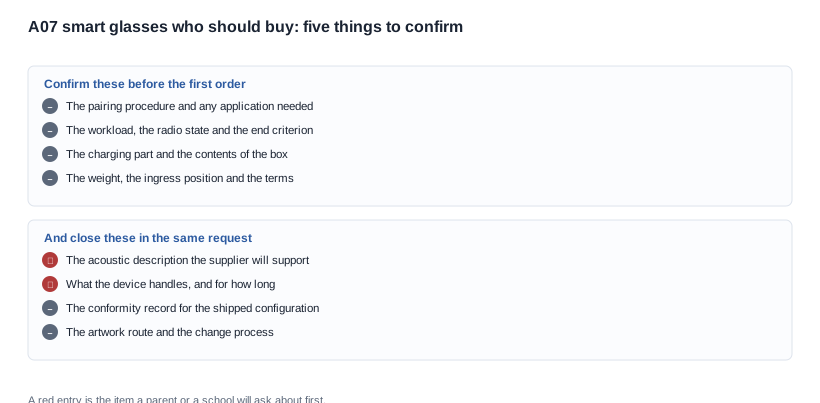
The list below is short because the page is short, and every item on it can be met from files the supplier already holds. It is written in the order that costs least to get wrong, and the first item is the one that changes how the rest of the programme is run.
- The connection routine a customer follows on the first day, whether an application is involved, and what the household is told once it is done.
- The workload behind the approximately twenty-hour rating, including the radio state during the measurement, with its start state and end criterion.
- What the charging part is, whether it travels in the box, and what else the box contains.
- The weight as shipped and the packed weight, whether an ingress marking exists for the model, and the four commercial terms a quotation has to settle: the unit price, the smallest order, the production lead time and the length of the warranty cover.
- The conformity record covering the configuration that ships, how artwork is approved, and the procedure that keeps a file valid when the build moves.
Item one is first because it decides the shape of the after-sales load, the content of the setup material and the length of the first-use experience for a household, and because it is the item a supplier can answer most precisely. Item two is the one that determines whether a published band can be quoted with a condition attached, and the radio state is the part of it that is specific to this product. Item three is the one that decides whether a customer can use the product on the day it arrives.
The fourth is a long item because it is a list of things our catalogue publishes for no product in this line, and a buyer who treats the absence of a number as a reason not to ask will end up with a product page it cannot write and a freight file it cannot close. The fifth belongs in the contract rather than in a folder, and it is the item whose absence is most likely to be discovered at the point where a configuration has already changed.
A procurement lead who has to build the business case for this model will find that the case has to be written from the requirement rather than from the product, and that the product's published rows are what tell the lead which parts of the requirement are already settled. The commercial terms — the unit price, the minimum order quantity, the lead time, the warranty term, the sample order and the landed cost — are not published for this model, and a budget built on an assumed figure is a budget that has to be rebuilt after the first quotation. The total cost of the evidence work is small next to the cost of a launch that discovers its own copy has nothing to stand on, and the due-diligence sequence above is the most direct available way to keep the two in order.
There is a closing point for a buyer who came here looking for a verdict. Any conclusion about who should buy this product would have to rest on something our catalogue does not publish, and a conclusion resting on something unpublished is a sentence a channel has to withdraw later. The framework above produces a different kind of output: it produces a requirement written down, a list of the rows that already answer it, a list of the questions that close the gaps, and a procurement file that a customer, a panel or a partner can be shown. The requirement is the buyer's own, and it is the part that decides the outcome.
The five questions are short because the page is short, and short is what a supplier can answer without an excuse.
Send us what you are buying against, the copy you have drafted for the A07, the volume bands and the markets you intend to sell into, and we will show which parts of it the page already answers, where the page says nothing, and which parts no catalogue can answer — then work out the sequence that gets the five questions above answered first.


