

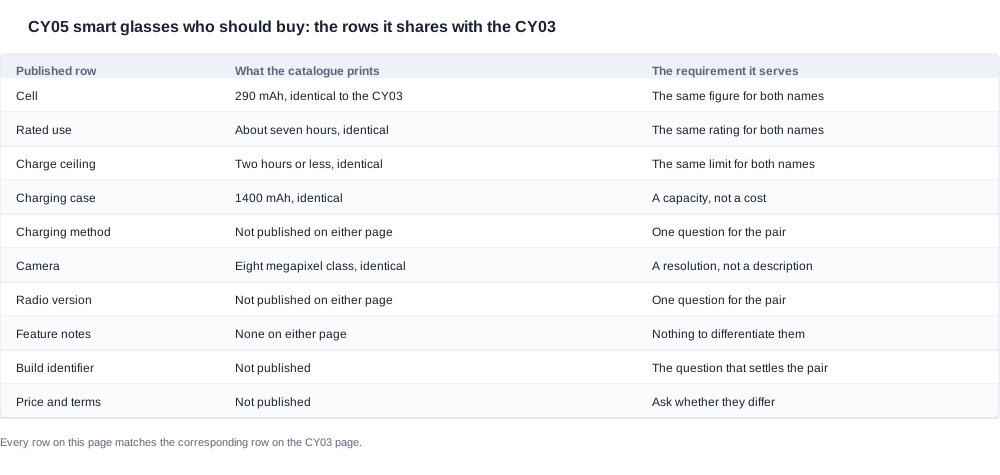
The CY05 is published in our catalogue with the same designation as the CY03 and with the same rows underneath it, and that single fact shapes everything a buyer can sensibly do with this product. Every published line on the page matches the CY03's line, from the cell through to the camera row, and two subjects a buyer would expect to find are absent from both: the radio version and the charging method. The CY05 also carries no feature note of any kind, and neither does the CY03. Because the page matches the CY03's line for line, a buyer cannot build a comparison between the two from the catalogue, and a buyer who receives two different quotations for the two designations has been given two assertions rather than two documented configurations. This page is about the procurement language that works when a catalogue treats two names as one product.
Who should buy CY05 smart glasses: a twin designation with the same published rows
A buyer looking at this page in isolation will find a short specification list and a set of open questions, and there is nothing unusual about that. What is unusual is what happens when the page is placed next to the CY03's, because the two are indistinguishable on every published line. The designation is the same kind of designation, the cell is the same 290 mAh, the rated use is the same approximately seven hours, the charge ceiling is the same two hours or less, the charging case is the same 1400 mAh, the camera row gives the same resolution class, and both pages are silent on the charging method, on the radio version and on any feature notes.
That silence is where the procurement work is, and it is worth being precise about what the twin fact does and does not give a buyer. It does not tell a buyer that the two products are the same. It tells a buyer that the catalogue provides no basis on which to treat them as different. Those are different statements, and the second one is a statement about documentation rather than about hardware, which means the resolution is a question to the supplier and not a conclusion from the page. A buyer who treats the twin fact as a conclusion will be quoting a specification for a product they have not identified; a buyer who treats it as a gap will ask the question that identifies it.
A third consequence, and the one most often left until the quotation stage, is the effect on the sample order and the inspection plan. If the two designations turn out to be one configuration, the incoming inspection has one set of checks to run. If they turn out to be two, the inspection has two, and the two sets of checks may not be the same, because a configuration difference may sit in the camera, in the accessory set or in the case arrangement. A buyer who has not asked the first question will build a receiving procedure that assumes one product and then discover a second one in the cartons, which is the point at which a quality file has to be rebuilt rather than completed.
There is a second, commercial consequence, and it is the one that catches teams planning a range rather than a single order. If the published rows are identical, then the open questions are identical too, and so is the documentation work. A buyer who asks the charging-method question twice, once per designation, may well get two different answers, and will then have two answers on file for what may be the same product — or two answers that are correct for two different builds. The shorter route, in exchanges rather than in documents, is a single request that names both designations and asks whether the answers apply to one build or to two.
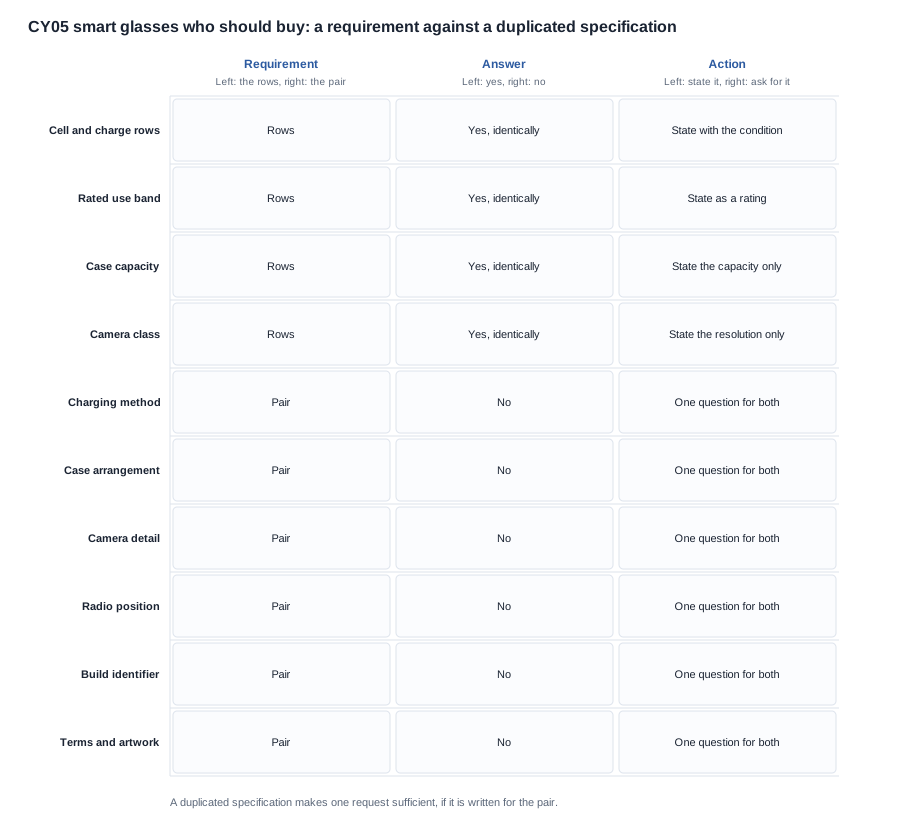
The matrix above is the framework this page offers in place of a verdict, and it is organised around what a duplicated specification means for a procurement decision. Where a requirement is about the electrical rows or the case capacity, the published rows answer it identically for both designations, and the buyer's task is to attach the conditions and to record which build the answer applies to. Where a requirement is about how the two names relate, about the charging arrangement, about the camera, about the radio or about the commercial terms, the catalogue provides no basis at all, and the question goes to the supplier.

The 290 milliampere-hour cell, the seven-hour band and the 1400 milliampere-hour case
The three published figures on this page each need the treatment that a published figure needs, and the case is the one that most often gets treated as a costed item when it is only a capacity.
The 290 mAh is a cell value and the fact is a straight one. The approximately seven hours is a manufacturer rating, and the conditions that would make it usable — the workload behind it, the state the unit started in, and the criterion that marks the end — are absent from our material. So it cannot be turned into a recording session, it cannot stand for a claim about the working time between charges, and it cannot be measured against a number published for another model unless that number arrives with conditions of its own. The cell and the band are two separate rows, and the relationship between them on this product is something a supplier has to document rather than something a buyer can calculate.
The 1400 mAh case capacity is the published figure with the most commercial weight and the least commercial support. It is a real published number, it is a substantial one against a 290 mAh cell, and it describes a component that a customer receives. It is not a cost, a minimum order quantity, a lead time, a weight or a replacement rate, and none of those is published for any product in our range. A case has a material cost, tooling, a freight weight, a replacement rate, a minimum order quantity, and a lead time longer than the product's, so the accessory programme can cost more than the product it accompanies, and a business case built on the capacity alone is built on the one number that cannot be costed from the page.
That is the point at which the twin fact becomes a planning advantage rather than an inconvenience. The two designations share a case capacity, a cell, a band and a charge ceiling, so a buyer who has established the method and the camera configuration for one of them has most of the file for the other. The duplication reduces the work rather than increasing it, provided the request is written for the pair. A buyer who plans two files where one is needed has added cost without adding evidence; a buyer who plans one file covering both designations has added evidence and saved a cycle of correspondence.
There is a further consideration about how a buyer writes the requirement, and it is the one that determines whether the rest of the work goes quickly or slowly. A requirement written as a product name produces an answer that describes a product, and a requirement written as a set of rows produces an answer that describes a configuration. The second is what a buyer needs, because the first cannot be tested. So the practical instruction for a range in this position is to write each requirement as the rows it depends on — the cell and the band and the charge ceiling and the case capacity, each with the condition it carries — and to send that to the supplier as the thing being asked about. The reply can then be checked against the requirement rather than admired, and two suppliers' replies can be compared because both of them answered the same question in the same terms.
That framing also decides what a buyer does when the two designations turn out to be one configuration. In that case the file is one file, the artwork may still be two, and the range page has to say so. In the other case, the file is two files, the minimum order quantities are two, and the catalogue is still silent about the difference. Either way the requirement has to be written before the range can be planned, because a range built on the catalogue's silence will be a range whose commercial structure is a guess, and a guess at this stage is the most expensive kind.
The two figures that have to travel with the ones above are the charge ceiling and the camera row. The ceiling is two hours or less, which is a limit rather than a duration and has to be written as one. The camera row gives the eight megapixel resolution class and nothing further — the sensor, the field of view, the frame rate, the video format, the storage capacity, the stabilisation and the low-light behaviour are all unstated — so a listing can state a resolution and cannot describe a camera.

Why the catalogue does not separate this model from the CY03
Six places in a buyer's own checklist are where a difference between the two designations would show up, and none of them shows one — which is worth setting out together, because a buyer holding that list in front of them stops hunting through the catalogue and starts asking a question that can actually be answered.
The first is the specification itself: the cell, the endurance, the charge ceiling and the charging method are the same, and the charging method is unprinted on both. The second is the case: the same 1400 mAh, and no description of the arrangement on either. The third is the camera: the same resolution class and nothing further on either. The fourth is the connectivity: neither page prints a radio version. The fifth is the construction: neither page prints a feature note. The sixth is the commercial position, and this is the one that produces the most confusion, because quoting one set of terms for one designation and a second set for the other, while both pages print identical rows, asserts a difference rather than describing one.
That distinction has a practical consequence for a range page. Two designations that print identically can be presented to a customer as a choice, and a customer who notices that the two are the same will conclude that the difference is in something the documentation does not cover. Whether or not there is a real difference, the published data does not support the presentation, so the range page either has to be built on a documented difference or has to present one product rather than two.
A procurement lead who has to present a range internally will find that the twin fact makes the presentation simpler in one place and harder in another. It is simpler in the product sheet, because one set of rows describes both names. It is harder in the cost model, because the number of minimum order quantities, the number of artwork sets, the number of transport files and the number of case-by-case quality checks all depend on the answer to the first question, and a budget built on the assumption of two products is wrong in one direction or the other. The due-diligence step that removes the uncertainty is a single question in a single email, and the total cost of asking it is a fraction of the cost of a programme planned on the wrong side of it.
There is a sixth consequence that is quieter and that a procurement lead should not lose. Because the two pages are identical, a build change on one of them will not appear in the catalogue row that describes the other, and a channel that has qualified both and filed one file will have a file that quietly stops matching. The written change process is what turns that into a notification, and it is the one item on the list below that belongs in the contract rather than in a folder.
A buyer who has asked the pair question once and has a documented answer can then work out which of the two names their requirement actually needs, and the answer to that determines the artwork, the minimum order quantity and the documentation effort. A buyer who has not asked it is planning on the assumption that there are two products with two specifications, when what the catalogue actually shows is one specification printed twice.
The practical instruction, then, is the one this page is built around. Write the requirement once, test it against the published rows for the pair, ask one set of questions that names both designations, and file one specification that says plainly which build each answer covers. That is the procurement language for a catalogue that prints the same product twice, and it is a different document from the one a single-model product needs.

The pre-order request that covers both designations
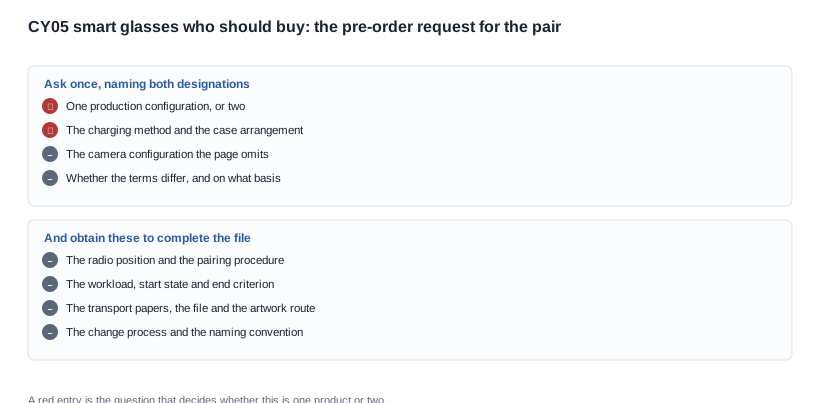

The request below is written for the pair, and every item can be met from documents the supplier already keeps. A final point belongs with the request list, and it is about the part of the programme that is not about the product at all. Two designations that print identically are a naming problem as well as a sourcing problem, and the naming has to be settled by the same enquiry that settles the configuration, because the name is what the artwork carries, what the file is filed under and what the customer searches for. A range that carries two names for one configuration has to explain that in its own copy, and a range that carries two names for two configurations has to prove it. Neither of those is possible from the catalogue, and both are cheap to settle while the request is open.
The first four close the blanks that the published rows leave open, the next three are the conditions attached to the figures that are printed, and the last three are the file and the commercial position.
- Whether the two designations correspond to one production configuration or two, and what identifies each.
- The charging method for the model, and whether the answer applies to both designations.
- Whether the charging case is the charging path for the product or an accessory that travels with it, and what the case contains.
- The camera configuration the page does not print: the sensor, the field of view, the frame rate, the video format, the storage capacity and the file format.
- The radio position for the model, and the pairing procedure if it has one.
- The workload behind the approximately seven-hour rating, with its start state and its end criterion.
- The start state and completion criterion behind the two-hour-or-less charge ceiling.
- The weight of one unit and of one packed carton, and whether an ingress marking exists for the model.
- The commercial position for each designation — the unit price, the smallest order accepted, the production lead time, the warranty term and the sample order terms — and whether any of it differs between the two.
- The transport paperwork covering the 290 mAh cell and the case, and the conformity record for the shipped configuration.
- The artwork approval route, the naming convention that keeps the two designations apart in the file, and the change process that keeps both valid.
Item one is first because it decides the shape of everything after it, and item nine carries the question that has to be asked explicitly: if the commercial terms differ between two designations whose published rows are identical, the difference is being asserted rather than described, and a buyer who has not asked for its basis cannot put it in a listing. Item eleven is last and is the one most often deferred, and the naming convention in it is worth a sentence of its own — a file that cannot tell the two designations apart cannot be used to answer a question about either of them.
Sending the same eleven questions to two suppliers and reading both sets of answers against one standard is the only way to compare them. A usable reply identifies the designation and its configuration, is dated, cites a document rather than a description, and is consistent with the reply to the item before it; one that misses any of those can be filed against the supplier but not against the CY05. The result is a set of documents, not a set of brochures, and the designation a buyer carries forward follows from the requirement that buyer brought, not from the comparison — which is why the work on this page matters more than the comparison does.
Several things in a supplier reply are red flags, and they are worth reading before the answer rather than after it. A reply that sets out the charging method for one designation and leaves the other silent is usually a file that holds a single configuration rather than a supplier who holds two. A reply that returns the same document twice under two names, with nothing in either that says the two are interchangeable, tells a buyer that the naming question has not been asked internally either. And a quotation that separates the two designations commercially while presenting them identically technically is the clearest signal of all, because it asserts a difference that the published rows do not carry. None of these proves anything on its own, and each of them is a question that goes back to the supplier rather than a conclusion a buyer can act on — which is where the due diligence on this model actually sits.
The quotation has to be read as a set of lines rather than as a single number, because the twin fact decides which lines are duplicated and which are shared. Five of them have to be stated separately if a buyer is to know what the second designation costs: the unit price for each, the smallest order the supplier accepts for each, the production lead time for each, the warranty term on each, and the sample order terms on each. The lines that are shared — the artwork, the transport paperwork, the incoming inspection plan and the file that carries the conformity record — are the lines a buyer should expect to pay for once, and a quotation that prices them twice is pricing a programme the buyer has not decided to run. This is where the total cost of the twin fact becomes visible, and no commercial term is published for this product or for any other in our range, so the line items have to be asked for and then read against each other on one sheet, in the same order, so that the difference between two quotations is a difference in the lines rather than in the formatting. The criteria a buyer applies to that sheet are the same in both cases — does the line name the designation, does it carry a date, does it point at a document, and does it agree with the line above it — and a quotation that answers three of those four is a quotation that has to be reissued before it can be compared.
The eleven questions are short enough to send in one message and to answer in one reply.
There is one more thing worth adding for a channel that intends to list both names, and it is about the customer rather than the supplier. Two names for the same configuration invite the question of why there are two, and a customer who asks that is being entirely reasonable. The answer a channel can give depends on whether the difference is real, and a channel that has not established the difference cannot give a confident answer — which means the range page has to describe one product, or the programme has to wait for the documentation. Either outcome is acceptable; discovering the question from a customer rather than from a supplier is not.
Send us what you are buying against, the two designations you are considering, the volume bands, the target markets and the copy you have drafted for the CY05. We will then set out which parts of it the published rows already settle, where the page leaves a blank line, and what has to be closed before the first order — so that the range you list and the file you keep describe the same product.


