

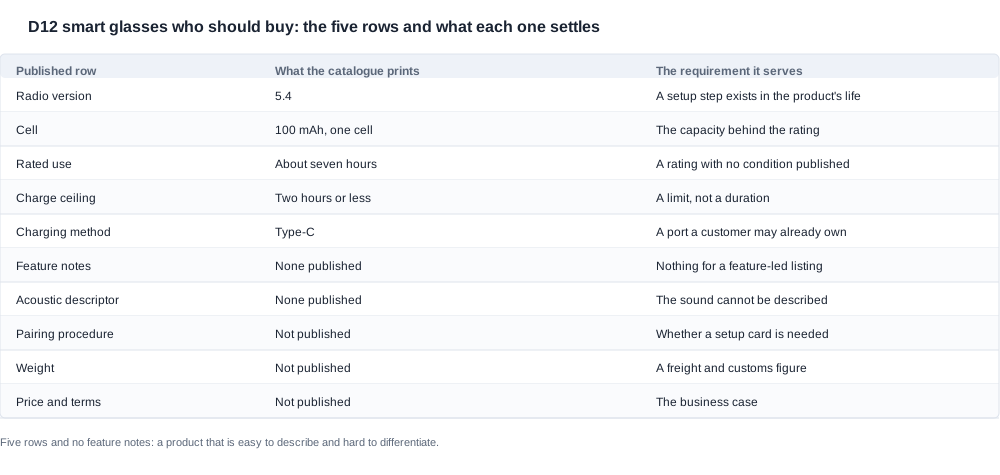
The D12 is published in our catalogue as an AI 蓝牙音频眼镜, and its page carries five rows and nothing else: a cell of 100 mAh, a rated use of approximately seven hours, a charge time of two hours or less, a radio version of 5.4 and a Type-C charging method. There is no feature note on the page — no element list, no indication list and no acoustic descriptor. For an importer, that is a specific and workable position rather than an awkward one: the product is fully described in the terms that a technical file, a listing and a compliance pack can all be written from, and the commercial decision rests on the requirement rather than on a comparison of feature sets.
Who should buy D12 smart glasses: identical rows, and no feature line
The five rows on this page are the same five rows the D11 publishes: the same radio version, the same cell, the same charge ceiling, the same endurance rating and the same charging interface. The difference between the two pages is the empty feature-note section on this one. That is worth understanding precisely, because it produces a specific kind of listing opportunity and a specific kind of risk, and a buyer who has not separated the two will get them the wrong way round.
The opportunity is that a product with a complete electrical profile and a published radio version can be described accurately and completely without waiting for a single document. A listing can state the designation, the cell, the rated use, the charge ceiling, the charging interface and the radio version, and every one of those statements is a printed row. The setup is documented in the sense that the connectivity is documented, so a channel can promise a customer that the product connects and can write a setup step around it.
The risk is that a product with no feature notes is easy to describe and hard to differentiate. A channel whose listings lead on a configuration — a listed element, a listed indication, a described acoustic arrangement — has nothing to lead with here, because the catalogue does not print one. A channel that leads on a specification has plenty. The decision about which kind of channel this product suits is therefore made on the channel's own listing conventions rather than on the product, and it is a decision a buyer makes early, because it determines the artwork, the photography, the comparison page and the cost of the listing itself.
A third point belongs in the same place, and it is about the commercial model rather than the copy. A product with no published feature notes and a full electrical profile is a product whose margin has to come from somewhere other than the feature list — from volume, from the accessory programme, from the service position, or from the packaging. That is a legitimate model, and plenty of channels run on it, but it means the buying decision and the selling decision are the same decision, and a buyer who takes this product forward for its specification without working out where the commercial case comes from will find the two decisions arguing with each other. Working it out before the order costs less than working it out after the launch.
The fourth point is the one that a buyer's own finance colleague will ask about. A product with five published rows and no feature notes has a documentation cost that is low and a marketing cost that is higher than the documentation cost implies, because the copy has to be built from the electrical profile and then made worth reading. That work is real, it falls on the channel, and it is the reason a product with a sparse page sometimes suits a channel with a strong service position and suits a channel with a strong feature-led catalogue rather less well. Deciding which kind of channel is carrying it is a decision the buying team makes with the commercial team, and it is easier to make before the first order than after the first campaign.
The second thing the empty feature section means is a limit on what may be written. A channel may describe the product as published, and may state the five rows. It may not describe the sound, because no acoustic descriptor is printed for it. It may not describe an element or an indication, because none is listed. And it may not attach a claim about what the product does for a customer, because nothing in the published material supports one. That is not a restriction the catalogue imposes; it is simply the boundary of what five rows can carry, and a listing that stays inside it is one that can be defended when a customer asks.
The framework that follows from this is the three-way split, and this product makes it particularly clean. A requirement about the electrical profile is answered by the rows, with the conditions attached. A requirement about how the product behaves in use — the sound, the connection behaviour, the control method, the setup — is answered by nothing on the page and has to become a request. And a requirement about a measured result has to be sourced from evidence that does not sit in our catalogue at all, which is a sourcing decision with a different lead time and a different cost from a documentation request.
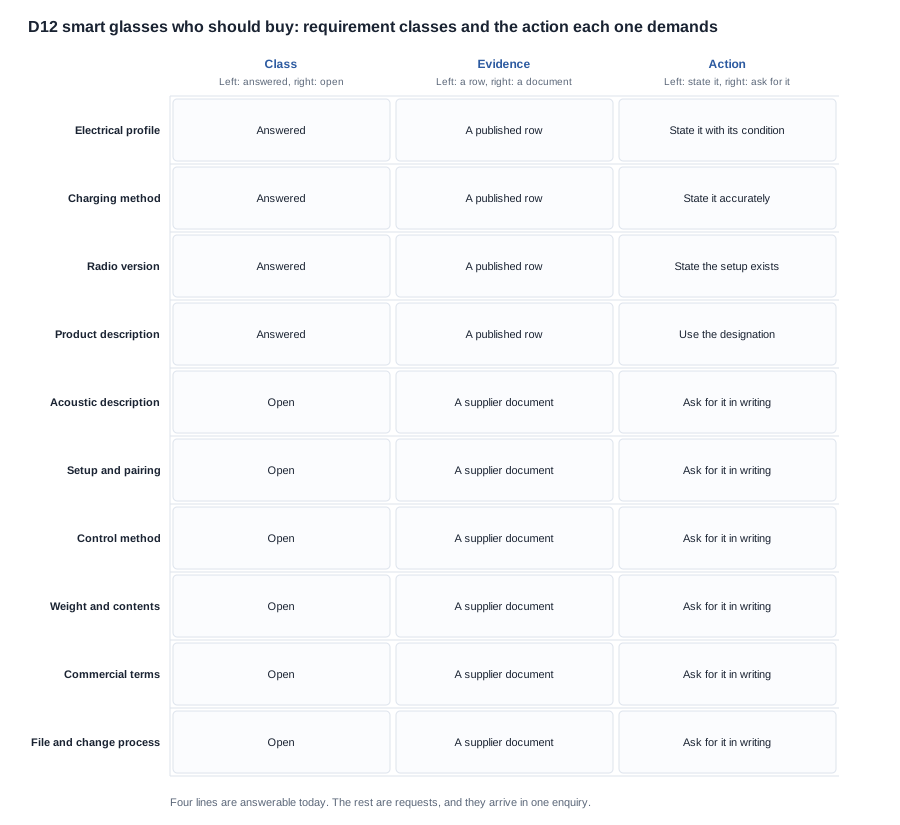
The matrix above is the working version, and its right-hand column is the part a buyer acts on. Where a row exists, the buyer states it and attaches the condition. Where the row is absent, the buyer puts a question and holds the corresponding line out of the copy. Where the requirement is about a result, the buyer has to establish whether the evidence exists at all before the programme can be scoped — and a requirement that cannot be evidenced cannot be listed.

The 100 milliampere-hour cell and the Type-C interface
The two rows that shape the physical and the commercial picture here are the cell and the interface, and the third that shapes the operational one is the radio version.
The 100 mAh is a single cell, and the approximately seven-hour figure sits beside it as a rating the manufacturer prints without conditions: there is no workload behind it, no indication of where the measurement started, and no point defined at which it finished. A rating in that position cannot be turned into a working session, cannot be read as a promise about how long the product runs between charges, and it cannot be read against a figure from a different model unless that figure is stated with conditions of its own. The cell and the rating are two separate printed rows, and how they relate on this product is a question the supplier has to answer in writing rather than something a buyer can work out from the page.
The Type-C interface is the row that makes the accessory question a small one, and small questions are worth as much as large ones in a buying programme. A customer with a Type-C product needs a cable, and many customers already own one, so the question "what does the customer receive in the box" comes down to whether a cable is supplied, how the port is described, and what the customer does in the first minute. It also means the accessory line a channel stocks is thin, which lowers the cost of the programme and simplifies the packaging decision.
The radio version of 5.4 is the entry that decides how much support work this product creates. A published radio version means the product's life contains a step a customer has to carry out, usually once, usually one-handed, with a printed sheet in the other. The instructions that go with it have to exist, they have to be in a language the customer uses, and they have to describe a procedure the supplier will support. The catalogue prints nothing about the connection routine and nothing about whether an application is needed, so both are requests, and they belong in the first exchange rather than the second, because they feed the artwork and the support script.
There is one more consequence of the radio row that a buyer should put in the business case rather than in the copy. A connected product draws differently depending on the connection state, and that is what makes the condition behind the published rating matter more here than it would on a page that prints no radio row at all. Scheduling a programme against a rating taken in a different state means planning against somebody else's number, and the cure is a single question — what was the radio doing when the figure was taken — connected but idle, connected and working, or with the radio switched off.

The absence of feature rows, and how to handle that in a sell-through argument
A sell-through argument for a product with no feature notes has to be built from what exists, and what exists is a published designation, a complete electrical profile and a documented radio version. That is enough for a specification-led listing, and a channel that has built its pages that way will find that this product is straightforward to describe accurately. What it is not enough for is a feature-led listing, because there is no feature to lead with, and a copywriter who has to invent one will invent a claim the documentation does not carry.
The practical answer is to move the differentiation to the places the catalogue does not speak about, and to do it with work rather than with words. A well-designed setup card, a support line that answers within a day, a warranty term that is explicit, a packaging structure that suits the way the product is actually used — each of these is a channel decision, each is visible to a customer, and none of them requires a published feature row. A buyer who is deciding whether to take this product forward should decide it against that list, because the list is what the product's page leaves to the channel.
It is worth putting a number on the commercial side of that decision, because it is the part a buyer can put in a business case. A product with a complete electrical profile and a published radio version needs a short technical file — a setup card, a compatibility note, a weight and a freight figure. A product with a rich feature set needs a long technical file, because every feature has to be described, checked and supported before it can be printed. The first takes less work to produce and is harder to sell; the second takes more work to produce and is easier to write about. Which of those a channel can carry is a property of the channel, and the decision belongs to the buying team rather than to the catalogue.
The second half of the answer is knowing what not to write. There is no acoustic descriptor printed for this model, so a listing may not describe how it sounds, may not quantify it and may not compare it with another product. There is no element list and no indication list, so a listing may not describe what is fitted inside the frame. There is no ingress marking published for it, so a listing may not state a protection level. And nothing in the published material supports a statement about what the product does for a person, so a listing may not make one. A product with five rows and no notes is easy to write correctly and easy to write wrongly, and the difference between the two is entirely in whether the copy stays inside the rows.
There is a fourth point in the same place, and it concerns the after-sales line rather than the listing. A product whose page publishes a radio version and no feature notes leaves a support team with a connectivity story and no product story, and the product story is the one customers ask about. A channel that has obtained the acoustic figures and the control method before launch has a support script that answers both. A channel that has not will answer the connectivity question from the row and improvise the product question from whatever the customer says, and the cost of that improvisation lands on the channel's service position rather than on the catalogue. The practical advice is to treat the ten questions below as the support script's source rather than as a document that exists for its own sake.
There is a third thing that is worth putting in the same place, and it is the one that the empty feature section makes more visible rather than less. With no features to describe, the product's value in a range is more dependent on everything the catalogue does not publish: the weight, the setup, the control method, the acoustic position, the contents of the box, the price and the terms. A buyer who has read this page and taken the impression that the product is fully described has read it backwards. It is fully described in five respects and entirely open in ten, and the ten are where the buying work is.

The open rows that decide a first order
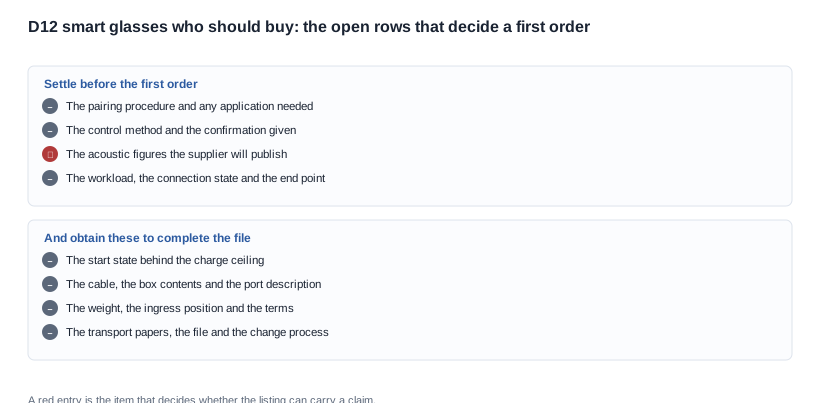
The list below is what a buyer needs in writing before the first order, and every item can be met from records the supplier already keeps. It is written in the order that costs least to get wrong.
A shortlist of two or three candidate models is not the same thing as a decision, and the difference is a checklist rather than a verdict. The due-diligence step that separates them is small: for each candidate, write the requirement down in one line, mark which published rows answer it, and mark the questions that still have to be closed. When to run that exercise is the buyer's own decision, and the total cost of running it is one round of correspondence; the total cost of skipping it is a launch that discovers the copy it published has nothing underneath it. Three red flags in the replies are worth naming: a figure quoted without its conditions, a document offered without a date, and a row read as though it were a measured result.
- The full contents of the carton for this model, item by item, including whether a charging cable is included.
- The acoustic configuration the supplier will describe, and any figures it is willing to put in writing.
- How a customer connects the unit for the first time, whether an application is part of the process, and what the customer is told afterwards.
- The workload the seven-hour figure was taken under, the connection state at the time, and where the measurement began and ended.
- The state a unit has to be in to reach the two-hour-or-less charging ceiling.
- How the unit is operated and what the wearer gets back as confirmation.
- The shipping weight and the packed weight, and whether an ingress marking applies to this model.
- The commercial papers the order will need: a price per unit, a smallest order, a production lead time, a warranty period and the sample terms.
- The transport file for the 100 mAh cell and the conformity record for the configuration that ships.
- How artwork is approved and how the file is kept valid through a configuration change.
A procurement lead who has run this enquiry on more than one model in the line will recognise the pattern, and the pattern is worth naming because it makes the second enquiry cost far less than the first. The same ten questions, in the same form, produce answers that can be compared between suppliers and between models, and the answers that arrive earliest are usually the ones that decide the packaging, the artwork and the setup material. Sending the list before the sample, rather than after it, is the difference between a programme that runs to plan and one that runs to the launch date.
The first three are the ones that decide what the listing can say, because all three describe behaviour rather than configuration. The fourth and the fifth are the conditions attached to the two figures the listing will carry. The sixth and the seventh are the physical answers. The eighth and the ninth turn the requirement into a cost and into a file. The tenth is the one that protects both once the programme is running.

Two suppliers, one model, one list of ten questions: that is the whole comparison. Send the same items to both, in the same order, and read each reply for four things — does it name the D12 and the configuration it covers, does it carry a date, does it point at a document rather than a description, and does it agree with the reply to the item before it. A reply that clears all four can be filed against this model; one that clears three can be filed against the supplier but not against the model. How to choose between two suppliers on a page this short comes down to that filing test. The part that decides the schedule, though, is what happens to the file afterwards: a document written for the configuration running today covers the next production run only while that configuration holds, so a reply that is entirely correct today has a shelf life, and a buyer who has not asked how long it stays valid will discover the expiry at the moment a second order has to be placed. This is where the two designations diverge in practice even though their rows are identical — one of them may be reordered against the same file, while the other has to be re-confirmed first. The purpose of this page is to show what the requirement can be asked, and to set out the criteria a buyer should check before you commit to an order, including the one that asks when the answer on file stops being the answer.
A buyer who is establishing a range around this model should also decide where the evidence file lives and who maintains it. The answers to the ten questions below belong to a model rather than to a range, and a file kept against the range is a file that will be wrong for one model at some point. The naming convention matters for the same reason: if two entries print the same rows, a file that does not distinguish them cannot answer a question about either. That is a small piece of administration, and it is the piece that makes a documentation file usable when a customer asks where a unit came from, which is the only test that matters.
There is one closing point for an importer, and it concerns the range rather than the product. A page with five rows and no feature notes is unusually stable in one sense and unusually open in another: it is unlikely to be revised in a way that changes what a listing can say, and it is certain to leave every operational question open. That combination suits a buyer who has the time to ask and file the answers, and it suits a channel whose differentiation is in service rather than in specifications. It suits a buyer who is looking for a product with a rich published feature set rather less well, and the point of the framework above is that a buyer can tell which of the two they are before the first order rather than after it.
The ten questions fit inside one message, and the answers are short enough for a model file rather than a range file.
Send us what you are buying against, the markets you intend to sell into, the volume bands and the copy you have drafted for the D12, and we will set out which parts of it the catalogue already answers, where the page leaves a blank line, and which parts no catalogue is able to answer — and then arrange the ten questions above in the sequence that gets them answered first.


