
Most buyers reach the D17 smart glasses with a single question: is a one-hour charge time a selling point, or just a table row? The honest answer is that it is a selling point only if the remote shutter is in the box, and whether it is at your quantity is not published. That one unconfirmed line decides more about this model than the six rows that are published, which is why a buyer who treats it as a specification question gets the purchase wrong.
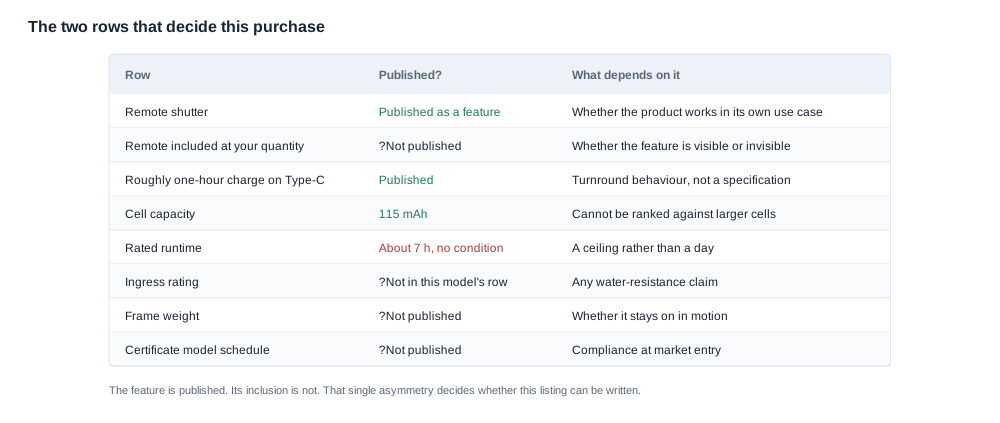
D17 smart glasses: the published row and the row underneath it
The published configuration for this model is Bluetooth 5.4, a 115 mAh cell, a charge time of roughly one hour, roughly seven hours of rated runtime, Type-C charging, a remote shutter, and a stereo surround-sound description. Seven items. A buyer can write a listing from that list without inventing a single word, which is rarer in this category than it should be.
Two of those rows decide the buying decision, and one of them depends on something that is not published.
The first is the remote shutter. It is the only row in this model's specification that describes something the wearer cannot do with their own hands, and on a frame worn in motion that is the difference between a photograph and no photograph. The second is the roughly one-hour charge time on Type-C, which is the fastest published in this range and changes the routine around the product more than any other row here.
The row underneath them is the one nobody has written down. Whether the remote ships in the box at your quantity, whether it appears as a separate line item on the quotation, and whether it is available in the colourways you intend to order are all open questions in our documentation. We will not answer them with a plausible assumption, because a buyer who plans a listing around an accessory that turns out to be optional has already built the wrong product.
That gap is not unusual in this category. What makes it unusual here is that the remote is the feature. Every other model in the range can be described entirely from its own row. This one cannot.
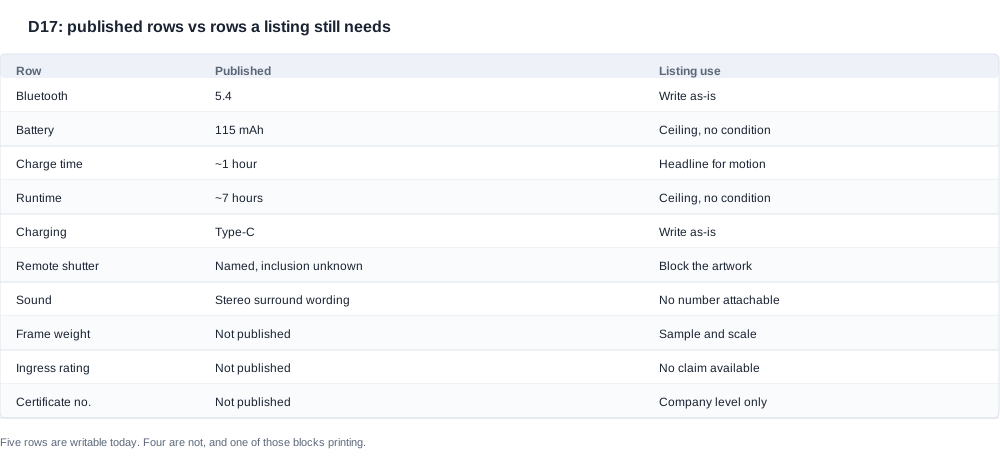
The commercial consequence is specific. If the remote is bundled, it becomes a visible line in your unboxing photography and a defensible reason for the price. If it is optional, it becomes an upsell your customer discovers late, and your listing has to carry a picture and a sentence that the product itself does not. If it does not exist at all in a given colourway, the listing is describing a product variant that does not exist, and you will find out from a returns ticket rather than from a sample.
The order of operations matters more here than on most models. A buyer who settles the remote question before artwork, before the packing list and before the quotation has three cheap options. A buyer who settles it after has one expensive one, which is to reprint and re-list. This is why we raise it before anything else in this article: it is not a specification detail, it is a schedule decision.
There is a second structural point worth making before moving on. The published row describes a platform, not a market. Bluetooth 5.4, Type-C and a cell capacity are global constants, but the remote availability question is a factory and colourway question, and a factory answer does not automatically survive a change of production batch. Ask whether the answer holds for repeat orders, not only for the first one, because a supplier who bundles the remote in the trial and drops it in the bulk order has changed the product without changing the part number.

The scene this product is built for
Picture a cyclist or a runner on a long effort, moving, with both hands occupied, wanting a photo without stopping and without fumbling at their own temple.
That is the scene. A remote shutter is not a convenience feature in it; it is the reason the product works at all, and it is the feature a customer will accept a higher price for. Two models in our sport range publish one.
So the buyer this product serves is a channel whose sell is hands-free capture in motion, and whose customer will notice the turnround. A brand that lists this model for a desk-bound customer has removed the reason to buy it and kept the price, which is the worst of both outcomes.
The charge time deserves the same weight. A 115 mAh cell with a roughly one-hour charge time produces a behavioural difference rather than a specification one: charge it while you change, charge it in a café, charge it at the car. A buyer whose customer charges overnight and never again is buying the wrong product, because the one-hour figure is invisible to that customer and the 115 mAh cell becomes the only thing they will feel.
The reverse is equally true, and it is the trade-off worth writing down before you negotiate. Small cell plus fast charge is a combination of two constraints, not two independent advantages. A larger cell at the same charge time would be a strictly better product, and a reviewer scanning rows will assume that is what you have.
Ask about the two numbers together rather than separately. A supplier who can explain why the cell is small and the charge is fast is describing a deliberate design choice, and that answer usually carries useful information about battery chemistry, thermal behaviour and what happens at low temperature. A supplier who gives you the two figures and no explanation has given you two numbers from a test report rather than a product position. Neither answer makes the purchase wrong, but they support very different amounts of confidence in the listing.
How to evaluate the remote on a sample order
Because the remote is the model, the sample programme has to be designed around the remote rather than around the frame. Most buyers order one sample, wear it at a desk for an hour, and conclude the product works. That test cannot settle this question, and it is the reason so much of this category arrives at a purchase order with an unverified assumption baked in.
Here is the sequence we would use, and it costs one additional unit rather than a production run.

First, open the carton with the customer present. Not your staff, the customer or their channel manager, and not on video alone. Record the contents against the packing list at the moment of opening. If the remote is present, photograph it beside the frame, because that single photograph is what your listing needs and what no supplier can produce for you later.
Second, confirm the correspondence without the manual. Check that the remote maps to the frame by power-cycling, not by opening an app and reading a support page. If the remote pairs on first attempt after a full power cycle, that is the only evidence worth having. If it needs a second attempt, ask whether that is expected and get the answer in writing. A remote that only works within a short distance of a certain angle is a remote that will generate returns, and you cannot detect that at a desk.
Third, test the capture path at speed, standing. The failure mode that matters is not whether the shutter fires, it is whether it fires while the wearer is moving and cannot see the frame. Ask the wearer to stand, walk, and then repeat it with a helmet on if the channel is cycling. Record the number of attempts each person needed, because the answer will vary by hand size and by how the wearer holds the frame, and your customer support team will need the typical figure rather than the best one.
Fourth, measure the charge turnround yourself. Start from the state the customer will actually start in, which is usually a partly used frame rather than a flat one. Time it to a state the wearer would call full. If it is materially more than the published hour at partial charge, that is a listing correction, and you need it before the artwork goes to print rather than after. Ask also whether the charge time quoted is to a usable state or to a full state, because those are different claims and only one of them is what a customer experiences.
Fifth, weigh the packed unit. Not the frame, the packed unit, and not one unit, five units from different cartons. Packing variance is where a light frame becomes a heavy parcel, and the parcel is what your customer pays freight on. Record it before you build a shipping calculation, not after, because the difference between a modelled weight and a measured one is frequently the difference between a margin that works and one that does not.
Each step produces a line in your technical file. Each one that cannot be completed is a line in your red flags list, and a red flag found on a sample is cheap while the same flag found after a bulk order is not.

Who should not buy the D17
If your channel is outdoor and needs an evidenced water-resistance claim, this is the wrong product. No ingress rating appears in this model's own row. Our sport category carries an IP54 marking at category level, and we have not been provided with a third-party test report behind it and we do not hold one. Get a report from a testing body before you commit to a claim, or describe it as a category marking and claim nothing beyond that. A buyer who writes "IP54 waterproof" into a listing on the strength of a category note carries the compliance risk alone.
If your customer is a long-session user without access to a charger, the roughly one-hour charge helps but does not solve it. Roughly seven hours from a 115 mAh cell has no published test condition, so treat it as a ceiling rather than a figure. A customer who expects an eight-hour day will be disappointed, and the returns conversation will be about battery rather than about the product.
If your channel lives on specification comparisons, this model has one clear advantage, the fastest charge in the range, and several rows where it presents as weak against models with larger published cells. Whether 115 mAh is better than 260 mAh cannot be determined from the data, because capacity and runtime are not aligned figures in this category: the same chemistry appears behind very different published hours. A comparison chart that places the two side by side without a note is a chart you will be asked to defend by a customer who read it.
And if your customer expects a sound claim, the stereo surround description is a wording, not a measurement. No leakage figure, no driver size, no frequency response, no microphone count and no pickup distance is published for this model or any other in the range. You can repeat the description as a description. You cannot attach a number to it, and you cannot defend it if a customer asks what surrounds what.
Finally, if your procurement process needs a complete technical file on day one. The gaps on this model are closeable, but they are closeable through questions and samples rather than through documentation, and a buyer whose due diligence checklist requires a file before a supplier is selected will disqualify a product that is entirely capable of serving the scene.

The rows to settle before you commit to a purchase order
Most of the open rows on this model have the same character: they are not hard, they are simply unanswered, and an unanswered row becomes an assumption at exactly the moment somebody is signing.
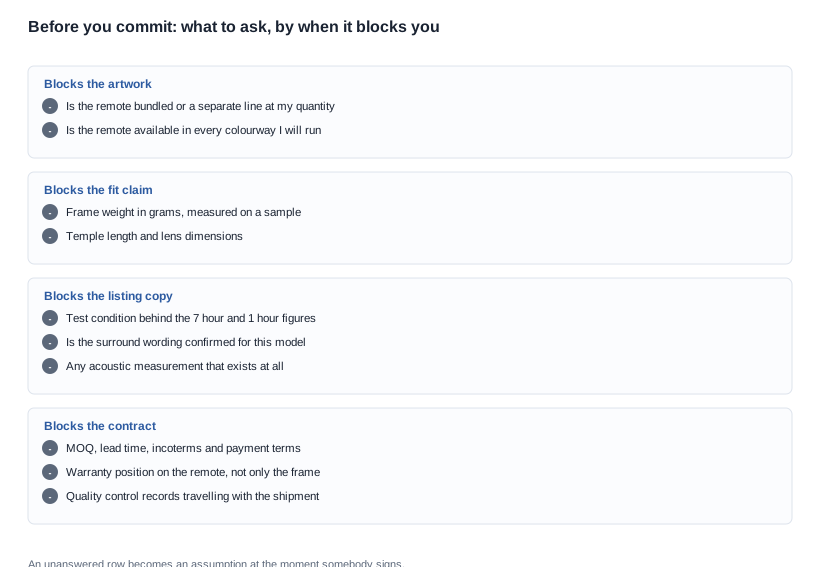
The first question is the one that changes the product. Is the remote shutter included at my quantity, and at what cost? Ask it in writing, ask whether it is bundled or quoted separately, and ask whether it is available in every colourway you intend to run. A supplier who answers this clearly is telling you something about the factory that is worth more than the answer itself.
The second is frame weight and temple dimensions. Neither is published for any model in this range, and on a product worn in motion it decides whether it stays on. This is a scale, a calliper and a sample, not an email.
The third is the test condition behind both numbers. Ask what produced the seven-hour figure and the one-hour charge, and ask whether the camera and the audio were active. In this category the difference between those two answers is frequently the whole difference between the published figure and the customer experience.
The fourth is the acoustic description. Ask whether it is confirmed for this specific model rather than inherited from a category page, and ask for whatever acoustic measurement exists, even informally. If none exists, the honest listing omits the word.
Then the commercial set, in this order: minimum order quantity and lead time, which we do not publish in any of our material; price and incoterms, so the quotation is built on a landed basis rather than an ex-works one; payment terms and deposit structure; and the warranty position, which for a frame with a detachable-function accessory is a question about the remote rather than only about the frame.
A warranty question that names the accessory is worth more than a warranty paragraph that names the product. Ask specifically what happens if the remote fails inside the warranty period: replacement, credit, or nothing. Ask whether the replacement remote is the same part or a current-generation part, and whether that is true for the next two years. An accessory that is superseded while the frame is in the market turns a service promise into a support cost.
Beyond those: whether a declaration of conformity names this model, whether the technical file covers the specific configuration you are ordering rather than the platform, and what quality control records travel with the shipment. On a bulk order, the inspection record is the only evidence you will have that the units you received are the units you specified.
Then the batch questions, which are separate from all of the above. Ask whether the published charge time and runtime were measured on the production unit or on an engineering sample, and whether the unit you will receive is the same hardware revision. Ask whether the remote and the frame ship in the same carton or separately, because a split shipment changes both the unboxing and your ability to photograph the set as one product. Ask what the packing list says when the remote is bundled, so your customer service team has a reference for what is missing. And ask what the agreed sample configuration was in writing, because the most common failure in this category is not a bad product, it is a good product that arrived in a different configuration from the one that was approved.
Negotiate the remote before you negotiate the price. A unit price agreed with the remote assumed bundled is not the same transaction as a unit price agreed with the remote optional, and the difference shows up as a cost on your side rather than as a concession on theirs. Get the configuration written into the purchase order, not into an email thread that a future colleague will have to reconstruct.
A shortlist of two or three models is worth more than a longlist of everything. For this category the shortlist question is not which model has the most rows, it is which model has the fewest rows you would have to defend. On that criterion the D17 is a strong candidate for a motion channel and a poor one for an evidence-led retail listing.
What we will and will not put in writing
We can tell you what this model is published as, and we can say plainly that its best feature may or may not be in the box. We will not quote a remote inclusion, a frame weight, an ingress report or a certificate number, and we will not present a surround-sound description as a performance claim. A supplier who does fill those rows with typical values has given you a listing that reads well and a compliance exposure that arrives later, and the exposure always arrives at the brand rather than at the factory.
We will also tell you when a different model is the better answer. If your customer needs a verified protection marking, that is a different conversation. If your channel sells on datasheet rows, we will point you at a model that can win one. And if you need a charging case in the box, the whole case proposition belongs to the camera family rather than this one.
Send us the market, the channel, the quantity and what your customer does in the scenario you have in mind, and we will tell you whether this model serves that scene — and if it does not, which of the models we would shortlist instead does. If the answer depends on a single line we do not hold, we will say that first rather than give you a recommendation built on it.
Related reading
- The range behind this model — sport smart glasses
- Where it sits against its siblings — sample evaluation
- Reading an IP rating before you write it — certification checks
Send the market, the channel, the quantity and the scenario, and we will tell you whether this model serves it.


