

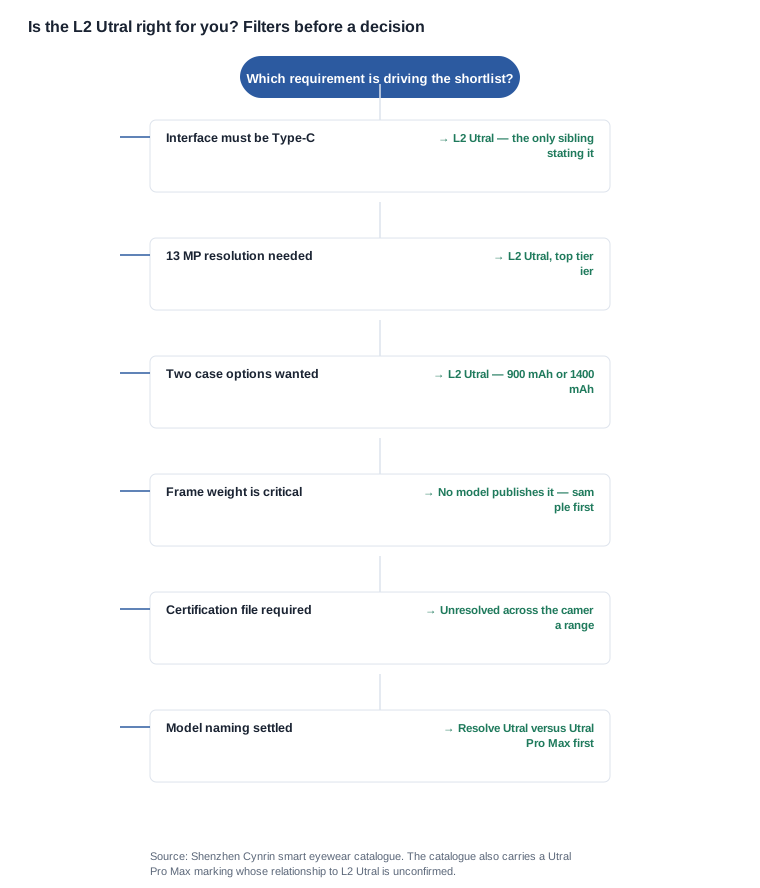
You need the L2 Utral if your supply chain standardises on Type-C and your channel wants a choice of charging case capacity, because this model states an interface and offers 900 mAh or 1400 mAh cases where its sibling publishes neither. You need it if 13 MP is the tier you sell on. You do not need it if frame weight or comfort is your differentiator, because no model in this catalogue publishes a weight.
L2 Utral smart glasses: what the stated interface actually changes
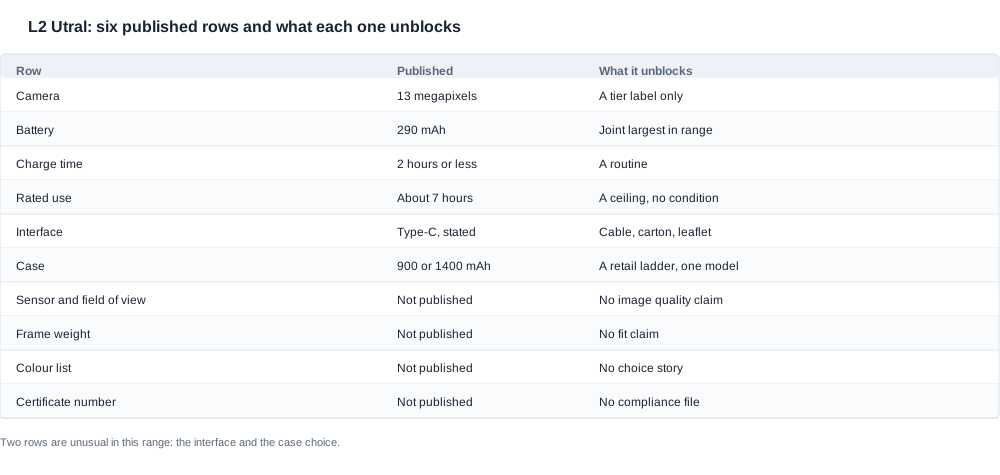
A 13 MP camera. A 290 mAh cell. Charge time of two hours or less. Roughly seven hours of rated use. A Type-C charging interface. Charging cases at 900 mAh or 1400 mAh.
Six rows, and two of them are unusual in this range. The interface being stated removes a packaging and charger-compliance question that the sibling leaves open. The dual case option gives a channel a lighter retail proposition and a higher-value one from the same model, without carrying two product development programmes.
Start with the interface, because it is the row buyers underrate. An unstated interface is not a cosmetic omission: it decides whether you ship a cable, whether the cable is in the box or sold separately, what goes on the carton, and what the instruction leaflet says. It also decides whether your existing accessory inventory works at all. A brand whose warehouse already holds Type-C cables, Type-C chargers and Type-C packaging can launch this model with almost no accessory spend. A brand facing the same question on a model that does not state its interface has to resolve it before artwork, and that is a schedule risk rather than a cost.
Second, the case options. Two case capacities from one model is a genuine channel asset, because it lets you build a retail ladder without a second product: a 900 mAh case for the price-sensitive listing and a 1400 mAh case for the one where the customer is buying endurance. Most categories require a separate model, a separate listing and a separate inventory line to do that, and most of those separate models then drift apart in firmware and packaging.
Before treating that as settled, check one thing: whether the two case capacities carry the same minimum order quantity. An option that requires a separate tooling or setup charge per configuration is a second product in disguise, and the convenience disappears the moment the supplier quotes it that way. Ask for the minimum order, the setup cost and the lead time for each case configuration separately, and compare the two answers. If they differ, your retail ladder has a fixed cost that belongs in the pricing model rather than in a footnote.
The trade-off is freight, and it is worth naming plainly. Two case capacities means two shipping profiles, and the smaller one changes your landed cost. The charging solutions guidance covers the arithmetic, and the practical advice is to model both profiles before you pick a case for your primary listing, because the case choice and the retail price are not independent decisions.
There is a third consequence that only appears after launch. A two-option product tends to fragment reviews, because customers who bought the 900 mAh case and customers who bought the 1400 mAh case are describing different experiences under the same product name. If your channel ranks by review score, that fragmentation is a real cost, and the usual mitigation is to make one option the default and present the other as the step-up rather than as an equal choice.
The third row worth reading twice is the 290 mAh cell. It is the joint largest in the camera range, shared with the CY03, the CY05 and the L1 Pro, and it arrives here with roughly seven hours of rated use. In this range a large cell and a moderate runtime figure is the normal condition rather than a contradiction, and the reason is that no runtime test condition is published anywhere in the catalogue. Treat the seven hours as a ceiling until a condition is stated, and ask for the condition in the same words you would use on every other model so that the answers are comparable.
The four filters
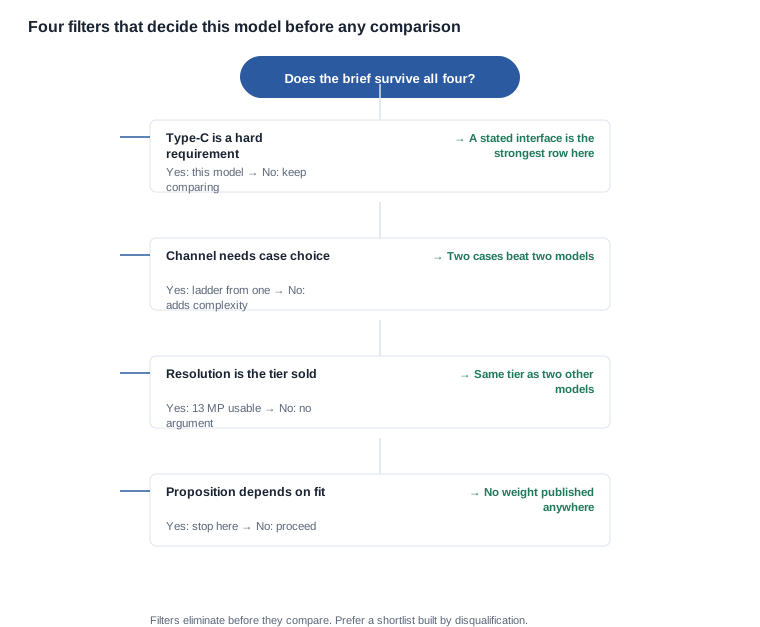
Filter one: is Type-C a requirement? If yes, this model. The V03 Pro also states Type-C, but it is an 8 MP model without a listed case, so the two requirements rarely point at the same product. In a channel where your customers already own Type-C cables, that is the whole argument, and it is an argument about the customer's habits rather than about the product.
Filter two: does your channel need case choice? The 900 mAh case is a lower shipping weight and a lighter proposition; the 1400 mAh case supports the sample-then-wear-daily story. Offering both from one model avoids carrying two SKUs, two sets of artwork and two technical files. If your channel is a single market with one price point, the second option may be complexity you do not need — ask what the minimum order looks like per case configuration before assuming it is free.
Filter three: is resolution the tier you sell on? 13 MP places this model alongside the L1 Pro and the S7 at the top of the range. That is a usable tier position, and it is a weak one, because three models at the same published resolution will not separate themselves in a comparison. Your differentiation has to come from the interface row or the case row, not from the resolution, because the resolution is identical across all three.
Filter four: does your proposition depend on fit? Stop here. Frame weight is not published for any model in this catalogue, so comfort cannot be decided from data, cannot be advertised, and cannot be answered in a retailer questionnaire. See materials and ergonomics for the measurements worth taking on a sample, and treat them as a project rather than a lookup.
A fifth filter, applied after the first four, decides whether this is the right model at all: can your channel carry an open row? Every model in this catalogue has unpublished sensor, weight, ingress and certificate rows. Some buyers can hold an open compliance item for the launch period and update the technical file later; others cannot, because a retailer, a marketplace or an insurer requires a complete file before listing. That is a channel property rather than a product property, and it eliminates models that would otherwise have won.
And the way to apply all five is in order, not together. Filters one to four are product facts and cost nothing to establish. Filter five is a question for your own compliance team, and asking it early costs a phone call while asking it late costs a launch date. The order is: disqualify on the product facts, then test the survivors against your own process. Doing it the other way round is how buyers end up negotiating hard on a model they were never allowed to list.
The naming question, before anything else
Before you decide anything else, understand what you would be committing your own brand name to. Two designations appear in this catalogue — L2 Utral and Utral Pro Max — and our source does not tell us whether the second is a different hardware configuration, a regional label, or a leftover from an earlier listing. Treat them as two names until somebody puts the equivalence in writing.
What this blocks is narrower than it looks, and that distinction matters when a buyer decides how urgently to chase it. It does not block a purchase order, a sample order, or a private label programme. None of those require the model designation to be resolved, because the physical unit is the same either way.
The narrow case for chasing it now rather than later is a schedule argument, not a risk argument. If the answer changes the name, every artefact that carries the name has to be reissued: artwork, leaflets, packaging, the certificate application, the customs paperwork and the warranty document. The cost of that is not the reprinting — it is the calendar, because packaging artwork is usually the item on the critical path that cannot be shortened later. If you can resolve the designation before packaging artwork is locked, the whole question costs one email. If you cannot, the same answer arrives too late to matter.
What it does block is anything that permanently fixes the name. Artwork, a certificate application, a customs line, a certification filing and a warranty document all carry the designation forward, and a mismatch discovered during inspection, during a certification audit or during a recall is a far more expensive problem than the same mismatch discovered during a conversation. The cost of the answer is one email; the cost of guessing is a set of printed cartons.
There is a second-order consequence worth planning for. A name that changes after launch changes your search visibility, your reviews and your support history at once. Whatever the answer turns out to be, the practical advice is to keep one designation on all customer-facing material from the first unit, even if you are uncertain, and to treat a change as a deliberate event rather than a correction. In practice that means writing the name in one place in your documentation rather than retyping it, so that a change propagates instead of surviving in the places nobody opened again.

How to evaluate two case options on a sample order
Two case options is a straightforward advantage and a slightly unusual test, because the sample you receive may arrive with one case or the other. Ask which case configuration the sample represents, in writing, before it ships, because a sample with the 900 mAh case tells you almost nothing about the 1400 mAh option and a supplier who does not track this will eventually send the wrong one.

Weigh both configurations packed, not assembled. The packed weight and the packed dimensions are what your freight model needs, and the difference between the two cases is usually larger than a buyer expects. Record both, because the choice between them is usually a landed-cost calculation rather than a preference.
Charge the frame from each case and time it. A larger case does not necessarily charge faster, and the answer here tells you whether the two options are genuinely different products or the same product in a bigger box.
Check the case state indication on each. If one case shows its state and the other does not, that is a listing difference you can use, and it is also a support difference you will pay for.
Establish whether either case is available as a separate order, and at what minimum quantity. A case option that can only be bought bundled is a variant rather than an accessory, and it cannot be used to serve an existing customer who lost theirs.
And confirm the interface physically, not from the specification: charge the frame from a Type-C cable you own, not from one supplied in the box. The published row is what makes this model attractive, so it is worth five minutes to verify that the published row is true.
Then run the receiving check that a two-option model deserves and rarely gets. Open three cartons from the same delivery and compare the contents against the packing list: the frame, the case, the cable, the leaflet. Record the case capacity actually present in each carton rather than the one ordered. A mixed delivery between the two case configurations is the single most likely failure on this model, because the two are physically similar, the listing may not distinguish them clearly, and the customer discovers the mismatch when the endurance is not what they paid for. If your channel sells both, put the case capacity on the box somewhere the customer will see it before they open it.
Finally, write the acceptance criteria into the purchase order. State which case configuration each line must contain, what accessories must be present in every carton, and what the remedy is if they are not. A quality control record that lists quantity and appearance will not settle any of it, and a purchase order that does not specify it leaves the buyer holding whatever arrived.
What is missing, and what it costs you
Sensor model, field of view and video specification are not published, so 13 MP remains a tier label rather than an image quality statement. See AI camera glasses imaging for why that distinction decides whether a camera claim survives review.
Frame weight is not published, so no fit claim and no comfort claim are available. Ingress protection is not published, so no durability claim is available. Certification numbers are not published, so no retailer compliance file can be completed on the catalogue alone — see the certification checklist for what a complete file requires.
There is a commercial consequence of the case option worth modelling in detail. Two case capacities means two shipping profiles, and the smaller case changes your landed cost. If you price the 900 mAh configuration and then discover at quotation stage that the freight band differs, the retail price has to move, and a retail price that moves after artwork is printed is a cost. Model both before you commit to either.
And there is a reputational consequence that arrives later. A two-option product that customers experience as two products generates two sets of questions, two sets of reviews and two sets of returns reasons. That is not a reason to avoid the option — it is a reason to write two installation guides rather than one and to make sure your support team knows which case the customer has before they ask anything else.
One more gap is easy to miss because it is not a specification at all. No colour list is published for this model. If your channel is built on choice, that is a question to close before the artwork budget is committed, not after.
What we will and will not confirm for the L2 Utral
This model is the more complete of the two 13 MP options on published rows — the interface is stated where the sibling omits it, and the case choice is a genuine channel asset. We will not describe the resolution as image quality, and we will not proceed with a naming question unresolved.
We will also tell you when the naming question does not matter. If you are placing a purchase order, ordering a sample, or negotiating a price, the designation is not blocking anything, and you can proceed while it is being answered. It becomes blocking the moment a name is printed, filed or registered, and we would rather flag that at the start of your artwork schedule than at the end of it.
On the commercial set, the position is the same for every model in this range: minimum order quantity, lead time, price, incoterms, payment terms and warranty are not published, and the first three belong in a quotation rather than in a catalogue. Ask whether the case option carries its own minimum order, and whether the warranty covers the case as well as the frame — a case with a cell in it has a failure mode the frame does not, and a single warranty paragraph will not settle it when a customer calls about one.
Tell us your interface standard, your channel and your volume, and we will confirm the case options, flag what we cannot answer, and tell you if one of the other models in this range settles a question this one leaves open.
On the questions to ask before you commit, the order is: product rows, then transaction rows, then certification. The product rows — interface, sensor, video, weight, colour list — decide whether the product can be listed. The transaction rows — minimum order quantity, lead time, price, incoterms, payment terms, warranty — decide whether the purchase works. The certification rows are needed in every market but rarely decide between two models in the same range. Checking them in that order stops a compliance question from displacing a product question, which is the most reliable way a shortlist goes wrong.
The red flags to watch for are specific rather than general. A supplier who gives a lead time as a range rather than a date. A supplier who declines to confirm whether the case is bundled at your quantity. A supplier who provides a certificate for the company but not a schedule covering the model. A supplier who answers the same question differently in two emails. Any one of those is survivable; two together are a pattern, and the pattern is the finding.
On negotiation, put the case configuration and the interface into the purchase order rather than the email thread. Both are the kind of row that gets agreed verbally, forgotten by whoever handles the next run, and discovered at receiving. Written into the contract, they are commitments; left in a thread, they are history. And where we cannot answer a row, we will say so before you order rather than after — we will not state a colour list, a weight or a sensor model that the documentation does not contain, and we would rather disqualify the model than invent the row that saves it.
Related reading
- Where this model sits in the camera range — AI camera glasses
- Why resolution is not image quality — AI camera glasses imaging
- How case choice changes your economics — charging solutions
We need the target market, the quantity and the required configuration, and we will come back with what is available and what is not.


