

A smart glasses contract is not a status a buyer earns by order size. It is a response to one number: how much of the committed money is unrecoverable if the programme fails. Most buyers measure the wrong thing — they count the purchase order value, which is the largest number in the file and the least informative one. The number that decides whether a contract earns its cost is the unrecoverable share: the deposit, the tooling, the artwork and the custom parts committed before a single unit arrives.
Work out that share before choosing an instrument, and the answer becomes mechanical. A buyer whose commitment is fully recoverable needs a configuration sheet. A buyer who has paid a deposit into production needs a short-form supply agreement. A buyer who has committed tooling and artwork needs a full agreement with change control. Below that, at every tier, one clause is non-negotiable, and it is not the one most agreements open with.
Smart glasses contract: measure the unrecoverable share, not the order value
Three tiers of commitment and the instrument each one needs
The tier is set by what has already been paid out and what happens if the programme stops. It has almost nothing to do with the quantity on the quotation.
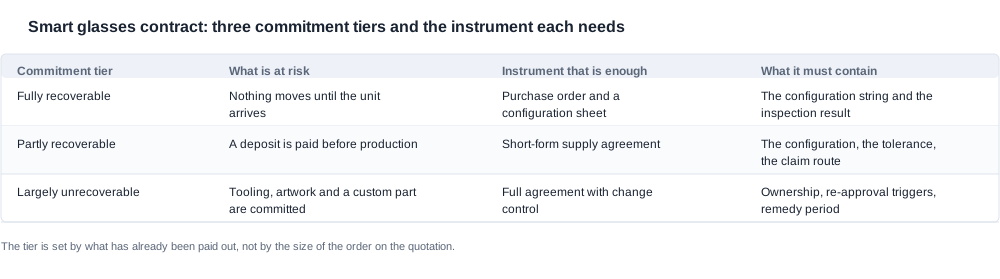
At tier one, the commitment is fully recoverable. Nothing moves until the units arrive, they can be refused at the gate, and the buyer has paid nothing that cannot be reclaimed by declining the shipment. A purchase order plus a configuration sheet is sufficient, and a full agreement adds signature time and negotiating rounds without adding protection. Buyers in this position often over-document, because a contract feels safer than a well-specified order.
At tier two, the commitment is partly recoverable. A deposit has been paid before production, so the money is gone if the order is abandoned, but the build can still be inspected before the balance is released. A short-form supply agreement is the right instrument: it needs the configuration, the tolerance rule and the claim route, and it does not need a governance section, a service-level schedule or a termination negotiation.
At tier three, the commitment is largely unrecoverable. Tooling, artwork and possibly a custom component have been paid for, and they exist only for this programme. Here the agreement has to carry ownership, re-approval triggers and a remedy period, because the loss from an abort is a loss of assets, not a loss of goods.
Why the purchase order value is the wrong number
Buyers routinely rank programmes by order value and reach the wrong conclusion in both directions. A large order that is paid entirely on delivery carries less unrecoverable risk than a small order with a 40 per cent deposit and a custom lens, and the second is the programme that needs the contract.
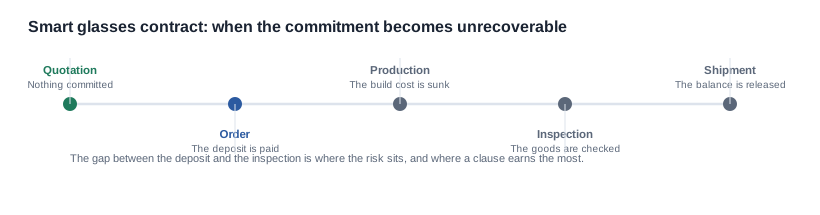
The reason is simple. Order value measures what you might lose; the unrecoverable share measures what you actually cannot get back. Between the deposit and the inspection of the goods, the money is already spent and the units do not yet exist — that interval is where the risk lives, and it is invisible in a total.
Three questions get a buyer to the number quickly:
- What has been paid that is not refundable if the programme stops? Deposits, tooling and NRE, artwork fees, and any custom component committed to a purchase order all count.
- What has been paid that is refundable only by making a claim? These are worse than the first category, because recovery depends on the counterparty's cooperation at exactly the moment the relationship is under strain.
- What is still recoverable by refusing the goods? Payment terms on delivery, inspection before release, and the right to refuse a non-conforming unit.
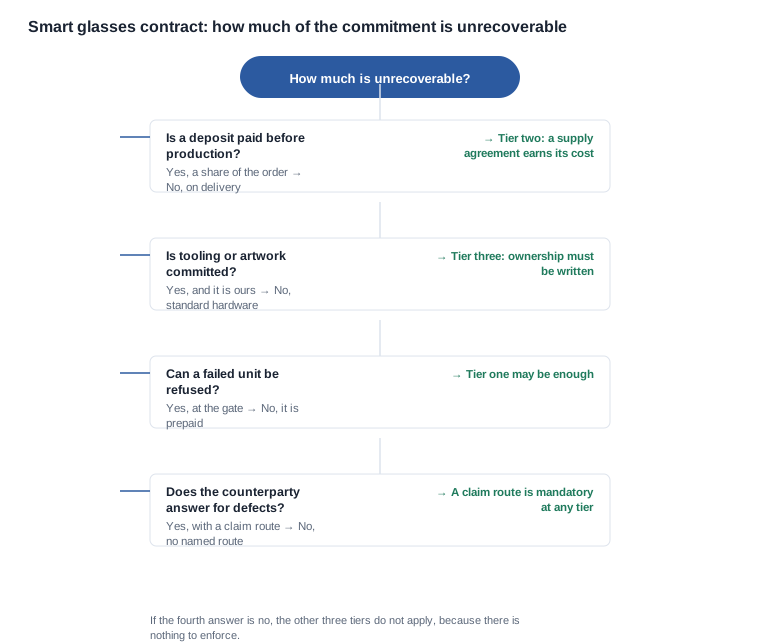
The decision chart above is the same three questions arranged as a test. If the fourth answer is that the counterparty does not answer for defects at all, the tier does not matter, because there is nothing to enforce in any tier.
How to choose between the three instruments
Once the tier is known, the shortlist of documents is short, and the criteria for choosing between them are narrower than most buyers expect. The criteria are the cost of producing the document, the number of parties who have to agree it, and the number of events in the programme that could reopen it.
A configuration sheet and a purchase order are produced by one party, signed by one party and reopened only when the configuration changes. A short-form supply agreement adds a second signatory and a tolerance rule and a claim route, and it is reopened when a component changes. A full agreement adds ownership, a change route and a remedy period, and it is reopened by every change event in the programme. The right instrument is the cheapest one that covers the unrecoverable share, and choosing a more expensive one adds negotiation rounds and version control rather than protection.
There is a total cost to each option that does not appear on the purchase order. Negotiating a clause is not free: it takes a commercial conversation, it usually crosses at least one organisational boundary, and it produces a document that then has to be kept in sync with the order, the artwork and the payment schedule. For a buyer at tier one, that cost can exceed the exposure it protects. For a buyer at tier three, it cannot, because the exposure is a paid-for asset that no clause can refund.
Three practical rules follow from how to compare two suppliers on this. First, compare the instruments against the same tier, because a supplier offering a full agreement for a tier-one order is selling complexity rather than protection. Second, compare what the documents exclude, since the exclusions are where the supplier has kept a term. Third, ask when each document is reopened and who pays to reopen it, because a change route with a price and a schedule attached is the difference between a controlled change and an absorbed one.
The questions to ask are the same in every programme and the answers are what distinguish a supplier who can produce a file from one who describes it: what may be substituted without re-approval, which documents are delivered with the goods, what a buyer must send to make a defect claim and within what period, and who owns the tooling if the programme stops. A buyer who puts those four questions in the first round is not negotiating terms, they are establishing which quotation is complete — and how to compare two quotations only works when both answer the same questions.
Two failure patterns are worth naming because they are common and because both are visible before signing. The first is signing an agreement whose scope is a product family, where the bound object is a description rather than a buildable configuration; the second is signing an agreement that states a total cost of ownership nowhere at all, so that a change, a rework and a documentation route are all absorbed by the buyer without anybody deciding to absorb them. Both are trade-offs rather than errors, and both are visible in the exhibits.
What the published rows let a contract bind, and what it cannot
The rows a buyer can cite directly
A contract is only as good as the configuration it binds, and the configuration is only as good as the rows behind it. In this category a substantial part of the specification is already written down, which is why a buyer can bind more than they might expect.
The catalogue covers 28 models and publishes cell capacity, charge time and run time for every one of them. A charging interface is published for 24 of the 28 — 17 on magnetic charging and 7 on Type C. A camera resolution class is published for all 11 camera models, splitting into 8 MP for eight of them and 13 MP for three, the L2 Utral and the L1 Pro, and the S7. A charging-case capacity is published for five camera models: the L1 Pro and the CY03, and the CY05 — each at 1400 mAh, the L2 Utral at 900 or 1400 mAh, and the MT6 as a 1200 mAh folding case.
Two of those published rows need care in the drafting, and both are the kind of detail that becomes a dispute. Charge time is published for all 28 models, 26 of them written as a ceiling of two hours or less and the D17 and the ZH12 written as about one hour — a ceiling is an upper bound, so a contract that says "under two hours" has changed the meaning of the published row. Cell capacity is published as cell values with a cell count, 55 mAh twice, 90 mAh twice, 70 mAh twice and 100 mAh as a single cell, so a combined figure in an agreement is a derived number and has to be labelled as one.
The rows that have to be asked for
Four published gaps are structurally important to a contract, and in each case the agreement should carry a value, a request or an explicit tolerance rather than a silence.
- The charging interface on four camera models. The CY05 and the MT6, and the L1 Pro and the CY03 publish no interface row at all, although all four do publish a charging-case capacity. The contract clause here should require the connector to be stated for the unit in the carton, not inferred from the range.
- The radio version for every camera model. No camera model publishes a Bluetooth version. Any agreement that touches pairing behaviour, radio performance or a market-specific radio rule needs the version requested in writing.
- The case status for four camera models. The V03 Pro and the V06, and the S7 and the V03 publish no charging-case row, which is an absence rather than a statement that there is no case, and a contract that assumes either way has to put the question in writing first. The difference has to survive into the packing list and the order line.
- Weight and ingress. A body weight is published for one model only, the MT6 at 158 g for the glasses body including the 265 mAh cell and the camera and excluding the folding charging case, whose own weight is not published. An ingress marking appears on two rows only, the V06 and the S7. Every other model in the range has no published weight.
The four open rows that stop a consignment
The rows that do not appear in the catalogue at all are the ones that stop consignments, because they are the ones a buyer is most likely to believe exist somewhere else.
- Unit price, price tier and minimum order quantity. These live in the quotation and nowhere else, which is why the quotation has to be an exhibit to the agreement rather than a document that disappears once the order is placed.
- Production capacity and lead time. Not published for any model, so any date in an agreement is a plan and not a measurement. A contract that converts a plan into a commitment does so by attaching a remedy, not by restating the plan.
- Yield and per-unit test records. Not published, so the consistency mechanism has to be created contractually if it is to exist.
- Conformity evidence. The catalogue has no per-model certification row, and its text contains no CE, FCC or RoHS reference for any model. A document handover clause is therefore not a formality; it is the mechanism by which the evidence reaches the buyer at all. On the European side the instrument has to be named correctly: the Radio Equipment Directive is (EU) 2014/53/EU, the electromagnetic compatibility directive is the separate (EU) 2014/32/EU, and the EN 301 489 series is a harmonised standard cited inside a conformity assessment rather than a directive. The general product safety regime, Regulation (EU) 2023/988, applicable since 13 December 2024, adds the responsible economic operator and manufacturer identification requirements that a brand placing goods on the market has to satisfy in its own name.
The four clauses that decide the outcome at every tier
Configuration binding and the tolerance rule
The configuration string is the clause that everything else refers to. If it is not in the agreement, then the tolerance rule, the documentation list and the remedy all attach to nothing. In this category the string has to carry more than a product name, because the published rows differ model by model: the case configuration, the interface and the camera class all vary inside the range, and the L2 Utral genuinely publishes two case capacities. The catalogue prints that model as "L2 Utral"; whatever its origin, an agreement has to reproduce the designation exactly as it appears on the documentation, because a mismatch between paperwork and label stops a consignment.
The tolerance rule is the second half of the same clause. It needs to state what may be substituted without approval, and what triggers a re-approval. Without it, an open-ended "equivalent component" provision lets a cheaper part arrive under a name that means nothing.
The documentation handover
The documentation clause should list, by name, what is delivered with the goods and what is held on file, and should say how the buyer obtains the second category. A general promise that documentation will be provided is worth very little, because it does not identify either the document or the route. Naming the route also solves the routing problem when a trading company sits between the builder and the buyer: the clause can specify that the buyer is entitled to the document from the party that holds it, whoever that party is.
The claim route with a period
A remedy without mechanics is a warranty statement, and a warranty statement is not a claim route. The clause needs four elements: what the buyer must send, to whom, within what period after the goods arrive, and what the supplier must do with it. Testing this before the order is released is cheap; discovering the route does not exist after a defective batch has shipped is not.
Tooling ownership and the change route
At tier three the missing clause is usually tooling and artwork. Ownership, the amortisation period, and the cost of a re-tool caused by a change in the buyer's own requirements are commercial terms rather than technical ones, and they are the ones most often settled by whoever writes the stronger letter last.
The change route belongs next to them. A change after the agreement is signed has to alter both cost and schedule; if it does not, the change is absorbed by one side by default, and the default is usually the buyer.

Checking an agreement against the quotation before you sign
Four reads that take about an hour
- Read the agreement against the quotation, not on its own. Every number, date and configuration string in the quotation should appear in the agreement. Any that does not is a term the supplier has kept, and the gaps are where the money is.
- Ask for the tolerance clause to be read back against one specific component. Take a part the supplier might substitute and ask what happens if a different one arrives. A clear answer means a real rule exists; a vague answer means nothing does.
- Confirm that the exhibits are attached, not referenced. The approved sample, the artwork file, the configuration sheet and the documentation list should carry revision numbers inside the agreement, so that a later dispute is about an exhibit rather than about recollection.
- Test the claim route with a scenario. Ask exactly what a buyer must send to make a defect claim, to whom, and within what period. A route that requires a form nobody has seen is a route that will be used once.

The order of the four reads is deliberate: identify the tier first, then check the exhibits, then the tolerance, then the claim route. A buyer who tests the claim route first discovers that the problem is not the claim route.
The red flags worth walking away from
Five findings are worth pausing on, and none of them is unusual enough to look serious on the page.
- The quotation is not an exhibit. Without it, the agreement and the price are separate documents that will disagree eventually.
- "Equivalent component" with no tolerance. An unlimited substitution right on a bill of materials that already has three different cell configurations.
- A delivery date with no owner and no remedy. A date that can move without consequence is not a commitment and does not need to be signed.
- Documentation promised in conversation. The handover clause names a mechanism, not an intention.
- A change route by email. Where the final version prevails by default, the buyer loses every change argument, including the ones that were legitimate.

A reasoning case: the same model ordered twice
The following is a reasoning exercise, not a client project. No customer is named and no figures are claimed; the model, the quantity and the market are assumed so that the reasoning can be followed.
A brand-side buyer places two orders for the same camera model within one year. The first is a single-market order for a standard bundle, paid on delivery, with no custom artwork. The second is the same model into a second market with a private-label bundle, custom artwork on the carton, a deposit of 40 per cent and a promise of a fixed launch slot.
The first order sits at tier one. Nothing is paid before delivery, a non-conforming unit can be refused at the gate, and there is no tooling or artwork to own. The buyer builds a configuration sheet from the published rows for that model — cell capacity, run time, charge time as a ceiling, camera class, and the case configuration — and attaches the approved sample. That sheet, plus a purchase order that references it, is the whole instrument. A full agreement would have added signature time and one more thing to keep in sync, without protecting anything the sheet does not already protect.
The second order sits at tier three. The deposit is unrecoverable if the programme stops, the artwork is paid for and specific to the brand, and the fixed launch slot turns the schedule into something a clause has to manage. Here the agreement carries the configuration string, the tolerance rule, the documentation handover, the claim route with a period, tooling and artwork ownership, and a change route that moves both price and schedule.
The interesting part of the case is what the two orders share and what they do not. They share the specification work: the same published rows, the same sample, the same case decision. They do not share the conformity file, because the second order has a new market, a new designation on the artwork and a different importer. And they do not share the commercial instrument, because the unrecoverable share changed from nothing to a deposit plus artwork. The same product, the same factory, two different tiers, two different instruments.
A buyer who applies a single template to both orders will over-document the first and under-document the second. The tier test is what stops that, and it costs one afternoon.
Two things follow for the related commercial terms. The deposit and the milestone structure should be read together with the payment terms, and the minimum order quantity behind the order line against the MOQ framework, since both change the unrecoverable share. The documentary handover in tier two and tier three depends on the evidence route, which is set out in the certification verification pillar. And the configuration itself is decided on the AI camera glasses product line.
Where the contract conversation starts and stops
It is worth being precise: a contract should bind the configuration, and the configuration should be written from rows a buyer can check. We publish 28 models with their cell capacities, charge times, run times, charging interfaces where one is published, camera classes where they apply, charging-case capacities where they are published, and one body weight for the MT6. We do not publish unit prices, minimum order quantities, capacity, lead time or yield, and we do not publish per-model certification, because the catalogue does not contain them.
That last point has a direct contractual consequence. A buyer who expects a conformity certificate to be part of a supplier's standard document set will find that it is not, and the agreement needs a clause that creates the handover rather than one that assumes it. The same is true of the per-unit test record and of the yield figure: neither exists in our published material, so a contract that requires them is requiring something to be built, not restated.
What we can do is take a configuration, a quantity and a destination, and tell you which rows are settled, which are open, and which have to be requested from a party other than us. What we cannot do is supply a contract on your behalf, a certificate number for a model, or a date we cannot verify.
Send us the models, the quantities and the target market, and we will say which parts of the specification are settled, which are yours to close, and how large the unrecoverable share of the commitment is likely to be.


