

Photochromic: a light-responsive lens is not a colour
Why a light-responsive lens is an architecture and not a colour
A light-responsive lens is an architecture decision, and the reason it matters commercially is that two entirely different products sit behind the same retail word. One of them is a passive lens that responds to ambient light on its own; it adds no cell, no driver and no power drain, and in our catalogue it appears as a configuration on a named camera model. The other is a voltage-driven electrochromic lens, which needs a cell, a control path and a firmware function, and which appears in the catalogue as a product in its own right. A buyer who has been quoted the retail word has not been quoted a product. The consequences of the distinction reach far past the lens itself: they decide the number of SKUs in the programme, the cell and charging interface of the finished device, what happens to the lens when the battery is flat, what a certificate can name, and what the listing is allowed to say. Decide the mechanism before the artwork, write the lens onto the configuration string, and make the claim no wider than the measurement behind it.
The three requests that bring a lens question to a buyer
The reader is a brand-side product owner, a channel buyer, or a product manager who has been asked whether a light-responsive lens is worth adding to a range. The situations that produce the question are narrow and they arrive in a particular order.
The first is the range extension. A brand has a working model and a retailer asks whether a light-responsive version can be added, and the natural answer is yes because the lens looks like a colour. It is not a colour, and adding it creates a second product with a second artwork, a second colour matrix, a second minimum order quantity and a second claim, none of which is visible in the request. The second is a supplier comparison where two suppliers use the same retail word for different mechanisms, so the quotations appear comparable when the products are not. The third is a claim review: someone has written a description of how the lens behaves, and nobody in the business can say whether the description matches a measurement, because no measurement was ever requested.
What the buyer is afraid of is specific. It is a product that behaves differently from the approved sample in the one condition the customer actually cares about, which is the transition between light and dark. It is a listing claim that cannot be evidenced, discovered in a marketplace review rather than in a sales meeting. It is a second product that doubles the documentation scope without doubling the volume, so the cost of the second product lands entirely on the first.
What you can control is decided by where you sit in the chain. A brand owner controls the mechanism, the configuration, the claim and the artwork, and therefore controls most of the risk. A channel buyer controls only the purchase order, so the mechanism, the lens configuration and the claim have to be written into the order as conditions rather than assumed. A distributor carrying the same brand across territories has to be certain the product is not presented as a light-responsive product in one territory and as a standard one in another, because a mechanism described inconsistently across markets is a mechanism that will eventually be described wrongly.

Two published routes, and the commitments each one carries
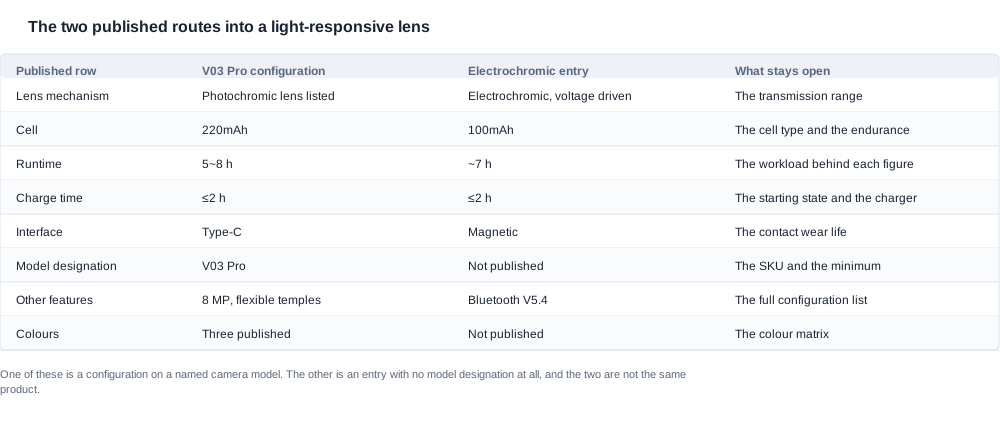
Our catalogue contains two ways into a light-responsive lens, and they are not variants of one product. They are separate entries with separate specifications, and the fact that they are sold under a shared retail word is exactly the thing that makes a buyer's diligence necessary.
The first route is a configuration on a named model. The V03 Pro is an 8 MP camera platform published with a 220 mAh cell, a runtime of five to eight hours, a charge time of two hours or less, Type-C charging, flexible temples, three published colour options, and a photochromic lens listed among its features. The important structural point is that the lens is an option on a product that already exists, with its own model designation, its own cell, its own interface and its own documentation scope. Adding the lens to a V03 Pro adds a configuration; it does not create a new product from nothing.
The second route is a product in its own right. The electrochromic entry is published with Bluetooth V5.4, a 100 mAh cell, a charge time of two hours or less, a runtime of around seven hours and magnetic charging. It carries no model designation at all. The cell is the tell: a voltage-driven lens needs a cell and a driver circuit and a control path, which is why the entry has a cell specification where the passive route adds none to the camera platform it sits on. The mechanical consequence is the same, and it is visible in the published rows: the electrochromic entry charges magnetically, while the V03 Pro configuration charges over Type-C. The two routes are separate products with separate bills of materials, and the retail word is the only thing they share.
What neither route publishes is the part a buyer most wants. There is no switching time in either direction, no transmission range in the clear and the dark states, no uniformity tolerance, no temperature range, no cycle life with a failure criterion, no lens material and no ultraviolet figure. For a passive lens that is a set of measurements the lens maker would have; for a driven lens it is a set the lens supplier would have. Neither is in our published data, and neither should be assumed.
One warning applies to any comparison a buyer makes across suppliers. Light-responsive figures are not directly comparable, and the reason is nearly always the condition rather than the product. A switching time measured from bright sunlight down to indoor light is not comparable with one measured in the other direction, and neither is comparable with a figure measured at a different temperature. A transmission figure quoted only for the darkened state is a half-figure, and the half that looks good on a beach. The threshold to hold is a pair of figures, one per direction, each with a light level, a temperature and a statement of whether it is typical or best case.
What the mechanism decides that cannot be changed later
The mechanism is worth more attention than it usually gets, because it propagates into decisions that become expensive to reverse. There are four of them, and a buyer who takes them in the wrong order will pay for it in tooling, in documentation and in reprinting.
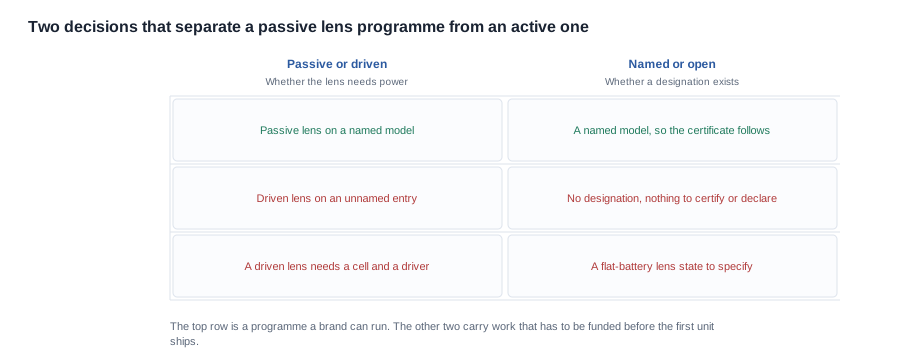
It decides how many products the programme carries. A passive lens on an existing named model is a configuration, and a configuration multiplies the variant count without multiplying the platform. A driven lens is a product with its own bill of materials, its own model designation, its own minimum order quantity and its own documentation scope. A brand that wanted "the same product, but light-responsive" has, depending on the mechanism, either a larger range or a second product. The commercial consequence is the same either way and it is not visible in a unit price.
It decides the power budget, and therefore the flat-battery behaviour. A passive lens has no flat-battery state, because it needs no power. A driven lens does, and that state is a product behaviour: what the lens looks like when the cell is empty, whether it returns to a clear state, whether it holds a partially driven state, and what the camera or the display behind it does at the same moment. That behaviour has to be specified before the sample is approved, because it becomes a support script line and, in some cases, a listing statement.
It decides the interface and the packaging. The electrochromic entry charges magnetically, the V03 Pro configuration charges over Type-C. A driven lens may also need a case for a product that otherwise would not have one, and a case is a second cell, a second certification scope, a second accessory set per market and a second item in the battery transport paperwork.
It decides what a certificate can name and what a customs broker can be told. A configuration on a named model inherits that model's documentation scope, subject to a re-issue when the configuration changes. A product with no model designation has nothing for a certificate to name, nothing for a customs declaration to describe and nothing for a minimum order quantity to attach to. In the electrochromic entry that gap is real, and it is the first thing a buyer should close, because everything downstream of the designation depends on it.
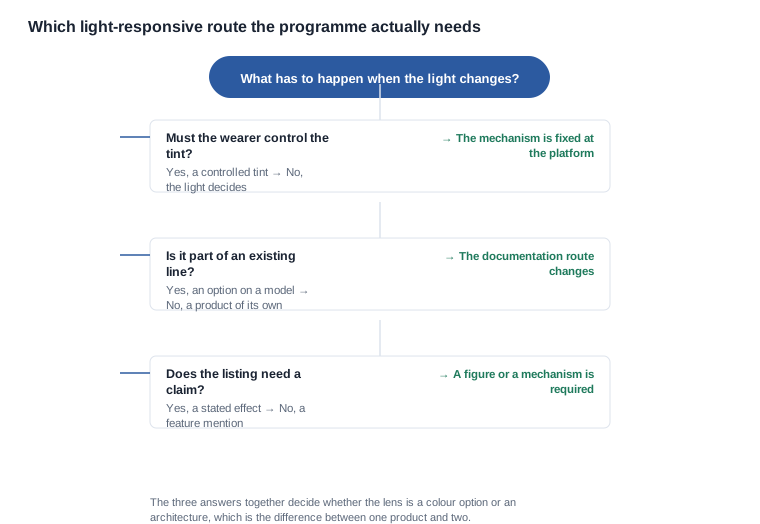
The practical summary is that the mechanism is an architecture decision with a commercial tail, and the tail is larger than the lens. A buyer who treats the lens as a colour option has not budgeted the second product; a buyer who treats it as an architecture has to decide which architecture, and that decision is made once.

Nine questions that separate a passive lens from a driven one
- Is the lens passive or driven, and what does the driven route add to the bill of materials?
- Is the lens a configuration on a named model, or a product with its own model designation?
- If it is a configuration, does the existing documentation scope cover it, and what is required to re-issue it?
- What are the switching times in both directions, with the light level and the temperature attached?
- What is the transmission range in the clear state and in the dark state, and is the clear state published?
- What is the behaviour of the lens when the cell is flat, and what does the rest of the product do at the same moment?
- What is the uniformity tolerance between zones, measured on a stated grid, and what grid is it?
- What is the cycle life with a failure criterion, and who writes the criterion?
- What claim will the listing make, and which measurement supports each part of it?
Before you order, the light-responsive checklist is short: the mechanism in writing, whether the lens is a configuration or a product, the documentation scope that covers it, the switching times in both directions, the transmission range, the flat-battery behaviour where there is one, the uniformity tolerance, and the claim wording. How to compare two quotations that both use the same retail word is to lay those rows out in the same order before any number is compared, because the trade-off between a lower unit price and a second product to document is invisible until the rows sit side by side. The red flags worth naming are a mechanism that was never stated, a claim with no measurement behind it, and a variant count that was never costed. Those three are the usual pitfalls, and a buyer who closes them at quotation stage avoids a launch that has to be documented twice.
Question two is the one that has the largest effect on the programme, because the answer decides whether the buyer is running a range or a second product. It is also the question most likely to be answered vaguely, since the retail word invites an answer that avoids the mechanism entirely. The commercial discipline is to insist on the mechanism, in writing, before anything else is discussed.
Question three is where the configuration route either pays off or does not. A lens added to a named model is a change to the bill of materials, and a change to the bill of materials means the conformity position has to be reviewed rather than assumed to carry over. A buyer who treats the lens as a colour option will discover this at the documentation stage, after the artwork is approved.
Question six applies only to the driven route, and it is the question most often left unanswered because it feels like a detail. It is not a detail. A lens that holds a dark state when the product is dead is a lens a customer photographs and a support agent explains, and both of those cost more than the specification did.
Question eight is the one that makes a durability warranty measurable. A cycle count without a failure criterion is a quantity rather than a life, and the criterion has to be written by the buyer, because only the buyer knows what a failed lens means for the product it sits in.


Where a light-responsive lens programme goes wrong commercially
The configuration that became a second product. The symptom is a documentation scope that doubles, a minimum order quantity that halves, and a range that has doubled in variants without doubling in volume. The root cause is that the lens was added as a colour option when it was an architecture. The control is to write the mechanism onto the configuration string and to treat the variant count as a commercial decision with a price.
The claim that outran the measurement. The symptom is a marketplace review or a competitor comparison pointing at a phrase in the listing. The root cause is that the copy was written from the retail word rather than from a result. The control is a claim register, with every phrase in the listing tied to a measurement and its conditions.
The lens that behaved differently in the cold. The symptom is a seasonal cluster of complaints, usually concentrated in one part of the year and in one climate. The root cause is that the switching figure was quoted without a temperature, and the figure was taken at a temperature the customer does not live in. The control is a figure per direction with the temperature attached, and a claim narrower than the worst case.
The uniformity that failed at first article. The symptom is a batch rejected at inspection for a difference in depth between the centre and the edge. The root cause is that no tolerance existed, so a centre reading was being used as a proxy. The control is a maximum difference between zones on a stated grid, agreed before the first article rather than discovered at it.
The flat-battery state that nobody had specified. The symptom is a customer reporting that the lenses stayed dark after the product died, and a support team improvising. The root cause is that the driven route's behaviour at zero charge was never written down. The control is to specify it, publish it in the support material and state it in the listing where it is visible.
The designation that was never assigned. The symptom is a quotation, a certification request and a customs line all waiting on a string that nobody had produced. The root cause is that the entry is identified by its product name rather than by a model designation. The control is to make the designation a condition of the first order and to have it quoted on the purchase order.
Every one of these could reasonably appear in a photochromic specification, and none of them is grounds for moving the order. Each one is a decision, a tolerance or a clause, and every one of them is cheaper to settle at quotation stage than to correct after a launch.
The published position, and the claims we will not make
The total cost of a light-responsive programme is the lens plus the artwork plus the documentation plus the packaging plus the returns reserve, and only the first of those appears in a quotation. A due diligence question asked of a supplier before the order is therefore worth more than a unit price concession, because the answer determines how many products the programme carries and how many markets it can enter.
The commercial terms of a light-responsive programme are decided in three places: the variant count, the documentation scope, and the claim. Everything else is smaller.
What moves in a negotiation is worth naming. The number of configurations and their minimum order quantities move when you commit to a variant count rather than a unit count. The artwork round count is negotiable and each round is a week, so one extra round for the claim wording is cheaper than a reprint. The claim wording itself is negotiable in the sense that a narrower claim is always available, and a narrow claim is worth more to a brand than a price concession. The market list is negotiable, because a channel served from markets where approvals already exist is a cheaper programme. The lens specification is negotiable as a document, and agreeing it before the quotation is worth considerably more than negotiating the unit price afterwards.
What does not move is the mechanism, because it is a platform fact and no price turns a passive lens into a driven one. The cell capacity and the charging interface that follow from the mechanism are hardware commitments. Conformity cost and time are fixed per product family and sit in a queue at the test laboratory, and pressing on them produces a longer schedule rather than a shorter one. The transmission range, the switching time and the cycle life are physical characteristics of the lens, and they are measured rather than negotiated.
The documents worth collecting before the deposit are: the mechanism stated in writing, the model designation of the product the lens sits on, the switching times in both directions with their conditions, the transmission range in both states, the uniformity tolerance and the grid, the flat-battery behaviour for a driven route, the cycle life with a failure criterion, the material documentation for the lens module, the model designation written on the quotation, and the battery transport summary for the fitted cell.
The clauses worth writing into the purchase order are: the lens configuration as a named field on the configuration string, the lens specification and the exact model designation attached to the order, the acceptance criteria from a measurement protocol with its conditions and its sample size, a clause requiring notice before any change of lens, coating, tint range or frame material because each of those invalidates the configuration, a clause requiring the documentation pack to be reissued for a configuration change, and a warranty set against an agreed failure criterion rather than against a cycle count.
On our own side, the boundary is this. We publish the mechanism, the cell, the runtime, the charge time and the charging interface for both published routes, and we publish the lens as a listed feature of the V03 Pro configuration and as the defining feature of the electrochromic entry. We do not publish switching times, transmission ranges, uniformity tolerances, temperature ranges, cycle lives, lens materials, ultraviolet figures or the flat-battery behaviour of the driven route, and we will not fill any of those rows with a value from elsewhere in the industry. We will also not publish a claim about what a lens does for a person's eyesight. The parameters we do publish are the input to a claim review, and a claim written wider than the evidence is a liability for the brand that owns the listing rather than a feature of the product.
That is why the mechanism matters to a buyer. It decides whether the programme carries one product or two, whether the documentation scope has to be reissued, what a support script has to say when the battery is flat, and how much of the listing a compliance reviewer can leave alone. Send us the models, the quantities, the markets and the wording you have in mind, and we will tell you which configurations exist, which of these questions our published rows already settle, and which have to be requested from the engineering file. The photochromic lens page carries the published lens rows, and we will tell you plainly which questions we can answer from our documentation and which ones need the lens supplier's own file.
Related reading


