

Smart glasses AI features: a chain of dependencies
Why the published data stops at the sensor
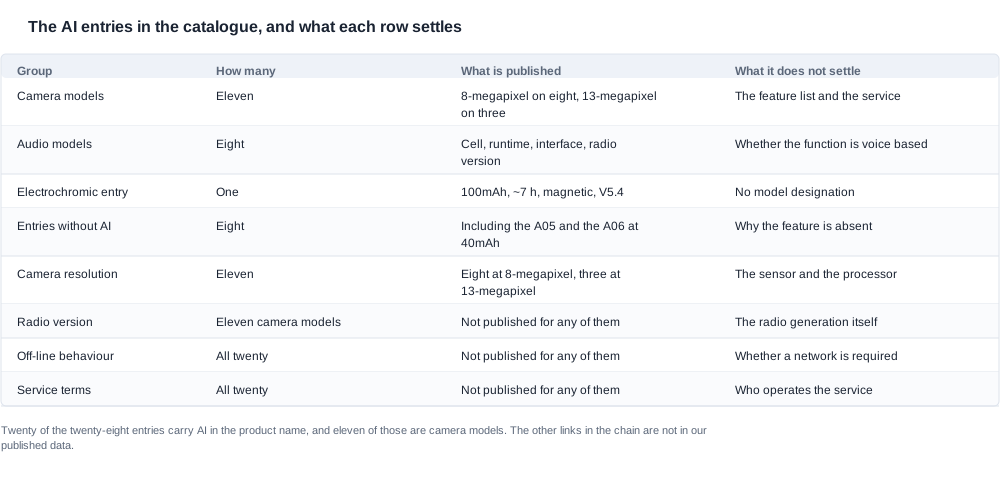
AI on a product page is a label, and a label hides a chain of five parties: the sensor that captures the input, the processor that runs on it, the application that requests it, the model that answers it, and the network that connects some of those. A buyer can only manage what they can name, so the first question in any AI conversation is not what the feature does but which links in that chain the programme is actually buying. Our catalogue makes the first link unusually visible. Twenty of the twenty-eight entries carry AI in the product name, and eleven of those are the camera models, with 8-megapixel on eight of them and 13-megapixel on three. The remaining AI entries are eight audio models and the electrochromic entry, and those have no camera at all, so their AI has to be something else entirely. Everything past the sensor is not published: no function list, no off-line behaviour, no language coverage, no latency, no service terms, and no model designation for the electrochromic entry. Write the claim, the limits and the fallback into the order, because a feature that depends on somebody else's service is a supply relationship, not a specification.
The three questions that bring an AI feature to a buyer
The reader is a brand-side product owner, a channel buyer comparing two suppliers' AI claims, or a product manager who has been handed a feature list and asked which of the functions are actually deliverable. The situations are recognisable.
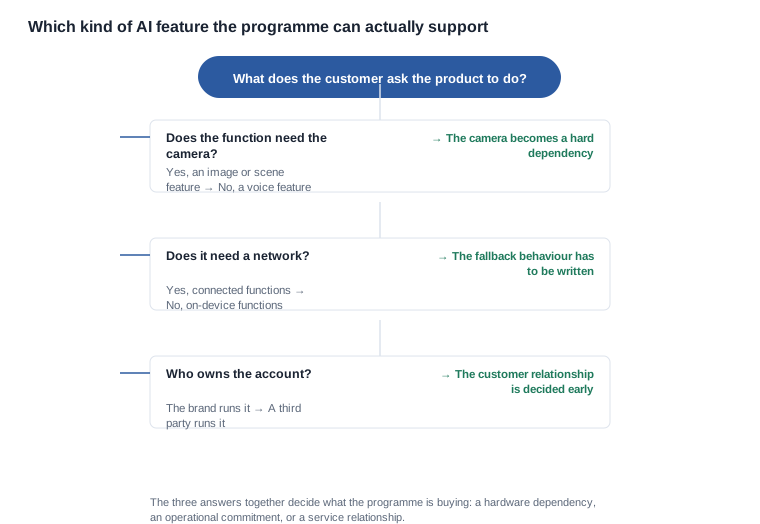
The first is the comparison. Two quotations both say AI. One of them means a camera model on the device that does a defined set of things, and the other means a voice feature that runs through a server operated by a third party. On a spec sheet they look identical; in a programme they are different products with different costs, different failure modes and different contracts.
The second is the listing. Somebody has written a feature bullet for a product page, and the question is what has to be true for that bullet to be true. A feature that needs a network needs a network, and a customer in a lift with no signal is a support contact. A feature that needs a specific language needs that language, and a brand selling into several markets has to know which ones are covered.
The third is the internal argument. A product manager wants a feature, a procurement manager wants a cost, and a compliance function wants to know what data the feature touches and where it goes. All three are asking about the same chain, and the chain is what nobody has written down.
What the buyer is afraid of in each case is specific. It is a launch that depends on a service whose terms can change without notice. It is a return rate that rises after an update, because the update changed an output the customer had learned to rely on. It is a claim about a feature that a competitor can demonstrate and a regulator can read differently.
The point in the chain where you stand decides what you can change. A brand owner controls the application, the account, the claim and the customer relationship, which is most of the stack. A channel buyer controls only the purchase order, so the update path, the fallback behaviour and the claim wording have to be written into the order as conditions. A distributor carrying a brand across territories has to be sure a feature that depends on a service in one market is presented identically in all of them, because a feature with a regional difference is a support problem waiting for the first holiday period.
What the catalogue publishes about AI, and what it does not
It is worth pausing on what that means for a procurement conversation. In most categories the buyer's problem is that the supplier publishes too much and the data has to be triangulated. Here the problem is the opposite: the sensor layer is documented and the rest is not, so a buyer who assumes the standard documentation set exists will wait for documents that were never going to arrive, and a supplier who reads that silence as a refusal to discuss the feature is being unfair. The efficient approach is to ask for the function list first, because it is the only artefact that turns the conversation from a demonstration into a specification, and because a supplier that has one has already decided which claims the product can support.
The published data gives a buyer an unusually clear view of the sensor layer and an unusually blank view of everything above it. That asymmetry is worth understanding before a quotation is compared.
Twenty of the twenty-eight catalogue entries carry AI in the product name. The other eight do not: the AR glasses entry, the three children's models, the YKC02, the D17, the ZH12 and the bone conduction entry. The twenty are the eleven camera models, eight audio models and the electrochromic entry.
Within the camera group, the published hardware is specific. Eight of the eleven are published at 8-megapixel, which covers the KY06 and the V03 Pro, the V03 and the CY05, and the CY03 and the MT5, and the MT6 and the V06. Three are published at 13-megapixel, which covers the S7 and the L2 Utral, and the L1 Pro. The cell and the runtime are published for all eleven, and so is the charging arrangement, with the magnetic interface on most of them and Type-C on the V03 Pro and the L2 Utral.
The second structural fact is that the nine AI entries without a camera are the audio models and the electrochromic entry. Their published rows carry no camera figure at all, which means any AI function they offer is a voice, audio or scene function rather than an image function, and a claim built on it has to be worded differently. A buyer who asks "what does the AI do" and receives an image-based answer for a model with no camera has been told something untrue, and the discovery will be on a live listing.
The third fact is the one that decides the programme. The catalogue publishes no function list for any of the twenty entries, no indication of which functions run on the device and which require a connection, no language coverage, no response-time expectation, no update policy, no service terms, and no information about the data a function touches. It also publishes no Bluetooth version for any of the eleven camera models, so even the radio row that the audio models carry is open on the group where the AI claim is most often made.
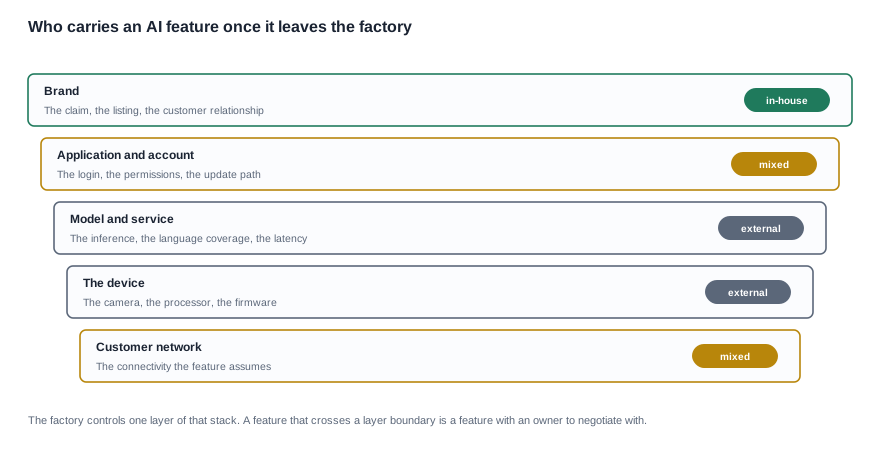
The commercial implication is that the AI row in a quotation is the least informative line in it. A buyer who is comparing two suppliers' AI claims has almost nothing to compare, because the interesting part of the feature lives in documents that do not circulate at quotation stage. The only lever available is to insist on the function list, to separate the on-device functions from the connected ones, and to treat the service terms as a deliverable with a named owner.
One warning applies to any comparison made across suppliers. Published camera resolutions are not directly comparable, and the reason is that a resolution figure is a sensor output rather than a system output. The image a user gets depends on the lens, the sensor, the processor, the pipeline and the application, and a 13-megapixel sensor behind a wide-angle lens produces a different usable image from a 8-megapixel sensor behind a normal lens. The threshold to hold is a figure with the conditions attached, and a buyer who needs a claim about image quality should require the output rather than the sensor.
The four links a buyer has to assign before the claim goes live
The sensor. Which capture device the function reads, and whether the published camera figure on the model is adequate for the output the claim promises. This is the only link our published data settles, and it settles it well: eight models at 8-megapixel, three at 13-megapixel, and no camera at all on the nine audio and electrochromic entries.
The device. What runs on the product itself. This is where the cell budget comes in, and it is the link a buyer can negotiate, because an on-device function is a hardware and firmware commitment that the factory owns and a connected function is not. A programme that wants every function on the device is asking for a different product from a programme that accepts a network dependency.
The application and the account. Who the customer signs in to, who can delete the data, who receives the telemetry, and who the customer contacts when the feature is wrong. A brand that owns the account owns the complaint, and that decision cannot be delegated to a supplier later without a new agreement and a new support script.
The service. Where the inference happens, what it costs, what happens when it is slow, and what happens when it is unavailable. This link is outside the factory's control, and the honest position for a factory is that the service is a third-party dependency whose terms the brand accepts. A buyer who has not read those terms has not bought the feature; it has borrowed it.
The network. The customer's connectivity, which is a fact about the customer and not about the product. A function that needs a connection needs a stated fallback, and the fallback is a product behaviour: what the camera does, what the application shows, and what the support script says.

Nine questions that separate an AI function from an AI promise
- What are the individual functions, written as a list, rather than the label?
- Which of those functions run on the device, and which require a connection?
- Which functions depend on the camera, and on a particular camera figure?
- What does the feature do when the connection is unavailable, and is that written down?
- What languages, and which regional variants of them, are covered?
- What is the expected response time under a normal connection, and what is the behaviour under a poor one?
- What data does the function process, where is it processed, and who can delete it?
- How are updates delivered, how often, and can a customer or a brand defer one?
- What is the service relationship, who operates it, and what are its terms?
Before you order, the AI checklist is short: the function list, the on-device and connected split, the camera dependency, the fallback behaviour, the language coverage, the data-handling description, the update and notice terms, and the claim wording with its limits. How to compare two quotations that both say AI is to lay those rows out in the same order before any number is compared, because the trade-off between a lower unit price and an undocumented feature is invisible until the rows sit side by side. The red flags worth naming are a function described only as AI, a feature with no fallback, and a service whose terms nobody has read. Those three are the usual pitfalls, and closing them at quotation stage is cheaper than a listing that has to be withdrawn.
Questions two and four are the pair that decides whether the feature can be sold at all. A feature that needs a connection and has no defined fallback produces a support contact every time a customer is in a lift, and the contact is attributed to the product even though the fault is in the service.
Question seven is the one that turns the feature into a compliance question, and it is the reason the brand rather than the factory has to own the answer. The hardware boundary is clean: the factory is responsible for what the device captures and how it is processed locally. Everything after that, including what happens to an image in a service, sits with the brand and with whoever operates the service. Our AI features page carries the published hardware rows behind these claims, and the boundary discipline is the same one we apply elsewhere in the catalogue.
Question eight is the one that protects the customer relationship. A feature that can be changed by a remote update, without notice and without a choice, is a product behaviour a brand cannot explain to a customer whose workflow changed overnight. The update path, the notice period and the deferral option are all negotiable at the point where the service is agreed, and none of them is negotiable afterwards.


Where AI features fail commercially
The feature that needed a signal. The symptom is a cluster of returns and support contacts concentrated in places with poor connectivity, usually described as the product not working. The root cause is that the claim was written without a fallback. The control is the fallback behaviour in the specification and in the listing.
The claim that outran the function list. The symptom is a review pointing at a feature bullet that the product does not deliver. The root cause is that the copy was written from a label rather than from a list. The control is a claim register in which every feature phrase is tied to a function and a condition.
The update that changed the output. The symptom is a batch whose behaviour differs from the approved sample with no hardware change and no order change. The root cause is that the update path was not pinned and no notice was required. The control is a pinned firmware and application version on the order, with a change-notice clause.
The service that changed its terms. The symptom is a feature that stops working for a subset of users, or a cost that was never budgeted. The root cause is that the service relationship was accepted without the terms being read. The control is to treat the terms as a deliverable and to keep a record of the version agreed.
The camera that was not good enough for the claim. The symptom is an image claim that the product cannot support on the models it was written for. The root cause is that a sensor figure was treated as an output figure. The control is to evaluate the output on the specific model in the specific configuration, and to write the claim at the level the output supports.
The data nobody had assigned. The symptom is a compliance question from a corporate buyer or a marketplace that nobody in the business can answer. The root cause is that the chain was never mapped. The control is the four-link assignment, done before the claim is written, and it costs a page.
What follows is a normal part of scoping software, and no single item in it is grounds for moving to another supplier. Each one is a function list, a fallback, a clause or a page, and every one of them is cheaper to produce before the listing is live than to produce under a deadline.
The rows we publish, and the boundary we hold
The total cost of an AI programme is the device plus the application work plus the service terms plus the support handling plus the returns reserve, and only the first of those appears in a quotation. A due diligence question asked of a supplier before the order is worth more than a unit price concession, because the answer determines whether the feature can be sold, in which markets, and with what fallback.
The commercial terms of an AI programme are decided in three places: the function list, the update path, and the service relationship. Everything else is smaller.
What moves in a negotiation is worth naming. The function list is negotiable, and a documented list with a named owner for each entry is worth more to a brand than a unit price concession, because it is the only thing that makes a claim defensible. The update path, the notice period and the deferral option are negotiable and are the most valuable terms in the whole agreement, because they are the ones that protect the customer relationship. The service terms are negotiable through whoever operates the service, and the brand's leverage there is commercial rather than technical. The market list is negotiable, because a function that behaves differently by region is a localisation cost. The claim wording is negotiable in the sense that a narrower claim is always available.
What does not move is the sensor, because it is a hardware fact and no commercial term turns an 8-megapixel sensor into a 13-megapixel one. The on-device and connected split is a design and platform decision rather than a per-order variable. Conformity cost and time for the device are fixed per product family, and the service is outside the factory's control, which is exactly why the brand has to own that layer rather than assume it.
The documents worth collecting before the deposit are: the function list, the on-device and connected split, the camera dependency for each function, the fallback behaviour, the language coverage, the response-time expectation, the data-handling description, the update and notice terms, the service terms, and the model designation of the product the features sit on.
The clauses worth writing into the purchase order are: the function list attached to the order, the fallback behaviour as an acceptance criterion, the pinned firmware and application version, a change-notice obligation covering firmware, application and service changes, the data-handling description, the claim wording with the limits stated beside it, and a warranty scope that distinguishes a device fault from a service interruption.
On our own side, the boundary is this. We publish the cell, the runtime, the charge time, the charging interface and the camera figure for the models that have a camera, and we publish the fact that an entry carries AI in its product name. We do not publish a function list, a language coverage, a response time, an update policy, a service term, a data-handling description, or any Bluetooth version for the eleven camera models. We will not fill those rows with values from a demonstration unit, because a demonstration runs on the factory's own network, on the factory's own account and on the factory's own firmware, and none of those conditions is the customer's. And we will not claim an AI capability we cannot show on a product in the configuration you are ordering.
Send the models, the quantities, the functions you want to claim, the markets and the networks you expect the product to be used in, and we will tell you which configurations exist, which of the chain our published rows already settle, and which of them have to be answered by the application and the service before the claim can be written. The AI features in smart glasses page carries the published rows, and we will tell you plainly where the factory's responsibility ends and where the brand's begins, because that boundary is where an AI programme is usually found to be one link short.
Related reading


