
Will it interfere with a helmet is two questions wearing one phrase, and answering only one of them produces either a safety claim nobody can defend or a fit objection nobody cannot answer. The first is whether the glasses and the helmet can physically coexist. The second is whether the product's own features — the camera, the audio, the charging contact — behave correctly with a helmet on. A buyer putting a product into a helmet-wearing channel needs both answered before the listing exists, and the second one is where the returns come from.
This page is written for a brand owner, a procurement manager and a channel buyer, and it sets out the rows to request from a supplier, the tests to run on a sample, the wording that is safe to publish, and the commercial terms that decide whether a helmet channel is worth opening at all. It is not a product recommendation, because the fit data a helmet decision needs is not published for the models in our range.
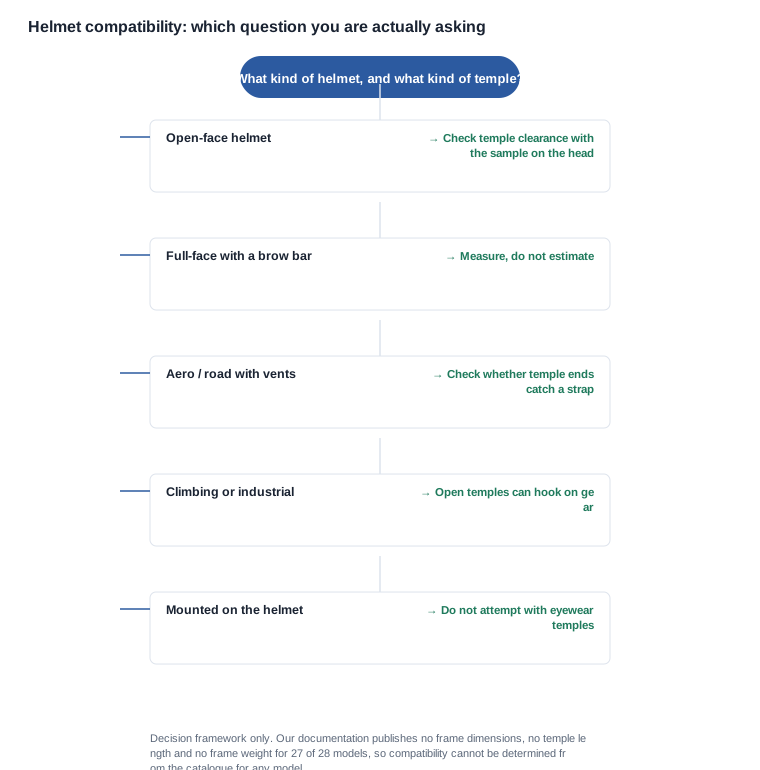
Will it interfere with a helmet: the two questions inside one question
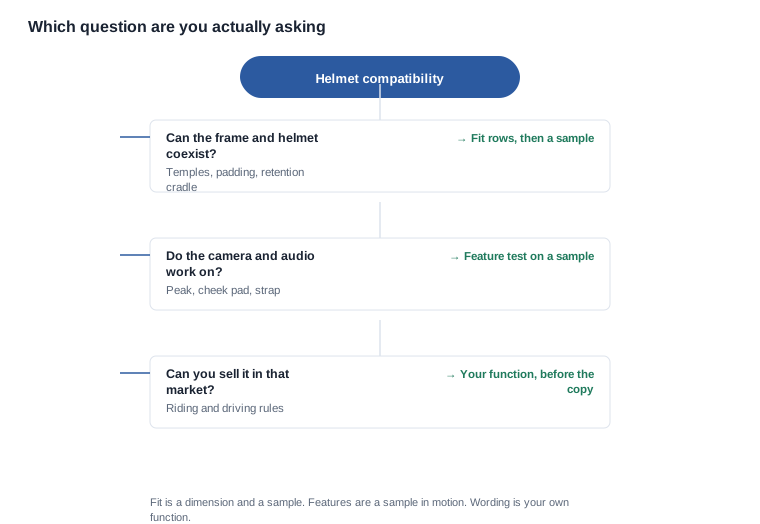
Question one asks whether the glasses and the helmet can physically coexist. It is a geometry question, and it is answerable with a sample and a set of measurements: temple length, temple curve, frame width at the brow, and where the temples sit relative to the helmet's cheek padding and brow pad. It is also the question most suppliers can answer quickly, because a temple dimension is a number on a drawing.
Question two asks whether the product's own features behave correctly with a helmet on. It is the harder one, and it is the one most often skipped. A camera placed under a peak records the underside of the peak. An open-ear speaker sits against a cheek pad that partly occludes it. A magnetic charging contact in a temple sits along the line a retention strap takes below the ear. None of these shows up in a fit check, because the fit check does not involve the feature, and all of them are exactly what a customer in the channel will find in the first ride.
The two questions have different owners, different evidence and different costs. The first is settled by a supplier row and a sample on a table. The second is settled by a sample in motion, on the actual helmet, for long enough that pressure and heat build. A procurement plan that funds only the first will ship a product that fits and disappoints.
A brand owner entering a cycling, motorcycling or site-safety channel needs to know whether the product can be positioned for it at all, and needs a defensible answer before the artwork is committed. A procurement manager specifying for that channel needs the fit rows that decide the shortlist, and needs to know which of them will arrive as data and which will arrive as a sample result. A channel buyer writing the packaging and the listing copy needs to know exactly how far the helmet wording can go, because the packaging is the document that survives when the product fails in a customer's hands.
The commercial consequence follows from who is asking. A brand owner is exposed to the cost of a claim that cannot be supported. A procurement manager is exposed to the cost of a sample programme that was scoped too narrowly. A channel buyer is exposed to the cost of a return rate in a channel where the customer cannot easily explain what went wrong, which in practice means the returns land on the party that did not make the product.
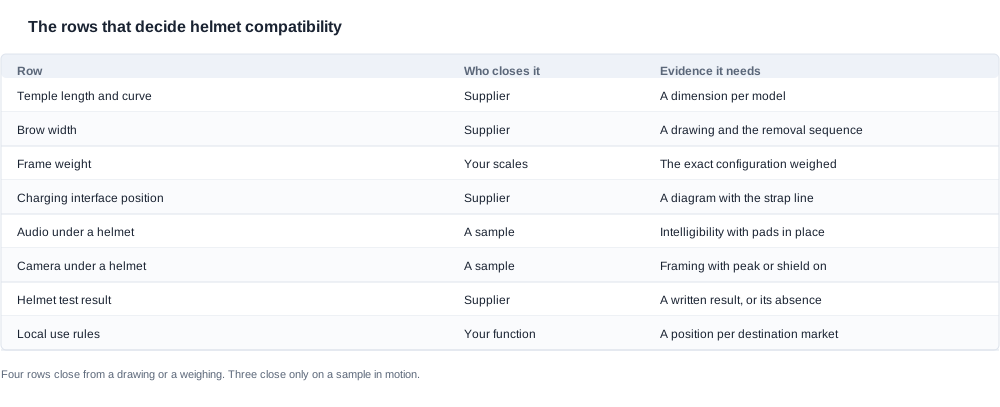
The rows that decide compatibility, and who closes each one
Compatibility is not a single attribute, and the rows below are separated by what each one actually depends on. Read across, they also show which of the rows a supplier can close from a drawing and which of them only a sample can close.
| What decides it | The mechanism | The threshold or the question | Who closes it |
|---|---|---|---|
| Temple length and temple curve | Whether the temples fit inside the helmet's cheek padding and clear the brow pad | The temple length and curve in millimetres, per model. Not published for any model in our range | The supplier, in writing |
| Frame width at the brow | Whether the frame can be taken out of the helmet shell without removing the helmet | The brow width per model, and the removal sequence the wearer will actually use | The supplier, with a drawing |
| Frame weight | A heavier frame presses differently against a helmet's padding over a long ride, and the pressure pattern is not the same as without one | The measured weight for the exact configuration. Published for one model in the entire catalogue, the MT6 at 158 g for the glasses body including its cell and camera and excluding its folding case, and not published for the rest including every sport model | A sample on your own scales |
| Charging interface position | A magnetic contact in a temple sits along the line a retention strap runs below the ear | Where on the temple the interface sits, and whether a strap crosses it. Our smart glasses frame materials page covers what the frame is made of, which is also not published | The supplier, with a diagram |
| Audio under a helmet | A cheek pad partly occludes an open-ear speaker, and the result depends on the helmet and on the wearer | The intelligibility in a real helmet, on a sample | A sample test |
| Camera under a helmet | A peak or a face shield changes what sits in the upper part of the frame | The framing in the actual helmet, on a sample | A sample test |
| The product's own test position | Our bone conduction buying checklist page covers the acoustic questions, and the wearable's own body position changes the geometry of every one of them | Whether the product has been tested in a helmet, and what the result was | The supplier, in writing |
| The helmet's own function | A mount or a frame must not obstruct the retention system or the wearer's field of view | The position relative to the retention cradle, and the fit of the frame under the retention dial | A sample, and the accessory's own documentation |
| The local rules | Whether a device may be used while operating a vehicle or a bicycle is a legal question in most jurisdictions | The local position, per destination market | The brand's own function, before the copy exists |
Architecture and fit first, features second, legal third. The fit rows decide whether the product is physically usable at all, and they are the cheapest to close because a dimension settles them. The feature rows decide whether it is usable in the way the channel expects, and they close only on a sample in motion. The legal question decides the wording rather than the product, and settling it first is a common and expensive habit because it produces copy that has to be withdrawn when the product turns out not to fit.
What is published in our own range is worth stating plainly, because it defines the size of the gap. The catalogue carries twenty-eight models, and for the models it covers it publishes the rated runtime, the cell capacity, the charge time and the charging interface. It publishes a charging method for twenty-four of the twenty-eight, with seventeen magnetic and seven Type-C, and it leaves the method unstated for four. It publishes the camera resolution class for the eleven camera entries, eight at eight megapixel and three at thirteen. It publishes an ingress marking on two models only, the V06 and the S7, as an annotation rather than as a report behind it. It publishes a remote shutter on two models, the D17 and the ZH12, and both of those are sport models rather than camera models. It publishes a removable or detachable part on three, the inner frame on the V06 and the S7 and the temple on the G07. And it publishes exactly one weight in the whole catalogue.
What is not published is the part a helmet decision needs. There is no temple dimension row, no brow width row, no frame weight for the sport models, no helmet test result anywhere in the range, and no per-model certification row at all. That is not an omission to be filled in by inference; it is the boundary of what a catalogue can carry, and a helmet channel sits right on the far side of it.
Checking compatibility before the product is listed
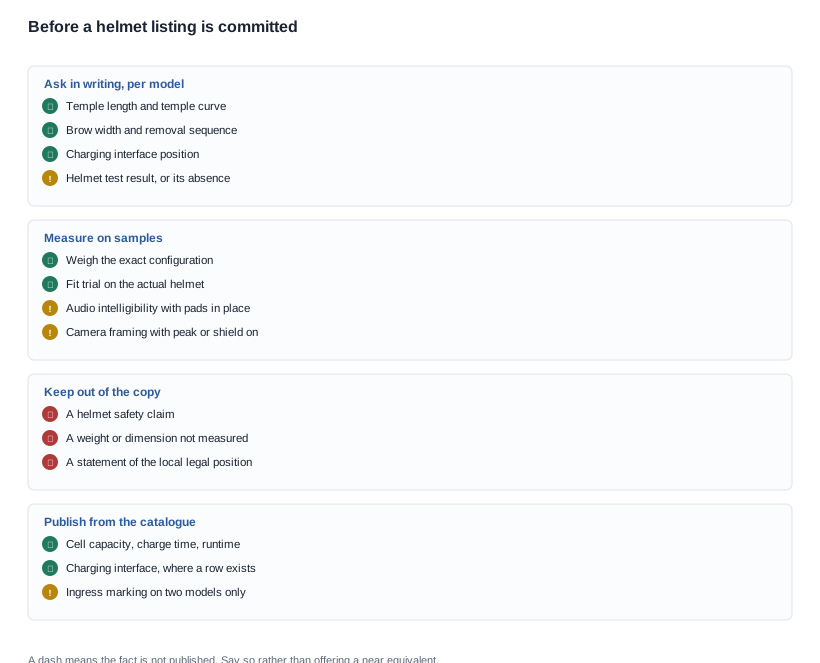
Request the fit rows in one message, per model. Temple length, temple curve, brow width, the measured weight and the interface position, asked together, for the specific configurations you intend to order. Five rows asked in one request take one reply; asked separately they take a week of correspondence. The sample evaluation page covers the protocol, and the sports and outdoor solutions page covers the wider positioning for a channel built around outdoor use.
Run the fit trial with the actual helmet, on the actual team, for a real ride length. Discomfort points appear at forty minutes, not at five, and a fit that works in a shop is not a fit that works under a retention dial. This is the single most common failure in helmet channels and it is nearly free to prevent: it needs the rider, the helmet and an afternoon. It also has to include taking the helmet off and putting it back on, because the removal sequence is where a frame that fits on the head gets discovered to be trapped in the shell.
Test the features under the helmet rather than the frame alone. Audio intelligibility with the cheek pads in place, and camera framing with the peak or the face shield on. These are two separate tests from the fit test, and they are the ones the channel will find. A frame that fits and a product that works are different questions, and the second one is the one that generates the complaint.
Route the strap as it would be in use. A frame that works with the strap adjusted one way does not work with it adjusted another way, and the adjustment is the rider's, made in the dark, at the roadside. Test the contact with the strap laid over it, with the strap laid under it, and with the strap in the position the rider prefers, because that is the position that will be used.
Settle the accessory question before the listing exists. A channel that includes a mount, a strap or a retention adapter has to carry that accessory's own documentation and its own instructions, and the accessory is where a compatibility claim is most often made by accident. If the accessory is supplied, ask the supplier what the accessory's own documentation says about the products it is described as working with, and whether that description names the products or only the general category.
Decide the listing boundary before the copy exists, and write it down. The published rows are what can go in the copy: the cell configurations, the charge times, the rated use, the charging interfaces, the ingress marking where the catalogue publishes one, the remote shutter on the D17 and the ZH12, and the removable inner frame on the V06 and the S7. The temple dimensions, the frame weight, the retention figures, the helmet test results and the local legal position are not, and a listing that reaches past that boundary is a listing that will be withdrawn or, worse, that will be defended.
Six ways a helmet channel goes wrong
A helmet-safety claim was printed on the box. The symptom is a customer in a specific helmet reporting a fit failure, with the brand's own packaging as the evidence. The root cause is a foreseeable use claimed without a test behind it. The prevention is to describe the fit conditions in the copy, or to publish the test, but not to imply a safety outcome from a product that has only been assembled and worn.
Only the fit was tested. The symptom is a camera framing the underside of a peak, or audio that is intelligible in the open air and unusable in a helmet. The root cause is that the feature rows were never tested in the helmet, because the fit test was treated as the whole test. The prevention is to run the two feature tests separately, each on its own, each with the helmet configured as the rider configures it.
The retention dial was never considered. The symptom is a frame pushed down at the sides or held away from the head, with the rider complaining about discomfort rather than about fit. The root cause is that the temple position and the cradle were never checked together. The prevention is a fit trial with the actual helmet and the actual retention system, which is the accessory that makes the helmet a helmet.
The charging contact was routed under the strap. The symptom is intermittent charging reported as a hardware fault, and the cost falls on the channel because a fault that reproduces intermittently on a subset of units is difficult to return. The root cause is that the interface position was never established before the instructions were written. The prevention is to ask where the contact sits, and to include the routing in the instructions as a diagram rather than as a sentence.
The weight was inferred rather than measured. The symptom is a product that is not worn for a full ride, and the reports that arrive describe comfort rather than quality. The root cause is that no measurement was taken, so a plausible number stood in for one. The prevention is to weigh the sample yourself, because the one weight our catalogue publishes is the weight of one specific configuration and it does not transfer to the others.
The legal question was answered by a salesperson. The symptom is a customer relying on a claim the brand made about use while riding or driving, with the brand carrying the consequence. The root cause is that a legal question was treated as a product attribute and quoted as though it were one. The prevention is to keep it with the brand's own function, to settle it per destination market before the copy exists, and to keep the copy clear of it entirely.
What a helmet position is worth, and the limits we publish
A helmet channel is a fit channel, and the fit rows are the ones that are not published. That makes the sample programme the decisive cost rather than the unit price, which is worth saying to a procurement manager before the quotation is discussed rather than after. The scope of the sample programme should be negotiated explicitly: how many units, which configurations, how many riders, how long, and whether the supplier participates in the trial. A sample programme scoped as one unit per model will not find a fit that only appears at forty minutes.
The negotiation is worth the time, and the list is not the usual one. Unit price and volume tiers, the accessory and mounting set with its minimum order quantities, the sample order cost including a helmet fit sample, the packaging specification, delivery splitting, payment nodes against inspection, the warranty period with a stated response, the return terms, and the terms of a pilot order. In a fit-led channel the return terms move more than the unit price does, because a fit problem is a return problem and the cost of a returned unit in a cycling or motorcycling channel is disproportionate to its price.
Some lines follow from the process and are worth asking about rather than arguing with. The cost of a certification and the time it takes are set out by the schedule and by whoever runs the test. Tooling is often amortised across the first order while certification cost is a per-product-family cost, and the two are frequently bundled into a single line that hides which is which — ask which one you are being quoted, and get them separated in the quotation. In a helmet channel there is a third line that is specific to the channel and is usually absent: the cost of a fit failure discovered after the packaging is printed, which nobody prices because nobody owns it.
Four things belong in the agreement for this channel. The published rows for the configuration ordered; the temple length and the temple curve; the measured frame weight; and the interface position with its clearance requirement, together with the audio and camera behaviour under the actual helmet, the retention behaviour, the warranty period with a stated response, and the return terms. Each of these is a fact that a sample can establish, and each of them is a fact that will otherwise be contested by the customer rather than by the parties.
Three things belong out of it. No helmet-safety claim, no weight or dimension that has not been measured, and no statement of the local legal position. These are not negotiation points; they are the places where a claim is made that nobody can support, and a supplier that puts one in a quotation is telling you how the rest of the agreement will be handled.
Where we stand on this is simple enough to state in one line. The honest answer to will it interfere with a helmet is a fit answer and a feature answer, and the fit data is not published for any model in our range. We will publish the ingress marking as a catalogue marking and not as a tested rating, we will not quote a temple length or a frame weight we have not been given, and we will not state that a product is helmet-safe when the test is not published. What we will do is tell you which published features bear on the question, which rows have to come from a supplier in writing, and which three tests a sample settles. The cycling applications page covers the channel context, the sports and outdoor solutions page covers the wider positioning, and the sample evaluation page covers the protocol for the fit programme.
What to do next.
- Settle the two questions separately: the physical fit, and the feature behaviour.
- Ask the fit rows and the interface position in one request, per model, in writing.
- Run the fit trial with the actual helmet, on the actual team, for a real ride length.
- Test the audio and the camera under the helmet, separately from the fit.
- Put the fit rows, the feature results and the return terms in the agreement.
Related reading
- What the channel adds — cycling applications
- The frame properties behind the fit — smart glasses frame materials
- The acoustic questions a helmet raises — bone conduction buying checklist
- Where the product sits in the wider outdoor range — sports and outdoor solutions
- Running the sample programme properly — sample evaluation
Tell us the helmet types, the channel and the destination markets, and we will tell you which rows are documented and which need a sample.


