

Will others hear my music faq has an answer that is true and useless on its own: yes, at some level. An open-ear frame radiates sound from the transducer as well as toward the ear, so a person standing close to you will hear something, and will hear considerably more when the programme material is dense and the output is high. That is not a defect and it is not a secrecy mechanism. It is the direct consequence of the geometry that keeps the ear open to traffic and conversation, which is the same property that makes the category attractive in the first place.
What a buyer needs is not the yes. It is the list of conditions that decide how much, the measurement that separates one candidate from another, and an honest account of what our own published material does and does not settle. We publish no leakage figure for any model in the range — no driver diameter, no sound pressure level, no distance at which the audio stops being audible to a bystander, and no microphone specification. That gap is real, and the way through it is a supplier question and a sample test, not an inference from our specification rows.
Will others hear my music: what the catalogue settles and what it leaves open
The buying task behind the question
Three people ask this in three different rooms, and they need three different outputs from the same answer.
A brand owner is deciding whether an open-ear product can go into a shared-space channel — a café, a showroom floor, a co-working space, a clinic reception — where a stranger standing within arm's reach is the normal condition rather than the exception. For this reader the question is not acoustic, it is channel: does the product create a situation in which a customer or a visitor forms a complaint, and who answers it.
A procurement manager is holding two supplier quotations and needs a comparable way to tell them apart. A verbal assurance about "privacy" is useless at this stage because it cannot be placed next to a second assurance and tested for consistency. What this reader needs is a question set that produces the same shape of answer from every candidate, including the ones that do not have the answer.
A channel buyer is writing listing copy and needs to know which phrases survive scrutiny. This reader is the one most likely to be harmed by an overstatement, because a privacy claim written into a marketplace listing is a promise the brand has to keep in a jurisdiction where the brand is not the manufacturer.
The three readers converge on one requirement: the answer has to be convertible into something written down. A verbal answer can be repeated in a meeting and forgotten in a purchase order; a written answer becomes a line in a due diligence file.
Why the question surfaces during sourcing rather than during use
Open-ear audio has moved out of the demonstration context and into channels where people share space with strangers who did not choose to be in the same conversation. The acoustic behaviour has not changed; what has changed is the number of people in the frame who did not choose to hear it. The question therefore gets asked earlier in the sourcing cycle, because the buyer now has to answer it before the first purchase order rather than after the first customer complaint.
The supply-chain consequence is that leakage becomes a documentation question. Once a channel exists, the brand needs a defensible position for two audiences at once: the retail staff who answer a customer, and the market regulator or the platform that handles a complaint. A position built on "they do not leak" fails both audiences the first time somebody in a quiet carriage complains. A position built on a measured figure, with the measurement conditions attached, survives both.
There is a second reason the question surfaces earlier. The technical work needed to answer it is cheap; the documentation work needed to carry the answer into a channel is not. A supplier can produce a leakage figure in a laboratory in a fortnight. Turning that figure into a claim the brand is permitted to make in every market it sells into takes a claim register, a review, and an agreement about wording. Buyers who leave the documentation until after the samples arrive usually discover that the sample they approved does not match the paperwork they now need.
The rows in our catalogue that bear on sound output
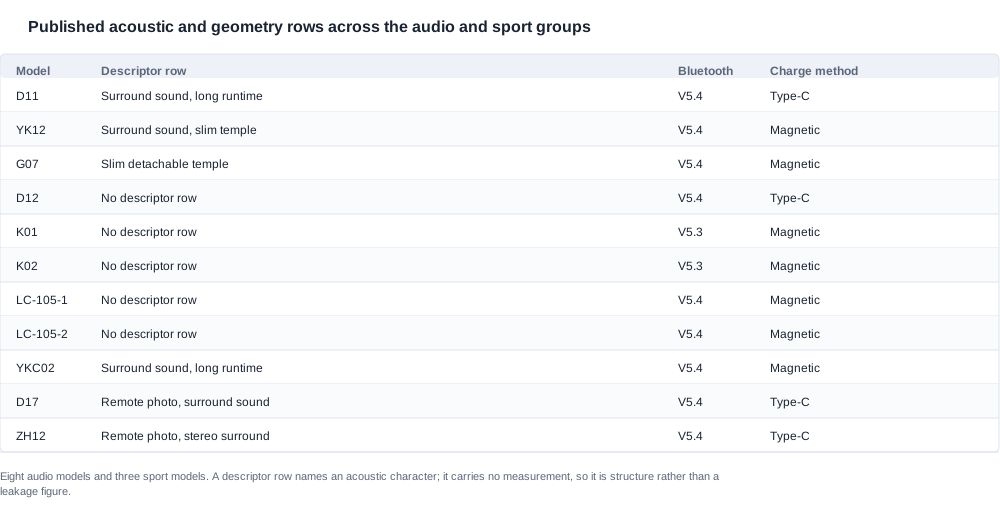
The catalogue publishes specification rows per model and a small number of feature rows, and only some of those touch on acoustics. The useful thing is to know exactly which ones, because they narrow the field without settling the question.
Acoustic descriptor rows exist on five models in the range. The D11 publishes a surround-sound row together with a long-runtime row. The YK12 publishes a surround-sound row and a slim-temple row. The sport models YKC02, D17 and ZH12 each publish a surround-sound row, with the D17 also carrying a remote-control-photo row and the ZH12 carrying a remote-photo row and a stereo surround-sound row. The remaining five of the eight audio models — the K01, the K02, the D12 and the LC-105 pair — publish no descriptor row at all. Their catalogue pages carry the standard specification lines and nothing further about sound.
That absence matters, because a descriptor row such as a surround-sound line tells you that the supplier considers acoustic character worth stating, and its absence tells you that the supplier does not. It does not tell you the leakage level, and it must not be read as a lower leakage level.
Two audio models publish a geometry row. The G07 publishes an ultra-slim, detachable-temple row, and the YK12 publishes a slim-temple row. These are the only published lines in the audio group that speak, even indirectly, to where a transducer can sit relative to the ear, because temple width and temple cross-section constrain the position and the direction of a driver. For every other model the question has no published answer.
One entry in the range publishes an acoustic gain figure. The bone-conduction entry, which carries no model identifier in the catalogue, publishes an amplification gain of 35 dB. That is a real published number and it describes a fundamentally different acoustic path — the signal reaches the listener through the skull rather than through the ear canal — so it should be evaluated on its own terms rather than compared directly with the open-ear figures. Two cautions apply. The first is that this entry has no model identifier, no separate specification sheet and no published leakage figure. The second is that an amplification gain in this range engages a compliance question of its own, and a buyer who handles that entry separately on compliance grounds is treating it correctly.
One control row exists in the whole catalogue, and it is not a touch row. The AR entry publishes an indicator-light row and a button-control row. No model in the range publishes a capacitive touch row, and no model publishes a touch surface, a gesture set or a swipe behaviour. That matters directly for this question, because a per-device volume limit is usually delivered through a control surface, and the catalogue gives you exactly one button-control line to reason from.
What the catalogue does not publish about acoustics
Here is the full list of what a leakage decision would need and the catalogue does not contain: the measured leakage level at any distance; the driver diameter or the transducer type for any open-ear model; the microphone specification for any model; the equalisation presets and their behaviour; whether a maximum output level can be imposed per device, per group or by firmware; the acoustic environment in which any published figure was measured; and the identifier under which the bone-conduction entry would be ordered, quoted or certified.
Two related gaps belong in the same file. The catalogue publishes no per-model certification row anywhere, and the export-certification page is a picture page carrying ten patent certificate images — eight appearance-design patents and two utility-model patents. Those describe design novelty and utility, not radio or product compliance, and they cannot be used as evidence of anything a buyer would need for a leakage claim. The absence of a per-model certification row also means the certification side of due diligence has to be run as a request list, not as a lookup.
The honest position is therefore a three-part answer, and it is worth stating it in exactly this shape because each part leads to a different action.
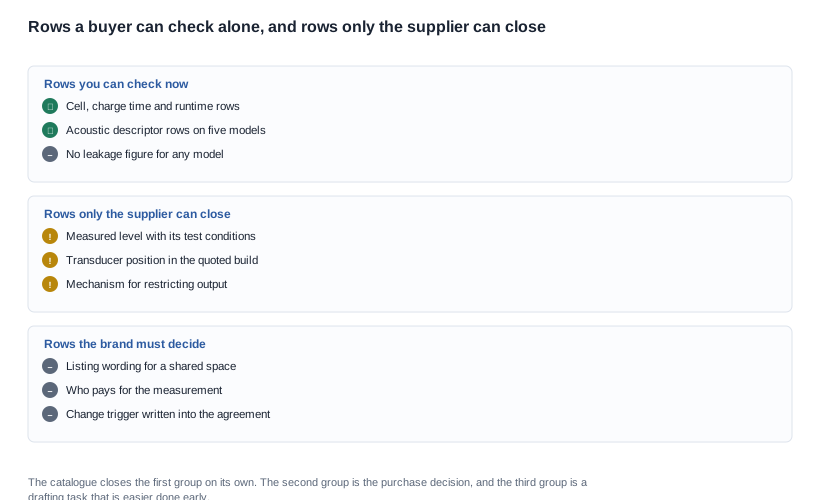
Published. The per-model cell configuration, charge time, rated runtime, charge method and interface, the Bluetooth version where the catalogue records one, the five acoustic descriptor rows, the two geometry rows on the G07 and the YK12, the 35 dB amplification gain on the bone-conduction entry, and the single button-control row on the AR entry.
Not published. Any leakage figure, driver size, microphone specification, output limit, equalisation behaviour or measurement condition, for any model.
To be asked of the supplier. The measurement and its conditions, the transducer position for the quoted configuration, the mechanism by which a brand can restrict output, and the documentation that would accompany the configuration you actually receive.
The three questions to put to a supplier
These three are the ones that consistently separate a supplier who has measured from a supplier who has assumed.
Question one — is there a measured leakage figure for the exact configuration, and under what conditions? The useful form of the answer names the distance, the environment, the programme material and the output setting. A figure without those four is a number without meaning, and a supplier who has one but will not state the conditions is telling you the number is not comparable.
Question two — can output be restricted, and by what mechanism? A maximum level implemented in firmware, in the companion application, or by a physical control are three different answers with three different costs. A brand that wants a channel-specific ceiling needs to know before the order which of the three is even possible.
Question three — where does the transducer sit in the configuration you are quoting? Temple, ear canal, or against the skull. This single answer does more to predict the observable behaviour than any specification line in the catalogue, which is why it is worth asking even when the supplier declines to give a figure.
Will others hear my music: the six factors that move the audible level
Buyers tend to ask for one number and get a paragraph. The paragraph is more useful if it is organised, because the factors behave differently: some are properties of the product, some of the programme, some of the room, and only one of them is under the buyer's control at the point of ordering.
1. Transducer position relative to the ear
This is the dominant factor and the one the catalogue is quietest about. A transducer sitting on the temple and pointing forward and slightly downward radiates in a broad pattern, and the level a bystander receives depends on the angle between the ear and that pattern. A transducer seated at the ear canal entrance produces a much more concentrated field, and the bystander level falls away faster with distance.
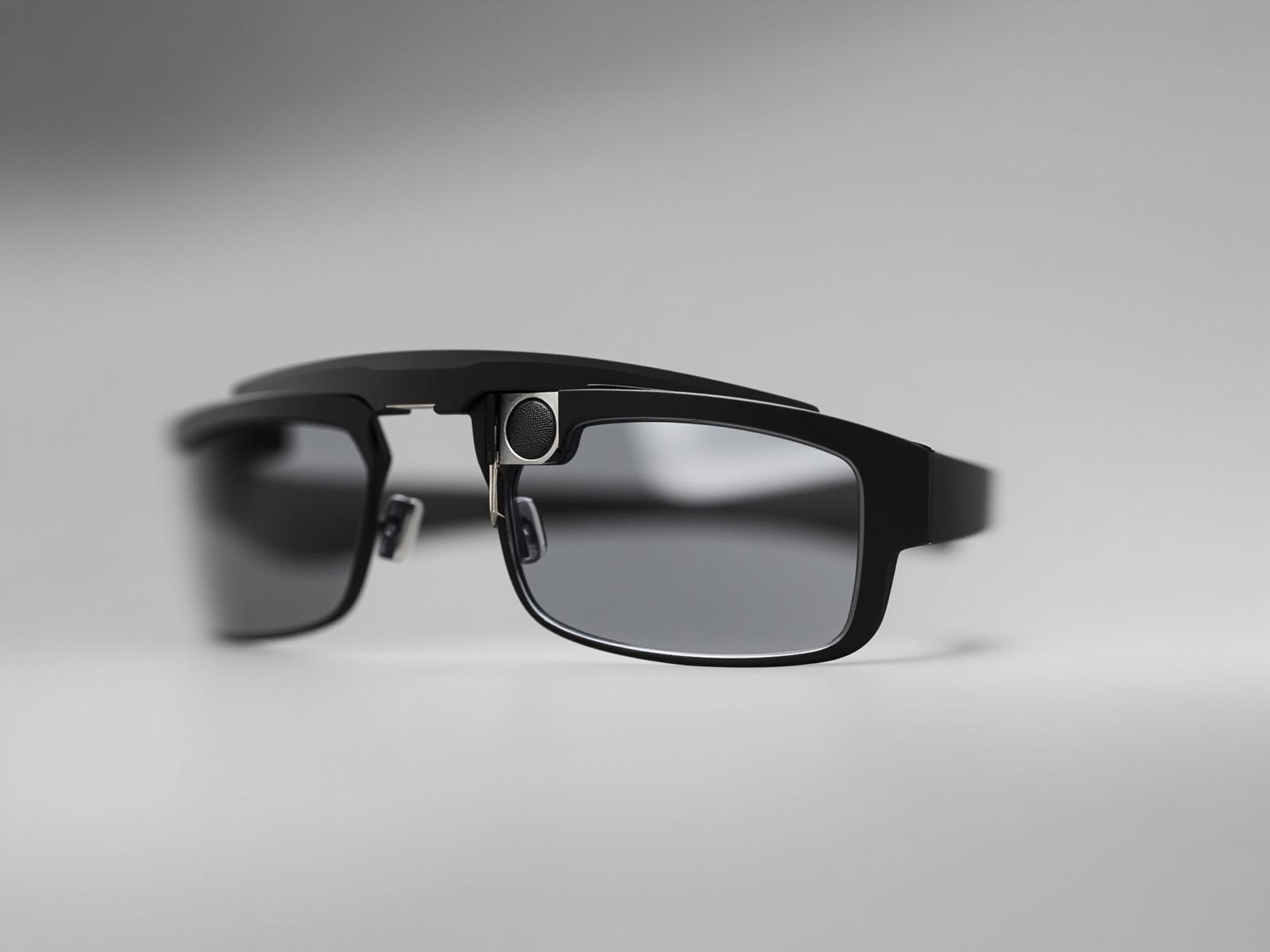
Two published rows touch this, and only two: the ultra-slim detachable temple on the G07 and the slim temple on the YK12. Both describe temple geometry, and both constrain where a driver can be mounted and how much room there is around it. Neither tells you the resulting field. For the other six audio models and for the sport group, the position has to come from the supplier's own drawing or from physical inspection of a sample.
This is also where the bone-conduction entry separates from the rest of the range. Because the signal path bypasses the ear canal, the question "how much leaks into the room" is asked differently: the radiation pattern that matters is what leaves the transducer before the signal is delivered through the skull. That is a materially different measurement, and a buyer who treats the entry as "an open-ear model with a bigger number" is measuring the wrong thing.
2. Output level and whether a ceiling can be imposed
The second factor is the one buyers most often forget to control, because it is the only one that can be set by the brand after the product arrives.
Output level is a continuous variable and the audible level at a bystander's position rises with it. The published rows do not describe output level at all — there is no maximum-output row anywhere in the catalogue, and no row describing equalisation presets or their effect on the mid-range, which is where programme material is usually perceived as loudest.
The commercial significance is this: if no ceiling can be imposed, then the observable behaviour of the product in a channel is set by the customer, not by the brand. A brand that has accepted a product with no output restriction has accepted that the leakage behaviour it sells is the leakage behaviour a customer chooses to create. If a ceiling can be imposed — and question two of the supplier set is precisely the question that establishes whether it can — then the brand owns the variable and can write a defensible statement about it.
This is worth noting as a selection criterion rather than a feature request. It is the kind of row that separates two candidates that otherwise look identical in every published line.
3. The ambient floor of the space
Audibility is a ratio, not an absolute. The same product in a quiet carriage and in a busy café produces a completely different experience for a bystander, and the difference is large enough that a test in one place cannot be generalised to the other.
A buyer who runs a test in a silent room learns almost nothing about a café channel. A buyer who runs it in a realistic space learns a lot but gets a number that is not transferable to a second space. The practical resolution is to treat the ambient floor as a variable to record rather than a constant to eliminate, and to require the supplier's figure — if one is offered — to state the environment in which it was taken.
There is a second-order point here. A channel that will be quiet is not only a channel where leakage is more audible; it is also a channel where the open-ear architecture delivers its benefit most clearly, because the ambient floor is what the open ear is there to solve. The trade-off runs in both directions and a buyer who wants an answer should decide which side of it the channel sits on before evaluating any candidate.
4. Distance and orientation
Distance attenuates, and orientation determines how much of the radiated field reaches a given point. Two people at the same distance on different sides of the wearer do not receive the same level, because the radiation pattern is not symmetric about the head.
This is the factor most often handled carelessly in testing, because a test usually has one listener standing in one place. A test with two listener positions, one forward and one to the side, costs nothing extra and immediately shows whether the product has a directional character. If it does, the channel copy can describe the practical situation honestly; if it does not, the copy must be written to assume the worst listener position rather than the most flattering one.
This is also the factor that most affects the number written in a listing. A distance-based claim — "audible only within one metre", for example — is a claim about the product at a stated output level in a stated environment, and it is not a property of the product alone. Any listing language built on distance has to carry its conditions.
5. The programme material
The same output level produces very different audibility depending on what is playing. Sustained tones and narrow-band material radiate differently from speech; dense modern material with a wide dynamic range peaks far above its average level; classical and acoustic material concentrates energy in the mid-range where the ear is most sensitive.
Buyers rarely consider this because the specification is about the hardware and the material is about the customer. But a channel that plays continuous music at a fixed level — a retail floor, a waiting area, a gym — produces a far more consistent bystander exposure than one where the customer controls the material and the level. A channel decision should therefore include the question of whether the product will be used for continuous playback by the brand itself, because that case has a predictable exposure level and a very different answer.
6. The bone-conduction pathway as a separate case
The bone-conduction entry is published with an amplification gain of 35 dB, no model identifier, and no other acoustic detail. For a leakage question it belongs on a separate sheet of the file, not in the same comparison, and there are three reasons to keep it there.
First, the acoustic path is different, so the measurement that matters is different. Second, the entry has no identifier, which means a quotation, a certification file and a purchase order all need a naming convention agreed in advance — a procedural problem that gets expensive when it is discovered late. Third, an amplification gain at that level raises a compliance question that has to be settled before the product is listed in any market, and it is a question for a specialist rather than for a purchasing department.
None of this makes the entry unusable. It makes it a different purchase, with a different file, and a buyer who treats it as one more row in an open-ear shortlist will produce a file that is wrong in both parts.
How the six factors combine into a single judgement
The factors do not average out. They compound in one direction and cancel in the other. Transducer position and output level set the baseline; the ambient floor decides whether that baseline matters in the channel; the programme material decides whether it is sustained; distance and orientation decide how far the exposure travels and in which direction.
The useful output of a leakage assessment is therefore not a verdict but a description: for this configuration, at this output level, in this class of space, a bystander at these positions would hear approximately this. A supplier that can produce that sentence, with its conditions attached, has given you something you can use in a channel. A supplier that offers a single number without conditions has given you something that will be misquoted within a month.
Will others hear my music: a sample test you can run before the order
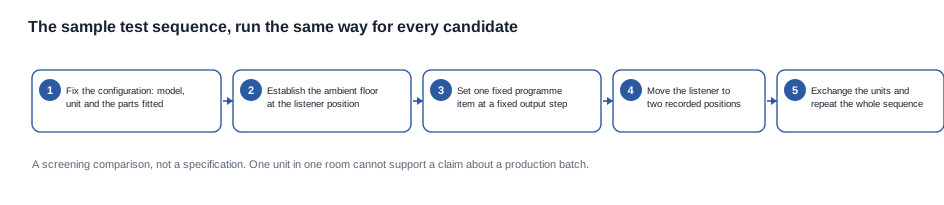
A sample test is cheap, and the main risk is that it is designed in a way that produces a misleading answer. The sequence below is arranged so that the most expensive mistake — generalising a single-room result to a channel — is structurally prevented.
Designing the test so it can be repeated
Run the same protocol against every candidate, write it down before you start, and do not change it mid-comparison. The value of the protocol is not the answer it produces but that two suppliers' answers become comparable because they were obtained the same way.
The minimum viable version needs two candidate units, one uncontrolled space that is not silent and not noisy, one listener role, and a written record. A listening position diagram on a single sheet of paper — distances and angles, not a photograph — is enough.
Three rules matter more than the equipment. Do not test a unit whose configuration you cannot describe, because the configuration is the thing you are buying. Do not test only the loudest setting. And do not treat the first answer as the answer; run the sequence twice with the units exchanged, because an unfamiliar unit sounds different from a familiar one.
The five conditions to vary
Output setting. Start low and step up through the range a customer would actually use, rather than to the maximum. Note where the bystander first detects sound, because that is the number most relevant to a shared-space channel.
Listener position. Two positions at minimum, one roughly level with the wearer and one to the side or slightly behind. The difference between them indicates whether the product has a directional character, and it is the cheapest way to find out.
Programme material. At least two kinds, one speech-based and one music-based, because the difference between them is one of the largest effects you will observe.
Ambient floor. Record the room in a way that is comparable between sessions — a level reading at the listener position is enough. A rising ambient floor during a test invalidates the comparison, and a café next door opening a door is a real and common cause.
Unit configuration. Record the unit identifier, the settings in force, and the physical configuration of the frame. A change of temple or of a detachable component changes the answer, which is precisely why the G07 and the YK12 rows about temple geometry matter to a buyer planning channel variants.
What to record and how to file it
A readable test record has five fields per observation: the candidate and its unit identifier, the output setting, the programme material, the listener position, and the detection outcome. Add the ambient reading and the date. That is the whole record, and it is enough to produce a defensible statement later.
Two filing habits make the record worth keeping. The first is to record the negative results as carefully as the positive ones, because a candidate that only meets a threshold under one setting is a different commercial proposition from one that meets it across the range. The second is to write the conclusion as a conditional sentence — "at output setting X, in a room with an ambient reading of Y, detection occurred at position Z" — rather than as a general property. A conditional sentence survives the customer complaint that follows a different setting in a different room; a general property does not.
One limit has to be stated: a test of this kind is a screening comparison, not a specification. A single unit in a single room cannot support a claim about a production batch. Its correct use is to sort candidates and to expose the questions that the supplier's own documentation should answer.

Will others hear my music: where a leakage answer goes wrong
The question attracts confident answers because it sounds binary. Most of the damage in a sourcing programme comes from answers that are true of some configurations and are then applied to all of them.
The categorical claim that cannot be substantiated
"They do not leak" is the most common answer and the least useful. It cannot be tested by a customer, it cannot be defended in a complaint, and it fails against the first observation anybody makes in a quiet space. The same failure appears in a milder form: "the audio is private enough for public transport", which hides three variables — the output setting, the listener distance and the ambient floor — inside an apparently specific sentence.
The usable replacement is a bounded statement: a configuration, an output range, a space, and an expected outcome. It is longer to write and it is the only version that survives contact with a customer.
The comparison against a phone speaker
Phone speaker comparisons are extremely common in this category and they are not informative. A phone speaker is a small driver in a small enclosure held close to the head, radiating into a space largely blocked by the head and the hand. An open-ear frame is a driver mounted on a temple with a long, open acoustic path. The two radiate into different environments and leak under completely different conditions.
A comparison is useful only when it is used to say something specific — that the frame's output is directional, or that it does not behave like a small speaker in a sealed body — and only when the comparison is stated in terms of the observable rather than the emotional. "People next to you can hear it" is a legitimate observation; "like a phone speaker" is not a specification.
Reading a descriptor row as a leakage figure
This one is specific to our own catalogue and easy to get wrong. The D11 publishes a surround-sound row, the YK12 publishes a surround-sound row and a slim-temple row, the YKC02 publishes a surround-sound row and a long-runtime row, the D17 publishes a surround-sound row, and the ZH12 publishes a stereo surround-sound row. It is tempting to read that as a statement about acoustic quality, and then to read acoustic quality as a statement about how far the sound travels.
It does not support either step. A descriptor row states that the supplier considers the acoustic character worth naming. It contains no measurement, no distance and no environment, and the five audio models with no descriptor row are not thereby quieter. The two rows that genuinely constrain the acoustic outcome — the temple geometry on the G07 and the slim temple on the YK12 — constrain it because of physical position, not because of a marketing label.
Privacy wording that creates a mismatch
The most expensive failure in this area happens on the listing page rather than in the factory. Copy that promises privacy — "private listening", "hear only what you hear" — turns an architectural property into a performance promise, and it does so in a document the brand owns. When a customer later reports otherwise, the mismatch is between the brand's own words and the product, and the brand cannot point at a supplier to explain it.
The correction is a copy discipline rather than a product change. Describe the architecture; state the conditions; do not promise a private outcome. Where a channel wants a stronger promise, the answer is a configured ceiling and a written configuration, not a sentence.
Will others hear my music: what to negotiate and what to write down
Everything in the previous sections reduces to one commercial problem: the useful information is not in the catalogue, so it has to be bought. Four things are worth negotiating, and they are worth negotiating in this order because the first one makes the other three easier.
A written acoustic position rather than a verbal assurance
Ask for the leakage position of the configuration you are quoting, in writing, with its conditions. The ask is deliberately narrow — not "prove the product is quiet", but "state the measured level for this configuration, at this distance, at this output setting, in this environment, or state that it has not been measured".
The second half of that sentence is the valuable half. A supplier who answers "we have not measured it, and here is what we can offer instead" has given you a stable position that you can plan around, and the difference in reliability between that answer and a vague assurance is the difference between a programme and a hope.
Then put the answer in the agreement rather than in the meeting notes. The clause that matters is the change trigger: if the driver, the supplier, the acoustic configuration or the firmware changes, the acoustic position is re-confirmed. Without that clause the position silently ages, and it will still be in your file when the question is asked again.
Paying for the measurement instead of assuming it
A measurement has a cost and a buyer should expect to bear part of it. There are three routes, and they are not equivalent. An on-site measurement during sample approval is the cheapest and the least generalisable. A measurement at an accredited laboratory is the most transferable and the slowest. A supplier's internal figure is fast and useful only if its conditions are stated.
A workable commercial structure is to agree, before the sample order, that the acoustic measurement is performed on the sample units, that the report travels with the documentation pack, and that the brand receives the raw conditions rather than a summary line. Ask explicitly which party bears the cost, because the answer is informative about how the supplier sees the position and it is cheaper to agree in advance than to argue about afterwards.
The claim register and the wording you are allowed to use
Agree the list of phrases the brand may use, in writing, before the artwork is produced. Three categories are worth distinguishing: descriptions of the architecture, which are generally safe; statements of published specification, which must match the catalogue rows exactly; and outcome claims, which need a measured figure behind them and the conditions attached.
The category that causes trouble is the third, and the reason is that it is the one that sells. A brand that has negotiated a measured figure can use a specific statement; a brand that has not will be tempted to reach for the descriptive wording and accidentally make an outcome claim. Deciding the wording in advance, while the request for the figure is still open, is the cheapest protection available.
The lever when the answer is conditional
Not every supplier will commit to a figure, and a buyer needs something other than frustration in that case. Two substitutes are available and both are negotiable.
The first is a configured output ceiling. If the supplier can restrict output per device or per group, the brand controls the worst case even without a measured level. The mechanism matters — firmware, application or a physical control — and so does who can change it and when, because a limit that any user can lift is not a channel control.
The second is a written description of the configuration, combined with a stated policy on what the brand's own listing may say about it. Where the supplier will not commit to a figure but will commit to a configuration, the brand can still write an honest, defensible statement, and it can write it before the first customer ever asks.
Will others hear my music: a worked shortlist and the boundary of this answer
A hypothetical shortlist, run through the sequence
Take a brand owner building a shared-space channel and comparing three candidates: an audio model that publishes a descriptor row, an audio model that publishes none, and the bone-conduction entry. This is an illustration of the method, not a recommendation, and no candidate is proposed as the selection.
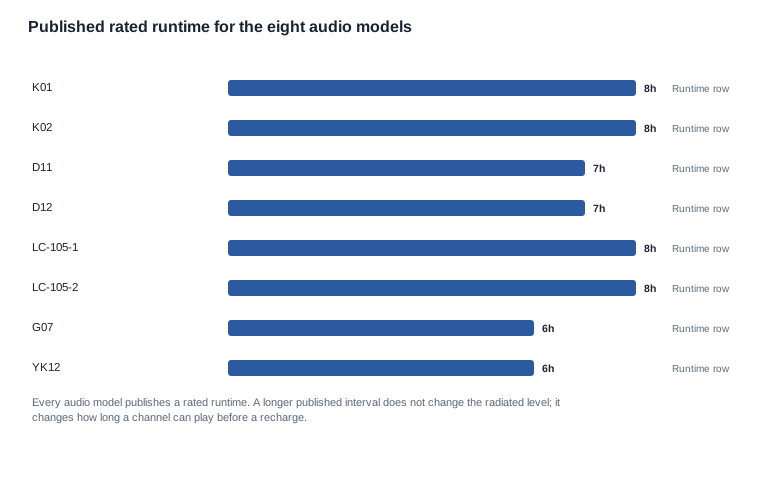
Step one, the published rows. The first candidate and the second differ on paper in almost nothing — the same class of cell configurations, the same charge-time ceiling, comparable rated runtimes, and a Bluetooth version recorded for each. The first carries a surround-sound descriptor row; the second carries none. The third is a different acoustic path entirely, with a published amplification gain of 35 dB and no model identifier.
Step two, the questions. Asking all three suppliers the same three questions separates the field immediately. One supplier returns a measured figure with its conditions and a drawing showing the transducer position. One returns a figure without conditions and no drawing. One returns a written description of the configuration and an answer to the output-restriction question that names a mechanism.
Step three, the sample test. The two open-ear candidates are tested under the same protocol. The candidate with the descriptor row and the one without produce materially different detection outcomes at the same output setting, which is exactly the result that would be expected from a difference in transducer position and would not be expected from a difference in marketing vocabulary. The bone-conduction candidate is removed from this comparison because the test protocol does not measure the right thing for it, and is scheduled for its own evaluation.
Step four, the file. The shortlist now contains a measured figure with conditions for one candidate, a screening observation for the second, and a separate compliance workstream for the third. That file can answer a channel manager, a platform and a customer, which is the standard the question was asked against.
Notice what decided the outcome. It was not the descriptor row, and it was not any published specification line. It was the answers to three questions that the catalogue does not answer — the same three questions every buyer should ask before this question is answered for them.
What this page can settle, and what it cannot
What we can state. The catalogue publishes, per model, the cell configuration, the charge time, the rated runtime, the charge method and interface, and the Bluetooth version where a row exists. It publishes acoustic descriptor rows on the YK12 and the D11, the ZH12 and the D17, and the YKC02, a geometry row on the G07 and on the YK12, an amplification gain of 35 dB on the bone-conduction entry, and one button-control row on the AR entry. Every audio model has a published rated runtime, and every model in the range publishes a charge time, which is an upper bound rather than an exact duration and therefore a figure to plan with rather than to promise.
What we will not state. No leakage figure, no driver size, no microphone specification, no output limit and no measurement condition for any model, because none of those are published. We will not estimate a level from the runtime rows, from the descriptor rows or from the geometry rows, and we will not quote a typical figure from the industry as if it applied to a model we have not specified. A number of that kind ends up in a tender document and then in a claim.
What we will do. For a specific model and a specific channel, we can identify which published rows apply, which of the three supplier questions has to be answered before the position can be written down, and what has to be in the agreement so the position survives a change of supplier or configuration.
The next actions for a buyer who has to answer this
- Write the three supplier questions into the request for quotation, so every candidate answers the same thing in the same form.
- Shortlist on the published rows that bear on acoustics — the descriptor rows, the temple geometry rows and the bone-conduction entry's separate status — and treat them as structure, not as a performance ranking.
- Order samples before committing the copy, and run the five-condition protocol once per candidate with the units exchanged.
- Decide the claim wording in advance with the supplier, so the listing describes the architecture and does not promise an outcome nobody measured.
- Put the acoustic position and its change trigger into the agreement, so the answer is still true in the sixth month.
The short answer to will others hear my music is that a bystander will hear something, that how much is decided by transducer position, output level, the space and the programme material, and that our catalogue publishes none of the four. What it does publish is a structure you can use to write the question properly — and that structure is where a defensible answer actually starts.


