

We do not publish a price for this model, so this article is about what a value argument for it can and cannot rest on. The conclusion is specific and slightly awkward: this model publishes the shortest rated runtime in its group and the smallest cells, which means its value case cannot be endurance — it has to be form factor, and form factor is the one thing a buyer can evaluate in a sample.
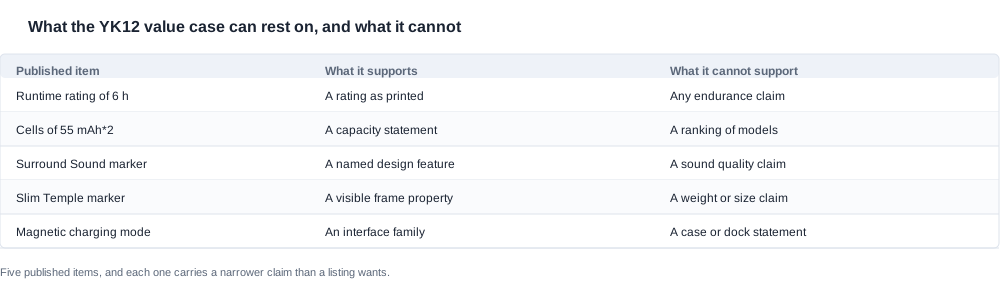
The published configuration: Bluetooth V5.4, a pair of 55 mAh cells, a charge ceiling of two hours or less, roughly six hours of rated runtime, magnetic charging, and a slim-temple surround-sound designation.
Mistake one: treating six hours as a disadvantage
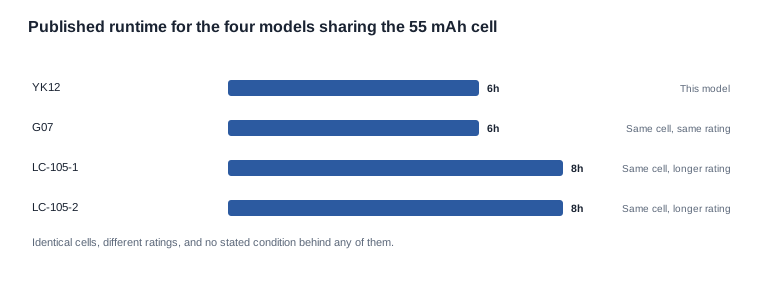
Roughly six hours is the lowest figure published among the models sharing this cell configuration, with the others at roughly eight. It looks like a weakness on a comparison sheet and it may not be one at all, because no test condition is published for any of those figures.
A shorter published figure can equally mean a more honest measurement, a heavier duty cycle, or a platform that was tested conservatively. The difference cannot be established from the data.
So the question is not which figure is higher. It is what each figure was measured under — volume, codec, distance from the source, sample size, mean or best case. A supplier who answers that has measured it; one who does not has a marketing number.
Four models, one cell, two ratings
It is worth making the group concrete, because the shape of it is the argument. Four models in the audio range share one cell configuration, 55 mAh times two: this one, the G07, and the two LC-105 variants. Every one of those four prints the same radio version, the same charge ceiling of two hours or less, and the same magnetic charging mode. The only published differences between them are the runtime rating and the name printed against the temple.
The ratings split the group evenly. Two of the four are published at roughly six hours and two at roughly eight. Since the cells are identical and the ceiling is identical, the difference cannot be a capacity difference, and it cannot be a charging difference either. Whatever produces it is in the measurement, and the measurement is not published.
That is the practical point for a value case. A sheet that ranks these four models by runtime is presenting a two-hour gap that four identical configurations produced, which makes four products look like two categories when the catalogue treats them as one cell family. A sheet that ranks them by cell capacity would produce something worse, because the capacity is the same for all four and the ranking would be empty.
So the honest summary of the group is: one hardware configuration, one charging arrangement, one radio generation, two published ratings, and one design marker each. Which of those a buyer can actually sell is the question the rest of this article answers.
What a buyer cannot do with this group is treat it as a range. A range implies an ordering that can be read off a sheet and acted on, and the catalogue offers no ordering here. All four models share the radio generation, the cell, the ceiling and the charging mode. The group is not a ladder with four rungs; it is one step with four designations on it, and the only things that vary are the length of the rating and the frame markers each one prints. A comparison table that presents it as a range is presenting an ordering the catalogue does not contain, and the ordering is usually borrowed from the sort order of the sheet.

Mistake two: treating the cell capacity as the spec
Two 55 mAh cells is the smallest published total capacity among the four models sharing it, and it is also the configuration that produces the longest published runtimes in that group on two of them. Capacity and runtime in this category are not aligned, which means one of the two figures is being measured more generously than the other across the board.
The practical consequence: you cannot use capacity to rank these models, and you should be suspicious of any supplier who ranks them that way — including a comparison sheet that ranks by the smaller number, because it will make the models look more different than they are.
Why capacity and runtime disagree, and why that is worth knowing
The disagreement between capacity and runtime is not a curiosity. It is a test of how the catalogue is built, and it changes what a buyer should expect from any figure taken out of it.
Take the group as a whole. The four models with 55 mAh cells are published at six and eight hours. The two models with 90 mAh paired cells are published at eight hours. The two models with a single 100 mAh cell are published at seven hours. A model with 70 mAh paired cells is published at eight hours. Read as a curve, those numbers do not describe a relationship. More cells do not reliably produce more hours, and in one case the smallest configuration in the range produces the same rating as a configuration twice its size.
Two readings are possible and the published data cannot separate them. Either the runtime figures were produced under conditions that differ from model to model, in which case they are not comparable with one another; or they were produced under one common condition, in which case the disagreement is a property of the hardware that nobody has explained. Either way the consequence for a buyer is identical, and it is the only one that matters here: a runtime figure in this range cannot be transferred between models, cannot be quoted as a working day, and cannot be multiplied by a duty cycle to produce a specification.
That is also why the capacity figure is the more useful of the two, even though it is the less interesting one. A cell configuration is a physical fact about a unit. It is stable, it is checkable on a sample with a scale, and it does not depend on a protocol that was never published. A runtime is a statement about a procedure, and a procedure that is not published cannot be reproduced.
The criteria for using either figure are short enough to write down and worth writing down. Capacity may be quoted, compared and carried into a freight model. Runtime may be quoted only as the rating printed on the page, attributed to that page, and never applied to a working day. Any buyer who has those two rules written down will find that the value conversation stops being about the number and starts being about the model, which is the only place where a decision can actually be made.
Mistake three: expecting the product to be differentiated by its numbers
This model publishes no feature note beyond the slim-temple surround-sound designation. Its published configuration carries nothing else: no camera row, no application row, no accessory row.
Which means the value argument has to be made on things a customer can see rather than read. That is not a weakness in the product; it is a different product strategy. A slim temple is visible in the first five seconds and is worth something to a channel selling design. A named surround-sound designation is worth something to a channel that needs to describe the unit in one line. Neither is worth anything on a specification comparison, and if your channel is a specification comparison, this is not the model.
The four-branch test for a value argument
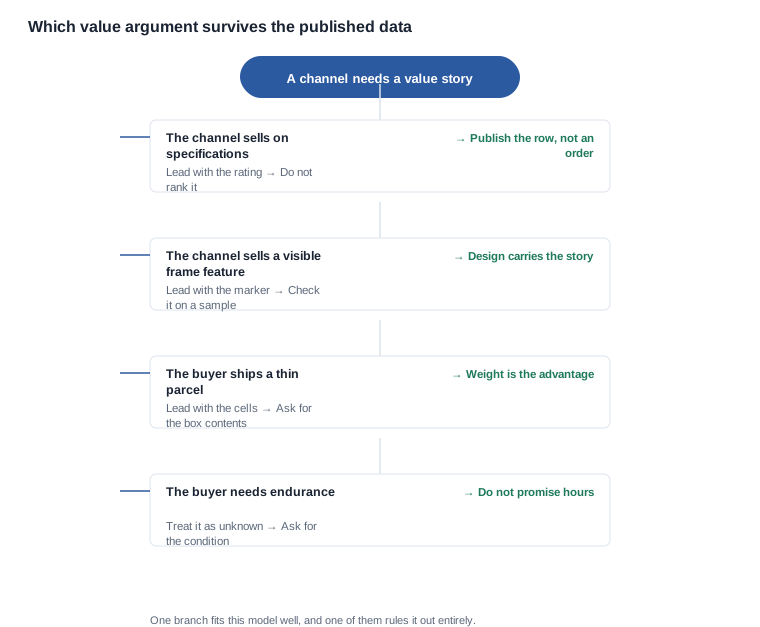
Which of the four published items can carry a value argument? The chart below walks the branches a buyer actually has to take, and it is worth reading for the branch that rules this model out.
The first branch is a channel that sells on specifications. For that channel a value case is a ranking, and this model cannot be ranked. Its runtime is the lowest in its group with no condition attached, and its cells are the smallest with the same consequence. A specification channel publishing a comparison table would put this model's figure in a column that makes it look weaker, without the condition that would make the figure mean anything. The red flags in a value case are rarely in the product; they are in the comparison sheet.
The second branch is a channel that sells a visible frame property. Here this model is genuinely strong, because the two named markers are concrete, photographable and specific. The strength is real, and it is also the entire strength — there is no second differentiator behind it, which means a shortlist built around it has one reason in it rather than three.
The third branch is a buyer moving thin parcels. The smallest cell total in the group is a genuine advantage, and it is the one advantage here that scales with volume rather than with taste.
The fourth branch is a buyer who needs endurance. That branch is closed by the published data, and no amount of listing copy reopens it. How to choose between these branches is a question about the channel, not about the model, and the answer should be written down before the model is selected rather than discovered afterwards.

What the value case can honestly rest on
- The slim-temple designation, which is a visible difference and does not require a specification to defend.
- The surround-sound note in its own row, which is a model-specific feature rather than a category phrase — verify it on a sample, since no acoustic measurement is published.
- The smallest cell total in its group, which for a buyer shipping thin is a genuine parcel advantage.
- A sample-tested frame, which is the only way to establish how the frame sits, since frame weight and temple dimensions are unpublished for every model in this range.
Why the list is shorter than a typical value case
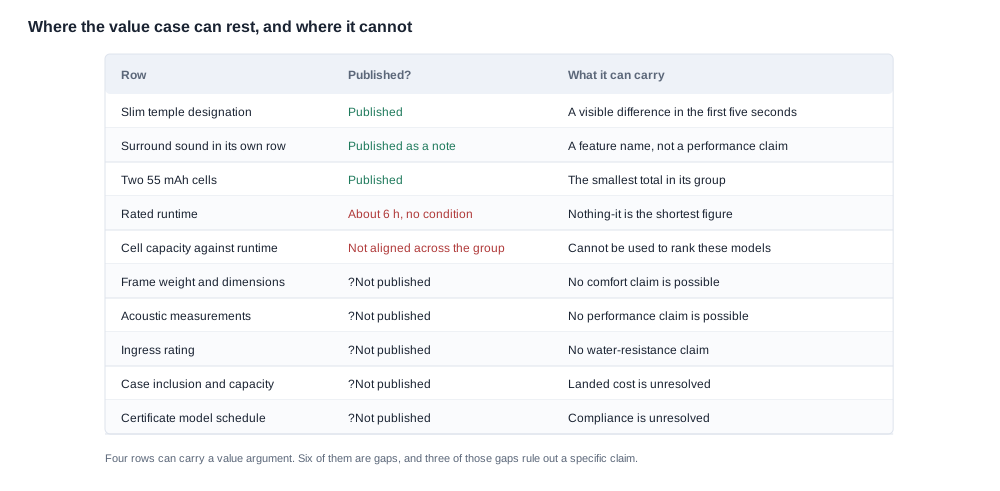
A value case in this category usually runs to six or eight numbered benefits. This one runs to four, and the reason is structural rather than editorial. The published configuration has seven rows, and only three of them support a claim that a customer can be shown. Producing a fifth item would require either an inference the catalogue does not license, or a promise the supplier has not made. Both are cheap to write and expensive to defend.
The cost of a short list is that it narrows the channel rather than widening it. A channel briefed to find six reasons will not shortlist this model, and it would be wrong to pretend otherwise. The useful response is to stop looking for reasons and start looking for the buyer who needs two. Choosing a model because a brief asked for six bullet points is exactly how a catalogue ends up with a product page that contradicts its own specification page.
Each of the four items also comes with its own evidence requirement, and this is where the total cost of the value case actually sits. The first needs a photograph and no specification at all, because a visible frame property defends itself. The second needs a sample, because the sound marker is a name rather than a measurement and the only way to know whether it means anything is to hear the unit. The third is a claim about cells rather than about the parcel, and it turns into a parcel claim only once the packed weight is established. The fourth needs a technician with a scale and a tape measure.
Three of the four therefore need something before they can be used, and a due diligence note that lists them is worth more than a fifth bullet point written from imagination.

What it cannot claim
No frame weight, temple length or lens dimension. Not published for this model or any other in the audio range, so a claim about how the frame sits has no published basis.
No acoustic measurement. Leakage, driver size, frequency response and microphone pickup distance are unpublished across the range, so the surround-sound note is a feature name rather than a performance statement.
No ingress protection rating, so no water-resistance claim of any kind.
No certificate numbers, issuing bodies, validity periods or covered model schedules. The catalogue text carries no reference to CE, FCC or RoHS at all; we publish no conformity claim of our own, and model-level certificate numbers, covered variants and validity periods are not published because no such document sits behind them.
No price, and no minimum order quantity we will quote. The catalogue publishes neither, and a quantity figure that gets written into a purchase order has to arrive on a document rather than in a conversation.
And whether a case or dock is included at your quantity is not published — the catalogue prints the charging mode as magnetic and prints no charging case row for this model at all. Published case capacities elsewhere in the range run from 900 mAh to 1400 mAh, so that omission is worth a question before you build any landed-cost model.
What each absence costs, and who can close it
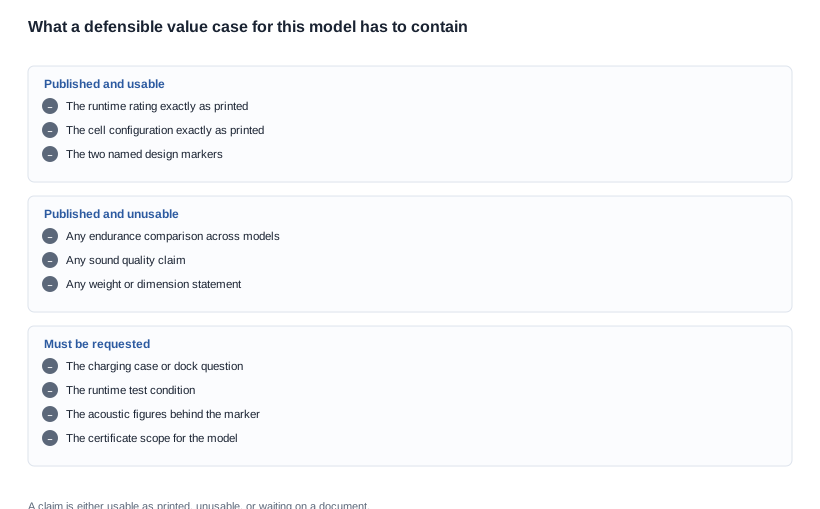
The six absences above are not equal, and treating them as one list is what makes a value case feel impossible. Two of them can be closed with a sample: the frame weight and the temple dimensions need a scale and a tape measure. Two can be closed by a written request: the acoustic figures and the microphone pickup distance exist inside the factory and can be stated in a reply. One is a document question: the certificate scope, which depends on the market and on the exact model designation. One is a packaging decision: whether a case or dock exists and what it holds.
The ordering matters because it tells a buyer which of the six is worth chasing this week and which will not move. A sample request is cheap and closes two rows in a day. A written request closes two rows over a longer cycle. The document question and the packaging question both sit with parties outside the factory floor, which is why they belong in the programme plan rather than in a message sent on the day the model is selected.
The most expensive absence is not the one that blocks a listing sentence. It is the one that changes a number. Two of the six do that: the missing packed weight changes the freight model, and the missing runtime condition changes what can be promised to a customer. The remaining four cost copy rather than money, which is a much easier thing to absorb.
A practical way to run this list is to sort it into three columns — what a sample closes, what a written request closes, and what nobody can close today. The third column is short, and it is the column to disclose rather than bury, because a buyer who finds it late finds it at the worst possible moment.
Where CYNRIN stands on the YK12 value case
We can tell you what this model is published as, and we can tell you plainly that its value case is a form-factor case rather than a specification case. We will not quote a price, a frame weight or an acoustic figure, and we will not rank it against its siblings on figures whose conditions are unpublished.
Send us the channel, the target retail price, the quantity and what your customer responds to, and we will tell you whether this model is the right value proposition for that buyer.
What we will put in writing, and on what date
The value argument for this model can be put on paper today, in three parts. The published configuration, in the exact wording the catalogue uses for it. The claims the published rows carry, each one stated with the condition it omits. And the list of what has to be requested, with the party that owns each answer and the date it is due.
What cannot be put in writing is anything about a price, a quantity, a packed weight, or a duration under a stated condition. That is not caution for its own sake. It is a statement about which documents exist. A value case built on rows that exist can be signed, quoted and repeated without being re-argued. A value case built on rows that do not exist has to be defended again at every order, and the defence gets weaker each time because the same figure keeps being asked for.
The practical instruction is to decide which kind of value case the business actually wants, and to do it before the model is selected rather than after. A channel that can sell a design marker and a compact cell configuration has a defensible case for this model today. A channel that needs endurance figures or an acoustic comparison does not have one, and no amount of further reading of the catalogue will produce it.
Before you order on this model, the due diligence is therefore short. Confirm the channel branch first, because one of the four branches has no case for this model at all. Then convert the six absences into the six requests they imply, and put them on the register with an owner and a date. The checklist above is that register, in the form it should be handed to whoever will answer it.
Related reading
- The group this model sits in — Bluetooth audio glasses
- Checking a unit before you commit — sample evaluation
- Reading the runtime claims — smart glasses battery life
Send the channel, the price, the quantity and what your customer responds to, and we will tell you if this is the right value case.


