

Price positioning between the YK12 and the D11 is the first question a channel buyer asks and the last question either supplier will answer with a number. Neither model has a published price. That is not a gap we can close by quoting a market average, because an average of two unreported numbers is still an invented number. What we can do is separate the two frames into the hardware differences that actually move a cost curve, and let you build a price position from real components instead of from a supplier's guess about your retail.
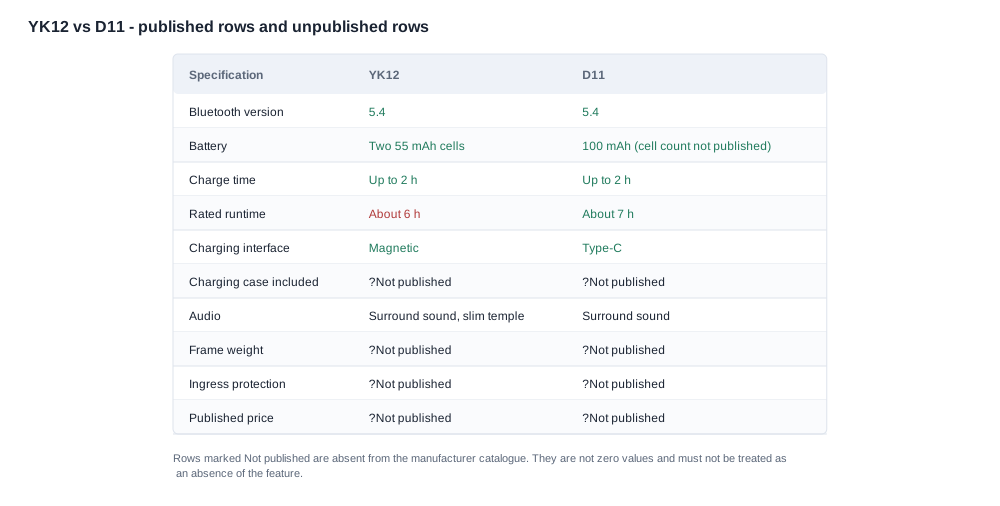
YK12 vs D11 price positioning: no published price on either side
Both models appear in our product catalogue with full electrical specifications. Neither appears with a price, a minimum order quantity, or a lead time. This is not unusual for a factory that quotes per configuration, but it has a consequence worth being blunt about: any comparison of these two models that ends in a specific price band is comparing the writer's assumptions, not the products.
If you have seen one, treat it as an opinion. If you need a defensible position, the only defensible basis is the bill of materials, the tooling implications, and the certification status — and of those three, the first two can be reasoned about publicly and the third has to be asked for.
Why a price band is not a comparison
A price band looks like a fact and behaves like an opinion. It has the shape of a number, which is what makes it persuasive, and it is usually produced by averaging whatever a handful of other suppliers charge for whatever they think the nearest comparable product is. The arithmetic is invisible and the assumption is load-bearing.
The two models in this comparison make the point cleanly, because the published record between them is short and unusually well defined. Four rows differ between the two pages. Everything else printed for them is identical: the same radio version, the same two-hour charge ceiling, the same absence of any charging case row, the same silence on weight, dimensions and certificate numbers. A buyer who wanted a price band could not construct one from this comparison without inventing the two inputs that matter most, which are what the frames cost to make and what the box costs to ship.
So the honest alternative is not a band with a wider error bar. It is a position built from named components, where every number in it is either published or requested in writing, and where the reader can see which parts are still open. That is a smaller claim than a price band, and it is the only one of the two that survives a costing review.
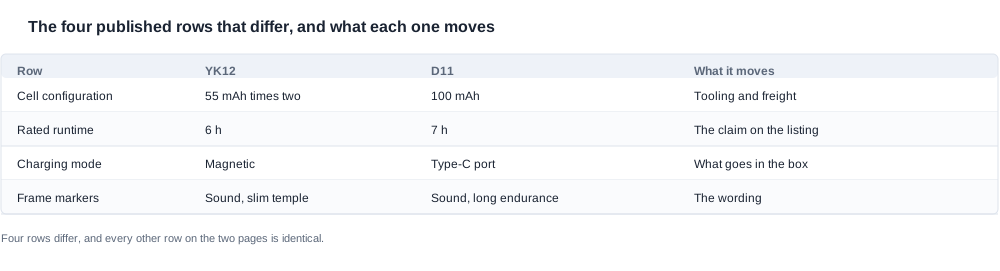
The four published rows that differ
Everything the catalogue says about these two models fits in a short list, which is exactly why the comparison is easy to get wrong — buyers assume there is more hidden detail than there is, and pad their estimates accordingly.
Runtime is the one that moves a shelf price. The YK12 is published at roughly six hours of rated use. The D11 is published at roughly seven. For an open-ear audio frame sold on battery anxiety, that single hour is frequently the deciding spec, and it is the hardest difference to argue away in a product listing.
Charging interface is the one that moves your box. The YK12 charges magnetically. The D11 charges over Type-C. Magnetic charging on a frame usually involves a mating dock or a case, and that changes the tooling and the carton. Whether a charging case is supplied with the YK12 is not published, and that single unstated item can be larger than the entire component difference between the two frames. Ask it directly.
Battery configuration is the one that moves tooling. The YK12 is published as two 55 mAh cells. The D11 is published as a single 100 mAh figure. How many cells the D11 actually uses internally is not published, so do not build a tooling assumption on the arithmetic.
Acoustic positioning is the one that moves the marketing copy. Both are described with surround or directional audio. The YK12 adds a slim-temple designation; the D11 does not carry one. Frame weight is not published for either, and for a product used through a full day that is the number you will be asked for most often after the runtime.
The runtime difference, and why one hour is not a cost
One hour of published runtime is a marketing difference before it is a cost difference, and it is worth separating those two things because a buyer who treats it as a cost difference will overpay for the correction.
The honest position on both figures is that they are ratings without a stated condition. Neither page says at what volume the audio was played, over what codec, at what distance from the source, or whether the figure is an average across units or the best result in a batch. One of them may well have been measured more generously than the other, and nothing published allows a buyer to say which.
So the hour cannot be converted into a component cost, because the thing that would let you convert it — the condition — does not exist in the record. What it can be converted into is a copy decision and a returns decision. On copy, the model with the longer published rating can say more about endurance than the other one can. On returns, a model whose rating is quoted by customers as a working day will generate different support contacts than one whose rating is quoted as a rating.
The practical instruction is to quote both figures as ratings, attributed to their pages, and to write the condition into the file once it is known. A listing that says "rated six hours" is defensible. A listing that says "a full working day" is not, for either model, on the current record.
The interface difference, and where the money actually sits
Magnetic charging against Type-C is the difference with the largest cost consequence and the smallest published footprint, which is why it deserves the most attention and the most questioning.
A Type-C frame charges from a cable the customer is likely to own. A magnetically charged frame generally involves something else in the box, and that something is either a dock, a case or a pad. The catalogue prints a magnetic charging mode for this model and prints no charging case row for it at all, which means the accessory question is genuinely open rather than answered.
Three costs follow from that single unanswered question, and they are of different sizes. The first is the component cost of the accessory, which is the smallest. The second is the tooling and the carton, which is larger, because a dock changes the moulding and the packaging. The third is the effect on the product page and the unboxing, which is the largest in commercial terms because it changes what the customer believes they have bought.
That is why this is the first question to ask rather than the fifth. A buyer who has answered it can model the box. A buyer who has not is pricing a carton that may not exist.
The cell configuration difference, and the arithmetic not to do
Two paired 55 mAh cells against a single published 100 mAh figure is a tempting comparison and a poor one, because the two numbers are not measured the same way and the second one does not say how many cells it describes.
The temptation is to add the two cells on one side and conclude that the frames differ by a small amount, or to convert one into the other and price the difference. Both moves fail. The published figure on the D11 side is a capacity number for a single stated figure with no cell count attached, so it cannot be read as a one-cell or a two-cell configuration, and no inference about its internal arrangement is safe. The 55 mAh pairing on the other side is a count the catalogue does state, which means it can be planned around and cannot be extrapolated.
There is also a reason the numbers are not directly comparable that has nothing to do with units. A paired-cell frame and a single-cell frame place their mass differently, and mass distribution is one of the things a buyer is usually asked about after the weight itself. Since neither weight is published for either model, the paired-versus-single difference shows up first as an unanswered question rather than as a cost.
The defensible use of both figures is therefore narrow and still useful: they are the inputs to a freight calculation once a packed weight exists, and they are the inputs to a battery-request that can be put to the factory in one line. What they are not is a basis for a unit-cost difference between the two models.
The copy difference, and what it is worth
The fifth difference is not a hardware row at all, and a price comparison that ignores it usually lands on the wrong model.
The YK12 carries a slim-temple designation that the D11 does not, and both carry a surround-sound marker that is common across the range. A named frame property is worth something in a channel that sells a designed object, because it is concrete, visible and photographable without a measurement behind it. It is worth much less in a channel that sells on specification, where it settles nothing.
The trap is to price the marker as though it were a component. A designation does not add cost to the bill of materials; it changes what the page can say and therefore what the channel can charge for the page. That is a positioning decision, and it belongs to the channel, not to the catalogue.
The second trap is to treat the surround-sound marker as a differentiator when it appears across the range. A marker shared by several models does not separate them, and a listing that leads with it is leading with something the customer can find elsewhere in the same category. The slim-temple row is the one that is specific to this model, and it is specific by being a frame description rather than a performance one.

Turning four rows into a price position
Here is how we would approach the decision if we were buying, which is the closest we get to a recommendation.
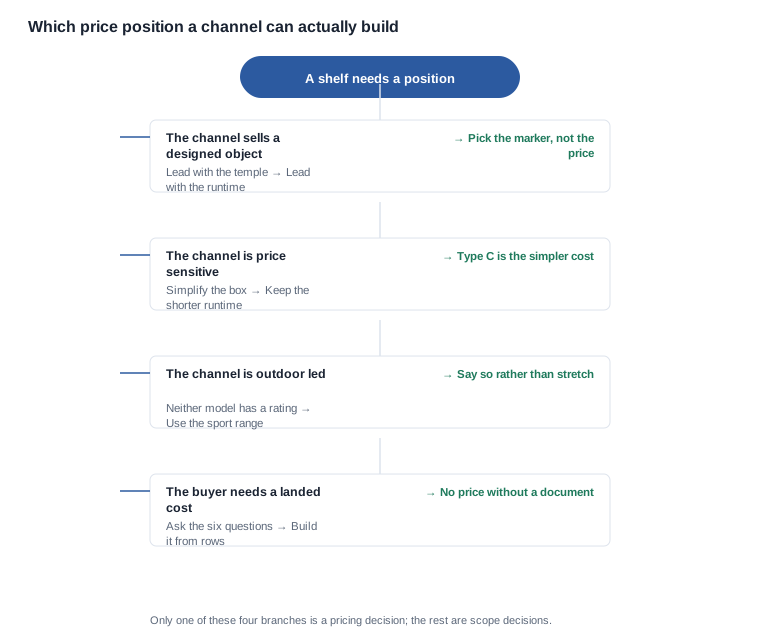
If your channel is a design-led retail shelf, the YK12 is the more flexible product. A magnetic charging format gives you a dock story, a dock changes the unboxing, and the unboxing is what supports a higher shelf price. The cost is the one hour of runtime and the fact that the case inclusion is unconfirmed.
If your channel is a value or utility shelf, the D11 is the simpler product. Type-C charging means a cable the buyer already owns, no dock to package, and the better published runtime figure. Simplicity is worth real money at the low end of a price band, because every component you remove is a component that cannot go wrong in transit.
If your channel is sport or outdoor, neither is the right answer and we would rather say so. Neither model carries a published ingress protection rating. Our sport smart glasses range is the one to look at instead, and even there the rating is a catalogue marking rather than a certified test result.
How to build a landed cost from published rows only
The way to make this comparison defensible is to build the cost from the top down in the order the information becomes available, and to keep an explicit line for everything that is still open. Four steps do it.
Start by removing the rows the two models share, because they cannot justify a price difference and they will otherwise inflate the comparison. What is left is the four rows above, and of those only two are cost rows: the charging arrangement and the cell configuration. The runtime row and the copy row belong in the listing, not in the costing.
Next, close the cost rows with a written request rather than an assumption. That means the accessory question, the packed weight and the internal cell arrangement, and it means accepting that the answers arrive over days rather than minutes. While they are outstanding, the cost model carries an explicit line for them instead of a number.
Then put the two models on one basis, which means the same weight basis, the same carton assumption and the same freight terms. A total cost that compares a gross weight with a net weight is not a total cost, and the difference between the two models is small enough that a basis error would be larger than the difference itself.
Finally, hand the result to the quotation request rather than to the listing. The cost model is an input to a conversation about a price. Publishing it as a price is the step that turns a defensible position into an invented one, and it is the step most often taken by accident.


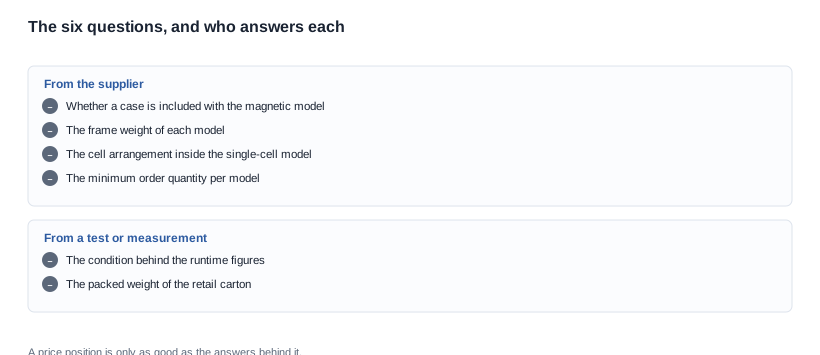
Six questions that settle the price question
Before you ask a supplier for a quotation on these two models, get these answered in writing. Each one changes the number, and each one is currently unpublished.
- Is a charging case included with the YK12? This single answer moves the landed cost more than every other difference on this page combined.
- What is the frame weight of each model, including batteries? Not published for either. Weight drives both the shipping band and the return rate.
- What test condition produced the six-hour and seven-hour figures? Volume level, codec, distance from the phone, and whether the figure is average or best case.
- How many cells does the D11 use, and what is the replacement path when one fails?
- Do the certificates cover both model designations, or one? The catalogue text carries no reference to any conformity mark, and the certificate numbers and the model coverage are not published, so this has to be checked against a document.
- What is the minimum order quantity for each model, and is it the same for both? The catalogue publishes neither, and a figure that arrives without a document cannot go into a purchase order.
The quotation request, and how to compare two answers
The six questions are only worth writing down if the answers can be compared when they come back, and the way to guarantee that is to ask each one in the same form for both models. "What is the frame weight of each model" is a question with one answer per model. "Which model is lighter" is a question that produces an opinion, and opinions cannot be costed.
There is a second discipline that matters just as much, and it is what to do with an answer that is not a number. A supplier who says the case is included but cannot say what it holds has answered the box question and left the cost question open. A supplier who says the weight depends on the configuration has told you the weight is a variable rather than a figure, which is useful, because it means the model has more than one and the costing has to name one of them.
The comparison criteria that work here are the same ones that work in any negotiation of this kind: how many artefacts each answer touches, which role has to sign it, what evidence exists today, and what it costs to reverse later. Where two answers are otherwise equal, the one that can be closed with a document is the one to fund first.
There is also a red flag worth naming, because it is common and it is quiet. A quotation that arrives complete, with a price band, a minimum order quantity and a certification statement, before any of the six questions has been answered, is a quotation of an assumption. It may be an excellent assumption, and it may still be the wrong one, and the difference between the two is exactly the work this list exists to prevent.
Where CYNRIN stands on the YK12 and D11 comparison
We do not publish a price for the YK12 or the D11, and we will not estimate one for you. If you send us a target retail price, a target market and a quantity, we will tell you which of the two models can be built to land there, what has to change to get there, and where the margin is genuinely thin. If the honest answer is that neither reaches your price band, we will say that instead of quoting a number that fails at the first costing review.
What we can put in writing this week
Given a target market, a target retail price and a quantity, we can return the four differing rows on one page, mark each one as a cost row or a copy row, and name the open items against each with the party that owns the answer. That is a narrower answer than a price band and a more useful one, because it survives being passed to a costing team.
We can also tell you which of the two models the published record suits, using the criteria above rather than a ranking. On the current record, a channel with a design-led shelf and a magnetic-charging story has more room with this model, and a channel that wants the simplest possible carton and the longer published rating has more room with the D11. That is a description of two fit cases, not a recommendation, and the choice between them belongs to the channel.
What we will not do is shorten the six questions into one. A single request for "the price" produces a single number that hides which of the six inputs it actually contains, and the buyer ends up with a position that cannot be defended in a costing review. The list is the deliverable.
Related reading
- How published battery figures are actually measured — smart glasses battery life
- Form factor differences that change channel fit — open-ear frame formats
- Running a sample before committing — sample evaluation
Send target market, retail price and quantity, and we will tell you which model is realistic.


