

Use case fit is decided by packaging, not by the specification table, and that is the whole argument of this comparison. The YK12 and the D12 differ in four published rows — the cell configuration, the charging method, the rated runtime and the feature designations — and two of those differences are about how the product gets charged and how it looks while it is being worn. Neither is a specification a shopper compares; both are things a buyer feels. So if you work out the yk12 smart glasses vs d12 use case fit question from the battery numbers, you will get the wrong answer with high confidence.
The working method is the opposite: name the scene first, then pick.
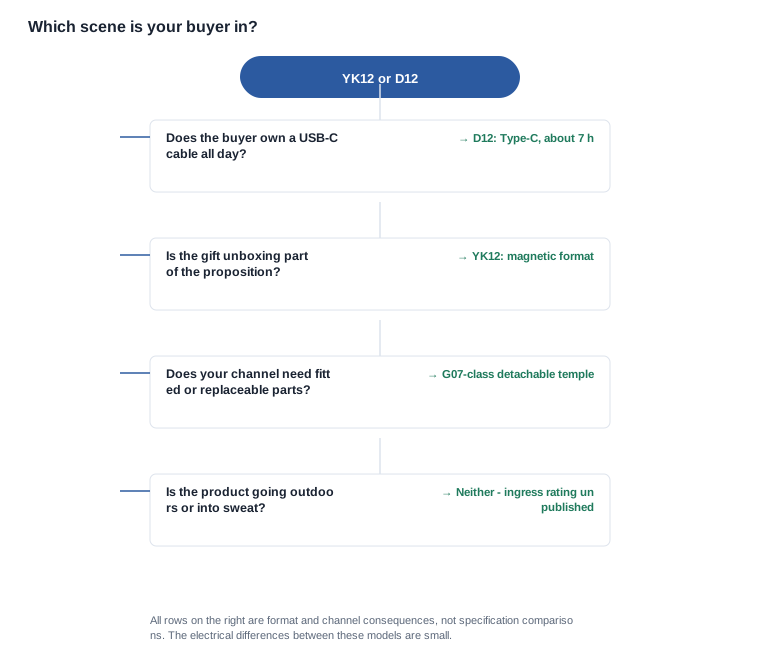
Scene one: a commuter who charges at a desk
Picture the buyer. They leave the house at seven, arrive at the office at eight, and their USB-C cable is in the laptop bag all day. They use the glasses for calls and for audio on the move.
This is the D12's scene. Type-C charging means the cable they already own is the cable the product uses. Nothing else is needed, nothing else has to be explained in the listing, and there is no dock in the box that a shopper has to be sold on. The D12 is also published with roughly seven hours of rated use against the YK12's roughly six, which in this scene is the difference between finishing the day and reaching for the cable at four.
The trade is honest and should be stated in your listing: no magnetic dock means no dock story, and if you want to sell a premium unboxing experience, this product will not give you one.
What the desk scene needs in writing
A desk-commuter scene sounds trivial, and that is exactly why it is worth writing down, because the specification that wins it is the specification a shopper never reads.
The scene in one line: the buyer leaves the house with no cable, sits near a socket for eight hours, and needs the product to survive the commute and the afternoon on a single charge.
What that scene actually rewards. A charging method the buyer already owns the cable for, and a rated runtime long enough to cover the day without a lunchtime charge. Those two rows are published for both models, which is why the desk scene can be decided on paper at all. Everything else about the desk scene — weight, comfort over a long session, whether the frame stays put — is not published, and it has to be settled on a sample.
What the scene costs. If you build a listing for this buyer, the absence of a dock is not a gap to apologise for; it is the thing that makes the product work with what the customer already has. The trade is that there is no unboxing moment to sell, and a channel whose retail proposition depends on packaging theatre has to build that moment some other way.
The decision to make. For a desk commuter, the question to ask is not which model sounds better but which one can be handed over with a single sentence: it charges over the cable you already own. A channel that wants to be able to say that has a requirement on the model, and the requirement is checked against the published charging row rather than against a sample impression.
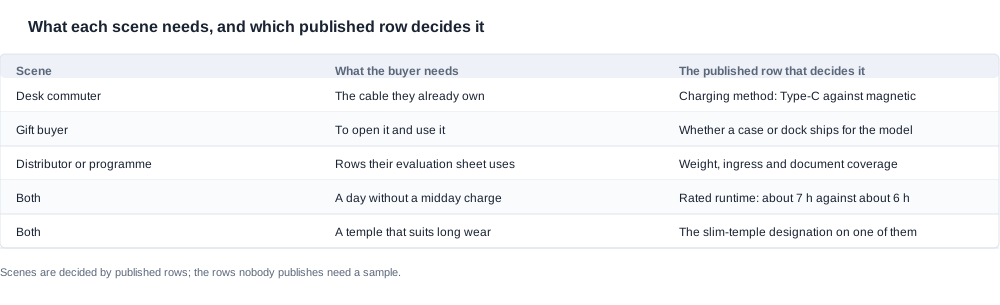

Scene two: a gift buyer, or anyone who does not own a cable
Now picture the opposite buyer. They are buying this as a gift, for someone who has never heard of open-ear audio glasses and will not read a specification sheet. They open the box, they put it on, it pairs, it works.
This is the YK12's scene, and the advantage is not the six-hour figure. The advantage is that the charging format is magnetic, which means the product can be presented as a self-contained object that charges by being put back on a dock. Whether a charging case is actually supplied with the YK12 is not published, and you need that answered before you build a listing on it — but the format creates the option, and Type-C does not.
The YK12 also carries a slim-temple designation in the catalogue. For a first-time buyer who is going to wear the product in an office for eight hours, a lower-profile temple is a better story than a spec sheet.
The gift scene, and the answer it depends on
The gift scene is the one where the emotional argument is strongest and the published evidence is thinnest, so it is the scene where a buyer is most likely to build a listing on an assumption.
The scene in one line: the recipient has never used open-ear audio, will not read a specification sheet, opens the box, and expects the product to work immediately.
What the published rows support. The magnetic charging format creates the option of a self-contained object that goes back on its own dock. The slim-temple designation is a design story a gift buyer can be shown in three seconds. Both are real, and both are configuration entries rather than measurements.
What the published rows do not support. Whether a charging case or dock actually ships with this model is not published for it, and the whole gift-positioning argument rests on that single answer. If the answer is no, the scene still works — it simply has to be sold on the cable and the temple rather than on the dock — and a listing written around a dock that does not ship is a return, a review and a support ticket.
The question to ask before the artwork exists. Ask whether a case or dock is available for the model, at what quantity, and with what capacity. The answer decides whether the gift scene gets a packaging concept or not, and packaging concepts are expensive to change late.
Scene three: the channel that is not retail at all
If you sell through distributors, clinics, corporate wellness programmes or fleet-style buyers, the fit question changes entirely. Those channels buy on a comparison sheet, on warranty terms and on serviceability, and they care about weight, certification coverage and the availability of replacement parts more than they care about the dock.
For those channels, neither model wins on the published material alone, because the material does not contain the rows that matter to them. Frame weight is not published for either. Ingress protection is not published for either. There is no per-model certification row in the catalogue for either model, and no certificate number or model coverage schedule is published for either. Build the evaluation around those three gaps and let the supplier fill them or explain why they cannot.
The evaluation sheet those channels actually use
Distributors, corporate programmes and fleet-style buyers do not shop on a scene. They shop on a sheet, and the sheet has the same rows for every model, which is why a comparison article that only describes scenes is of no use to them.
The rows their sheet contains. Frame weight and dimensions, ingress position, the documents that cover the exact model designation for each destination market, service and replacement terms, the lead time a purchase order can actually plan around, and the minimum order quantity per model. None of those six rows is published for either of these two models, or for any other model in this range.
What that means for a comparison. A channel working this way cannot choose between two audio models on published evidence, because the published evidence covers cell format, charging method, runtime and feature designations — none of which is on their sheet. The honest move is to build the evaluation around the six gaps and ask the supplier to fill them, in one request with one deadline, rather than to rank two models on rows the sheet does not use.
What to do with a supplier who cannot fill them. That answer is itself the finding, and it is worth more than a promise. A supplier who can state the weight, the ingress position and the model coverage in writing has given a channel a document it can build on. A supplier who cannot has told the channel what the risk of this programme is going to be, and it is better to learn that before the artwork than after.

What the two models actually share
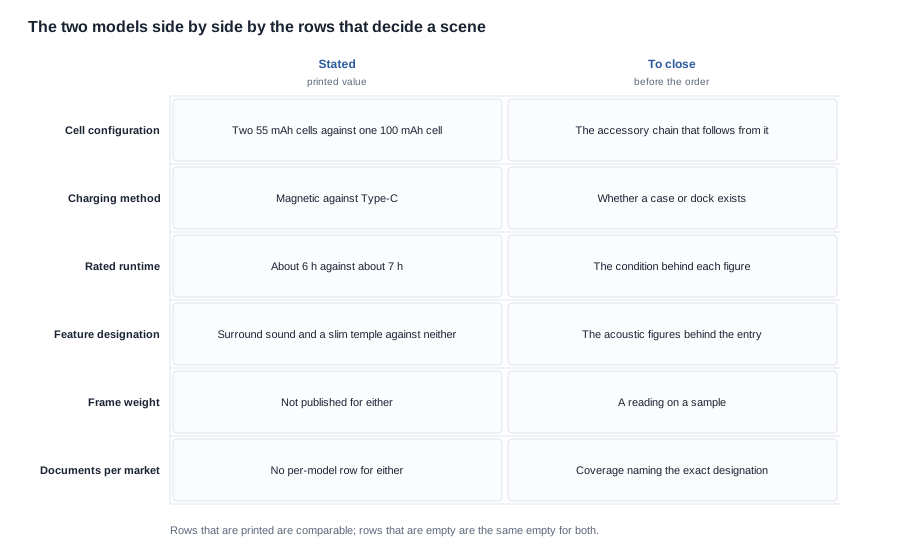
It is worth stating plainly, because comparison articles tend to manufacture differences. Both are published at Bluetooth 5.4. Both have a charge time of up to two hours. Neither publishes a frame weight. Neither publishes an ingress rating. Neither publishes a price, and neither has a published minimum order quantity.
The category description for this range refers to open-ear directional audio, and the only noise-reduction mention anywhere in the catalogue sits in the company introduction rather than in a model row. The YK12's row additionally carries a surround-sound designation with the slim temple; the D12's row carries no separate audio designation. Treat that as an absence of a model-specific note rather than as a confirmed feature difference.
The shared gaps, and why they are shared
Two models can share a gap without sharing a cause, and the difference matters when a channel is deciding which gap it can live with.
The gaps that are genuinely shared. Neither model publishes a frame weight, a temple length, a lens dimension or a head-size range. Neither publishes an ingress position. Neither publishes a per-model certification row, a certificate number or a covered-model schedule. Neither publishes a minimum order quantity, a lead time or a price. Every one of those rows is empty for both, and the empty rows are the same rows because they belong to the catalogue rather than to the model.
Why they are shared. The catalogue publishes what the product sheet states and does not fill the gaps with figures borrowed from elsewhere. That is a property of how the documentation is written, not a decision that was taken separately for each model, which is why the same row is empty for a model with two cells and for a model with one.
The gap that is not shared. The charging method is published for both models and it is the one row where the two differ in a way a customer feels. The cell configuration is published for both, and it is the one row that tells a buyer whether the accessory chain has one item in it or two. Everything else that differs between these two models — the runtime band, the feature designations — sits in the category of rows that are published without their conditions.
Why that matters for a comparison. A channel that wants a defensible comparison between these two models cannot build it on the published rows alone, because the published rows describe how the products are built rather than how they perform. The defensible comparison is: two models that differ in charging method and cell format, that share every operational gap, and whose operational rows a supplier has to fill before either of them can be listed.

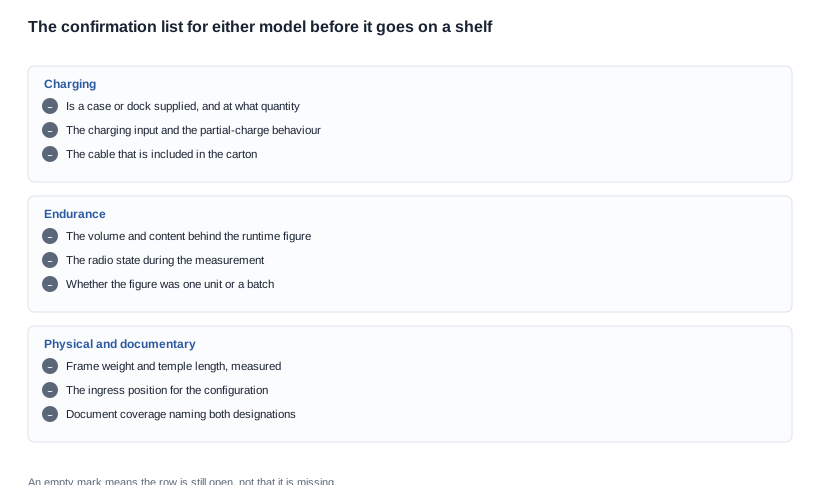
Five things to confirm before either goes on a shelf
- Is a charging case in the YK12 box, and at what quantity? The whole gift-positioning argument depends on this single answer.
- What volume, codec and phone distance produced the six-hour and seven-hour figures? Neither is published, and the difference between them may shrink or reverse.
- Frame weight for both models. Not published for either. For an eight-hour wear scenario this is the parameter that decides returns.
- Do the documents name both models? No certification row exists per model in the catalogue, and the export page carries company-level patent certificates rather than model-level conformity records. Model-level coverage has to be checked against the document itself, not against the brochure.
- What is the minimum order quantity per model, and does it differ? We hold three conflicting internal figures on our own MOQ and will not pick one for you.
The order to confirm them in
The five confirmations on this page are not equally urgent, and the order below is the one that keeps a programme moving.
First, the dock or case question for the YK12, because the gift positioning, the packaging concept and the artwork all hang on it. It is one question, and it can be asked before anything else is.
Second, the runtime conditions for both models, in a single request that asks what content was running, how loud, whether the radio was idle or active, and whether the cell started full or part-charged. The published figures are about six hours and about seven hours, with no condition attached to either, and the difference between them may narrow or reverse once the conditions are stated.
Third, the physical rows on a sample — frame weight, temple length, bridge width — because they decide the return rate in a long-wear scene, and they are the cheapest of the five to close.
Fourth, the document coverage, per model designation and per destination market. The catalogue carries no per-model certification row, so this is a request rather than a lookup, and it is the item with the longest lead time of the five.
Fifth, the commercial rows — the minimum order quantity per model, the lead time, and the terms — which need no laboratory and no sample, only a date and a signature.

What to write on the listing while the rows are still open
A listing does not have to wait for every row to be closed, and waiting is often the more expensive choice: artwork, packaging and photography all cost money once they are approved.
Write what is published, in the published words. The charging method, the cell configuration, the charge-time ceiling and the feature designations can go on the page today, because they are printed. Keep the runtime as a rating rather than a promise, and keep the weight, the ingress position and the document coverage out of the page entirely until they are measured or documented.
Write the gaps as a deliberate choice where it helps. A line that says the frame is configured with two cells and charged magnetically is doing more work than a line that says the battery lasts a long time, because a buyer can check the first and only has to trust the second.
Do not write around the gaps by implication. Describing a frame as light when no weight is published, describing it as water resistant because another model in the range carries an ingress marking, or implying a sound quality that no acoustic figure supports, are all claims the supplier has to honour without having made them. The cost of that is a withdrawal later, and a withdrawal is more expensive than a missing line.
Keep one register for both models. Two models with the same empty rows will be asked the same questions, and an answer that covers one of them usually covers the other. A single register with one line per row per model is what turns the second model's documentation into a copy of the first model's, instead of a second round of chasing.
Where CYNRIN stands on the YK12 and D12 comparison
We will tell you which model suits a scene, but only once the scene is real. Send us the channel, the retail price you need to hit, the average wear session your buyer has, and whether they are likely to own a USB-C cable already. On that basis we can tell you which of these two is buildable to your price point and which is not.
What we will not do is quote you a market price for either model, or invent a runtime figure for a test condition the manufacturer never published. Those two numbers would be the easiest to produce and the first ones to cost you an argument with your customer.
What we can and cannot tell you today
There are two halves to an honest answer about a pair of models like these, and it is worth keeping them apart.
The half we can answer today. The published rows: Bluetooth V5.4 for both; a charge time of up to two hours for both; two 55 mAh cells and magnetic charging for one, a single 100 mAh cell and Type-C charging for the other; a rated runtime of about six hours for one and about seven for the other; and a feature designation on one of them that the other does not carry. We can also tell you which rows are empty for both, and why they are empty.
The half we cannot. We cannot tell you which model is right for your channel, because that depends on the scene, the wear session, the cable your customer already owns and the rows nobody has published. We will not quote a market price for either model, we will not convert the two runtime figures into a working-day claim, and we will not present a weight we have not weighed or a certification record we do not hold.
What we will do. Send the channel, the retail price you need to hit, the average wear session and the destination markets, and we will tell you which of these two is buildable to that price point and which is not, which rows are closed and which are still open, and what has to be asked before the artwork exists. Where the answer depends on a row that has to be requested, we will say that too, rather than filling the gap with a typical value that becomes a commitment nobody agreed to.
Related reading
- The full range these two sit in — Bluetooth audio glasses
- How to read the runtime figure — smart glasses battery life
- Testing a sample before you commit — sample evaluation
Send the channel, the retail price and the quantity, and we will tell you which of the two is realistic.


