

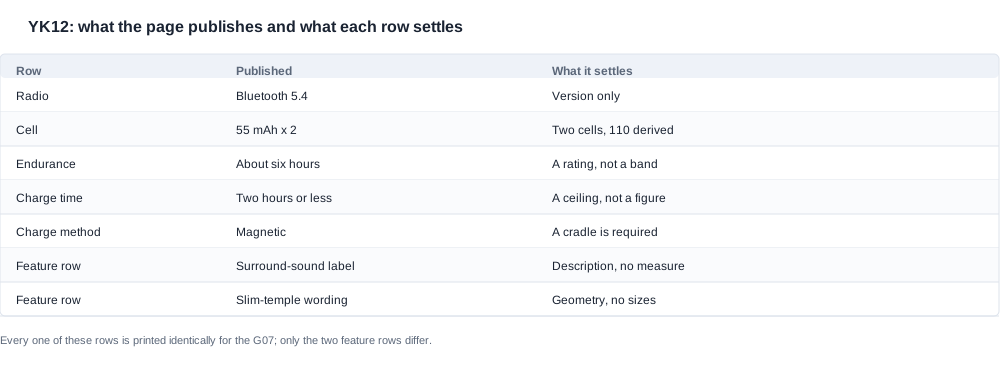
The YK12's catalogue page belongs to the eight audio models in the range, and it is one of the two hardest of those eight to argue from. This page gives a radio version of 5.4, a pair of 55 milliampere-hour cells, roughly six hours of running time, a two-hour charging ceiling, and a magnetic charging method. Every one of those five rows is identical to the row printed for the G07. The two pages differ in two descriptive lines and in nothing else at all.
That fact shapes everything a buyer can do with this page. The specification table cannot separate this model from its twin, so a shortlist cannot be built from the specification table, and no claim of the form "this is the only model with…" or "this model has the largest…" survives on this page — not because the catalogue forbids such sentences, but because the catalogue contains a counter-example. What the page offers instead is two feature rows, an acoustic label and a temple description, and the work of a buyer is to convert those two rows into evidence.
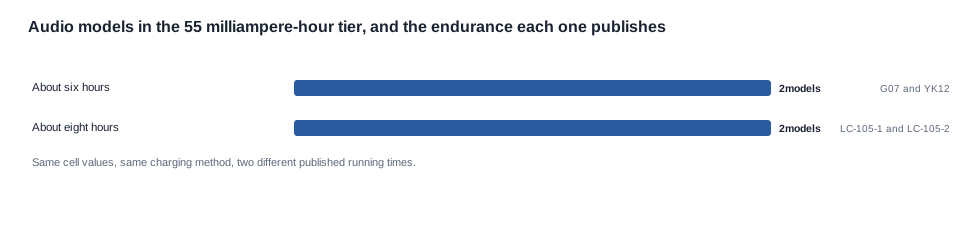
The six-hour figure is the second thing to look at closely, because it is published against a cell configuration that two other models in the range carry as well, and those two publish about eight hours on the same cells.
YK12 smart glasses: one of two models that publish the same cell
What the page prints is these, and there is not much of it.
The radio is Bluetooth version 5.4. The audio models in the range publish a version and the camera models do not, so this row is worth more than it looks: it is the only interoperability datum on the page. Six of the eight audio models publish 5.4 and two publish 5.3. What it does not settle is the connection procedure, the number of devices that can be held at once, the profile list, or whether a second device displaces the first.
The cell is published as 55 milliampere-hour times two — two cells of that size, which is 110 milliampere-hour in total as a derived figure rather than one the catalogue prints. Four audio models in the range publish that same configuration. The catalogue publishes the cell value and the number of cells as separate things on the row, and it is the multiplication that a buyer should keep in view, because two cells change the questions rather than simply doubling the answer: what charges each cell, whether both charge at once, and what a single charge cycle means for a unit in the field.
The endurance is about six hours. What the page prints for charging is an upper limit of two hours, and it prints nothing about the cell's condition before charging or about the level at which the unit is called charged. The charging method is magnetic, so the unit charges against contacts and a cradle rather than over a cable.
And the feature rows are two: an acoustic label reading as surround sound, and a temple description reading as slim. Those two lines are the whole of the difference between this page and the G07's.
That last sentence is the one to spend the most time on, because it is where the usual approach to a product page breaks down. A buyer comparing two audio models normally works through the specification table and stops when the table stops discriminating. Here the table never starts. This model is one of the two models in the range that publish 55 milliampere-hour times two, about six hours, magnetic charging and a charge ceiling of two hours or less; the other is the G07, and the two also share the 5.4 radio row. The correct way to write that sentence is exactly that way — as one of two — and any wording that implies exclusivity will be checked by a competitor, by a distributor's buyer, or by the customer's own procurement team, and it will be found to be false.
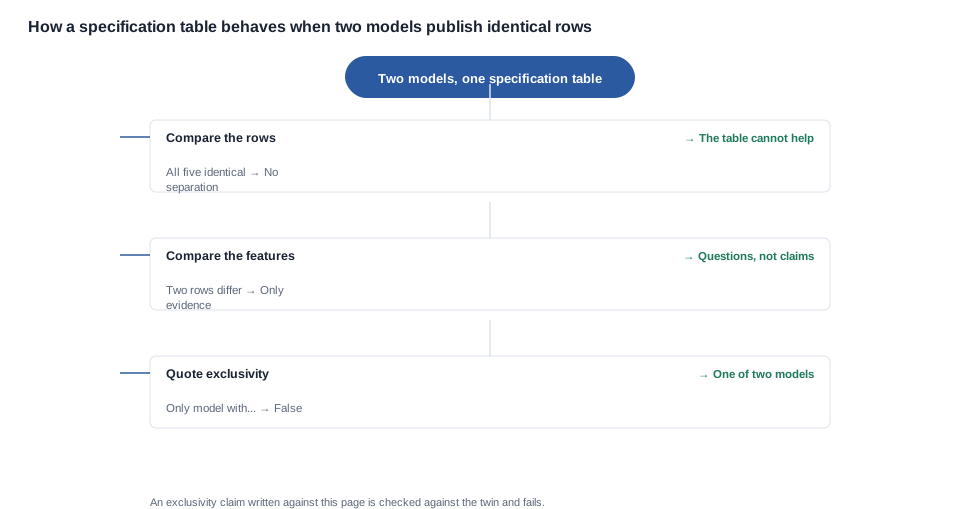
What the G07's own page carries is a different pair of rows — a temple description and a removable-temple line rather than an acoustic label — and that is where the two pages part company. Which means a shortlist for this model cannot be drawn from the catalogue at all. It has to be drawn from what a supplier will confirm, what a sample demonstrates, and what the two feature rows turn out to mean once they are interrogated. That is a more expensive shortlist to build, and it is also the reason the questions in this article are written as requests rather than as comparisons.
There is a structural point that follows from the same fact and that a channel will meet immediately. The audio models in the range divide into three cell configurations and three endurance figures, and this model sits in the group whose cell value per cell is the smallest the audio range publishes — 55 milliampere-hour a cell, against 90 a cell for the K01 and the K02 and a single 100 milliampere-hour cell for the D11 and the D12. Its six-hour band is shared with the G07 alone, and the models publishing the longer figure in its own cell group are the LC-105 pair, which carries the same two 55 milliampere-hour cells and rates about eight hours. So about six hours is the shorter published running time in that group rather than the longer one, and the derived total of 110 milliampere-hour is larger than the 100 milliampere-hour of the single-cell models rather than smaller. A listing built from this page therefore has to say "two 55 milliampere-hour cells, about six hours" and resist the temptation to compress it into "55 milliampere-hour", which reads as a specification that is smaller than the product. The same discipline applies to the running time: six hours is a rated figure that has to travel with its conditions, and those conditions are the subject of the next section.
The last item on the page that a buyer has to handle carefully is the one that is not there. No charging-case capacity is published for this model, and no case row appears on the page of any of the eight audio models. Magnetic charging implies that something holds the contacts, and what that something is — a cradle, a pad, a case — is a question with a commercial answer attached, because it decides the accessory line, the replacement cost for a customer who loses it, and what a returned unit is inspected against.
The 55 milliampere-hour pair and the six-hour band they share with the G07
Two cells of 55 milliampere-hour, an endurance of about six hours, and a charge ceiling of two hours or less. Those three numbers together describe a small, replaceable-charge product, and they are the numbers a channel will put on a page.
The endurance figure is the one that needs work before it can be used, and the reason is not on this page — it is in the range. Four audio models publish 55 milliampere-hour times two. Two of them publish about eight hours, and two publish about six hours. The two that publish about eight hours are the LC-105 pair; the two that publish about six hours are this model and the G07. Same cell values, same number of cells, same charging method, same charge ceiling, and two different endurance figures.
There is only one honest reading of that, and it is a reading about measurement rather than about hardware. Two products built on the same published cell configuration cannot differ by two hours of published running time for a reason the catalogue states, because the catalogue states no reason at all. The difference has to live in the conditions: what was running during the measurement, at what volume, whether a phone was connected throughout, whether calls were in use, whether the microphone was active, the ambient temperature, and how the unit was treated between the start and the end of the run.
This matters commercially in a way that is easy to miss. If a channel compares this model against the LC-105 pair and concludes that this one runs for two hours less, it has concluded something the catalogue does not support — and the conclusion is more likely to be wrong than right, because a rating produced under a heavier test condition is a conservative number rather than a shorter battery. The comparison that is defensible is not this one against those two; it is this one against a channel's own usage profile, and that comparison can only be made with a figure the supplier has stated for the channel's conditions.
So the question to put is not "how long does it last" but "what was running during the six hours". The answer should name the volume, the connection state, whether calls were part of the run, and whether the microphone was in use, and it should be recorded in the buyer's file so that a later listing can repeat the rating with its qualification intact. A channel that publishes "about six hours" on its own is making a statement about this product under conditions nobody has named. A channel that publishes "about six hours, as measured with continuous playback at the stated volume and no active call" is making a statement it can defend. The second version is not longer; it is simply the only one that survives a customer who measures the product themselves and gets a different number.
The charge ceiling carries its own gaps, and a two-cell design gives it an extra one. Two hours or less is a ceiling rather than a measurement, and the catalogue does not say what it covers. For a model with one cell, the ambiguity is whether the figure is the unit or the unit with its accessory. For a model with two cells and a cradle, there is a further question: do both cells charge together, or one after the other, and does the figure describe the pair or a single cell. A buyer who assumes parallel charging will have under-planned the turnaround at the warehouse, and a buyer who assumes sequential charging will have over-planned it. Either way the error is avoidable with one line in the request.
The cradle question belongs with it. Magnetic charging requires something that holds the contacts, and this page publishes no case row and no cradle description. What to ask is: what is supplied for charging, whether it is the same item as the storage accessory or a separate one, and whether it can be replaced on its own at a sensible cost. For a channel, that is an accessory line and a spare-parts decision; for a customer, it is the difference between a product that is usable on a desk and a product that needs a particular object to be usable at all. The same answer determines whether a returned unit can be inspected for charging faults at all, or whether the goods-in check needs a spare cradle on the bench.
The final point in this section is a working rule rather than a fact. A published endurance figure is the manufacturer's rating under conditions the catalogue usually omits. The procedure that handles this is to request the conditions, write them into the file, and quote the rating with the same qualifier every time it is used. The alternative — filling the gap with a typical value taken from somewhere else in the industry — quietly swaps this manufacturer's rating for somebody else's figure, and it is the practice most likely to produce a complaint that cannot be answered.

The surround-sound label and the slim temple, both in the feature rows
Two descriptive rows, and each of them behaves differently.
The acoustic label is the more visible of the two, and the more exposed. It reads as surround sound, and it appears on a handful of models in the range, this one among them. What the catalogue publishes alongside it is nothing at all: the driver size is absent, the response curve is absent, the output level is absent, and so are the microphone specification, the codec, any noise-control claim and any comparison against another product. The label is therefore a description of an approach, printed by the manufacturer, on a page that offers no way to test it.
What a channel may do with that row is narrow and legitimate: state that the model is published with a surround-sound label. What a channel may not do is describe the acoustic result. There is no published figure for how the sound is distributed, whether it is delivered to both sides, whether there is any channel separation, or how it compares with a competing product. A listing that says the audio is "immersive", "room-filling" or "the same as a pair of speakers" has made a measurement claim from a label, and a customer with a good ear and a pair of headphones is the person who will notice.
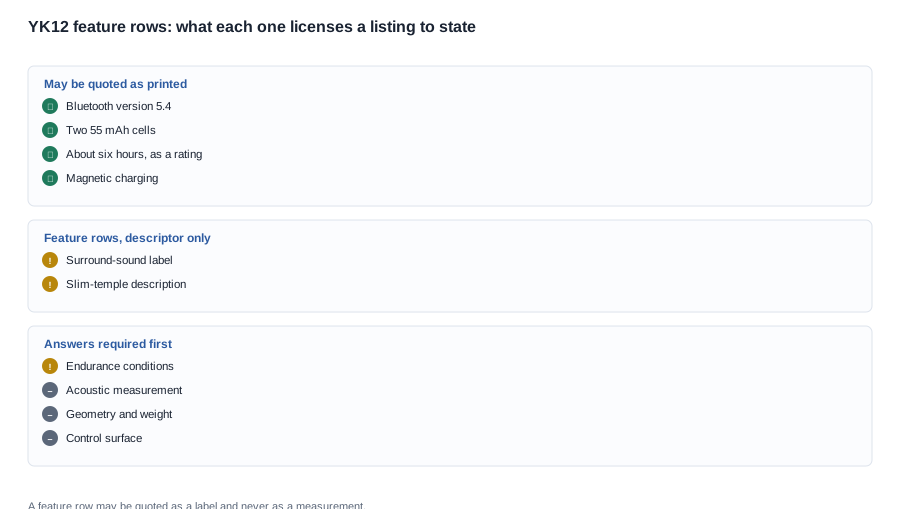
The temple row is quieter and, for a procurement team, more consequential. A slim temple is a geometry statement, and the catalogue publishes no temple profile, no temple length, no frame dimensions, no weight, no microphone position and no speaker position. That last group is what makes the row interesting: the way a temple is shaped and sized decides where the transducers sit relative to the ear, and no part of that chain is published here. A channel can state that the model is published with a slim temple. It cannot state what that produces, in terms of either the acoustic result or the stability of the product over a session.
This is where the two rows interact, and the interaction is the part to be careful with. A surround-sound label and a slim temple together describe an acoustic arrangement that has no published measurement behind either half. A listing can say the product is published with both. It cannot say the slim temple is what delivers the surround effect, because that is a causal claim between two rows and neither of them is measured. It is a plausible reading, and plausible readings are exactly what a channel should not publish.
There are three further open rows that belong with the feature rows because they are the practical consequences of them. The first is the control surface. Nothing in the catalogue prints a touch row for any model in the range, and the only entries describing a control surface sit on a different product — an indicator light and a button control on an AR model. So for this model, the control arrangement — how the unit is answered, muted, paused or adjusted — is a question, and the channel should not write a control description into a listing, a quick-start card or an unboxing video that has not been confirmed. The second is the microphone: the acoustic label implies sound is both captured and reproduced, and nothing is published about the microphone on this model. The third is the connection, which is the one place where a version is published and the behaviour is not — the radio row says 5.4, and the connection procedure, the number of devices held at once and the profile list are all absent.
What to ask, then, in one exchange with the supplier: what the acoustic label rests on, and whether a figure behind it exists that a listing could carry; what the temple geometry is in dimensions, and what the unit weighs; where the microphone and the transducers sit; whether the product has a control surface and how it is configured; and what the connection behaviour is. The sample settles the third and fourth of those in an afternoon and does not settle the first at all, which is why the first belongs in a written request rather than in a test plan.

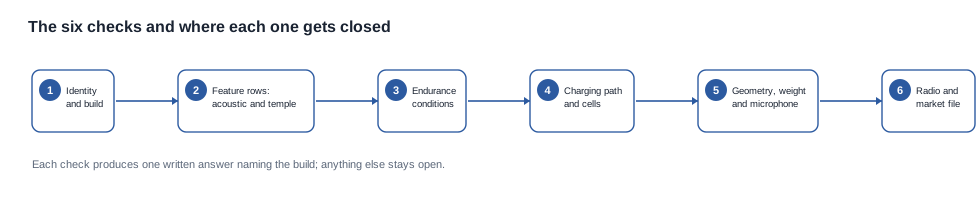
The six checks that matter on this page
Because this page publishes almost nothing that separates it from another model, the checks have to be chosen for what they unlock rather than for what they cover. These six are the ones worth making before a purchase order, and each is written as the request that closes it.
- The two feature rows. What the acoustic label is based on, whether any measurement exists that could be quoted, and what the temple description covers in dimensions. Both answers belong in the file before any listing copy is written, because both are visible to a customer and neither is checkable from the catalogue.
- The six-hour figure. What was running during the published endurance, at what volume, with the connection state and the microphone state as they were, and the figure this channel actually works to rather than the one the page carries.
- The charging path. What is supplied to charge the unit magnetically, whether it doubles as the storage accessory, whether both cells charge together, what two hours or less covers, and the state the cells start and finish in.
- The physical and acoustic detail. Frame and temple dimensions, the weight of the unit, where the transducers and the microphone sit, and what the product weighs with the supplied accessory — no weight is published for this model.
- The radio. The version is published; the connection procedure, the number of devices held at once and the profile list are not, and those are the ones that determine whether a customer's phone and the product work together on the first attempt.
- The market file. The certification and conformity documents held for this model and build, the destination markets each was issued for, and the body that issued it; the catalogue has no per-model certification row at all, and its company-level export certification page is images rather than text, with no reference to CE, FCC or RoHS anywhere in the catalogue text.
Two red flags are worth naming, because they are the ways this file stays open without anybody noticing. The first is an answer that describes the model generally rather than this build, and the second is a reply that repeats the acoustic label in a sentence instead of supplying a measurement or saying that none exists. Both leave the file looking complete while the two claims a customer will actually ask about are still unevidenced.
The commercial terms belong in the same exchange rather than in a later one, and the reason is particular to this model. With two cells of 55 milliampere-hour, the weight of the unit and of the charging accessory is unknown, and weight is one of the inputs that decides the freight rate per unit and therefore the landed cost on a bulk order. The case for settling the physical questions early is that they are settled by a sample and a scale in an afternoon, while the commercial conversation tends to absorb the attention of everyone involved. The trade-off is real and small: asking for six things instead of one delays the reply, and asking for the right six avoids three rounds of correspondence that would delay it more.
There is a criteria question that should be settled before the request goes out rather than after the first reply arrives. What does a closed file look like for a model whose catalogue page is this short? For this model the answer is specific: a written reply against each of the six checks, naming the build it applies to; either a measurement behind the acoustic label or a statement that none exists; the documents for each market this order will reach, plus a configuration record from which the next order can be built. Settle that definition before the request goes out rather than after the first answer arrives, and every reply after it can be judged against something written down.
On this model, our position is that the page is honest and thin, and both of those qualities have consequences. We publish the radio version, the cell configuration, the endurance figure, the charge ceiling and the charging method exactly as the catalogue prints them, and we will not present about six hours as a full working day. We will not present the acoustic label as a measured characteristic, and we will not present the slim temple as the reason for it. We do not publish a weight, a case capacity, a microphone specification or a certificate number for this model, and we will not fill those gaps with typical values from elsewhere in the industry. The signs that a file is genuinely closed are that each of the six checks has a written answer naming the build, the configuration record matches the unit that arrived, and the acoustic claim in the listing says no more than the row on the page says. When to treat the file as closed is a buyer's commercial decision, and the criteria for it are those same six checks.
Tell us which of these six checks your own purchase file is missing, and we will turn that check into a request in the format our documentation team files against a build.


