
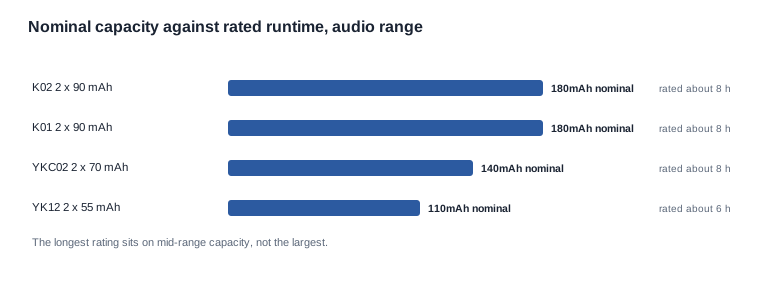
This model publishes two small cells rather than one, a charge time of up to two hours, a rated runtime of roughly eight hours, and magnetic charging. That combination contains a tension worth understanding before you build a listing on it: the eight-hour figure is the longest published runtime in our audio range, and it is delivered by the smallest published total capacity in that range.
Seventy milliamp hours per cell, two of them, against models that carry ninety per cell or a hundred in one. How that produces the best runtime figure in the range is a question about the platform, and ykc02 smart glasses charging options do not answer it — the documentation does not.
The practical consequence is that the charging story and the endurance story are the same question, and neither can be written until a supplier closes one number.
YKC02 charging options: what the published figures actually are
Two 70 mAh cells. The count is stated, which is unusual and useful — a two-cell architecture implies a cell on each side, and that changes the failure behaviour. One side failing is not the same event as the product failing, and the difference decides whether a warranty claim is a repair, a partial replacement or a write-off.
Up to two hours to charge. No input current, no source state, no ambient condition. For a customer who expects to charge from their own phone adapter, this figure may not reproduce, and that becomes a review complaint rather than a technical issue. "Up to" is doing real work in that sentence — it is a ceiling, not a typical value, and a listing that presents it as a typical value is making a claim the documentation does not support.
Magnetic charging. This is the format, and it implies a dock or case that only this supplier makes. Whether a case is included at your quantity, and what capacity it carries, is not published for this model.
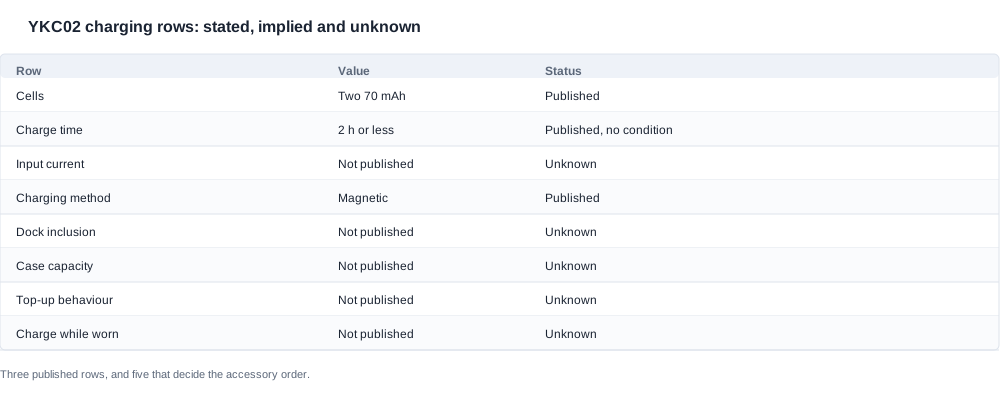
| Row | Value | Status |
|---|---|---|
| Cells | Two 70 mAh | Published |
| Charge time | 2 h or less | Published, no condition attached |
| Input current | Not published | Unknown |
| Charging method | Magnetic | Published |
| Dock inclusion | Not published | Unknown |
| Case capacity | Not published | Unknown |
| Top-up behaviour | Not published | Unknown |
| Charge while worn | Not published | Unknown |
Three rows published, five unknown, and the five are the ones that decide the accessory order. A buyer who treats this as a specification question will produce a page; a buyer who treats it as an accessory question will produce a purchase order that includes the right parts.

Why the runtime-to-capacity ratio deserves a question
Roughly eight hours from 140 mAh of nominal capacity implies an average draw of about 17.5 mA across both cells. That is efficient for an open-ear Bluetooth frame, and it is possible — modern low-power chipsets do a great deal from a given cell.
But the interesting comparison is not with the other models' capacities. Divide each model's published capacity by its published rating and the picture changes: the K02 and the K01, at 180 mAh across eight hours, imply about 22.5 mA, while the LC-105-1, at 110 mAh across eight hours, implies about 13.8 mA. This model sits between them. What the arithmetic tells you is that runtime in this catalogue is governed by average power draw, not by capacity — and power draw is a firmware and platform property that no model in the range publishes.
It is also the kind of claim that gets tested by whoever reviews your listing. A buyer who charges the product, uses it heavily and gets four hours will not forgive the number, and the difference between four and eight is usually the test condition rather than a defect. So the question is not whether the figure is plausible — it is: what was the condition?
Ask for the volume, the codec, the distance from the source, how many units were tested, whether the figure is a mean or a best case, and whether the surround-sound mode was engaged during the measurement. That last question is the one most worth asking first on this model, because it publishes a surround description and the mode state is binary.
We cannot answer that from the documentation, and we will not estimate it. If the answer comes back as a measured average across a production batch, that is a good answer and you can build on it. If it does not come back, treat eight hours as the ceiling of the range rather than its middle.
How to evaluate the answer when it arrives. Four forms, and they are not equally useful. A protocol with a date and a unit count is evidence, and you can plan a listing around it. A description of typical use is an assurance, which tells you the supplier has a view but not a number. A promise to supply the data later is a delay, and it should be attached to a date in the purchase order rather than left in a mailbox. A restatement of the eight-hour figure is nothing at all, and it is worth naming that this is the most common form, because a supplier who will not attach a condition to a runtime rating will not attach one to an acoustic claim either.
The question worth asking that nobody asks. Whether the eight hours was measured with the surround mode engaged. On this model it is not a general question about a general product — the model publishes a surround description, so the mode state is a specific variable with a specific effect, and it is binary. A supplier who can answer it in one line has a measurement process worth relying on; a supplier who cannot has a number rather than a result. Ask it first, because it is the cheapest question on the list with the largest effect on the listing.
What to do if your own measurement disagrees. Repeat it before you escalate, because the most common causes of a short result are protocol rather than product: the phone was in a pocket, the codec differed, the volume was higher than the protocol set, or the unit was one of three that behaved differently. Record the unit identity with every run. If the discrepancy survives a repeated, agreed protocol, that is a conversation to have before the bulk order — and it is a far better conversation to have with three sample units in hand than with a return rate to explain afterwards.

What the magnetic format commits you to commercially
Three consequences, and they are worth pricing rather than assuming away:
- A proprietary part in the customer's possession. Losing the dock is a support ticket that does not exist for a cabled product, and the cost of that ticket is a return plus a replacement rather than a troubleshooting step.
- An additional moulded component in the box, with its own tooling, its own unit cost, its own shipping weight and an extra assembly step at the factory.
- A case capacity you do not know. Published case capacities elsewhere in this catalogue run from 900 mAh to 1400 mAh, so this is a meaningful omission rather than a formality — and it is the omission that most affects the landed cost.
The accessory minimum order quantity is the line that surprises first. A dock is a separate moulded part, so it carries its own MOQ independent of the frame. A buyer who orders frames in their usual volume and adds a dock at the same volume can find that the dock minimum is larger than the frame minimum, which reverses the expected economics of the accessory and changes the packaging decision entirely. Ask for the dock MOQ and the case MOQ separately, at your quantity, in the quotation.
The freight consequence follows from the same unknown. Until you know whether a case ships and how heavy it is, the packed unit weight is unknown, and the packed weight sets the freight class and therefore the total landed cost on an incoterms basis. Weigh a packed sample if one is available. If it is not, ask the supplier to state a packed weight rather than a frame weight, and treat the figure as provisional until it is confirmed at inspection.
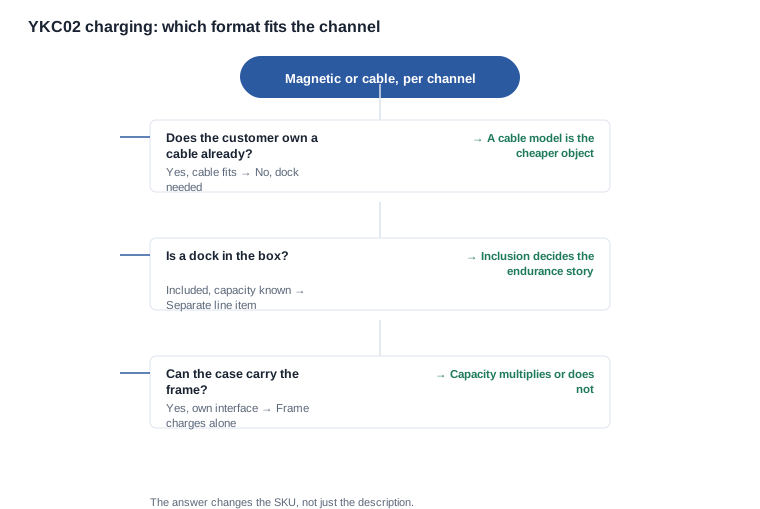
When a cable format is the better commercial object. If your channel ships thin, prices tight and assumes the customer already owns a USB-C cable, then a dock-only product forces a second object into the box and a second price onto the shelf. In that situation the absence of a cable is not a technical shortcoming — it is a packaging decision that costs you sell-through. Ask whether this model is available in a cabled configuration, and if the answer is no, price the dock into the unit cost before you commit rather than discovering it after the first production run.
The trade-off to name when you negotiate. A magnetic format buys two things a cable cannot: a customer-facing routine that reads as a premium object, and a route to a reserve battery that extends the day. It costs three: a proprietary part in the customer's possession, a moulded component in your box with its own tooling and minimum order quantity, and an unpublished capacity that leaves the endurance story unquantified. Which of those dominates is a channel decision rather than a technical one, and it should be made with the dock's real cost in the calculation rather than assumed away.
The due diligence questions on the accessory specifically. Does the dock use the same interface across the platform family, or is it model-specific? What is its minimum order quantity relative to the frame's? Does it ship assembled or as a separate packed item? Is there a spare-part route for customers who lose one, and at what price? And can the case be replaced independently of the frame? These five answers determine whether the accessory is an asset or a recurring cost, and none of them appears on a catalogue page.

Writing the charging story into a specification and a listing
A charging format with an unpublished accessory is a specification problem disguised as a packaging problem, and it is worth separating the two before any copy is written.
In an internal specification, record three things separately: the charge time as published with its starting state, the input current requirement as stated by the supplier, and the accessory configuration as quoted at your quantity. Merging them into a single line called "charging" is what produces specifications that cannot be checked, because a charge time without a current is not reproducible and an accessory without a capacity is not a specification at all.
In a listing, the honest version names the method and the format and stops there. Magnetic charging, a charge time of up to two hours and a rated runtime of about eight hours are all published rows and all safe to state. A case capacity, an all-day claim, a fast-charge claim and a charge-while-worn claim are not, and writing any of them converts a documentation gap into a customer expectation. The test is simple: would you be able to produce the report if a customer asked? If the answer is no, the claim does not go on the page.
In the support script, the two questions that will absorb most of the contact are the charge time and the missing dock. Give the agent the input current, the starting state and the adapter the customer is most likely to be using, so the first answer explains the observation instead of disputing it. And give the agent the dock replacement route, because a lost dock is a support ticket that cannot be closed by troubleshooting.
In the purchase order, put the accessory line into the agreement rather than the conversation: the inclusion threshold, the capacity, the dock minimum order quantity, the input requirements for both frame and case, and the packed unit weight as a figure to be confirmed at inspection. A total cost built on an unstated accessory is a total cost built on an assumption, and the assumption is usually the optimistic one.

Questions to settle before you write the listing
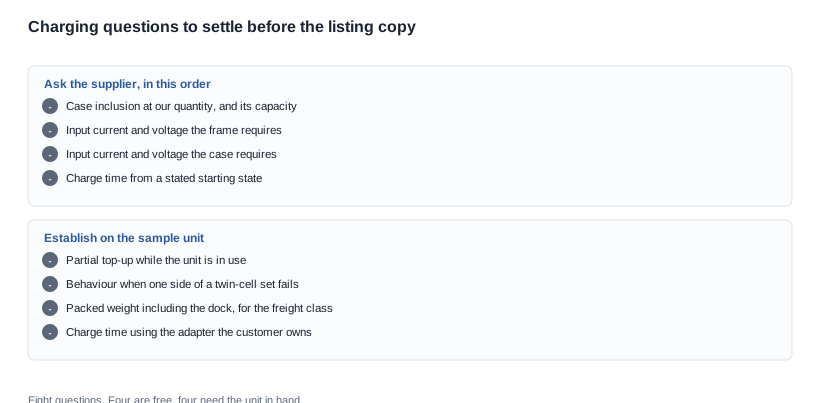
- What test condition produced the eight-hour figure? Volume, codec, distance, unit count, mean or best case, and whether the surround mode was engaged.
- Is a case included at our quantity, and what capacity does it carry? Ask for the inclusion threshold in the quotation rather than in conversation.
- What input current and voltage does the frame require, and what does the case require? Compare both against the adapter your customer already owns.
- Can the frame be topped up partially, and will it charge while being worn? Both change the routine the customer has to learn, and both are cheap to ask.
- What happens when one side fails — does the product continue in mono, or stop — and how is that settled on a warranty claim?
The commercial lines that belong in the same conversation. The accessory minimum order quantities for the dock and the case, the packaging specification, the payment terms with a deposit structure, the lead time on the sample order and on the first bulk order stated separately, and the warranty period with a stated response time. Where the factory accepts it, tying the final payment node to a passed quality control inspection that includes the packed weight is the cheapest form of due diligence available on a first order.
How to negotiate the accessory line specifically. It is usually the least negotiated line in an audio-glasses quotation and one of the most expensive, because it carries its own tooling, its own minimum order quantity and its own packing volume. Three approaches are worth trying. Aggregate it, by asking whether the dock minimum can be met across models in the platform family rather than for this model alone — this is the highest-value question of the three and the one most often left unasked. Defer it, by asking whether the dock can be supplied as a separately packed item added to a later shipment, which moves the cost off the first order without changing the product. And substitute it, by asking whether a cabled variant exists at all for a channel that would rather not carry the accessory at all. Which of the three applies depends on the channel, and the answer to the case-inclusion question determines which one is worth trying first.
The red flags to watch for in a charging quotation. An accessory minimum order quantity stated as "to be confirmed" — that is an unresolved MOQ, and it belongs in the quotation as a number before an order is placed. A charge time quoted without a starting state. A case capacity given as a range with no basis. And a lead time that covers the frame but not the accessory, which means the first shipment ships without something the packaging says is in the box. None of these is unusual, and all four are cheaper to close in a quotation than in a warehouse.
The boundary on what we will claim about charging
We can give you the published charging and capacity figures for this model, and we will tell you plainly that the runtime figure is better than its capacity would suggest — which makes the test condition the thing to establish rather than the number to advertise. We will not quote a case capacity, a dock minimum order quantity or an input current, because none is published. We will not present eight hours as a working day, and we will not present a magnetic dock as an all-day endurance solution while the case capacity is unknown.
Send us the channel, the target retail price, the quantity and whether your customer owns a cable already, and we will tell you whether a magnetic format or a cable format fits that brief better — including, where the answer is that this model is the wrong format for your channel, saying so rather than quoting a price.
A final word on the order of operations. The accessory decision precedes the specification, not the other way round, and that ordering is the reason this page puts the case question before the runtime question. If a case ships with a known capacity, the endurance story can be written and the runtime figure can be quoted as a rating within a larger story. If it does not ship, the runtime figure is the whole story and every claim on the listing rests on a number whose condition is unpublished. Those are different products commercially, and they cost different amounts to market — which is why the case capacity is worth more than any acoustic figure on this model.
The range this model belongs to is on the sport smart glasses page, how the case changes the product is covered in smart glasses battery life, and checking the figures against a sample is covered in sample evaluation.
One measurement that closes more than one row. Weigh a packed unit — frame, cells, dock and packaging — and record it in grams with the date. That single figure closes the freight class, gives the forwarder something real to quote against, lets you calculate the total landed cost on an incoterms basis, and tells you whether the packed weight is compatible with the delivery method you have priced. It is the cheapest measurement on this page and the one most often skipped, because it is not a product specification and therefore falls between the buyer and the factory rather than inside either remit.
Related reading
- The range covering this model — sport smart glasses
- How the case changes the product — smart glasses battery life
- Checking the figures against a sample — sample evaluation
Send the channel, the price, the quantity and the cable question, and we will tell you which format fits.


