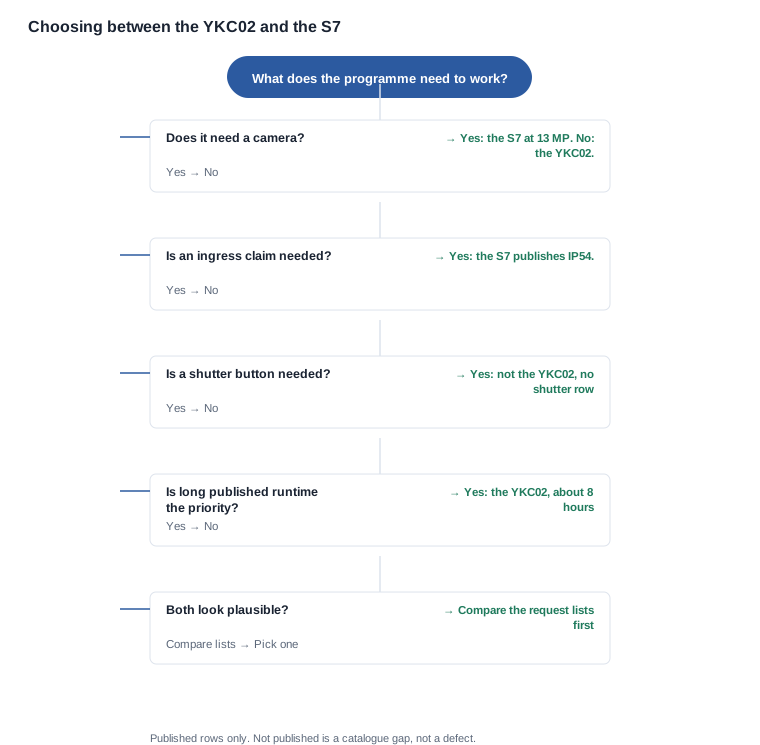
Two models from the same supplier, both sold as sport-oriented smart glasses, and a buyer standing in front of both catalogues with a purchase order to write. The naive comparison lines up two spec tables and looks for the winner. That is the wrong shape for this decision, because the two models are not competing on the same axis. One of them publishes a camera row. The other does not. Everything else in this article follows from that single published difference, and from the difference between what a catalogue states and what it leaves open.
This is a procurement article, not a product review. The question it answers is narrower than a verdict on the two models: it answers which model carries which published row, and what has to be confirmed in writing before a range decision gets locked.
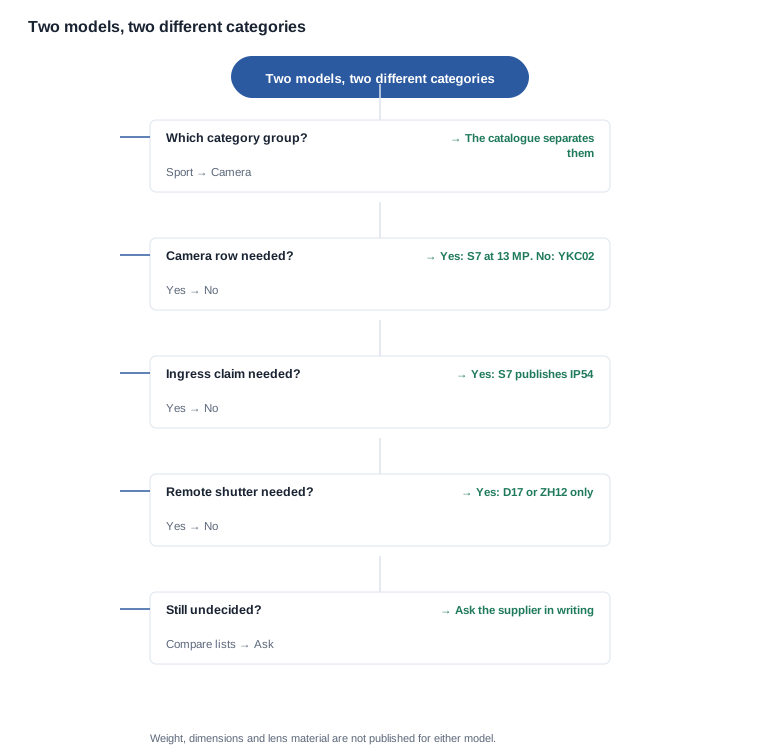
The decision this YKC02 and S7 comparison is
A buyer asking for a "YKC02 versus S7" comparison is usually doing one of three things, and the three lead to three different answers. The first is a requirement-filter: the programme has a hard need, usually a camera, and the buyer wants the shortest path to a shortlist. The second is a line-up review: the buyer already knows both models are in the sport-facing area and wants to understand how they differ so a broader range can be assembled. The third is a range design exercise: the buyer wants to know which model carries the volume and which carries the specification story.
We will walk all three, because the published evidence supports all three readings, and because the second and third readings are where a comparison article earns its keep. But we will begin with the first, because it disposes of most of the comparison immediately.
The YKC02 is a sport-category model. In the supplier's own grouping it belongs to the sport category alongside the D17 and the ZH12 — a three-model category. The S7 is a camera-group model: it is one of the eleven models in the catalogue that publish a camera row. Its product name carries a sport-photography descriptor, but that descriptor is part of the name and the marketing line, not a category assignment. The catalogue's own taxonomy puts them in different groups, and the grouping is what the supplier uses to organise the range.
So the first and most important structural point: these two models do not overlap on camera capability, because one of them has no camera row published at all. If the programme needs a camera, the YKC02 is not a candidate at all — not a weaker candidate, not a candidate pending verification, simply not a candidate. Shortlisting the YKC02 for a camera programme is a category error, and it is an expensive one because it happens late, usually after samples have already been ordered.
YKC02 and S7: what the published rows say
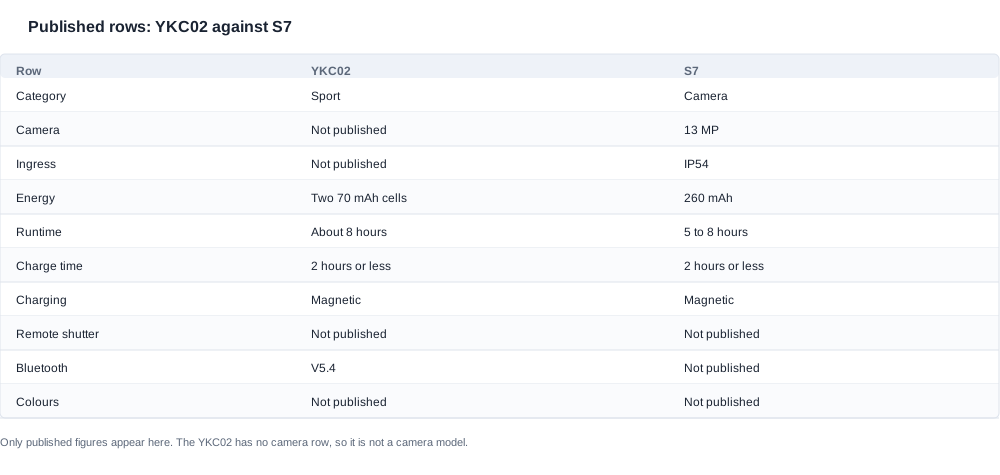
Here is what the catalogue actually publishes for the two models, and equally important, what it does not.
For the YKC02:
- Energy: two 70 mAh cells, a combined capacity of 140 mAh published as two separate cells.
- Runtime: about 8 hours.
- Charging: magnetic charging, charge time 2 hours or less.
- Connectivity: Bluetooth V5.4.
- Name: published in the catalogue as the YKC02 sport glasses model.
Not published for the YKC02: camera resolution — there is no camera row for this model, and it must never be described as a camera model. Also not published: frame weight, dimensions, lens material, colour options, ingress or IP rating, certification status, price, MOQ, lead time, sample policy, warranty, and the per-cell energy density or cell chemistry. When any of those come up in a procurement conversation, the honest answer is "not published" plus a request for the figure in writing.
For the S7:
- Energy: 260 mAh.
- Runtime: 5 to 8 hours.
- Charging: magnetic charging, charge time 2 hours or less.
- Camera: 13 MP.
- Ingress: IP54 — the S7 is one of only two models in the entire catalogue that publish an IP rating. The other is the V06.
- Camera placement: 13 MP appears on three models in the catalogue — the S7 and the L1 Pro, and the L2 Utral.
A note on the Bluetooth row that trips people up: the catalogue publishes a Bluetooth version for fourteen models, and does not publish it for the eleven camera models plus the A05, the A06, and the bone-conduction entry. The S7 is a camera-group model, so its Bluetooth version is not published. That is a category fact about how the catalogue is built, not a defect in the S7, and it should not be presented to a buyer as a gap in the product.
The same logic applies to capacitive touch and to translation. There is no capacitive-touch row and no translation row anywhere in the catalogue. Any claim about touch control or live translation for either model in this comparison would be an invention.
Both models charge magnetically and both sit under the same 2-hours-or-less charging ceiling. That is worth noticing early: charging is not where these two models differ. If a buyer is choosing between them on charge-cycle convenience, that is not a real differentiator, and treating it as one wastes evaluation time.
It is worth setting out up front how we will handle every gap in this comparison: a figure the catalogue does not publish is recorded as not published, and the matching buyer question goes onto the request list at the end of this article. Nothing here is inferred from a comparable model, or from what a similar product usually does.
One more structural point belongs here, because it changes how a range is built. Across the catalogue, 8 MP is published on eight models and 13 MP on three — the S7 and the L2 Utral, and the L1 Pro. The S7 therefore sits at the top of the published resolution tiers, not in the middle of them. When a brand decides which model carries the photography story in its range and which carries the volume, this is the number that decides it. The YKC02, with no camera row published, cannot carry a photography story at any resolution, and the absence is a category fact rather than a gap to be closed later.
When the YKC02 is the right candidate
The YKC02 is the right candidate when the programme does not need a camera and needs a long published runtime with magnetic charging.
Read that as a conjunction, not a list. The YKC02 publishes about 8 hours of runtime — a single figure, not a range — with magnetic charging and a two-hour-or-less ceiling. That combination is a specific fit for a specific use: a device that is expected to be worn for a working day of use and put down at the end of it, where the recharge happens once, at a base, and where nobody is going to hold the device up to look at anything because there is nothing to look at.
That last point is the commercial heart of it. A camera model sold into a sport programme carries a photography feature the buyer has to justify to the end customer: the customer has to want photos, the brand has to explain why photos matter in this context, and the channel has to handle a device with a privacy conversation attached to it. The YKC02 has no camera row, so there is no photography proposition to justify and no image-capture privacy question to answer at the point of sale. For a brand selling into cycling, running, or field-work channels, that can be a significant commercial advantage even though it is not visible on a spec line.
The two 70 mAh cells also change the channel conversation in a specific way, and it is a conversation worth having early. Two cells in one product means the spare-unit strategy, the replacement logic, the pairing story and the charging accessory all have to be thought about at the design stage rather than at launch. It is a real trade-off, not a marketing feature. It also means the battery-transport documentation has to be handled with care, because a device shipping with lithium cells travels under battery rules whichever arrangement those cells take — see /compliance-battery-transport for what to prepare.
There is a second decision path inside the sport category itself. If the programme does not need a camera at all, the comparison is not really YKC02 versus S7 — it is YKC02 versus D17 versus ZH12, because those are the three models in the sport category, and both D17 and ZH12 publish a remote control shutter. That remote shutter is published only on the D17 and the ZH12. The YKC02 publishes no remote control. So a sport programme that wants a physical shutter button rules out the YKC02 on that basis alone.
The published energy rows for those two neighbours are also different from the YKC02's. The D17 publishes 115 mAh in a single cell, about 7 hours of runtime, about 1 hour of charge time, and USB-C charging. The ZH12 publishes 100 mAh in a single cell, about 8 hours of runtime, about 1 hour of charge time, and USB-C charging. So a buyer who wants the sport category and wants a fast USB-C top-up with a physical shutter is looking at the D17 or the ZH12, not at the YKC02. And a buyer who wants sport-category positioning with magnetic charging and no shutter and no camera is looking at the YKC02.
The D17 and the ZH12 set their sound descriptor beside a remote-control photo row, and the YKC02 publishes surround sound without one. That is the difference between the three models, and it is a difference in what is paired with what rather than in whether a sound descriptor is published at all. The YKC02's category is not audio either — the audio tier is a separate group of eight models, and the YKC02 is not among them. Any brief that expects an audio-tier feature set has to be routed to that tier rather than folded into this comparison.
To be explicit about what this comparison is not doing: it is not ranking the three sport models against each other on value, and it is not assigning a price band to any of them. No price, MOQ, lead time or discount is published for any of these models. Comparisons that claim to know which model is cheaper per unit, or which offers better value at a given price point, are making claims the catalogue cannot support.
Later in this article we will return to this point, and the working rule for the rest of it is simple: every claim here is either a published figure or an explicit statement that a figure is not published.
When the S7 carries the programme instead
The S7 is the right candidate when the programme needs a camera at all, or when the programme needs a published ingress rating, or when the specification story requires a resolution the catalogue actually publishes.
The camera row is the obvious one. A 13 MP camera is a published figure, and it is the highest resolution tier in the catalogue — shared with only the L1 Pro and the L2 Utral. For a brand whose differentiation is capture and sharing, the S7 is a straightforward fit and the YKC02 is not a candidate. Any brief that says "we need to capture the ride and push it to the app" or "we need a camera in the product" ends the comparison immediately, in the S7's favour, on published grounds.
The IP54 marking is the quieter but possibly more decisive point for a channel. Across the whole catalogue, only two models publish an ingress rating: the S7 and the V06. That is unusual. Most of the range says nothing at all about water and dust ingress, which means a buyer cannot assume a rating and cannot claim one in marketing. The S7's IP54 is therefore not a nice-to-have detail — it is the difference between a product where the retailer can print an ingress claim and a product where the retailer has to stay silent. For a sport-facing brand whose customers will be rained on, that claim has commercial value at the shelf and in the listing.
It is worth being careful and honest about what IP54 means and does not mean, because it is the kind of figure that gets over-read. IP54 is an ingress protection rating covering dust ingress and protection against water splashing. It is not a submersion rating, it is not a wash-down rating, and it does not mean the device can be worn in the rain indefinitely or rinsed under a tap. It is a published, defined, testable figure — which is precisely why it is useful, and also why it must be quoted exactly as written rather than paraphrased into "waterproof". A buyer who wants a stronger rating should ask for a stronger rating and, more importantly, ask what evidence sits behind it.
Which brings up the certification question, which applies to both models and which buyers frequently assume away. The catalogue body does not mention CE, FCC, RoHS, RED or EN 18031. That means no certification status is published for either model, and it means the buyer must request certification evidence — the actual declarations and test reports, with the model numbers they cover — rather than assume it. This is not a red flag about either product; it is simply the published state of the range, and it is an item on the request list, exactly like MOQ, lead time, incoterms, samples, tooling, packaging, spares and warranty.
A camera model also carries a handling obligation that a no-camera model does not, and it belongs in the evaluation rather than after it. Any device with a camera has a privacy and data-handling story: what the camera captures, whether it stores locally, how it pairs, what the end user is told, and how the retail listing describes it. A brand that has not answered those questions internally should not commit to a camera model on the strength of the resolution row alone. The IP54 marking reduces a different risk — physical exposure to water and dust in use — but it does nothing for the data side, and the two risks should not be netted against each other.
So the honest summary of the S7's published position: it carries a camera row at 13 MP, it is one of only two models in the catalogue with a published ingress rating, it sits in the higher of the two published resolution classes, and it matches the YKC02 on the charging method and the charge ceiling. It publishes no remote control shutter, no Bluetooth version, no frame weight, no dimensions, no lens material and no colour count either. That means any statement about the S7 has to name the row it rests on, and a general claim about which model carries more published specification is not supported by either side of this comparison.
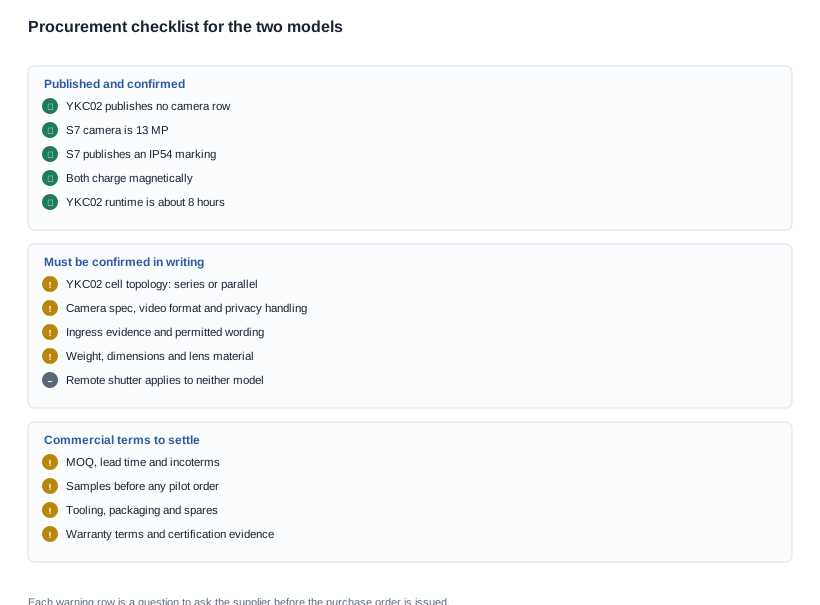
Locking the choice: the questions to ask before you sign. The right way to close this comparison is to convert every open row into a written question, send it as one list with a quotation request attached, and treat the answers as the specification. Below is the structure of that request list.
Category and capability questions
- Confirm in writing that the YKC02 has no camera, and confirm the S7's 13 MP camera specification, including the still-image resolution and the video output format.
- Confirm the S7's IP54 certification evidence, the test standard it was tested to, and exactly which statements of ingress protection the supplier permits in marketing copy.
- Confirm whether any capacitive touch control or translation feature exists on either model, and ask for the specification if so — neither is published in the catalogue.
- Confirm the Bluetooth version for the S7 and whether a radio variant is available, noting that the catalogue does not publish it for camera-group models.
Energy and mechanical questions
- Confirm the YKC02's two 70 mAh cell configuration: whether the cells are in series or in parallel, whether either cell is removable, and what the state-of-charge behaviour is when one cell is exhausted.
- Confirm the YKC02's weight, dimensions, and lens material, all of which are not published.
- Confirm the number of colour options and whether colour is available at MOQ or only above a higher quantity threshold — a tooling and paint-line question that affects the launch plan.
Commercial questions
- Confirm MOQ, lead time, and incoterms for each model, and ask for samples before any pilot order.
- Confirm the sample policy and cost, tooling requirements for private label, and the packaging specification and carton dimensions for your distribution channel.
- Confirm warranty terms, the spares programme for the YKC02's paired cells, and the replacement pathway for end customers.
- Confirm the certification evidence required for your market, and the lead time that documentation adds to the schedule.
- Confirm the battery-transport documentation package for each model, given that both ship lithium cells.
We will keep the recommendation simple, and we will not dress it up with price or value language that the catalogue does not support. If the programme needs a camera, choose the S7, and the discussion becomes the camera row, the IP54 claim and its evidence, the 260 mAh single cell, and the commercial terms. If the programme does not need a camera and needs a long published runtime with magnetic charging and no shutter button, choose the YKC02, and the discussion becomes the two-cell configuration, the about-8-hour runtime, the missing mechanical rows, and the commercial terms. If neither is right because the programme needs sport positioning, a physical shutter and a fast USB-C top-up, then the sport category's D17 and the ZH12 are the models to evaluate, and the YKC02 is out.
We will also say plainly what this article cannot settle for you. It cannot tell you what either model costs, what the MOQ or the lead time is, whether the supplier will negotiate on a pilot order, what the sample policy looks like, what the tooling charge would be for private label, what the packaging options are, what the warranty terms are, or what certification evidence exists for your market. Those are not published in the catalogue, so they are not published here. The output of this comparison is a shortlist and a question list — and the question list, sent with a quotation request, is the thing that converts a catalogue into a purchasable specification.
For the supporting detail on each of these models, the published specification write-ups for the YKC02 and the S7 are the right starting documents: /blog/ykc02-smart-glasses-specifications-and-features and /blog/s7-smart-glasses-specifications-and-features. For the buyer-review checklists that accompany each model, see /blog/ykc02-smart-glasses-buyer-review-checklist and /blog/s7-smart-glasses-buyer-review-checklist. For the sizing and fit considerations that come up whenever a sport glasses line is launched, /blog/sport-smart-glasses-fit-and-sizing is worth reading before samples arrive. On the application side, /blog/sport-smart-glasses-for-cycling is the closest reference to how a no-camera sport model is positioned in a channel, and /blog/sport-smart-glasses-water-resistance-options covers what the published ingress position means across a range where only two models carry a rating. If the range decision is broader than these two models, /blog/sport-smart-glasses-which-model-to-pick and /blog/ykc02-smart-glasses-best-for give the wider frame, and /blog/ai-camera-glasses-shipping-weight plus /blog/how-to-compare-smart-glasses-battery-life-smart-glasses cover the two axes that recur most often in procurement briefs: what the device weighs in the parcel, and how published runtime figures should be read.
One closing caution. The word "sport" appears in both product names and in the supplier's category names, and it is doing different work in each case. It is a category label on the YKC02, and it is part of a product-name descriptor on the S7. Importing the category assumption into the camera model, or the camera assumption into the category model, is the single most common error in this comparison — and it is the reason the first section of this article was about the decision rather than the features.