
Two models, one sport-facing name, and a buyer who has read both energy rows and wants to know what those two rows actually let them conclude. The answer is more interesting than a ranking, because the two models publish their energy in structurally different ways. The YKC02 publishes two separate 70 mAh cells. The V06 publishes a single 260 mAh cell. Those are not two versions of the same number, and they lead to different conversations with a supplier, a logistics team and a channel.
This article is about the energy rows, the charging rows, and what those rows do and do not license a procurement team to conclude. It is not a review, it is not a price comparison, and it does not attempt a total winner. No price, MOQ or lead time is published for either model, so a value ranking would be fabricated.
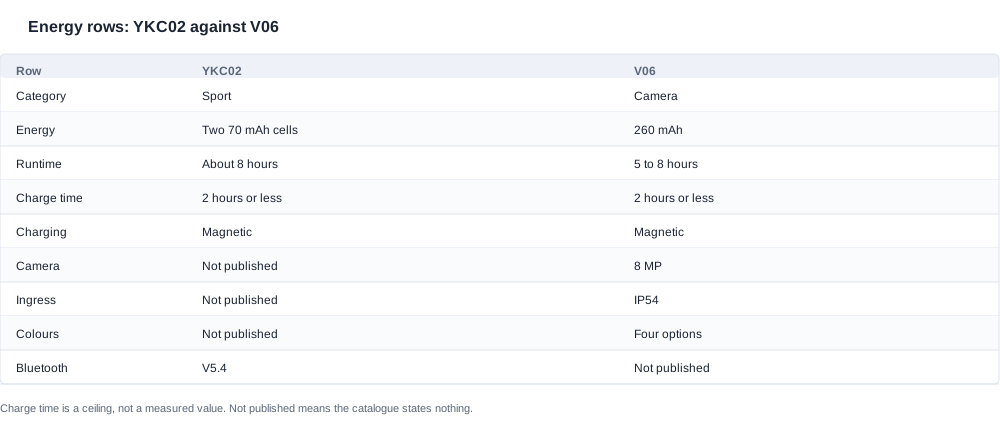
YKC02 and V06 energy rows side by side
Here are the published figures, stated exactly as the catalogue states them.
| Row | YKC02 | V06 |
|---|---|---|
| Catalogue name | YKC02 sport glasses model | V06 AI sport photography glasses model |
| Category group | Sport category | Camera group |
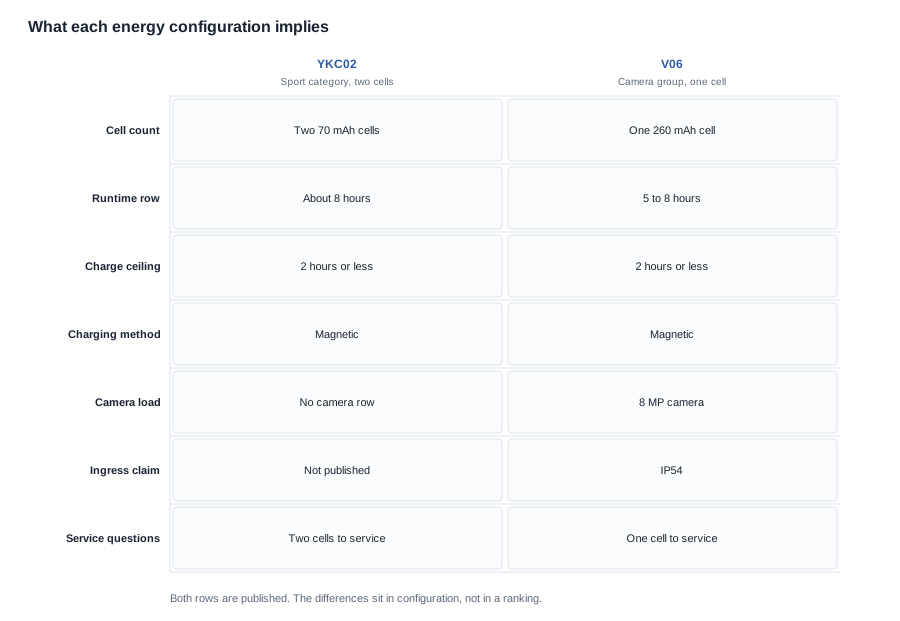
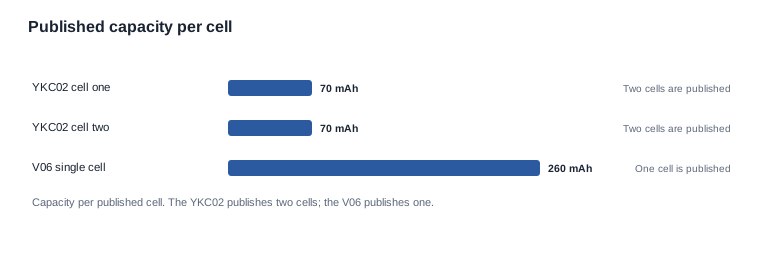
| Energy | Two 70 mAh cells | 260 mAh single cell |
| Runtime | About 8 hours | 5 to 8 hours |
| Charge time | 2 hours or less | 2 hours or less |
| Charging method | Magnetic | Magnetic |
| Camera | Not published — no camera row | 8 MP |
| Ingress rating | Not published | IP54 |
| Colours | Not published | Four options |
| Sound descriptor | Surround sound | Not published |
The first row that matters is the energy row, and it is worth reading carefully because the two figures do not describe the same quantity. "Two 70 mAh cells" is a cell-configuration statement. "260 mAh" is a single-capacity statement. A buyer who adds the two 70 mAh cells to reach 140 mAh and then compares that total against the V06's 260 mAh has performed an arithmetic comparison across two different types of published figure — and the mistake is not that the addition is wrong, it is that a total cell capacity is not the same thing as the published single-cell capacity. The two models are telling you about their power in different terms.
The runtime row has the same shape of problem, and it is the one that most often gets misquoted in a brief. The YKC02 publishes about 8 hours. The V06 publishes a range, 5 to 8 hours. A single figure and a range are both valid catalogue statements, but they carry different information. A single figure is a claim about a point on the scale, and the natural question to ask is what the test conditions were. A range is a claim about the span of expected outcomes, which usually reflects variation between units, between usage patterns, or between test conditions — the catalogue does not say which. Neither figure states a test protocol, a screen brightness setting, a workload profile, or a measurement tolerance. The request list at the end of this article is where we will come back to that.
There is a second reason the runtime row cannot be read as a duration-to-schedule calculation. A quoted runtime describes how long a device runs under a stated load; it does not describe how long the device will run in a customer's hands, because that depends on connectivity, on what the device is being used for, and on how the end user treats it. For the YKC02 the use case is comparatively simple — no camera row is published, and the sport category contains only three models — so the workload profile is narrower. For the V06 the camera is a live component of the proposition, and a camera that is powered and streaming consumes differently from a device that is only pairing and playing audio. Neither the catalogue nor this comparison quantifies that difference. We will say plainly that the V06 is a camera-group model with an 8 MP camera and an IP54 rating, while the YKC02 has no camera row published, and that the published runtime figures should be read against those very different workloads.
The two rows where the models genuinely differ are the camera row and the ingress row, and both are absences rather than presences on the YKC02 side. The V06 publishes an 8 MP camera and an IP54 marking; it is one of only two models in the catalogue that publish an ingress rating at all, the other being the S7. The YKC02 publishes neither, and it publishes no camera row whatsoever — which means it is not a camera model, and the sport category it belongs to contains exactly three models: the YKC02, the D17 and the ZH12. The V06, despite its sport-photography product name, sits in the camera group, not the sport group. Category membership and name wording are different things, and this comparison is a good illustration of why.
One more point of context for the V06 side: the catalogue publishes 8 MP on eight models and 13 MP on three models. The V06 is an 8 MP model. If a programme is being built around a camera, that is a row to weigh against the resolution tier, and it is separate from the energy question this article is about.
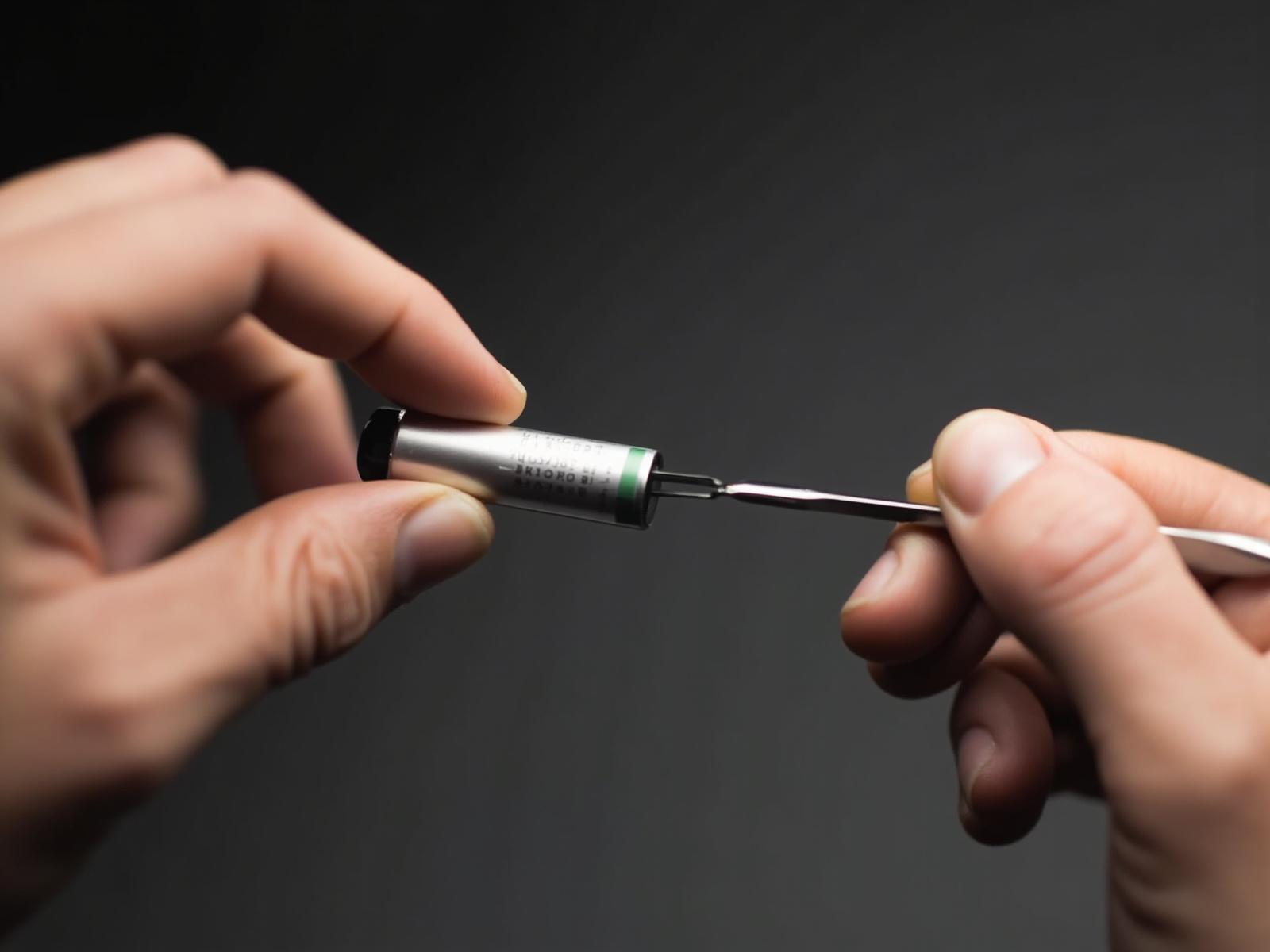
One V06 cell against two YKC02 cells
This is the section that matters most for a channel, and it is the one the runtime row cannot substitute for.
A single 260 mAh cell is one cell. A pair of 70 mAh cells is two cells. On the published rows, that difference is visible; what it means operationally is not published, and the honest way to handle it is to describe the decision the difference forces rather than to assert a performance outcome.
In this section we will work through the practical consequences a buyer should raise with the supplier, each of which follows directly from the published configuration:
- Replacement logic. With one cell, a cell-level failure is a device-level replacement. With two cells, the question of whether either cell can be replaced independently becomes a live service-design decision. The catalogue does not state whether the YKC02's cells are user-replaceable, tool-replaceable, or sealed into the frame.
- Spare units and channel stocking. A two-cell product raises the question of whether the channel stocks matched spares, and whether a spare is a single cell or a complete unit. For a distributor building a spares programme, this changes the shape of the inventory plan.
- Charging accessories. One cell typically implies one charging path. Two cells raise the question of whether they charge together or independently, whether a dock must serve both, and whether a partially depleted pair can be topped up. Not published for either model.
- Pairing and the user-facing behaviour. If the two cells are in series, runtime behaves differently than if they are in parallel. The catalogue does not state the topology, and the topology question is exactly what a buyer should put in writing before the runtime figure is used in any product claim.
- Shipping documentation. Two lithium cells and one lithium cell are both regulated cargo, and the documentation package is a fixed cost of shipping either device. It is treated in more detail in the final section.
We will not turn this into a performance claim in either direction. It is entirely possible that a well-balanced two-cell pack outperforms a single cell on real usage, or that a single cell is simpler to integrate and cheaper to certify. Neither conclusion is published, and a buyer who states one as fact in a brief is asserting something the data does not support. What is supportable is this: the two models present different engineering configurations, and the configuration difference propagates into service, spares, accessories and logistics in ways the runtime figure alone does not capture.
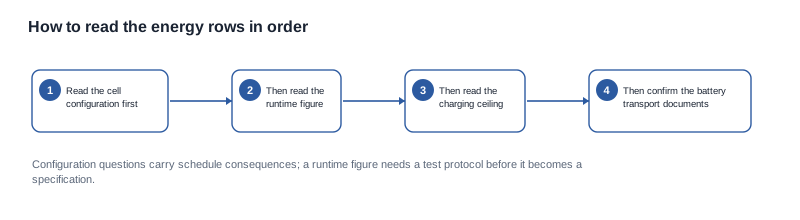
The reason this distinction is worth the buyer's attention is that configuration decisions are made early and are expensive to reverse. Cell topology, dock design, packaging for the battery declaration, and the shape of the spares programme are all locked around the same time as the industrial design, and all of them land on the schedule. By contrast, the published runtime figure is a line in a catalogue that can be re-confirmed in a single email. So the order of attention should be inverted: settle the configuration questions first, because they are the ones with schedule consequences, and treat the runtime figure as a downstream consequence to be verified against a test protocol once the configuration is fixed.
One more published fact belongs in this section for completeness. The only public weight figure anywhere in the catalogue belongs to the MT6, at 158 grams for the glasses body, excluding a 1200 mAh folding case. Neither the YKC02 nor the V06 publishes a weight at all. That means a buyer cannot compute a shipping weight or a comfort figure from the catalogue for either model in this comparison, and it means the fit and comfort questions have to be answered with samples rather than with data.
The runtime rows do make one point directly. The YKC02's about-8-hours figure sits at the top of the V06's 5-to-8-hours range, not above it. Whatever the test conditions, the published numbers do not show the YKC02 lasting longer than the V06. A brief that says "longer battery life" on the basis of these two rows would be reading a single point figure against the top of a range, which is not a comparison at all — it is the absence of one.
It is equally important not to run the comparison the other way. The V06's published range starts at 5 hours, which is below the YKC02's about 8 hours, so a buyer could equally write a brief saying the V06 lasts shorter than the YKC02. That inference is no more valid than its mirror image. A range published as 5 to 8 hours tells a buyer the supplier expects the device to land somewhere inside that band under the conditions it was measured in; it does not tell a buyer that every unit will run for 5 hours, and it does not tell a buyer that the upper bound is guaranteed. The correct reading is that the two published figures overlap, that the catalogue supplies no basis for separating them, and that any decision which depends on runtime has to be made on a test protocol the buyer defines and the supplier agrees to — which is a request, not a conclusion.
That is the practical reason the question list at the end of this article asks for test conditions before it asks for anything else. It is also the reason we treat the battery-transport point as a separate workstream. A published runtime figure that cannot be reproduced under a defined protocol is a marketing number; a defined protocol turns it into an acceptance criterion you can write into a purchase order and use when the first production batch arrives.
What the YKC02 charge ceiling does not tell you
Both models publish the same charging figure: 2 hours or less. Both charge magnetically. These two facts together settle one question immediately — the charging story is not the differentiator between these two models, and no brief should list it as one.
The charging method is worth placing in catalogue context, because it explains how narrow the published picture is. Across the whole catalogue, magnetic charging appears on seventeen models, USB-C appears on seven, and four models do not publish a charging method at all: the CY05 and the MT6, and the L1 Pro and the CY03. The YKC02 and the V06 both sit in the magnetic group, so a buyer comparing either against a USB-C product is making a comparison with the seven-model group, not with this pair.
The ceiling itself needs care. "2 hours or less" is an upper bound, not a measured value. It tells you the supplier commits to a maximum, and it tells you nothing about the typical case, the minimum, the curve, or the conditions. A ceiling is the right way to publish a charge time when a figure varies with temperature, cell batch, cable, dock, or the state of charge at the start of the cycle. It is also the reason a ceiling cannot be used to compute anything — you cannot derive a daily charge schedule from it, you cannot compare the two models on it, and you cannot use it to claim a charging advantage over a competitor whose figure is also a ceiling.
The catalogue's own spread makes the point. Twenty-six models sit at the 2-hours-or-less ceiling, and only two models publish a shorter figure: the D17 and the ZH12, both at about one hour of charge time with USB-C charging. So within the range, a shorter published charge time does exist, and it is not found on either model in this comparison. A buyer who needs a fast top-up is asking a question that neither the YKC02 nor the V06 answers from the published data, and the answer to that question is a conversation with the supplier, not an inference from the catalogue.
What the ceiling does tell you is operationally useful. A magnetic dock that completes a charge in two hours or less is compatible with an overnight charge-and-go routine, and both models inherit that. What it does not tell you is whether the magnetic interface is the same standard across the two models, whether a dock is included in the box, whether a spare dock is available to the channel, or whether a third-party magnetic puck works. None of that is published for either model.
There is a channel consequence here that is easy to miss. Magnetic charging with a ceiling figure means the dock is part of the product, not an accessory that a customer can substitute with a generic cable. Every dock in the channel is a SKU with a cost, a stocking line and a replacement rate, and every model that uses magnetic charging across the range shares that logic. For a distributor assembling a spares programme, the dock becomes as much a part of the aftersales plan as the device itself — and the question of whether one dock serves both the YKC02 and the V06 in a mixed range is a legitimate negotiation item, because a unified dock simplifies the logistics and the training the channel has to carry.
There is one further point we will make here: a charging figure is a claim about a device, not about a parcel. Buyers assembling a landed-cost model should keep the charging row and the battery-transport documentation as separate line items, because one is a product specification and the other is a logistics obligation with its own cost and lead time.
YKC02 and V06 questions to ask before ordering
The battery-transport point is the one that catches people out, so it comes first. Any device shipping with lithium cells travels under battery rules, and the YKC02 ships with two cells while the V06 ships with one. The volume and the cell count both feed the declaration, the packaging requirement, the labelling and the paperwork. Before a purchase order is issued, the buyer should ask for the battery-transport documentation package that covers the specific model and the specific shipping configuration, and should check the requirements that apply to the intended route rather than assuming a generic statement from the supplier covers it. The compliance reference for this is /compliance-battery-transport.
We will put the rest of the request list in the order a buyer should actually work through it, because the sequence matters: a technical question that invalidates the model shortlist should be answered before anyone negotiates terms on it.
Cell configuration and energy
- Confirm the YKC02 cell topology — series or parallel — and state what that means for the published about-8-hours runtime.
- Confirm whether either of the two 70 mAh cells can be replaced independently, and whether replacement is a service-centre operation or a channel operation.
- Confirm the V06's cell configuration and whether its 260 mAh is the rated or the typical capacity.
- Confirm the runtime test conditions for both models: workload, screen state, volume level, connectivity state, and the measurement method.
- Confirm the basis of the 5-to-8-hours range on the V06 — what varies between the two ends.
Charging behaviour
- Confirm the magnetic charging interface used by each model and whether the interface is common across the two.
- Confirm the charging dock contents of the retail box, and the availability and price of spare docks for the channel.
- Confirm the charge profile: does the device charge both YKC02 cells simultaneously, and does it accept a partial top-up.
- Confirm behaviour at low battery, at high temperature, and with a misaligned magnet.
- Confirm whether the charging figure changes with the Bluetooth state or with camera use on the V06.
Commercial and compliance
- Confirm MOQ, lead time and incoterms for each model, and request samples before committing to a pilot order.
- Confirm the sample policy and cost, the tooling and private-label requirements, and the packaging specification and carton dimensions for your channel.
- Confirm the warranty terms and how a cell-related fault is handled under warranty.
- Confirm the certification evidence for each model and the documentation lead time it adds to the schedule.
- Confirm the battery-transport documentation package for the model and configuration you intend to ship, and the spares arrangement for replacement cells or docks.
Then the negotiation. There is one point to make about how this list is used: the point of the list is to get the published-versus-unpublished gaps closed in writing, so that the eventual purchase order references a specification rather than a catalogue. We will not advise you to turn any of these questions into a price lever, because the commercial terms are not published and their structure is the supplier's to set — but we will note that a buyer who has a written technical specification and a named model on both sides of the quote has a materially better negotiation position than one working from a catalogue PDF, and that is true regardless of what the final incoterms turn out to be.
The decision summary is short. A programme that needs a camera and a published ingress rating is looking at the V06, and the energy conversation for that model is the single 260 mAh cell. A programme that does not need a camera and wants the sport category with magnetic charging and a published runtime figure is looking at the YKC02, and the energy conversation for that model is the two-cell configuration, which is the configuration carrying more service and logistics questions. Neither model can be ranked on battery performance from the published rows, because the catalogue does not publish the information that would let anyone rank them.
For the wider battery picture across the range, /blog/sport-smart-glasses-battery-life-explained sets out how published runtime figures should be read in general, /blog/v06-smart-glasses-battery-life covers the V06 in more depth, and /blog/v06-smart-glasses-charging-options covers the charging story for that model specifically. The technical reference is at /tech/battery-life, and the category entry point for both models is /products/sport-smart-glasses.


