
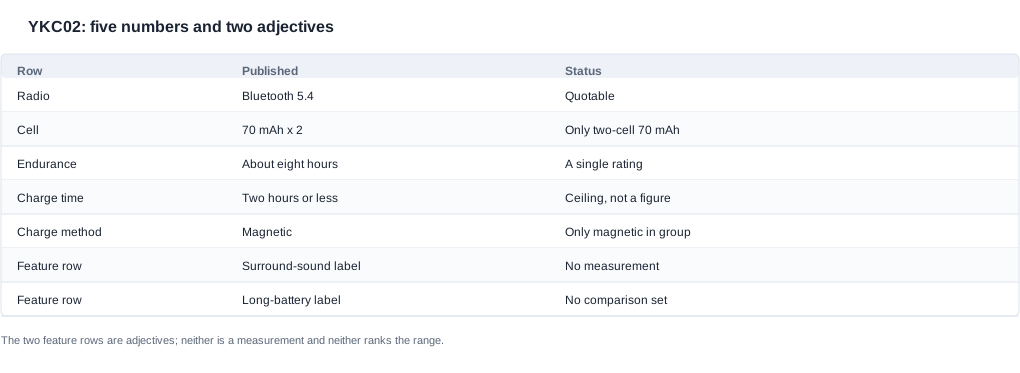
The YKC02's catalogue page is a page of five numbers and two adjectives, and the adjectives are where the work is. The five numbers are a Bluetooth version of 5.4, a cell configuration of 70 milliampere-hour times two, about eight hours of running time, two hours or less for a charge, and magnetic charging. The two adjectives are a surround-sound label and a long-battery-life label, and neither of them is a measurement.
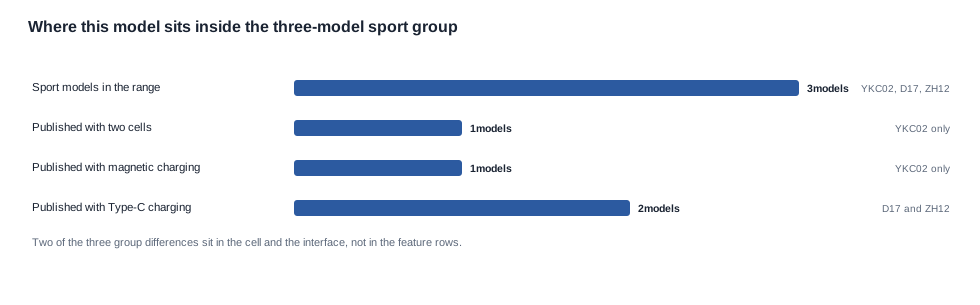
The model belongs to the three sport models in the range, and within that group its position is unusual in two ways that a buyer should establish before anything else. It is the only sport model published with two cells rather than one. And it is the only sport model that charges magnetically rather than over Type-C. Both of those facts change what the box contains, what the accessory line looks like and what a customer replaces when something is lost.
It is also worth saying at the outset what this page does not carry. There is no camera row, which is normal for a sport audio model. There is no colour list, no ingress marking, no weight and no geometry. Two models in the range publish an ingress marking and this is not one of them, so nothing about water, sweat or rain may be written for this model on the strength of the page.
What to check before ordering to know about YKC02 smart glasses: a sport model with two cells
The page prints the following, and it is a short page.
Bluetooth version 5.4 is the published radio row, and the sport models in the range publish a version, unlike the camera models. The cell is published as 70 milliampere-hour times two. The endurance is about eight hours. The charge time is two hours or less. The charging method is magnetic. The feature rows read as surround sound and as long battery life.
The cell configuration deserves a paragraph of its own, because it is both unique and easily misread. This is the only model in the range that publishes two 70 milliampere-hour cells. There is a separate model elsewhere in the range that publishes a single 70 milliampere-hour cell, in a different product category entirely, and the two figures are close enough that a comparison sheet built from memory will eventually merge them. Read this model's row as it is printed — a value and a count — and treat the total of 140 milliampere-hour as a derived figure rather than a published one.
The two-cell arrangement is the structural fact that shapes the rest of the page, and it is the reason the endurance figure is not straightforward to quote. Two cells raise the questions a single cell does not: whether both charge at the same time or one after the other, what the charge ceiling is describing, how the unit behaves when one cell has charge and the other does not, and whether the runtime figure assumes both cells or one. None of that is published, and all of it changes how a channel plans a working day.
Now the sport group. It has three models, and this is one of them; the other two publish single cells of 115 and 100 milliampere-hour, both charge over Type-C, and both publish about one hour for the charge. So this model is the only one of the three published with a pair of cells and the only one that charges magnetically. For a buyer, that is a difference in the accessory line and in the charging behaviour rather than in the specification table, and it is a difference worth confirming rather than assuming: what is supplied to charge the unit magnetically, whether that item also serves as the storage accessory, and whether a customer can replace it.
Magnetic charging against a pair of cells raises the practical question of what happens at the end of a charge cycle. If both cells charge in parallel, the ceiling describes the pair. If they charge in sequence, the ceiling describes one cell and the unit takes twice as long to return to full. A channel that plans a warehouse turnaround on one reading and discovers the other will have either an unrealistic recovery estimate or an unnecessarily slow one, and the difference is a single line in a supplier request.
The category itself is the other thing to settle, and it cuts in a direction that is easy to miss. A buyer choosing a sport model is usually responding to an expectation about the environment the product will be used in, and that expectation is reasonable — it is simply not documented for this model. The catalogue publishes no ingress marking on this page, no sealing specification, no temperature range and no test result. That is not a criticism of the product; it is the shape of the information available, and it is the same reason no condition claim may appear in any material for this model until a factory statement exists.
It is also worth naming what the absence of a camera row does and does not mean. This is a sport audio model and the page carries no camera specification, which is the correct reading for a product in this group. It does not mean that the product lacks a camera, and it does not mean that one can be fitted. Nobody in a procurement meeting needs to resolve that question, but a channel should not imply a camera either way, because the page is silent and the implication would be the channel's own.
The geometry and the weight are the remaining published-absences. No frame dimensions, no temple profile, no adjustment range and no weight are published for this model. For a sport product that is the category's most consequential gap after the endurance figure, because the weight is one of the first two things a customer judges and because it scales the freight rate per unit on a bulk order. The published weight figure for this range belongs to a different model in a different group and cannot be borrowed.
The 70 milliampere-hour pair, and the eight-hour band
About eight hours is published for this model, and it is published as a single figure rather than a band. That distinction is the substance of this section, because the section heading describes an eight-hour band and the catalogue does not publish one.
A band is a range, and a range carries its own conditions implicitly: it tells a reader that the product was measured under more than one set of circumstances, and it tells them that the answer depends on which. A single figure is a rated value, and it looks more definite than it is. It is the number a listing will carry, the number a customer will test against, and the number a competitor will compare. So the single figure raises the standard on everything around it: if the band lets a channel publish a range with a qualification, the single figure leaves the qualification doing all of the work, and the qualification has to come from the supplier rather than from the catalogue.
What to ask is therefore not "how long does it last" but "what was running for those eight hours". The answer should name what was playing, at what volume, whether the link to a phone was held for the whole run, and whether the microphone was live, and the conditions should be recorded so that the rating can be repeated with its qualification attached. A listing that publishes "about eight hours" on its own states a figure without a condition, and a customer who measures under different conditions will conclude the product underperforms, which is a returns driver that has nothing to do with the product.
Where the figure sits inside the range is also worth holding in view, because the descriptor beside it invites a comparison the catalogue does not make. Several models in the range publish about eight hours, and the two children's models publish about twenty. The range is not sorted by endurance in the catalogue, so a single figure of eight hours cannot support any statement about being the longest-running model, and neither can the descriptor printed beside it. The specific and checkable statement is the cell configuration and the rated figure, and that is what belongs in market material.
The charge ceiling of two hours or less is where the two-cell design does its damage to a quotation. The ceiling is a limit rather than a measurement, the catalogue states neither the state the cells start in nor the point at which they are treated as full, and it does not say whether the figure covers one cell or the pair. Within the sport group the contrast is worth noting for a buyer assembling a range: the other two models publish about one hour for the charge, and this model publishes two hours or less. That difference is a fact about two published ceilings, not a measurement of how long either unit takes, because neither figure states its start state or its completion point. It is nonetheless a meaningful difference for planning, and a buyer who quotes the two-hour ceiling without its qualifications has given a logistics team a number that cannot be checked.
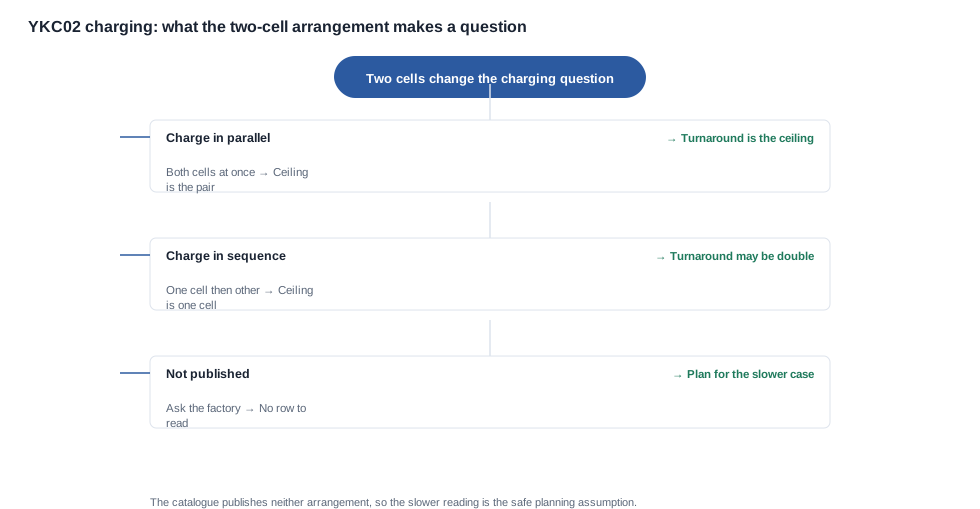
The practical consequence for a channel is that the runtime and the charge time are two halves of the same operating question. A unit that runs for about eight hours and takes up to two hours to return to full has a duty cycle that a buyer can plan a day around only if the two figures are stated under conditions they recognise. Which is the argument for getting the conditions in writing rather than for choosing a model differently. A channel that publishes the rating with its qualification, and the ceiling with its start state and completion point, is offering a buyer something it can build a schedule on; a channel that publishes the bare numbers is offering a buyer something it will have to discover in the field.
One more practical point belongs with the cell. Nothing is published about what happens at the end of the rated run — whether the remaining capacity is usable, whether the radio disconnects first, whether the product behaves differently in the last tenth of the run. For a channel that sells into use cases with a fixed session length, that behaviour matters more than the last half hour of the rating, and it is settled by a sample in an afternoon rather than by correspondence.

The surround-sound and long-battery feature rows, read as claims
This page publishes two feature rows, and both of them are adjectives. Neither is a measurement, and neither is a substitute for one. They are printed by the manufacturer as descriptions of the product, and a channel can repeat them as descriptions and cannot repeat them as findings.
The acoustic label reads as surround sound. It appears on a small number of models in the range, including this one, so it does not distinguish the product from its neighbours. Beside it the catalogue publishes nothing at all: no driver size, no response curve, no output level, no microphone specification, no codec, no noise-control claim and no comparison against another product. A listing may repeat the surround-sound label as the catalogue prints it, and stop there. What it may not do is claim that the audio is immersive, that sound is distributed to both sides, that it is comparable to a particular competing product, or that it delivers a measurable result. There is no published figure behind any of those, and an acoustic claim is the kind of claim a customer with a trained ear tests within a week of delivery.
The battery label reads as long battery life, and it is the more dangerous of the two, for a structural reason. A label with no comparison set is a ranking the catalogue does not make; the range contains models publishing about twenty hours and the sport group itself publishes figures of about seven, about eight and about eight hours. And here the label is not standing alone — it is printed immediately above a single rated figure of about eight hours, which is exactly the combination that turns a listing into a promise. A reader who sees "long battery life" above "about eight hours" will read the first as an explanation of the second, and will check the second. The number is the claim that survives contact with a customer; the adjective is the one that creates the expectation.
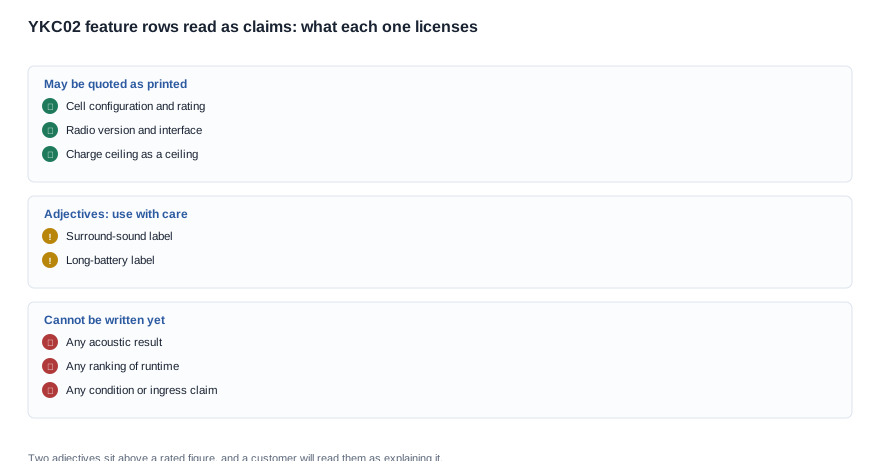
So the criteria for this section are narrow and worth stating as a rule. A published descriptor may be quoted as a descriptor. A published figure may be quoted as a figure. The two may not be combined so that the descriptor appears to explain or support the figure, because the catalogue makes no such connection and the customer will read one in. The commercially cleaner choice, and the one we take for our own material, is to publish the cell configuration and the rated figure and to leave the adjectives out of the copy, because the numbers carry the argument and the adjectives create an obligation the file cannot meet.
Two further rows that a buyer will want settled sit close to the feature rows. The first is the control surface: nothing in the catalogue prints a touch row for any model, and the only control-surface entries anywhere in it belong to a different product, an AR unit with an indicator light and a button control. So for this model, the way the unit is answered, muted, paused or adjusted is a question, and nothing about it belongs in a listing, a quick-start card or an unboxing video until it has been confirmed. The second is the microphone, which the acoustic label implies exists and which is described nowhere on this page.
The questions to ask for this section are therefore about evidence rather than description. Is there a measurement behind the acoustic label that could be quoted, and if there is not, can the descriptor be used in market material at all? What were the conditions behind the eight-hour figure? What is the control arrangement, and is there a control surface at all? What is the microphone specification, and what does it do on a call? And what, if anything, does the factory hold in the way of test evidence for conditions in a sport context, given that this page carries no ingress marking.
The pre-order sequence for a model in the sport group
What follows is the sequence in which this model should be worked through, every line written as the request that closes it. The whole set goes out with the sample request, so the answers and the unit come back in one round rather than in three separate conversations.
- Identity and build. The designation carried by the unit and its packaging, and the production build every answer below is written against.
- The two labels. The battery label first: what the long-battery wording is meant to cover beyond the rated figure printed beneath it. Then the acoustic label: what the surround-sound wording rests on, and whether any measurement of it exists that could be quoted.
- The endurance figure. The conditions behind about eight hours — playback state, volume, connection state, microphone state — and the figure under the conditions this channel operates in.
- The charging path. Two cells and one magnetic lead. What the box supplies to charge the unit magnetically, whether that supply also stores the unit, and what the two hours or less covers — measured from which cell state, and to which completion point.
- The physical detail. Frame and temple dimensions, any adjustment, the weight of the unit and of the supplied accessory, and what happens to the product at the end of a rated run.
- The control surface and the microphone. Whether the temple carries a control surface, how it is configured, and what the microphone specification is.
- The connection. Version 5.4 is the published row. The pairing procedure itself, how many devices can be held at once, and the list of profiles are not published for this model.
- The condition evidence. Whether the factory holds any test evidence for this model in a sport context, given that no ingress marking appears on the page.
- The market file. Which compliance papers the factory has on hand for this build, which destination markets each one covers, and whether any of it travels in the box. The catalogue carries no per-model certification row, and its export certification page shows pictures rather than text — the catalogue wording names no CE, FCC or RoHS.
- The commercial terms. The order quantity, the production and delivery schedule, the price per unit, the packaging specification, the warranty and defect terms, how payment is structured and which incoterm applies — every one of them to be written into the quotation rather than agreed in conversation.
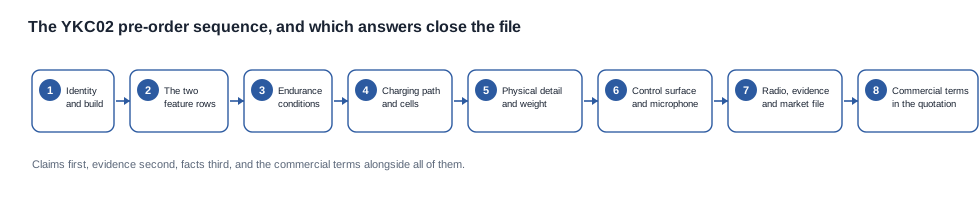
The order of the list is not arbitrary and the trade-offs are worth naming. The two feature-row questions are the ones that decide what the listing may say, and they are the ones that take longest to answer, because a question about the basis of a published descriptor is a question about the factory's own documentation. The charging and physical questions are settled by a sample and a scale. The condition-evidence question is the one with a deadline attached, because the answer determines whether a claim may appear in the launch material at all, and marketing material is usually produced earlier than anything else. So the sequence is: claims first, evidence second, facts third, and the commercial terms alongside all of them rather than after them.
Two ways this file stays open are worth naming. The first is a reply that covers the sport range generally rather than for this model and build, which is a common shape of answer and covers nothing in particular. The second is a written answer that repeats an adjective in a sentence rather than supplying a measurement or stating that none exists — that one is easy to miss, because it looks like a completed line on a request list.
The criterion that closes the file for this model should be written down before the request is sent rather than inferred from the first reply. For a page with this little on it, a closed file is: a written reply against each of the ten lines, naming the build it applies to; an explicit statement, one way or the other, on whether the acoustic label can be used in market material; the documentation for each market the shipment will reach; plus a configuration record from which a further order can be built. A buyer's commercial decision, and not ours, is when to treat the file as closed; the measure of it is those same ten lines. The criteria a buyer should write into the request before it goes out are not a formality: they decide which answers are worth waiting for.
On this model, our position is that the page is short and the specifications are sound, and we will publish the radio version, the cell configuration, the rated endurance, the charge ceiling and the charging method as they are printed. We will not present about eight hours as a working day, and we will not present the long-battery label as a comparison against anything, because the range is not sorted on endurance. We will not present the acoustic label as an acoustic specification. Nor do we publish a certificate number, a case capacity, a geometry or a weight for this model, and we will not estimate them. A file here closes when all ten lines carry a written answer that names the build, when the recorded configuration and the unit that arrived agree, and when the listing promises no more than the catalogue page does. When to close the file is a commercial decision the buyer takes, and the measure of it is those same ten lines.
Tell us which of these lines your own purchase file cannot be closed without, and we will draw that request up in the form our documentation team files against a build.


