
The ZH12 sits in a category that is easy to misread from a distance. It is not an audio-tier model and it is not a camera-tier model. In the catalogue it belongs to the sport category, alongside the YKC02 and the D17, and its published feature row is short and specific: remote control photo, and stereo surround sound. That is the whole of what the manufacturer states about how the ZH12 behaves in the field. Everything else a buyer might want to know about it — sensor resolution, frame weight, colourways, ingress rating, price, minimum order quantity, lead time, warranty — is not published.
This matters more than it sounds. Most buying decisions go wrong at the point where a buyer substitutes a plausible assumption for a published specification. Someone assumes the ZH12 has a camera because it can take a photo. Someone assumes an hour of charging is slow. Someone assumes a sport glass is waterproof because sport glasses are used outdoors. Each of those assumptions is reasonable, and each of them is unsupported by the published record.
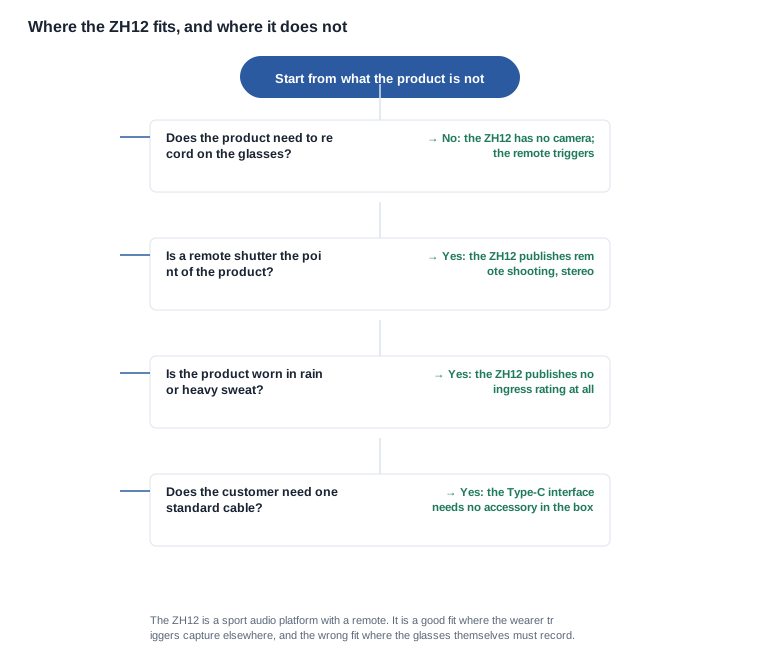
So the honest framing of this article is narrow and useful. The ZH12 is best for a specific workflow: a first-person-view capture where the shutter is triggered from the wrist, combined with open-ear stereo audio for a session that is more about what you hear than what you record. It is a good fit for a channel that wants a sport-category product with a genuinely fast recharge cycle and a demonstrable remote shutter. It is a poor fit for a camera programme, and it is a poor fit for a buyer who needs a certified ingress rating, because no camera row and no ingress row are published for it.
The rest of this article works through that: where the ZH12 fits a channel programme, where it does not, how it sits against the D17 and the YKC02, and what to ask the supplier before you commit it to a range.
What the ZH12 is actually for
Read the published row for the ZH12 and it resolves into two capabilities. The first is remote control photo — the capture is triggered by a remote rather than by a touch gesture on the frame or by a phone command, which is the behaviour that makes a sport-category product usable with gloved hands, with a helmet on, or with the arms in an awkward position. The second capability is stereo surround sound, which is an audio feature and is the reason the model carries a listening claim at all.
Everything else in the row that matters is about power and protocol. The ZH12 is published with a 100 mAh single cell, an approximately 8 hour runtime, an approximately one hour charge time, USB-C charging, and Bluetooth V5.4. Read those five items carefully, because two of them are unusually specific and one of them is commonly misread.
The approximately one hour charge time is the headline. It is exclusive to the ZH12 and the D17. Across the rest of the catalogue, the published charge time is "2 hours or less", which is a ceiling rather than a measurement — it tells you the worst case, not the typical case. So the ZH12 sits in a category of one alongside the D17: the two models where the charge figure is an approximate point value rather than an upper bound. If you are building a range around turnaround at a trade stand or a demo table, or around a consumer who will not wait two hours to get through a second block of use, that published one-hour figure is the single most useful operational fact on the ZH12's row.
The Bluetooth V5.4 figure matters in a quieter way. V5.4 is a protocol version, not a range claim and not a latency claim, and the catalogue publishes it as a spec and nothing more. Treat it as a compatibility line item for your connected app and your channel's accessory bundle, not as a performance guarantee.
What the ZH12 is not: it has no published camera specification. This is worth stating flatly because the model is frequently described online as a camera product. The catalogue publishes a camera row for eleven models — the S7 and the V03 Pro, the CY03 and the MT6, the MT5 and the CY05, the V03 and the V06, the L2 Utral and the L1 Pro, and the KY06 — and the ZH12 is not among them. The camera-tier models publish megapixel figures, 8 MP on eight models and 13 MP on three. The ZH12 publishes nothing of the kind. So when you see a ZH12 photograph with a remote in the frame, that is the remote shutter in operation, not evidence of a published sensor behind it. Do not brief a sales team, a packaging copywriter or a channel partner on the ZH12 as a camera. That brief will create a claim you cannot support with the evidence pack, and in several markets that is not a copy problem, it is a customs problem.
Now the honest limit of all of this: there is a set of attributes a buyer will expect on any smart glasses quotation and that the ZH12 row does not publish. Frame weight is not published — the only public weight anywhere in the catalogue belongs to the MT6 at 158 grams for the glasses body, excluding its 1200 mAh folding case, and that figure belongs to a different model entirely. Dimensions are not published. Lens material is not published. Colour options are not published for the ZH12, although four colour options are published for the V06. Ingress protection is not published for the ZH12; the only IP54 ratings in the catalogue belong to the V06 and the S7. There is no capacitive-touch row anywhere in the catalogue, so we will not claim a touch control surface for any model, and there is no translation row anywhere either, so no model should be described as having live translation.
That last point deserves emphasis for a sport-category buyer, because a translation feature is exactly the kind of thing that gets assumed in the category. It is not published for the ZH12 and it is not published for anything else in the catalogue. Write "Not published" on your internal spec sheet and let the supplier fill it in.
So the honest answer to "what is the ZH12 actually for" is this: it is a sport-category audio product with a remote shutter and the fastest published charge time in the range. It is not a camera product, it is not a ruggedised product on the published record, and it is not a feature-complete smart glasses platform. The trade-off is real and it cuts both ways — you get a fast recharge and a glove-friendly capture trigger in exchange for a specification sheet with more gaps in it than a camera-tier model's.
Where it fits a channel programme
The ZH12 fits a channel programme when the programme is organised around the session rather than around the recording. There are four situations where it is a strong pick.
The demonstration programme. The one-hour charge time is a demonstration asset. A dealer, a distributor showroom, or a channel partner running table-top demos can put a unit on charge during a conversation and have it ready for the next visitor with roughly an hour of turnaround, rather than the two-hour ceiling that the rest of the catalogue publishes. For a buyer's script — "here is the recharge demonstration you will not get from the other sport models" — the ZH12 is the only model in the sport category that can support it on published numbers. That is a real merchandising distinction and it does not require inventing a single specification.
The remote-trigger workflow. Remote control photo is published on the ZH12 and on the D17 only, across the entire catalogue. If your channel's positioning is hands-free capture for active use — cycling, skiing, mountain biking, skateboarding, first-person-view content where the wearer is gripping handlebars or holding a pole — the remote shutter is the feature that makes the product credible in that context. It is also the feature that is easy to demonstrate in a shop: press the remote, the wearer does not flinch and does not have to find the frame. Note carefully what this does and does not mean. It means the capture trigger is remote. It does not mean a sensor specification is published, and a remote trigger without a published sensor row is a reason to ask the supplier what the capture pipeline actually is before you build a claim on it.
The open-ear audio programme. Stereo surround sound is the ZH12's continuous function, and for a sport category, open-ear audio is a legitimate and marketable proposition — situational awareness, music during a session, or a coach talking while the wearer keeps their ears on the environment. If your channel already sells audio-tier products such as the K01, the K02, the D11 or the D12, the ZH12 gives you a way to add the remote shutter on top of the same audio proposition rather than swapping to a completely different category.
The short-duration, high-turnover rental or shared-use model. Where units rotate between users and the charging window has to fit inside a handover, the published charge figure becomes a throughput number rather than a spec-sheet number. This is the case where the ZH12 genuinely outperforms the YKC02, whose published charge ceiling of 2 hours or less makes a handover rotation materially slower even though its runtime is comparable.
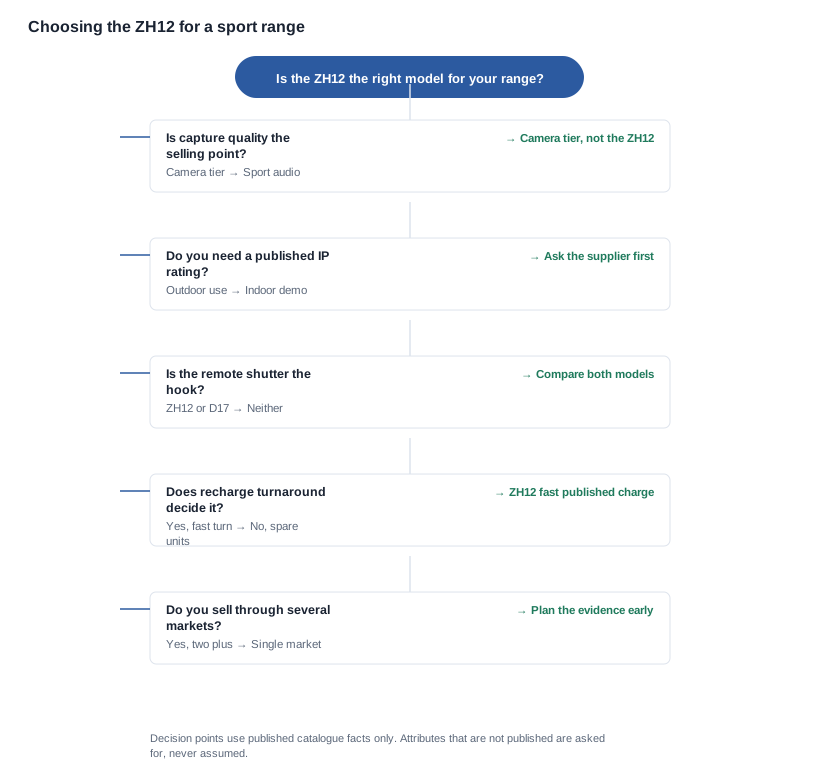
If the programme is instead organised around a retail shelf where the box has to win on a spec comparison, the ZH12 is a weaker pick than a camera-tier model. The shelf comparison that buyers will actually run is megapixels, and the ZH12 has no published megapixel figure to put on the shelf card. A buyer comparing the S7 or the V06 will find 13 MP or 8 MP and an IP54 rating printed on the box; a buyer comparing the ZH12 will find a remote shutter, surround sound, an approximately 8 hour runtime and an approximately one hour charge time. That is a strong conversation with a buyer who knows what they are buying, and a weak one with a buyer who is scanning for a number. Channel fit depends on knowing which of those two buyers you are talking to.
There is one more channel fit that is about the supply chain rather than the shopper. The ZH12 is published with a 100 mAh single cell and USB-C charging. That combination is materially simpler to handle in a warehouse than a magnetic-charging model. Magnetic charging — which is published for seventeen models in the catalogue, including the YKC02, the S7 and the V06 — requires the charging puck to be present, aligned and presentable at every point where a unit is being demonstrated, shipped, returned or displayed. A single-cell USB-C product can be charged from a standard cable off the shelf, in the back room, in the demo case, in the customer's hand. If your channel has a high-touch retail environment with a lot of demo units and a lot of returns, that is a quieter but real cost advantage of the ZH12 over the magnetically-charged alternatives in the same category.
The same single-cell architecture has a second implication. A single 100 mAh cell means there is no second cell to fail, no second cell to ship, and no second cell to certify. It also means there is no redundancy in the runtime figure: the published approximately 8 hours is the whole of the endurance you have, with no spare cell to swap. If your programme assumes all-day use with a mid-session top-up, the ZH12's fast recharge is doing more work than it would on a dual-cell product, and you should plan for spare units in the channel rather than spare batteries. Spares and packaging for the remote itself are also worth asking about, because the remote is a consumable in a retail environment — it gets lost, and the ZH12's headline feature is only as good as the remote that comes with it.
Where the published record is silent, we will put "Not published" on the internal spec sheet rather than a reasonable guess, because the figures a buyer repeats to their own customer should be figures they can evidence. The same rule applies to the channel script: the remote shutter, the surround sound, the runtime and the charge time are the four published claims, and we will not let a fifth one into the pitch by accident.
Where it does not fit
The ZH12 does not fit a camera programme. This is the single clearest exclusion, and it is not a soft one. There is no published camera resolution for the ZH12, no published sensor, and no published megapixel figure, so there is nothing to market, nothing to compare on a shelf card, and nothing on which to base a return-rate expectation. If your brief is a first-person-view video product, the camera tier of the catalogue is where you should be looking — the L1 Pro and the V06, the L2 Utral and the MT6, the V03 and CY05, V03 Pro and the CY03, the KY06 and MT5, and the S7 — and the ZH12 should be excluded from that shortlist entirely rather than positioned as a budget alternative to it. The comparison in /blog/zh12-smart-glasses-vs-s7-form-factor covers that positioning question in detail.
The ZH12 also does not fit a programme that requires a published ingress rating. IP54 is published on the V06 and the S7 only, and on no other model in the catalogue. If your channel sells into outdoor, marine, construction or any environment where a purchaser will ask for a water-resistance figure and a supplier's answer has to be a number rather than a "not published", the ZH12 cannot carry that conversation today. This is a documented gap, not a defect, and it is a solvable one — the manufacturer publishes an ingress rating for two other models, so the capability exists in the product line; what does not exist is a published figure for the ZH12 specifically. That is exactly what to ask the supplier.
Beyond that, there is a cluster of exclusions that come from the same root cause, which is a thin published specification. The ZH12 is not a fit for a programme that needs published weight, because consumers in the sport category genuinely shop on grams and no weight is published for this model. It is not a fit for a programme that needs published dimensions, because fit and tolerance matter for a frame and none are published. It is not a fit for a gift-led or colour-led range, because no colours are published for the ZH12 while four colour options are published for the V06. It is not a fit for a channel that plans to sell a protective case or a prescription lens insert as standard, because the interaction between the ZH12 frame and third-party accessories is not published.
And there is a commercial exclusion that buyers should apply early. The catalogue does not publish price, minimum order quantity, lead time, sample policy, warranty terms or capacity for any model, the ZH12 included. That means the ZH12 cannot be evaluated on a landed-cost basis from published information alone, and a pilot order has to be scoped with a quotation in hand. For a first-time buyer with a small test budget, that is a friction point worth knowing about before the samples arrive. Because none of it is published, we will treat every commercial term on this model as quotation-stage information, and we will not model a landed cost, a margin or a cash-conversion cycle from a catalogue page. The full published-versus-unpublished picture for this model is set out in /blog/zh12-smart-glasses-specifications-and-features, and the sport-category picking guide in /blog/sport-smart-glasses-which-model-to-pick covers how the ZH12 relates to the wider range.
How it sits against the D17 and the YKC02
The sport category is small — three models — and that is useful, because the comparison is short and the differences are published rather than inferred. The YKC02, the D17 and the ZH12 are the three sport-category entries in a catalogue of twenty-eight models. The rest of the catalogue splits into eight audio models, eleven camera models, three kids models and three entries that carry no model number at all.
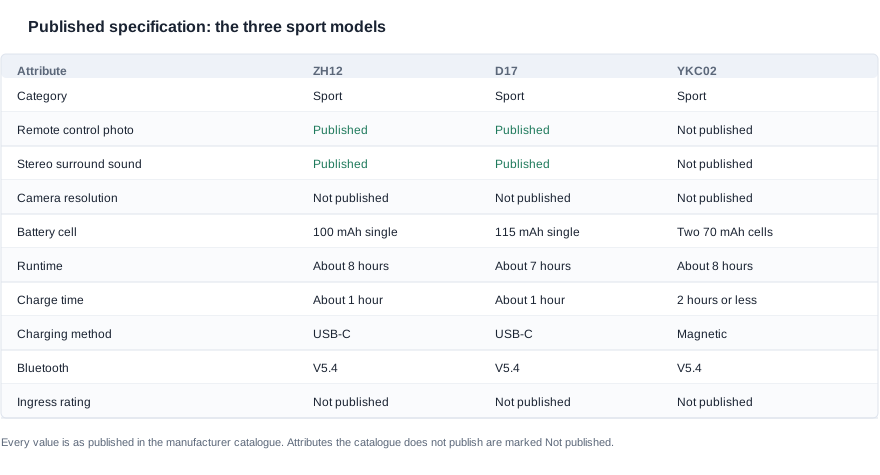
Against the D17. The D17 is the closest sibling, and in several respects it is the harder comparison for the ZH12 to win. The D17 publishes the same two headline features: remote control photo and surround sound. It publishes the same Bluetooth V5.4 and the same USB-C charging. It publishes the same approximately one hour charge time — it is one of only two models in the whole catalogue where that is a point value rather than a ceiling. The runtime is close: approximately 8 hours for the ZH12, approximately 7 hours for the D17. The battery differs: 100 mAh single cell for the ZH12, 115 mAh single cell for the D17.
So on published specifications the D17 has the larger cell and the runtime advantage goes the other way. What the D17 does not publish is a differentiator — it has the same remote shutter, the same surround sound and the same fast charge, with no extra feature row to justify a higher price. If a buyer asks "why the ZH12 rather than the D17", the honest answer is that the published record does not give one, and that is a real problem for anyone planning a two-model sport line. On paper the two are interchangeable apart from cell size, and the practical question becomes whether you want two near-identical SKUs in the same case at all. Note also that the D17 is absent from the ingress-rated list, so it shares the ZH12's IP54 gap; and neither publishes a camera specification, weight, colour or dimensions. The deeper D17 comparisons live in /blog/d17-smart-glasses-specifications-and-features and /blog/d17-smart-glasses-value-for-money.
Against the YKC02. The YKC02 is a cleaner separation, because the two models differ on three published axes at once. The YKC02 has two 70 mAh cells rather than one 100 mAh cell, so its total cell capacity is larger and the architecture is dual. Its charge time is published as 2 hours or less, a ceiling, against the ZH12's approximate one hour — a point value. And its charging method is magnetic, against the ZH12's USB-C. It has no remote control and no camera row, so it shares the ZH12's blank space on capture specifications. Its runtime is approximately 8 hours, matching the ZH12.
Read those two rows together and the trade-off is clean. The YKC02 is the choice when you want two cells and a magnetic charging dock as part of the product experience; the ZH12 is the choice when you want the faster published recharge and a USB-C cable that works everywhere. For a channel running demo tables and handovers, the charge figure favours the ZH12. For a channel whose packaging or accessory strategy is built around a magnetic dock, the YKC02 is the better structural fit. Both are blank on camera specifications and both are blank on ingress ratings. The use-case framing of this pair is expanded in /blog/ykc02-smart-glasses-vs-zh12-use-case-fit.
The decision across the three then comes down to which published fact you are selling. If your differentiator is the remote shutter, the choice is between the ZH12 and the D17, and you should look hard at whether two models with the same feature set earns two shelf slots. If your differentiator is the recharge turnaround, the choice is between the ZH12 and the YKC02, and the published figures make it for you. If your differentiator is capture quality, the ZH12 and the YKC02 are both out and you are in the camera tier.
That last point is where a lot of avoidable purchasing mistakes happen. The sport category is a category of three, and it contains no camera specification at all. A buyer who wants to put a smart-glasses capture product into the sport category has to choose between the ZH12 or the D17 with a remote shutter and no published sensor, the YKC02 with no capture specification whatsoever, or moving to the camera tier where published megapixel figures and, on two models, published IP54 ratings exist. Taking the sport category and quietly implying camera capability is the single most expensive error available in this range, because it creates a marketing claim that the evidence pack cannot support and, in most jurisdictions, a customs and labelling problem that follows the shipment.
Where all three sport models publish nothing on capture, we will say so plainly on the shelf card rather than imply a capability that the evidence pack cannot carry. A sport range built on published facts is defensible in a channel review; a sport range built on implied camera capability is not.
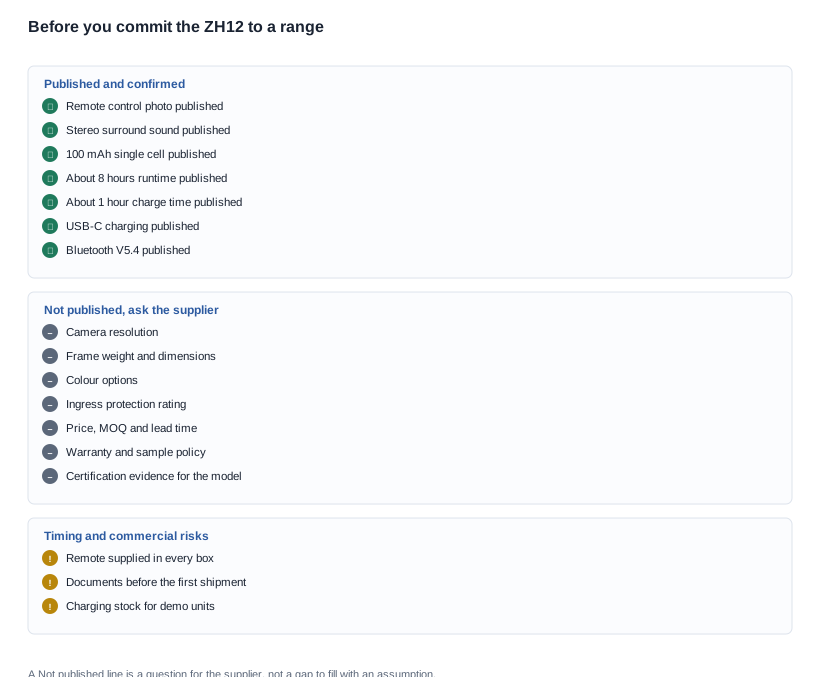
The questions to ask before committing the ZH12 to a range. Everything below is a question you cannot answer from the catalogue, and every answer should be written into the quotation and the evidence pack rather than held in a sales conversation.
- What is the capture path on the ZH12? The model publishes remote control photo but no camera specification. Ask what sensor is fitted, what the still-image resolution is, whether it records video, and whether the media is stored on the device, streamed to a phone, or both. This is the single most important question, because the whole product proposition depends on it.
- What exactly is published on the ZH12 but missing from this catalogue page? Ask for the full specification sheet for the model string ZH12, including frame weight in grams, frame dimensions, lens material, available colours, and the ingress rating if one has been tested.
- Is the approximately one hour charge time measured from empty? Ask whether the published figure is a measured typical value or an upper bound, because the rest of the catalogue publishes a ceiling and the two are not comparable in a quotation.
- Is the approximately 8 hour runtime measured with audio playback, with the remote, or idle? Ask which usage profile the published figure reflects, since the remote and the audio path consume differently.
- What is in the box, and what is the remote's own power source? Ask whether the remote is rechargeable, what its own charge time is, and how many remotes ship per unit. A glove-friendly trigger with a flat remote is a warranty and returns problem.
- What does a sample unit cost, and what does it include? Ask for the sample policy, the sample lead time, and whether the sample fee is creditable against a purchase order at pilot order volume.
- What are the minimum order quantity, the lead time and the incoterms you can offer? None of these are published. Ask for them in the same written quotation that carries the unit price, and negotiate the incoterms explicitly rather than assuming a default.
- What is the warranty and what is the spare-parts position? Ask for the warranty period, what is covered, who bears transit damage, and what tooling or spares are held for the remote, the cell and the USB-C port.
- What does certification evidence look like for the ZH12? Ask what market-access documents exist for this exact model string, what test reports sit behind them, and what a configuration or firmware change invalidates. Do not accept a statement that a product is certified without the report behind it.
- What is the packaging and labelling position for your market? Ask about retail packaging, plug and cable format, carton markings, and whether any configuration changes to suit your market.
Ask the first nine in writing, before the purchase order, and attach the answers to the purchase order as a specification annex. If a supplier cannot produce a written answer to question one, that is a procurement signal in itself: it is the question on which the entire positioning of this model rests, and it is not the kind of gap that gets closed after the first shipment lands.
One closing note on framing, since it will shape how your channel talks about this model. The strongest version of the ZH12 story is not "a cheaper camera" and not "a rugged sport camera". It is a specific and defensible one: a sport-category model with a remote shutter, stereo surround sound, approximately 8 hours of published runtime, and the fastest published charge time in the range, at roughly an hour. That is a real differentiator against the D17 and the YKC02 on the only axes where the published record allows a comparison, and it is an honest one. Buyers who will pay for that story are a genuine market segment. Buyers who want a megapixel number are not, and no amount of packaging will convert them. Know which shelf you are stocking before you place the purchase order, and let the published specification be the whole of the claim.
For the wider range, the pillar page at /products/sport-smart-glasses is the reference point, and the sport-category guides referenced above cover the model-by-model detail. The certification evidence question that follows any purchase order is handled separately in /blog/zh12-smart-glasses-certification-status, which sets out what an importer should request in writing before the first shipment.


