

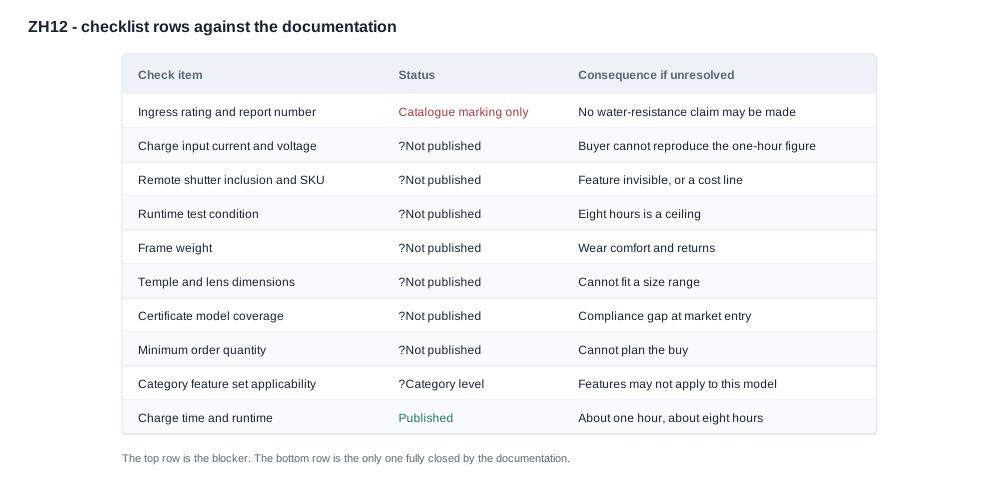
A purchase order for smart glasses is a document about promises, and the ZH12 is a good test of whether a buyer's review process is real or decorative. The catalogue row for this model is short and clean. A single 100 mAh cell, about eight hours of runtime, about one hour of charge time, USB-C, Bluetooth V5.4, remote control photo, stereo surround sound. That is the entire published basis for a decision that may commit your company to several thousand units.
What is missing from that row is longer than what is in it. No frame weight, no dimensions, no lens material, no colour options, no ingress rating, no certification status, no price, no MOQ, no lead time, no sample policy, no warranty. None of those are published. A buyer who signs against the catalogue row alone is not missing a detail; they are missing most of the evidence a purchase order needs.
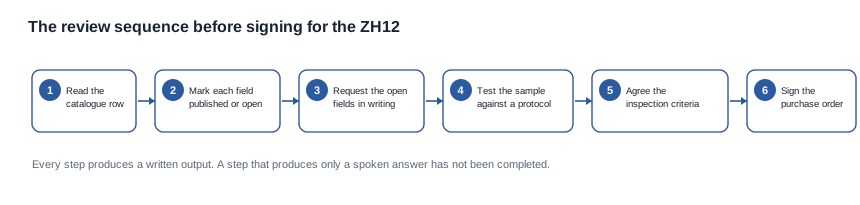
This checklist is the review we run before we sign. It separates what the catalogue publishes from what has to arrive in writing, sets out the document set we request, the questions we ask on inspection, and the commercial terms we refuse to leave vague. Nothing in it is exotic. It is the difference between a purchase order that reads well and a purchase order that survives a dispute.
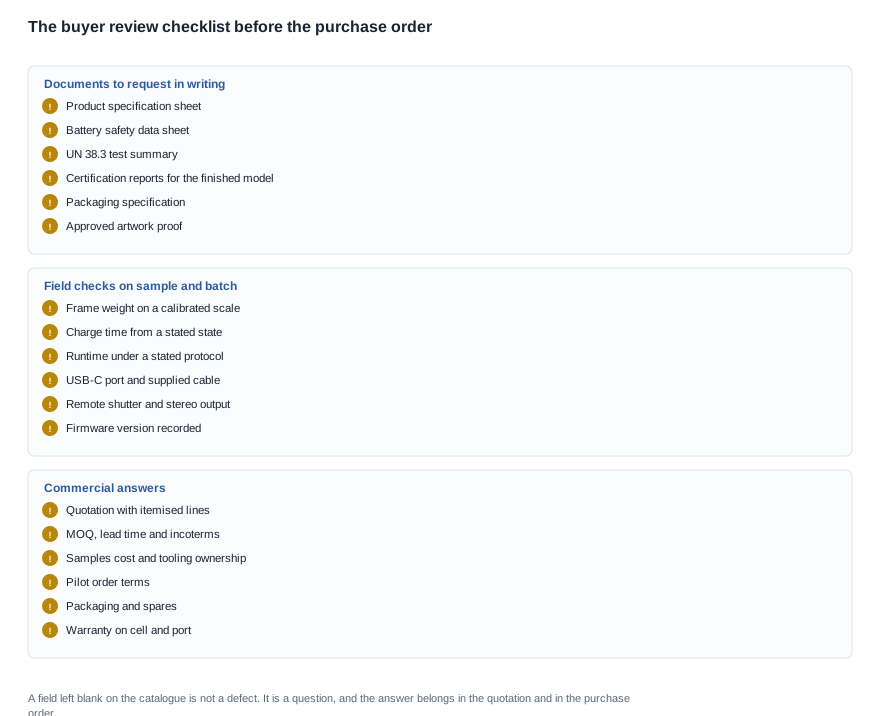
ZH12 buyer review checklist: the fields to confirm before signing
The first stage of the review is field-by-field. For each field, there are exactly three possible states: published, not published, or published but without a stated test condition. We will not let a field leave this table in a fourth state, which is the one where somebody assumed a value.
The published fields for the ZH12 are these:
- Category: sport smart glasses. The sport category contains exactly three models — YKC02, D17, and ZH12 — and the ZH12 is the one with the single-cell architecture and the one-hour charge claim.
- Cell: a single 100 mAh cell.
- Runtime: about eight hours.
- Charge time: about one hour.
- Charging method: USB-C, described in the catalogue under its Type C designation.
- Bluetooth version: V5.4.
- Feature rows: remote control photo, and stereo surround sound.
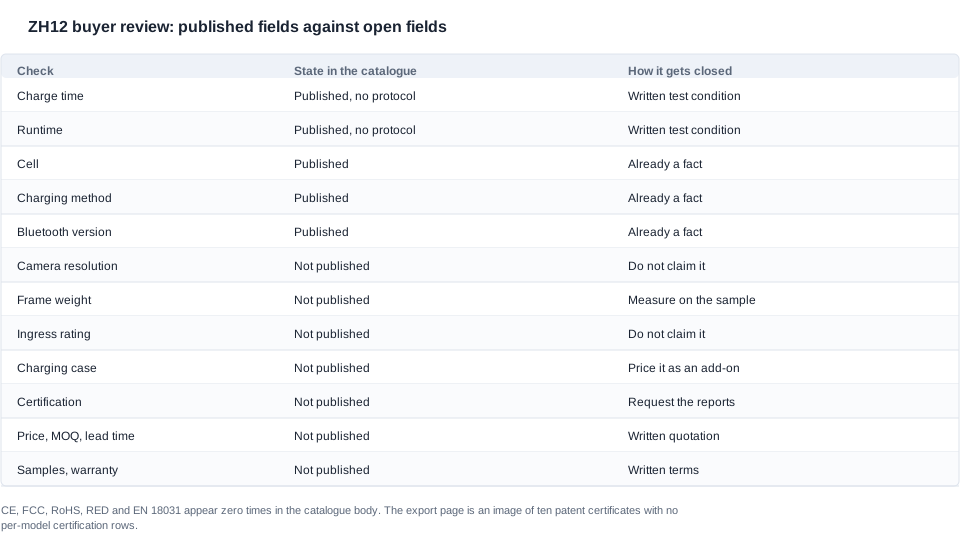
Two published fields carry more weight than they appear to. The one-hour charge time is published on only two models in a twenty-eight model catalogue, where the other twenty-six publish a ceiling of 2 hours or less. And the remote control shutter is published on only the D17 and the ZH12, which makes it a category signature rather than a common feature. Both facts are worth putting in front of a retail buyer, and both are worth asking about, because the published field is a figure without a protocol.
The not-published fields are equally explicit, and each one has to become a written answer:
- Camera resolution. There is no camera row published for the ZH12. It is not a camera model and no listing, packaging, or tender document may call it one.
- Frame weight. The only public weight figure anywhere in the catalogue is the MT6 at 158 grams, measured on the glasses body and excluding its 1200 mAh folding case. The ZH12 weight is not published.
- Dimensions and lens material. Not published.
- Colours and finishes. Not published.
- Ingress protection. Not published for the ZH12. Only the V06 and the S7 publish an IP54 rating in the whole range.
- Certification status. Not published, and see the evidence section below for why this one is larger than it looks.
- Price, MOQ, lead time, sample policy, warranty. Not published.
- Charging case. No case is published for the ZH12. Across the catalogue, five models publish a case capacity, two have a case with no capacity published, and three rows have no case at all — so the question of a ZH12 case is a real commercial question, not a formality.
- Touch control and translation. There is no capacitive-touch row and no translation row anywhere in the catalogue, so neither feature may be claimed for any model, including this one.
The third state, published without a stated test condition, is where the most money hides. About eight hours of runtime and about one hour of charge time both carry the word "about", and neither carries a protocol. Volume level, codec, paired phone connected or not, remote shutter idle or active, ambient temperature, and the battery state at the start of the charge are all undefined. We will record each of these as an open condition rather than treating the published figure as an acceptance threshold, and we will write the threshold we will actually test against into the purchase order.
It is worth being precise about the scale of the range behind this one model, because the published-versus-unpublished pattern is a property of the catalogue rather than of the ZH12. The catalogue holds twenty-eight models: eight audio models, three sport models, eleven camera models, three kids models, and three rows that carry no model number at all, covering AR glasses, electrochromic glasses, and bone conduction. Bluetooth version is published for fourteen models and is not published for the eleven camera models, for the A05, the A06, or for the bone conduction row. Camera resolution runs at 8 MP on eight models and 13 MP on three models, the L1 Pro and the S7, and the L2 Utral. Charging method is magnetic on seventeen models, USB-C on seven, and not published on four. When a catalogue withholds a field on a minority of models, the correct reading is that the supplier holds the data but has not committed to publishing it, which means it can usually be produced on request. That is a much better position for a buyer than a field the supplier does not track.
What to request as written evidence
The catalogue is a sales document. It is a good document for narrowing the range, and it is the wrong document to base a purchase order on. The clearest example is certification. Markings such as CE, FCC, RoHS, RED, and EN 18031 appear zero times in the body of the catalogue. What the catalogue offers on its export page is an image page showing ten patent certificates — eight design patents and two utility models — with no per-model certification rows anywhere behind it. A patent certificate is evidence of an ownership right over a design or a mechanism. It is not evidence that a finished radio product conforms to the requirements of the market you are shipping into. We will not put a conformity claim on a box, a listing, or a tender response on the strength of a patent image.
The document set we request before signing is short and specific:
- A signed and dated product specification sheet for the ZH12, listing the catalogue name and every field that the catalogue leaves open, with tolerances stated where a tolerance is possible.
- The battery safety data sheet for the cell actually used in this build, plus the cell specification sheet giving rated capacity, chemistry, and cycle life.
- The UN 38.3 test summary for that cell, because a lithium cell shipped inside a wearable needs transport documentation before it can move, not after.
- Certification evidence for the finished ZH12 as it will be shipped in your market, with the underlying test reports rather than a declaration that names a different model. The certification checklist for procurement is the format we work from.
- The packaging specification, including the master carton quantity, the gross and net weight, the carton dimensions, and the accessories list.
- The artwork proof and the printed sample for every panel that will carry a rating, a warning, or a claim, approved and signed before the run.
- The quality plan for the production batch, including the inspection level, the defect classification, and the pre-shipment inspection right.
- The firmware version that will ship on the order, recorded as a number rather than a description.
Every one of these is a request, not a demand, and every one has a legitimate supplier answer. The rule we apply is simple: if a document cannot be produced, the corresponding claim does not go on the packaging and does not go on the listing. That rule has saved more money than any negotiation we have run, because a claim that cannot be evidenced is a liability that a retailer, a marketplace, or a regulator can find for you. We will apply it to ourselves as well, and we will not print a figure on a panel that the document set does not support.
The same logic applies to the claims that come from the published row. A charge time of about one hour and a runtime of about eight hours are fine to market as published figures, provided the wording stays aligned with the published wording and does not add a protocol the supplier has not confirmed. A frame weight, a battery capacity, an IP rating, or a camera resolution for the ZH12 must not appear anywhere, because each of them is not published. And the published battery life behaviour a buyer should expect from this range is a reasonable reference for the field test you should run, provided you test against the conditions the supplier actually used.

The inspection questions worth asking
Inspection is where the catalogue's approximations meet reality. It is also where most buyers run out of the list of what to ask the supplier and settle for a spoken answer; we will not. We run it twice: once on the sample, and once on the production batch before shipment. The questions below are the ones we ask in both, and they are framed so that an answer can be written down.
On the physical side, we ask for the frame weight on a calibrated scale, in grams, with the unit stated, because the catalogue publishes no weight for this model. We ask for the overall dimensions in millimetres, the lens material, and the colour against the approved sample rather than against a colour name on a list. We check that the USB-C port is present, that the supplied cable is the same USB-C standard, and that the port is seated correctly. We confirm that the remote shutter control that the catalogue publishes is present, that it responds, and that the stereo surround sound output is clean at the volume level the packaging claims to support. Because no ingress rating is published for the ZH12, we also establish what the product can actually survive before any water or dust claim enters the channel material.
On the electrical side, we ask for the charge time measured from a stated battery state to a stated battery state, with the device idle and then active, and we record the ambient temperature. We ask for the runtime measured under a stated volume level and a stated codec, with the phone paired but idle, and again with the remote shutter used at a normal rate. We check the cell capacity against the published 100 mAh single-cell configuration. We verify the pairing sequence, the range, and the firmware version on a defined set of phones, because Bluetooth V5.4 is a published claim that is easy to honour in the laboratory and easy to lose in a firmware update.
Then the sampling. We agree the sample size, the defect classes, and the acceptance level in writing before production starts, and we keep the right to a pre-shipment inspection at our own cost. For a product sold on stamina and on a one-hour charge time, the two defects that matter most are a unit that will not hold charge through the day and a unit whose port fails early. Those are the defects we will write into the quality plan with explicit rejection criteria, and they are the ones a generic inspection sheet will not catch.
The sample inspection is worth structuring on its own, because it is the one chance to test the open fields cheaply. We hold a sample for a defined period, use it the way a customer would, and log every observation against the same field list. Frame weight goes on the scale. The charge time gets a stopwatch and a stated start and end state. The runtime gets a controlled session. The remote shutter and the stereo output get tested on the phone models the channel actually sells into. Then the findings go back to the supplier as a single document, in the same format as the specification request, so that a field marked not published either gets an answer or gets an agreed plan to produce one. A sample that only confirms what the catalogue already says is a sample that was not tested; the value is entirely in the fields that came back blank.
One last inspection habit is worth keeping: record the findings against the same field list that opened the review. If a field was marked not published and the sample turns out to answer it, update the record and ask whether the supplier will publish it. Over successive orders, a specification that started as eight published fields becomes a specification that covers your file. That is how the gap between a catalogue row and a purchase order closes for good.
The commercial questions worth asking
The commercial conversation is where a good product becomes a good deal, and it is the stage where vagueness is most expensive because everything after it is a commitment.
Start with the quotation. We ask for a quotation that separates the unit price, the packaging cost, the accessories, the certification cost, the tooling or customisation cost, and the freight, each on its own line. A single blended number cannot be negotiated, because any movement on one element moves all the others invisibly. We also ask for the quotation to state the currency, the validity period, and the basis of the price, so that two suppliers' quotes can be compared like for like.
Then the MOQ and the lead time, per colour and per configuration rather than as a single headline figure. The sport category publishes no colour list for the ZH12, so each colour should be a separate MOQ line and a separate lead time. We ask how the lead time breaks down between the sample, the pilot order, the first production order, and a reorder, and what happens to the lead time when the order sits at the MOQ rather than above it. We ask for the incoterms the price is based on, and we compare on the same incoterms, because a price quoted on one basis and a price quoted on another will make the cheaper offer the expensive one.
Samples are a commercial item, not a free courtesy. We ask for the sample cost, the sample lead time, whether the sample cost is credited against the first production order, and whether the sample shipped is production-representative in firmware and finish. For anything involving custom tooling, moulding, or a bespoke print, we ask who owns the tooling after the first payment, and what happens to it if we place a second order elsewhere. This is a small clause that prevents an expensive argument later, and we will not negotiate on it once the run has started.
The pilot order is the cheapest insurance in the whole process. We ask what the minimum quantity is that lets us validate the charging behaviour, the battery drain, and the field fit with real users, and we ask in writing how a pilot order that fails the agreed criteria is handled. A supplier who answers that question clearly is a supplier whose production order will also go well.
Packaging and spares complete the file. We ask for the packaging specification, the accessory list, and whether a spare USB-C cable and a set of spare units should be part of the standard pack. We ask what the spares arrangement looks like for the charge port and the cell over a twelve-month period, because a product that is charged every day for a year will produce a small but real return population, and it is better to plan for it than to discover it. We ask for the warranty terms on the cell, the port, and the electronics, and we ask whether the warranty period starts at production, at shipment, or at the end customer's date of purchase.
Finally, we negotiate the terms that will actually be enforced, and we accept a trade-off rather than pretending every term can be won. Price and MOQ move against volume and lead time. Payment terms move against the size of the order. Packaging cost moves against the customisation you ask for. A deal where each of those has moved in a different direction is a normal deal, and a deal where every term has moved against you at once is usually a sign that the specification was never written down.
Two of those terms deserve a paragraph each because they are routinely left out of smart glasses purchase orders entirely. The first is payment. A deposit, a balance against the pre-shipment inspection, and a milestone before the consignment leaves are three different risk positions, and the one you accept tells the supplier more about your order than the price does. We will pay against evidence — against the confirmed specification, against the approved artwork, against the passed inspection — because that structure is what converts a written specification into a controlled one. The second is the reorder. A price is a snapshot, and a first purchase order is the wrong place to discover that the reorder price, the reorder lead time, and the reorder minimum are all different from the first one. Ask for the reorder terms in the same document as the initial quotation, even if the reorder is a year away, and we will negotiate them then on the strength of a proven first run rather than discovering them by accident.
Here is the summary of the whole review. The published ZH12 fields are strong — a single 100 mAh cell, USB-C, about eight hours of runtime, a one-hour charge time matched by only one other model in the range, and a remote shutter that only one other model carries. Everything else on the checklist exists because the catalogue does not publish it: the physical specification, the ingress position, the certification evidence, the transport documentation, the price, the MOQ, the lead time, the incoterms, the sample policy, the pilot order terms, the packaging, the spares, and the warranty. Buy the published facts as facts, and buy everything else as a written answer. The sport smart glasses line gives you the models; this checklist is what turns a model into an order you can defend.


