

Here is the answer to the question, stated plainly because a vague answer here is worse than no answer at all: the certification status of the ZH12 is not published. There is no certification row for this model in the manufacturer's catalogue, no market-access document is referenced against it, and no report number is attached to it anywhere in the published material.
That is a fact about the published record, and it is a fact you can act on. It does not mean the ZH12 is uncertified, and it does not mean the ZH12 is certified. It means that as an importer you cannot take a certification claim for this model from the catalogue, and you cannot treat a catalogue listing as evidence that a market-access document exists for the SKU you are about to buy. Everything you ship under the ZH12 name must be supported by documents the supplier gives you, in writing, against the exact model string — or it must not be claimed at all.
This distinction is the entire content of this article, and it is worth being blunt about why it matters. In several markets, the document set that accompanies a radio-equipment product at import is not a marketing accessory. It is a condition of clearance. A product that arrives in the destination country with an unsupported conformity claim, or with a declaration of conformity that names a family rather than the model that is physically in the carton, creates a customs hold, a forced relabelling, a re-test, or a product withdrawal — and each of those costs far more than the certification conversation that would have avoided it. For a B2B buyer placing a pilot order or a first production purchase order, "the certification status is not published" is a perfectly workable starting position. "The supplier says it is fine" is not.
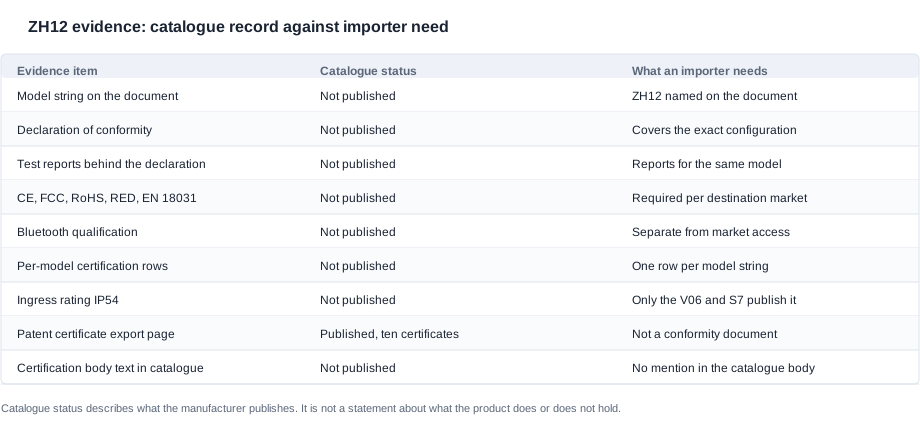
Let me set the boundary precisely before anything else, because this subject is where confident-sounding copy goes wrong most often. Across the entire published catalogue body, the terms CE, FCC, RoHS, RED and EN 18031 appear zero times. Not for the ZH12 — for every model, across all twenty-eight entries: eight audio models, three sport models including the ZH12, eleven camera models, three kids models and three entries with no model number. The catalogue also publishes exactly one certification-adjacent artefact: an export page that is an image page showing ten patent certificates, eight design patents and two utility models. We will come back to that page, because it is the single most misleading element in the whole subject, and separating it from market-access certification is the second half of this article.
So: nothing in this article states or implies that the ZH12 holds CE, FCC, RoHS, RED or EN 18031 certification. Nothing in it names a certificate number, a test report number, a validity date or an issuing body. Those are not secrets we are withholding — they are facts that are not published, and inventing them is the precise failure this article exists to prevent.
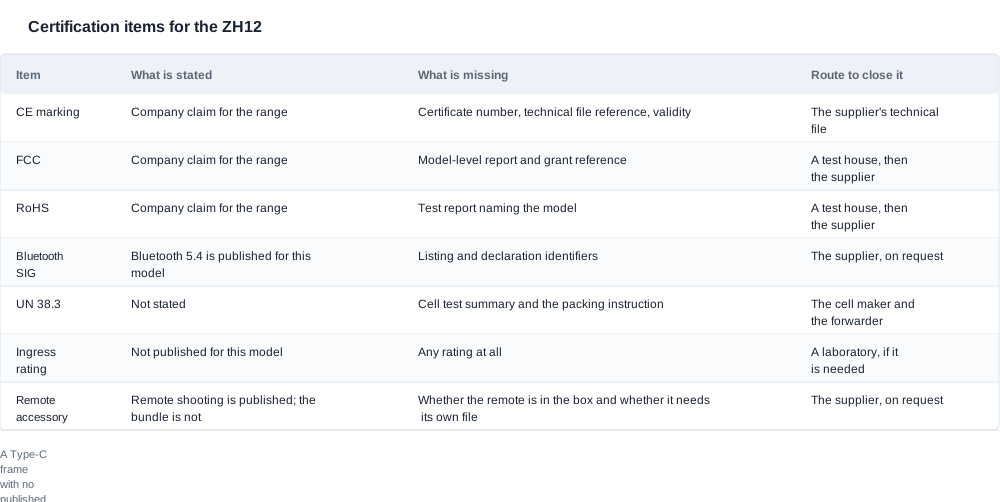
ZH12 certification status: what an importer actually needs
An importer's certification requirement is not a badge. It is a document set that a customs authority, a retailer, an insurer or an end customer can be shown, that covers the exact physical product that will be in the carton, and that supports the claims printed on the packaging, the manual and the online listing. Break that into the parts, because each part fails differently and each has a different owner.
1. A declaration of conformity for the exact model. The document has to name the model string ZH12, and it has to cover the configuration you are actually buying — the battery build, the radio module, the firmware and the accessories in the box. This is the document your market's authority will ask for at the border or the document your largest retail customer will ask for in their supplier onboarding pack. It is the highest-value document in the set and the one most often missing.
2. The test reports behind the declaration. A declaration is a claim; the reports are the evidence. The reports should cover the radio and the safety and the material requirements that apply, for the same model and the same configuration. When you ask for the declaration, ask for the reports in the same message. A supplier who can supply the declaration but not the reports is telling you the declaration is a formality, and you should price that information into your decision rather than ignore it.
3. Market-specific requirements. A single document set rarely covers every market you sell into. Radio equipment rules differ between the European economic area, the United Kingdom, the United States, Canada and much of the rest of the world, and each has its own conformity route, its own labelling conventions and its own transition periods. The practical consequence for an importer is that you cannot buy one document set and assume it covers your channel. You need to know, per destination market, which requirements attach to a device in the ZH12's class — a device with a Bluetooth radio and a rechargeable cell, sold as a wearable — and you need to know whether the supplier already holds them for this model or whether you commission them yourself.
4. Labelling and marking conformity. For most markets this is where the practical failure happens, because it is the part that is under-considered. If the market requires a conformity mark on the product or the packaging, if it requires a specific importer or responsible-party marking, if it restricts certain wording in the user manual, or if it mandates a language for safety information, then those obligations attach to what you print and what you ship — not to the factory's default artwork. These are decisions you make and pay for, and they need to be scheduled before the packaging artwork is locked, not after the first carton is produced. The longer you leave them, the more tooling and artwork you reprint.
5. The traceability and record-keeping trail. Customs authorities in most jurisdictions want to be able to trace a consignment back to the supplier and the batch. Practically, that means the purchase order records the model string and configuration, the shipment records link to the batch, and the file links the batch to the documents. This is the least glamorous item on the list and the one most often skipped in a rush to ship, which is why we will build it as a habit rather than a task.
Now the number one and number two are what people mean when they search for certification status, and the number three, four and five are what actually decide whether the shipment clears. A buyer who has only chased the declaration and has not asked about labelling will discover the labelling problem at artwork approval, which is the worst possible moment, because you have already paid for packaging.
The good news is that none of this is unusual or exotic for the sport category. A Bluetooth-enabled wearable with a lithium-polymer cell, sold into multiple markets, is one of the most standard compliance profiles in consumer electronics. The reason it feels difficult is not that it is hard — it is that the catalogue does not tell you what you already own, so you cannot tell what is missing.
The following comparison sets out the published picture for the ZH12 against what an importer needs to confirm. Every "Not published" cell is a question to the supplier, not a gap to work around.

The model string is the document
The central rule of import compliance is deceptively simple: a document covers the product it names, in the configuration it describes. Everything else follows from that one idea.
A family declaration is not a declaration for your SKU. This is the most consequential point in this article, and the most common one to get wrong. A supplier who holds a conformity document for a product family has held it for a set of models that share a radio module, a battery build, an enclosure and a firmware baseline. Your purchase order places a specific model string, with a specific configuration, into a specific market. If the document in the supplier's file names a family, a series, a platform or a project code, then the question "does this document cover the unit in my carton?" is unanswered — not answered yes, not answered no. You need it answered in writing before you ship, and the answer has to be traceable to the model string on your purchase order and on your packing list.
The configurations that quietly break a family declaration are the ones nobody thinks about. A different cell supplier, a different radio module or module revision, a different antenna, a firmware version outside the tested baseline, a different charger in the box, a different colourway if the material differs by colour, a different packaging, and even a different label artwork are all plausible. Each is a question the supplier can answer and each is a question an authority may eventually ask. The practical instruction is short: ask what a configuration change invalidates, get the answer in the document set, and record the current configuration in the purchase order so there is a baseline to check future shipments against.
The ZH12's own published specification is part of the configuration. This matters more than it first appears, because the ZH12's published row contains some distinctive items. It is published with a 100 mAh single cell, an approximately 8 hour runtime, an approximately one hour charge time, USB-C charging, Bluetooth V5.4, remote control photo and stereo surround sound. Note that Bluetooth version is published for fourteen models in the catalogue and not for the eleven camera models, A05, A06 or the bone-conduction entry. So for the ZH12 the radio protocol version is a known, stated configuration parameter — which is exactly the kind of thing that has to match between the product, the test report and the declaration.
The remote is part of the configuration, and it is where buyers get caught. The ZH12's remote control photo is published on the ZH12 and the D17 only. A remote in the box means an additional radio-bearing item, and possibly an additional power source, inside the packaging. Whether that remote is covered by the same document set as the glasses, whether it needs its own conformity treatment as a separate radio device, and whether the packaging can carry a combined marking — all of these are questions, and none of them have published answers for this model. Treat the remote as a configuration element to be documented, not as a cable in a bag.
The model string also has to be consistent across your whole file. Your purchase order, the supplier's production order, the packing list, the commercial invoice, the carton marking, the manual, the online listing and the evidence pack should all reference the same model string. Mismatches between these are one of the most common causes of a document challenge at the border, and they are entirely self-inflicted. When you ask the supplier for the model string, ask them to confirm it is the exact string used on the product label, the carton and the declaration. If the label says one thing and the paperwork says another, you have found a problem before the shipment, which is where you want to find it.
A patent certificate is not a conformity document. This is the point to make before it is made for you, and it belongs here because the catalogue's own export page creates exactly this confusion. The catalogue export page is an image page showing ten patent certificates — eight design patents and two utility models. Those are intellectual-property records. They tell you that the design of a product or the construction of a component was registered by someone. They say nothing about radio conformity, electrical safety, electromagnetic compatibility, hazardous-substance content, or any of the market-access requirements that an importer has to satisfy. No customs authority has ever accepted a design patent in place of a conformity assessment, and no retailer will accept one either.
There is a second layer to this. A patent certificate is also usually about the design or the mechanism rather than the model string. It may not even be specific to the ZH12 as opposed to the wider range. So the export page does not even do the job it appears to do for a model-level argument: it is not a per-model certification row for anything, including the ZH12. The catalogue publishes no per-model certification rows at all. Read the export page as what it is — a page that shows the company holds registered designs and utility models — and then treat the entire certification question as still open, which is where an importer needs it to be.
Certification evidence and Bluetooth qualification are two different systems. This is the last distinction to draw, and it is the one most often blurred in supplier conversations because both end up as a logo on a product page. The Bluetooth SIG qualification scheme is a trademark and product-listing regime for the Bluetooth protocol. It confirms that the product has been through the qualification process for its Bluetooth release, and it produces a listing and a declaration that the product uses a qualified Bluetooth component or has been qualified. It is not a market-access requirement for radio equipment, and a Bluetooth listing does not substitute for a conformity assessment in any destination market. The reverse is also true: a conformity assessment for radio equipment does not put your product on the Bluetooth listing. They are separate systems with separate paperwork, separate scopes and separate owners.
Why this matters for the ZH12 specifically: the catalogue publishes Bluetooth V5.4 for this model, so the protocol version is known, and a buyer may reasonably assume that a supplier who quotes a Bluetooth version also holds the corresponding qualification paperwork. That assumption may well be true, and it may be false, and the published record does not say which. If your channel's retail or marketplace onboarding requires a Bluetooth listing or a Bluetooth declaration, that is a separate evidence request to make — it does not get satisfied by the same conversation that covers market access, and it does not get satisfied by the patent export page either. The detailed version of this separation, with the questions to put to a supplier, is in /blog/bluetooth-sig-certification-buyer-checklist.
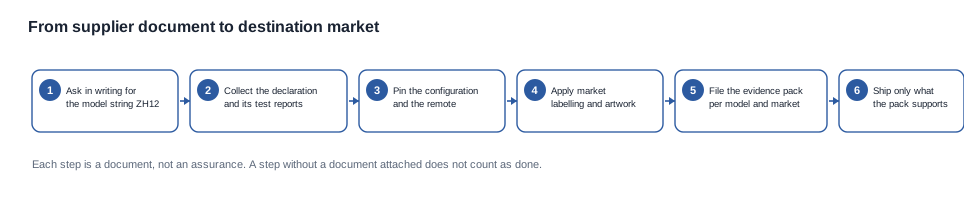
The practical summary of this section is a single working rule: for every market you intend to sell into, hold one folder, named for that market and for the model string ZH12, containing the declaration for the model, the reports behind it, the labelling and artwork decision, and the Bluetooth paperwork if it is separately required. If a document in that folder does not name the model string, or does not cover the configuration in the purchase order, it does not count. That rule is what turns "not published" from a source of anxiety into a source of clarity. Where a document does not exist yet, we will ask for the plan and the cost rather than accept a family-level reference, and we will record the gap in the purchase order annex instead of leaving it in an email.

What to ask in writing
Every item below should go to the supplier as a written request, ideally in the same message as the quotation, and every answer should come back in writing. Verbal assurances are the reason importers end up in disputes they cannot evidence.
- Does the supplier hold a market-access document set that covers the model string ZH12 as configured in this purchase order? Ask for the model string as it appears on the product label and on the carton, and ask them to confirm it matches your purchase order.
- If yes, ask for the declaration and the test reports behind it, for each destination market on your list. Ask which documents are held, which are not, and which are in progress.
- If no, ask who will commission them, on what timeline, at whose cost, and who owns the failure if one does not arrive before the shipment date. This is the negotiation that matters: the cost of a re-test or a delayed launch should sit with the party who controls the product configuration, which in a first purchase is usually the supplier.
- Ask what a configuration change invalidates. Get the list in writing — cell, radio module, antenna, firmware baseline, charger, packaging, artwork, colourway if applicable — and record the current configuration as the baseline.
- Ask how the remote control that ships with the ZH12 is treated. Is it covered by the same document set, does it require separate conformity treatment, and is it identified on the carton or in the manual?
- Ask what the labelling obligations are per market, and who applies them. Ask for the factory's default artwork and for a statement of what an importer must change: marks on the product, marks on the packaging, importer or responsible-party details, manual language, and restricted wording.
- Ask whether the Bluetooth qualification paperwork exists for this model, and ask for it separately from the market-access set. Do not accept one in place of the other.
- Ask what the published catalogue does not state about this model that you will need for the files. Frame it as a completeness request: camera specification, frame weight, dimensions, lens material, colours, ingress rating, price, minimum order quantity, lead time, warranty.
- Ask what the sample policy is for the compliance question specifically — whether a sample order carries the same configuration and the same documents as the production order, and whether the sample is the unit you will list. A sample that differs from the production build is the fastest way to discover a configuration gap, so ask whether the sample is a true production unit.
- Ask how the supplier handles a certification change request once you are in production. A supplier with a process answers with a lead time and a cost. One without answers with silence, and that silence is your risk.
- Ask what the lead time and incoterms are, and whether the compliance work sits inside the quoted lead time. A quote with a short lead time and an open compliance question is not a short lead time.
- Ask whether the supplier will sign the purchase order annex with the specification and the document set attached. If they will not, at least you have a record of exactly what was and was not agreed, and you can negotiate the wording.
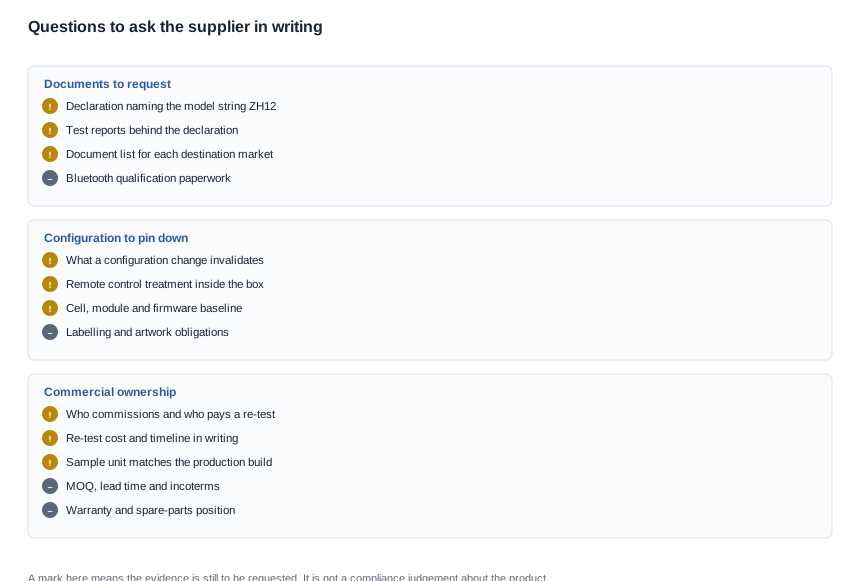
Write the answers into the purchase order annex, not into a separate spreadsheet that lives in someone's inbox. The annex travels with the purchase order, and it is what you would have to show if the shipment were ever challenged. We will also note the obvious commercial point: a supplier who answers these questions cleanly and promptly has effectively told you that the product is documentable, which is itself a form of certification evidence even though it is not a certificate. A supplier who cannot answer them has told you the opposite, and that is also information you can act on — before the first purchase order, not after.
The wording matters more than people expect, and we will keep our own requests specific for the same reason. "Do you have CE for the ZH12?" invites a yes or a no, and invites the wrong answer in either direction. "Please confirm which market-access documents you currently hold for the model string ZH12, identify the test reports behind each, and state any configuration change that would invalidate them" is a request for a document inventory, and it is much harder to answer loosely. The specificity of the question sets the specificity of the answer, and that is the entire negotiation technique for this category.

Questions to ask before you commit to a shipment
The certification conversation above is the supplier's side of the transaction. This section is yours, and it is the part most importers forget: you have obligations that the supplier cannot discharge for you.
Which markets are you actually shipping into on this shipment? The honest answer is usually narrower than the channel plan. Every market you add adds a conformity route, a labelling convention, an importer obligation and a document set to maintain. Know the list before you ask the supplier for documents, because the supplier's answer depends on the list, and a document set quoted for one market is not a document set for five.
Which claims will appear on your packaging and your listing? Every claim is a commitment. If your listing copy describes the ZH12 as a camera product, you are making a claim the published record does not support and that the model string has no published sensor for. If your packaging carries a conformity mark, you are claiming that a document exists for the unit in that carton. Audit the artwork and the copy against the evidence pack before it goes to print, and note that the ZH12 publishes no camera resolution, no ingress rating, no frame weight and no colours — each of those is a place where an unsupported claim can creep in.
Who is the importer of record, and whose name goes on the documents? In many markets this is a mandatory marking and it is not the manufacturer's name. If the marking must name your entity, then the artwork decision is yours, the cost is yours, and the lead time for it is yours. Some suppliers include an importer marking service in the quoted price; others charge for it and it appears as a line item later. Ask now.
What is the cost of getting it wrong? Set the number before you are under pressure. A customs hold costs demurrage and delay. A forced relabelling costs labour and reprinting. A re-test costs engineering time and lab fees and a lost sales window. A product withdrawal in a market where you have already built demand costs the stock and the reputation. This is exactly the kind of cost that is invisible on the purchase order, which is why it belongs in your negotiation rather than in a hope that the problem does not arise.
What is the fallback if a document does not exist for a market you planned? Every importer needs this answer before they need it. The options are: hold that market until documents exist, ship a different model in that market that already has a document set, or commission the work yourself with your own testing. The third is real and sometimes correct — a buyer with volume can justify owning a test programme — but it is expensive, slow, and it puts the burden of the configuration on you. Decide the policy now, while you are choosing, not at the border.
Does the volume justify the compliance investment? This is the trade-off nobody discusses out loud, and it should be discussed. Certification and evidence work has a fixed cost — lab fees, artwork changes, legal review, document management, the time of the people doing it — and it is largely independent of order size. A pilot order of a few hundred units can absorb it if the plan is to scale; a pilot order of a few dozen units followed by no reorder cannot. So the compliance conversation is really a volume conversation. If the model is not going to reach a volume that justifies the fixed cost, the honest answer may be that this model is not the right entry point for that market, and that a different model with existing documents is.
What is the cost of a re-test, and who owns it? Get this in writing. If a configuration change is made after the documents are in place, the re-test cost can be substantial, and in a first-purchase relationship the supplier will often not accept responsibility for a change that was commercially driven rather than technically driven. Asking this question at quotation stage is not adversarial — it is the same negotiation as the incoterms, the lead time and the warranty. It belongs in the purchase order, not in a side email.
Can you verify the documents rather than trust them? Ask for the underlying report, check that the model string on the report matches the model string on the label, and check that the issuing body's identity and report reference are internally consistent. If a report is not supplied and only a declaration is, that is a signal, and you should treat it as one. You are not obliged to become a compliance expert, but you are obliged to be consistent about what evidence you accept, because the day you accept a loose answer is the day your own retailer will expect the same standard from you.
How is the evidence pack going to be maintained? The document set has a shelf life. Requirements change, suppliers change, the product changes, and the person who held the file moves on. For a model you plan to keep selling, the pack needs an owner and a review cycle — a re-check before each significant shipment and a hard date on which someone confirms the documents are still current. The evidence pack for this model, per market, with the model string on every document, is the deliverable that makes certification a managed item rather than a recurring crisis. The export-documentation workflow for platforms of this kind is covered in /blog/oem-ready-platforms-export-documentation, and the sport-category buying guide at /blog/sport-smart-glasses-buying-guide covers the commercial framing.
A closing word on the honest position, because it is a legitimate commercial position rather than a weakness. "Certification status for the ZH12: not published in the manufacturer's catalogue, with a patent-certificate export page that is not a conformity document; the supplier's document set for this model string is provided on request and should be obtained in writing before the first shipment" is a complete, accurate and useful answer to an importer's question. It is also a better answer than a badge, because it tells the buyer exactly what is and is not known, what to request, and what the next step is. Buyers respect a supplier who draws that line precisely, and it is a far better foundation than a claim that cannot be evidenced when an authority asks.
If you want the published specification for this model before you go further, it is set out in /blog/zh12-smart-glasses-specifications-and-features, and if the ingress rating question matters to your application, the method for testing it before you order is covered in /blog/how-to-test-before-ordering-ip-rating-smart-glasses. For the certification evidence of a sibling model with a published ingress rating, see /blog/s7-smart-glasses-certification-status, which demonstrates what a per-model evidence pack looks like when one exists. The sport-category reference point is the pillar page at /products/sport-smart-glasses.
What we will not do, in writing, in any of these documents, is state a certification status for the ZH12 that is not published, and we would ask any supplier to hold the same line in the files they send you.


