
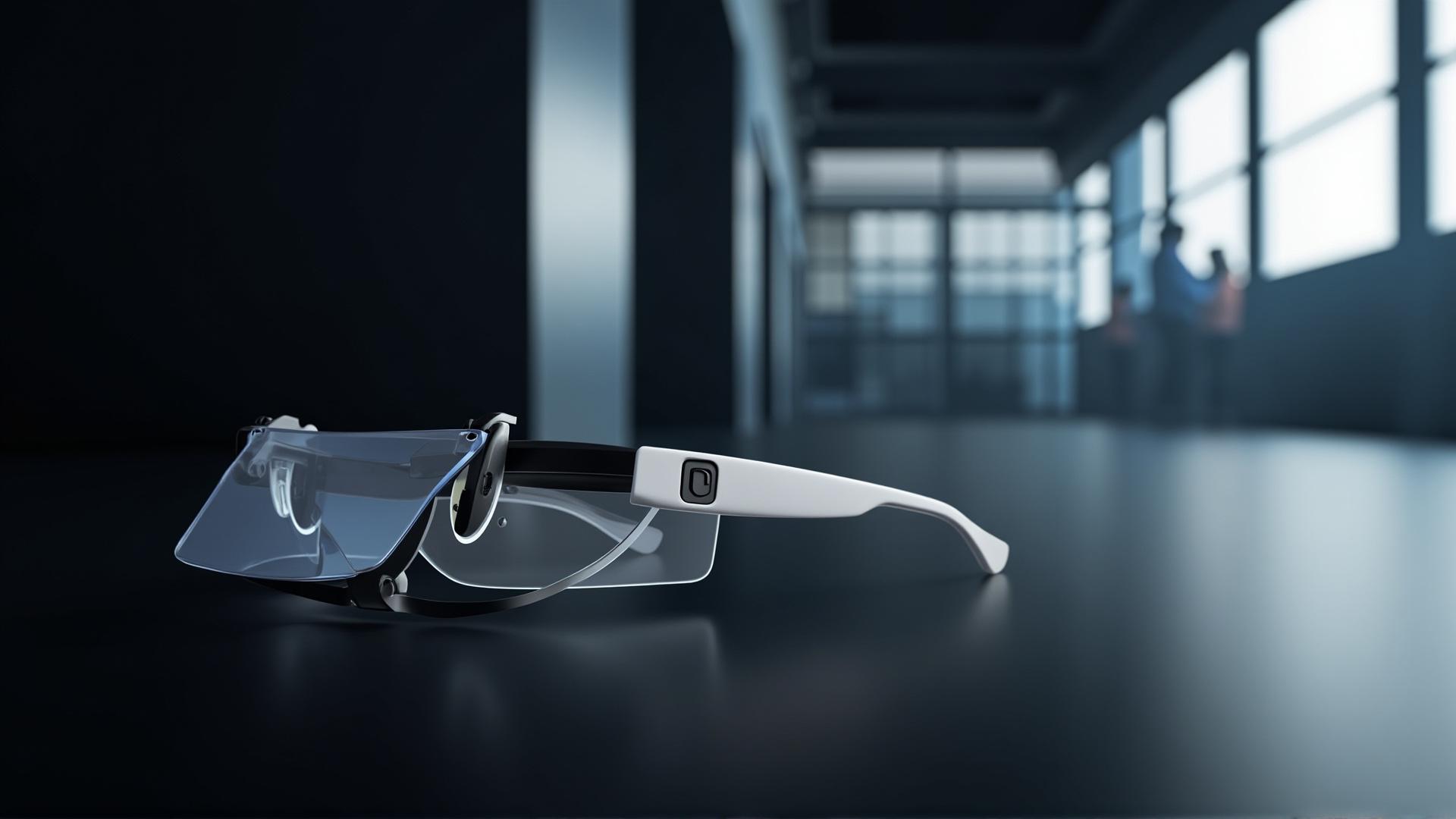
Smart glasses buyers in this category get very different files depending on which model they ask about. This one publishes seven rows and leaves a handful of others open — and an open row is not the same thing as a row that was measured and recorded. That difference decides whether a claim survives a reviewer and whether the same sentence survives a delivery dispute six months later. What follows is the file itself, row by row, with the claims each one can carry and the ones a supplier still has to fill in for the zh12 before it goes anywhere near a channel page. No price appears anywhere in this piece, because no price is published for any model in this range.
zh12 specifications: the rows the catalogue publishes
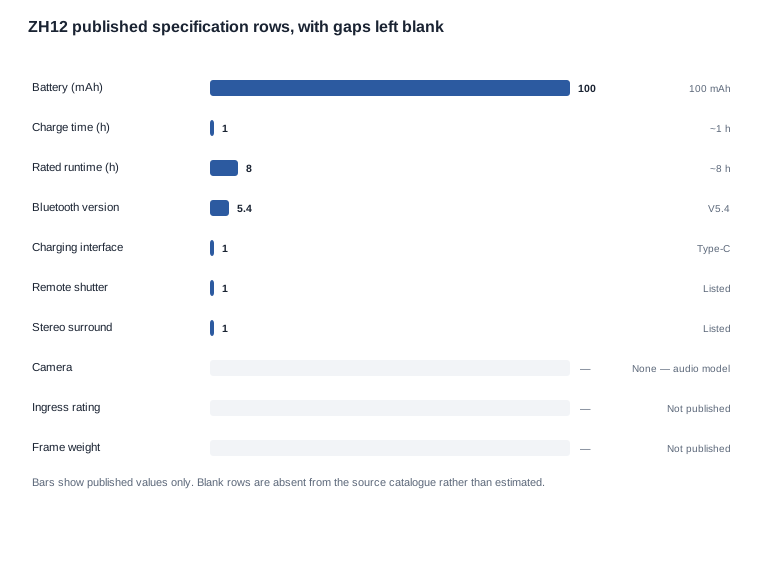
The published file for this model is shorter than a competitor data sheet and shorter than the rows several other models in this catalogue carry. Seven rows are published for the zh12, and each of them can be repeated verbatim in front of a buyer without interpretation:
- Battery — 100 mAh cell
- Rated runtime — about 8 hours
- Charge time — about one hour
- Charging interface — Type-C
- Bluetooth version — V5.4
- Remote shutter — published as a feature
- Stereo surround sound — published as a feature
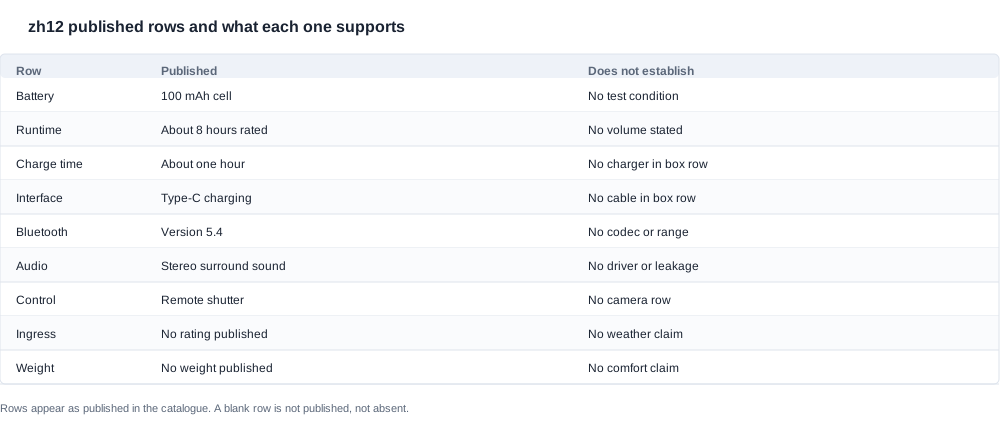
Read in that order, the file splits into four groups: three electrical rows, two connectivity and control rows, one acoustic row, and one charging-interface row that is really a packaging and logistics row. Nothing beyond those seven is published, and the absences are specific — they are the rows a sport-positioned product is most often expected to carry.
The 100 mAh cell is neither the largest nor the smallest in the range. It matches the cell in the D11 and the D12, it is larger than the 55 mAh cells in the LC-105 series and the G07, and it is smaller than the 115 mAh cell published for the D17. The camera models sit in a different band entirely, with published cells from 220 mAh to 290 mAh. Cell capacity is a proxy for three things: how long the product runs between charges, how much mass sits in the temples, and what the factory had to fit behind the hinge. None can be read directly off the figure, and one of them — the mass — is not published for this model at all.
The runtime row reads about 8 hours, which places it at the top of the published audio range, level with the K01 and the LC-105 series, above the D11 and the D12 at about seven hours and the G07 at about six. For a sport-positioned product that will be worn through a session in the morning and again in the evening, this is the most commercially significant row in the file, because it converts directly into how often a customer takes the product off and charges it. The figure carries one caveat that applies to every runtime figure in this catalogue: no test condition is published alongside it, and a figure without a test condition has no acceptance criteria attached to it. We set out why that makes cross-model comparison unsafe in smart glasses battery life, and it is worth reading before you put any comparative language on a product page.
The charge row reads about one hour. That is the shortest charge figure published anywhere in this catalogue, and only the D17 shares it. Twenty-six other models publish two hours or less, which is a ceiling rather than a target — it tells a buyer that the product will be ready within a window, not how long it actually takes. A one-hour figure is a point estimate, and it is the row buyers react to most quickly because it is the one they can verify on their own desk on the first evening.
Type-C is the row that quietly settles a packaging question that several other models leave open. In the catalogue as a whole, charging method splits into seventeen models on magnetic charging, seven on Type-C, and four models — the CY05, the CY03 and the MT6, and the L1 Pro — where no charging method is published at all. A Type-C interface means the same cable you already own charges the device, which removes the accessory question at the point of sale, one line item from the packing list, and a class of charger-compliance question from your retail programme.
Bluetooth V5.4 is a current version, and it is a real published row rather than an inference from a chipset. A version number is published for fourteen of the twenty-eight models in this catalogue. It is absent for the eleven camera models, for the A05 and the A06, and for the bone conduction models. The limit of this row is worth stating plainly: a version number states compatibility, not performance. No codec list, no connection stability figure and no multi-point behaviour is published for any model. Bluetooth connectivity covers what the version does and does not commit a supplier to.
Stereo surround sound is published for the zh12. Surround audio is otherwise published only for the D11, while the D17 carries a Surround Sound row of its own. As a feature claim this is straightforward to carry: it is a named audio mode a customer can hear. As a measurement it is empty — no driver size, no frequency response and no leakage figure appear for any model in this catalogue, so the claim can be repeated but never quantified. A customer comparing two product pages will find nothing to compare.
How the zh12 charge row differs from the rest of the range
The charge figure deserves more attention than it usually gets: it behaves differently from the catalogue norm, and buyers misread it more often than any other. Twenty-six models publish two hours or less. That phrasing is a filter: it excludes products that take a full day to recharge and tells the reader nothing about how long the device will actually be sitting on the desk. Two models publish about one hour — this one and the D17 — and those two rows are point estimates that a customer can test.
Those two published rows are not directly comparable with each other, because neither one carries a test condition, and that is the central trade-off in this file: a short quotable number set against an unstated method. A one-hour figure could be measured with the device charging from empty while powered down, or while connected to a source and playing audio, or with a particular cable and adapter in the loop. The catalogue does not publish the method for any model, so the honest commercial statement is comparative rather than absolute: this model publishes the shortest stated charge time in the range, and it publishes a stated time rather than a ceiling. That sentence survives a technical buyer. A sentence that claims it recharges faster than a named competitor does not, unless both test methods are supplied.
The practical consequences run through three parts of your business. The product page can say that the product recharges in about an hour; it cannot say that it outlasts the working day or that it is faster than the model on the next tab. Expectation management is the second: a one-hour expectation creates a return pattern when a device takes ninety minutes on a cold evening with a slow adapter, which is a support ticket, not a defect. The third is the physical package — a customer with no Type-C cable meets your brand through the charging instruction in the box.
The charging interface also affects how a mixed portfolio is sourced, and it is one of the easier items to negotiate because every buyer in this category has an opinion about it. Seventeen models in this catalogue charge magnetically, seven charge over Type-C, and four do not publish a charging method at all. If your channel carries more than one of these models, the accessory and merchandising decisions are not uniform, the spare-parts stocking list differs by model, and the warehouse cannot treat every product in the same way — which is precisely the question a shortlist has to answer before anyone places an order. For a sport range in particular, the split matters: the YKC02 charges magnetically over a paired 2 × 70 mAh configuration and reaches about eight hours of rated runtime, so it shares the runtime story with this model but not the charge story, and it carries a different mechanical proposition at the dock.
Against the D17 specifically, the comparison is tight. Both publish Type-C charging and both publish about one hour to charge. The D17 carries a larger 115 mAh cell at about seven hours of rated runtime; this model carries 100 mAh at about eight hours. Choosing between them on the charge row alone is not possible, because the charge row is identical. The decision has to be made on the cell, the runtime, the acoustic row, and what the two models publish about the features a customer will actually press — which is where the shortlist criteria start to separate the two. The sport smart glasses range contains exactly three models, and the published rows make that comparison tight but decidable.
One last thing to settle before the charge figure enters a listing: what the customer receives in the box. Charging time is a function of the device, the cable and the adapter. If the package ships without a cable, the published one-hour figure is a laboratory number with an unstated denominator. If it ships with a cable but no adapter, the figure depends on the customer's own wall plug. Either way the question belongs in the written specification, and it is one of the easier rows to negotiate because the answer is a packing list decision rather than a laboratory result.

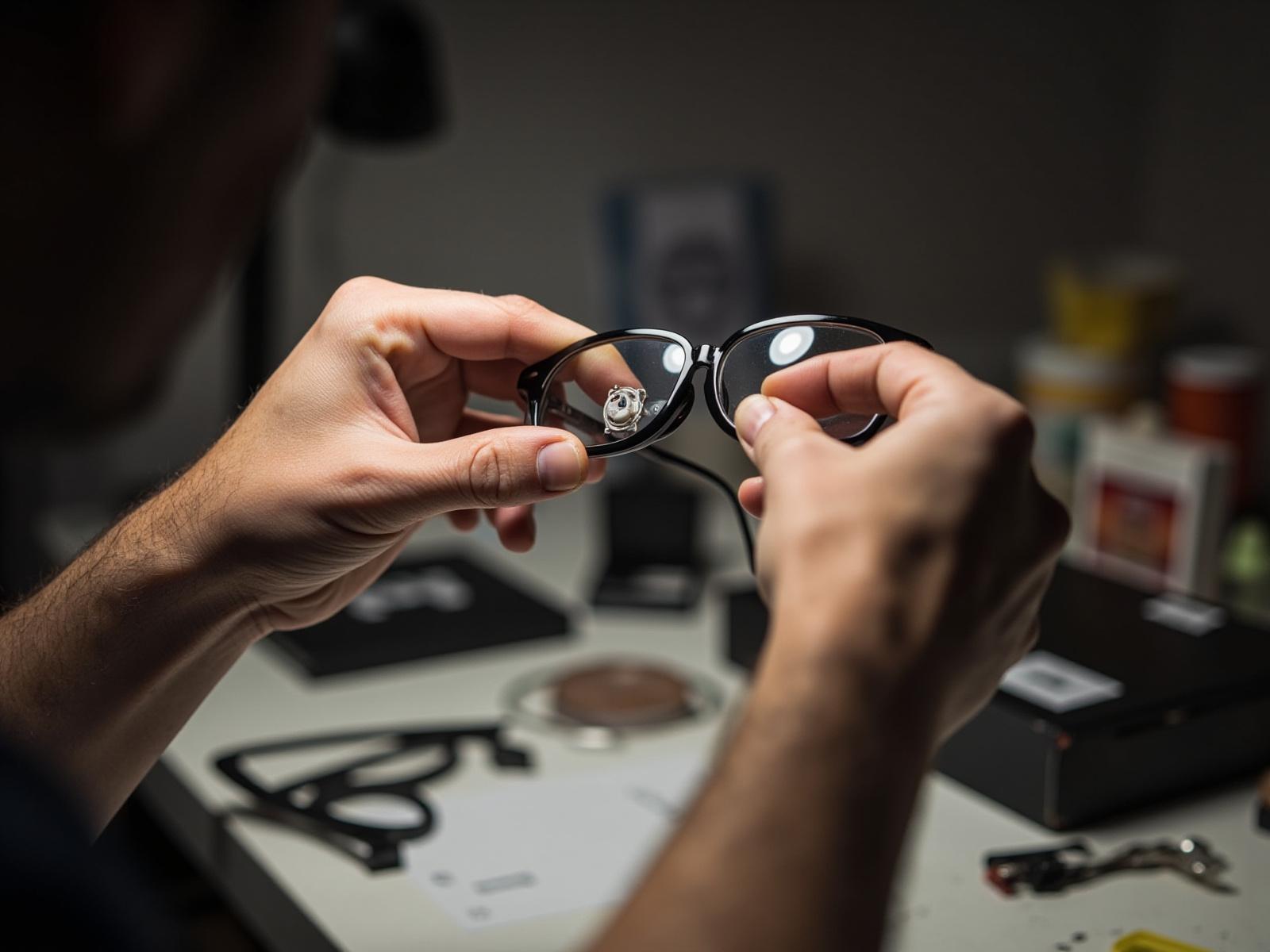
The zh12 remote shutter row, and the camera it does not have
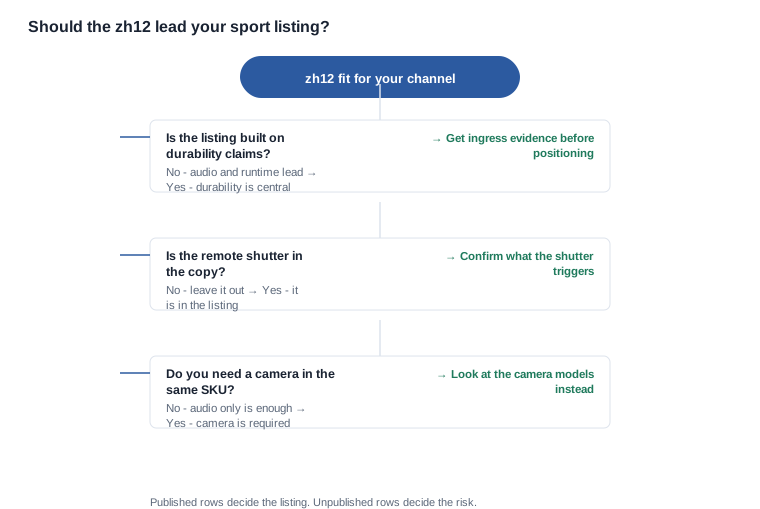
Remote shutter control is published for this model, and the catalogue publishes no camera row for it at all. That is the single unresolved item in the file, and it is worth handling properly rather than quietly dropping it, because the row is visible to every buyer who reads the specification sheet.
The same remote shutter row also appears on the D17. Two models in the same range carrying the same control row, with no camera row on either, points to a shared platform — the design was built once and the control line carried across the family. That is an observation about the catalogue, not an explanation of what the button does. There are at least three candidate explanations: the control triggers a camera on a paired phone, it works with a separate camera unit supplied in a bundle, or it is inherited from a shared design with no defined function here. The catalogue does not say which, and none of the three can be presented as fact. A page that asserts one without written confirmation is a guess with a product page attached.
Why it matters commercially comes down to how buyers read a specification sheet, and to which one of the available explanations they will assume. In practice, a shutter line on a product with no camera is read as a photograph button, because that is what the words imply in a category where most products do have cameras. If the control actually triggers a paired phone, the listing has to say so, and the customer experience is a remote capture on a device they cannot see. If it works with a separate unit, the bundle needs to state that the unit is included and what happens when it is not. If the function is undefined, the row does not belong in the listing at all, and shipping it there invites the question you would rather not receive in public.
The cost of getting this wrong is asymmetric. A missing feature costs one line in the specification table. A wrong feature costs a return, a marketplace review explaining that the button does nothing, and a credibility problem that extends to every other number on the same page — because a customer who catches one invented detail stops trusting the eight-hour runtime and the one-hour charge as well. Those two rows carry this model, and both are only worth carrying while the rest of the page is exact.
The resolution is a single written question, and it should carry the model string so the answer is tied to the product rather than to the family — one short piece of due diligence that removes the riskiest line on the sheet. Ask what the remote shutter control triggers on this model, whether it requires a companion device or a paired phone, whether that companion is supplied, and what the customer sees when the control is used. Four questions, one answer, in writing, attached to the purchase order. This is the difference between a feature and a rumour, and it is a low-cost question to ask because the factory already knows the answer.
The gaps a zh12 buyer should expect to find
An absent row is not a neutral space on a specification sheet. It is a limit on what you can sell, and it is worth naming each one rather than discovering it later when a channel partner asks for evidence and asks which model can carry the claim. The absences on this model are unusually easy to enumerate because the catalogue is consistent about what it publishes for other models.
Ingress protection is the first and most consequential gap. Only two models in this catalogue publish an IP marking: the V06 and the S7, both at IP54, and both are camera models rather than sport audio models. No model in the sport audio range carries a marking, so there is no baseline to point at, and even where a marking exists it is published without a report number. IP ratings and durability sets out what a marking would and would not establish. For a product positioned for sport this gap matters most, because the positioning invites the durability question: the listing cannot carry a splash-resistant, sweat-proof or weather-ready line, nor a softened version of one.
Weight is the second gap, and it is narrower than it looks. Exactly one model in this catalogue publishes a weight: the MT6, at 158 grams for the glasses only, explicitly excluding its 1200 mAh foldable case. Nothing about that figure transfers here, because a cell of a different size and a different hinge arrangement produce a different number. So no comfort claim, no weight comparison against another product, and no way to pre-screen fit before the sample arrives. If your channel sells on lightness, the weight has to come from the supplier in writing with a tolerance attached, because a few grams matter when the claim is "featherlight" and a competitor is making the same one.
Camera resolution is a third gap, and the least consequential, because this model publishes no camera row and cannot be asked for one. Knowing what the catalogue publishes for camera models helps you read a competing sheet accurately: eight models publish 8 MP, and three publish 13 MP — the L2 Utral, the L1 Pro and the S7. Audio models publish nothing there because there is nothing to publish, which is exactly why the remote shutter row here is worth chasing. If the shutter drives a camera, the resolution question reappears at once.
Two further absences are catalogue-wide rather than model-specific, and both change how you write listings. There is no capacitive-touch row anywhere in this catalogue, so "touch control" or "touch sensitive" cannot be written on a product page for any model — the correct description of the interaction here is the published remote shutter plus whatever button behaviour the supplier confirms. There is also no translation row anywhere, so a live translation feature has to arrive from the supplier as a written confirmation attached to the model string, not as an inference from a translation-shaped app.
Certification is the fourth gap and the one most likely to stall a shipment. The catalogue carries no per-model certification row. The export-certification page is a picture page: ten patent certificate images, eight design patents and two utility models. Patent registration and product conformity testing are different things with different documents, and a certificate image is neither a test report nor a statement that a particular model has been tested. Nothing in the catalogue body names a certification scheme or a report number. The practical consequence: the phrase "certified" on a product page needs a document behind it, and that document comes from the supplier, against a model string.
None of these gaps makes the model unsellable. They make the claims specific, and they set the criteria for what a listing may and may not say. A page built on seven published rows and no invented ones survives a technical buyer, a marketplace review and a returns conversation — because every number on it can be defended. The alternative, filling the blanks with plausible claims, fails all three, and it fails the first time somebody presses a button.
Turning the zh12 rows into a supplier request
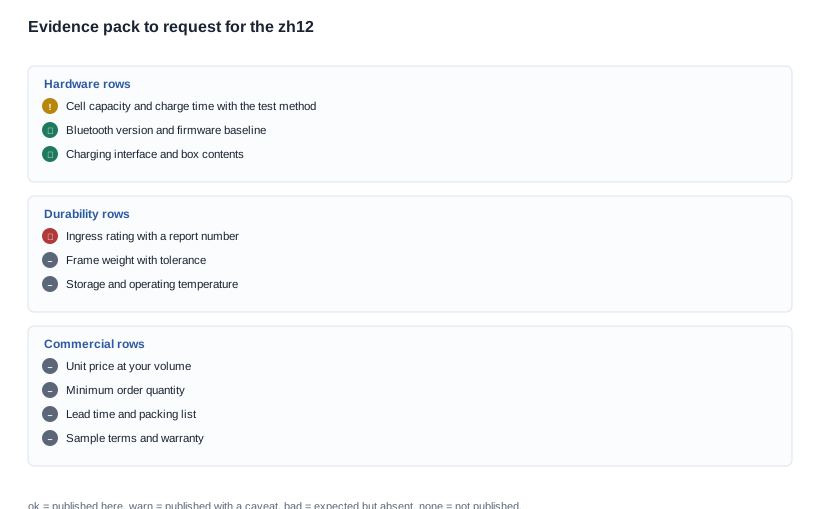
A published catalogue is a starting point for a specification, not the end of one, and a poor substitute for the shortlist a buyer builds once the missing rows have been answered. The seven rows above are the facts a supplier will confirm; the rows a buyer needs beyond them are the ones the factory has but does not publish. The practical move is to convert every gap into a written question, because an answer attached to a model string can be quoted in a quotation, a purchase order and a listing, while a verbal answer cannot be quoted at all.
Here is the request list we would send with an enquiry for this model:
- Model string and version — the exact identifier that appears on the factory label, plus any firmware or revision suffix, so that every answer below attaches to one product.
- Cell detail — the confirmed capacity, the cell supplier or chemistry grade, and the rated cycle life, since a 100 mAh figure without a cycle rating does not describe a product that will be sold for two years.
- Charge-time method — what was measured, from what state, with which cable and adapter, and whether the device was idle or playing, so that the published one-hour figure can be quoted with its condition.
- Runtime method — the volume level, codec, sample rate, ambient temperature and duty cycle behind the published eight-hour rating, so that the number can be reproduced.
- Bluetooth detail — the confirmed version, the firmware baseline, the supported profiles, and the pairing behaviour your app or your channel's app will actually rely on.
- Remote shutter behaviour — what the control triggers, whether a companion device or paired phone is required, and what the customer observes.
- Acoustic detail — driver size, frequency response and a leakage figure, so the surround claim can be described rather than only named.
- Frame weight — the weight of the glasses alone, with a tolerance, and whether the figure excludes any accessory.
- Ingress status — whether any ingress testing has been performed on this model and what it produced, even if the result is a nil test.
- Box contents — whether a Type-C cable and any adapter are supplied, and the exact packing list that accompanies them.
- Documentation — the test reports and certificates that exist for this model string, as documents rather than as a page of images.
- Tolerance and change control — the tolerance on each published figure, and the notice period you will receive if a cell, driver or supplier changes.
The commercial rows sit in the same file and are no more published than the technical ones, and they are where the negotiation with a supplier usually starts. Unit price at your volume, minimum order quantity per colourway, production lead time, sample cost and sample terms, warranty period and the spare-unit ratio are all unpublished for this model and for every other model in this range. Smart glasses battery life explains why the runtime figures are the ones most often quoted without their method; the same discipline applies to a quoted price without its volume, and a quoted lead time without its queue position.
Two habits make this work in practice. First, keep a two-column record for every model you sell: what the catalogue publishes on the left, what the supplier has confirmed in writing on the right. A listing built from the left column is defensible; a row moved to the right column is defensible with a document attached. Second, put the confirmed rows into the purchase order and the packing list, not only into the email thread — a row that exists only in an email disappears the first time two people disagree, and the second of them usually holds the customer complaint.
The result is a listing that says less and survives more, and a shortlist decision that survives the first round of supplier questions. Seven published rows: two carry the commercial argument (charge time and runtime), one carries the packaging (the Type-C interface), one carries compatibility (the Bluetooth version), and two carry the product story once confirmed (the remote shutter and the surround audio). It is a product page a buyer can interrogate without finding a number you cannot support, which in a category where catalogue pages routinely publish rows they cannot evidence is the more durable commercial position.
The sport smart glasses range is the context for all of this: three models, of which this one leads on the published charge-and-runtime pairing, shares that pairing with the D17 on charge alone, and sits behind the YKC02 on nothing at all. Tell us the target market, the quantity and the configuration you need, and we will tell you what is available, what is published, and which rows we would need to fill in before you carry more.
Related reading
- The sport range this model belongs to — sport smart glasses
- What an absent ingress rating means for sport positioning — IP ratings and durability
- Why the runtime figures are not comparable — smart glasses battery life
- What a Bluetooth version does and does not commit to — bluetooth connectivity
Let us know the target market, the quantity and the required configuration, and we will come back with what is available and what is not.


