

These two models are close enough to be confused and far enough apart to matter, and the confusion comes from the shape of the record rather than from the products. Both of them sit in the sport group of the range. Both of them publish a charge time of about an hour. Both of them charge over a Type C lead. Both of them publish a fifth-generation radio, and both of them publish an entry for a remote photo function and an entry for a surround sound function. Five rows agree.
Three rows do not, and they are the three that a requirement actually lands on. One of them is the cell: a hundred milliampere-hours on one page and a hundred and fifteen on the other. One of them is the endurance figure, and the direction of the difference is the interesting part, because the smaller cell is paired with the longer published runtime. The third is the language the feature entries are written in, which sounds like a footnote and is not.
The argument of this article is deliberately narrow. It does not say which of the two suits a given buyer, because the published rows cannot support that and because the answer would depend on a programme rather than on a product. It does something more useful: it sets out the rows, says what each one settles, and shows how a requirement gets mapped onto a row so that the choice is made against the specification rather than against a preference.
Nothing here describes how either product performs in use, and no figure is estimated. Where the catalogue is silent, the article says so and names the party that can close the gap.
Zh12 smart glasses vs D17 use case fit: two sport models that publish the same charge time
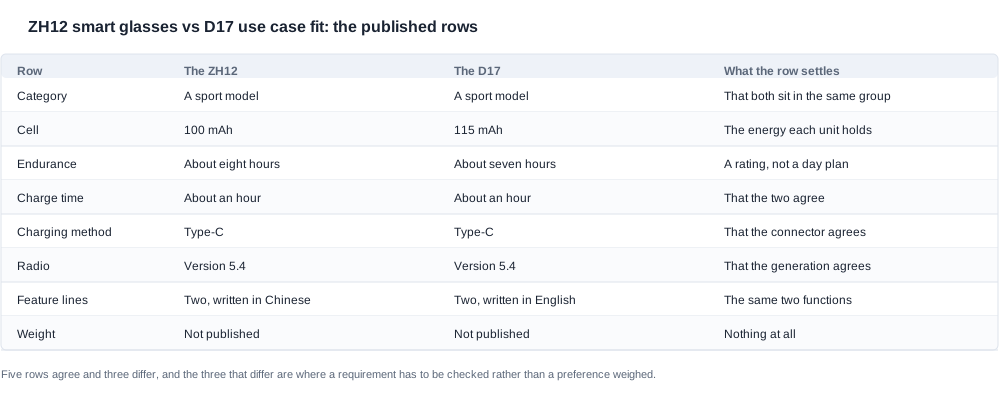
What the five shared rows do and do not settle
The charge time. Both pages publish about an hour, and that is the row that first draws a buyer's attention because it is the shortest interval anywhere in the published range. It is also the row that settles the least, because a charge time is a bound on an interval rather than a description of what a customer's day looks like, and the state the interval starts from is not published for either model. A buyer who reads about an hour as "a customer can top up over lunch" has made a decision on a figure whose condition nobody has stated.
The charging method. Both publish Type C, and a channel stocking both does not have to design two charging routines, two spare programmes or two customer instructions. That is a genuine saving and it is one of the two or three things that make a two-model range coherent at all.
The radio generation. Both publish version 5.4, so interoperation questions are the same question for both products and a single answer covers the range.
The category. Both are sport models, which tells a buyer something about the design intent, the accessory set and the use pattern, and tells them nothing measurable.
The feature functions. Both publish an entry for a remote photo function and an entry for a surround sound function. Those are the two functions a buyer can describe, and the two that a customer will ask about.
None of the five is a performance measurement, and none of them discriminates between the two products. That is the point of the shared rows: a requirement that lands on any of them cannot choose between these two models, and a buyer who spends a week comparing on the charge time has compared on the one row where the answer is already the same.
The third sport model, and why the sport group is not a tier
There is one other model in the sport group, and it is worth naming here for one reason: it stops a buyer from making two mistakes that the catalogue invites.
The published cells across the three sport models are seventy milliampere-hours in two cells, a hundred, and a hundred and fifteen. The published charge times are two hours or less for the two-cell model and about an hour for the other two. The published endurance figures are about eight hours, about eight hours and about seven hours.
Read that as a set and two conclusions follow. The first is that a hundred and fifteen milliampere-hours is the largest single published cell in this group, which is a fact about the numbers and not a claim that one model carries more than another. The second is that about an hour of charging is shared by two of the three models, so a buyer who describes a short charge as a distinguishing feature of one of them is describing something the other one also does.
The group is three products with different published rows, not three tiers of one product. A buyer who treats it as a tier ladder will end up comparing a sport model against a sport model on a row that was never a differentiator.
Where the three differing rows sit
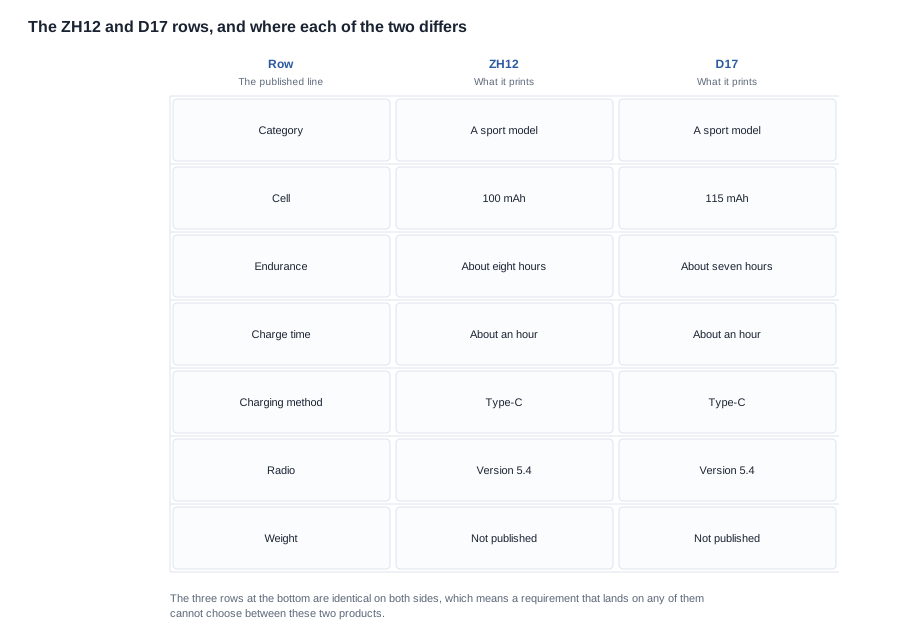
The matrix shows the same eight rows in a different order, and the useful change is the grouping. The two rows at the top are identical and cannot decide anything. The middle pair differ in a way that looks like a capacity comparison and has to be read as something else. The weight row is empty on both sides, which is a reminder that no comparison of how these two feel in the hand can be made from the catalogue at all.

The cell difference, and the endurance band that sits on top of it
The ZH12 publishes a hundred milliampere-hours. The D17 publishes a hundred and fifteen, which is fifteen milliampere-hours more in a single cell. The endurance rows run the other way: about eight hours on the first page and about seven hours on the second.
That is the whole of the anomaly, and it is worth a buyer noticing. The larger cell is paired with the shorter published runtime, and there are three explanations available, and the catalogue helps a buyer choose between none of them.
The loads differ. The two products are not the same device with a different battery. Nothing published says what either of them spends its energy on, and the two differ in the cell figure, the endurance figure and the language their feature entries are written in, which is a reasonable indication that they are not identical designs. Two devices with different loads can land on similar runtimes with different-sized cells, and nothing in the record contradicts that.
The measurement conditions differ. A rated figure is produced under a stated or unstated condition. Two products measured on different benches, at different volumes, with different pairing states, produce two numbers that describe two experiments. The catalogue publishes neither the bench nor the condition.
The figures are rated under the same kind of test but not the same kind of day. A rating is a rating; it is not a day plan, and a channel that puts either figure on a listing is publishing a laboratory condition as though it were a customer outcome.
What this means for a use-case decision
It means the cell difference is not usable as a selection criterion, and a buyer who reads a hundred and fifteen milliampere-hours as "more endurance" will find the endurance row contradicting the conclusion. That is the trap this pair sets, and it is a trap because the two rows sit next to each other on the page and invite exactly that reading.
What the pair can be used for is narrower and still useful. A buyer whose requirement is a published energy figure has a hundred on one side and a hundred and fifteen on the other, and that is a legitimate line to put in a specification. A buyer whose requirement is a published runtime has about eight hours and about seven hours, and that is a legitimate line too. What neither pair of numbers will do is let a buyer infer what a unit does in a customer's day, or which of the two a buyer should take, because the condition behind both figures is unpublished and the loads are not described.
The questions that close it
- What load was each model running when its endurance figure was measured, and at what volume, pairing state and setting? This is the question that converts two ratings into a comparison, and it is also the question that decides whether a channel can publish a runtime at all.
- Does the difference in cell capacity show up anywhere else in the specification? A larger cell with a shorter rated runtime is a design decision rather than an accident, and the design decision usually has a visible consequence somewhere.
- What does the charge time of about an hour mean in practice, from what starting state, and what does it restore? Two products share the published figure, and the conditions behind it are not published for either.
The criteria for judging the answers are the ones that matter across this whole category. A figure with a unit and a method. A condition somebody else could repeat. A date against it. Anything less is an assurance, and an assurance cannot go on a specification sheet.

A Chinese feature row and an English one, side by side

The feature entries are the third differing row, and they differ only in the language they are written in. The ZH12's page carries two entries in Chinese, one for a remote photo function and one for a surround sound function with an extra qualifier attached to it. The D17's page carries the two equivalent entries in English, one for a remote photo function and one for a surround sound function.
Why a buyer should care about a label
Because a translated spec sheet is where a function quietly changes. A row written in Chinese and rendered into English in a data feed, a distributor sheet or a tender response can lose a qualifier or gain an implication, and nobody checks a line that was never a line in the first place. The extra qualifier on the Chinese entry is exactly the kind of detail that disappears in a translation, and it is the kind of detail a buyer may need in order to describe the function accurately to a customer.
Because a buyer who needs a function has to find it in the right language. A channel reading the range in one language and a supplier's reply in another is working from two different renderings of the same catalogue. The reliable way to handle it is to ask for the entries in the language of the reply, and to keep the original line next to the translation.
Because the remote photo function is shared, and that is worth stating plainly. Two models in the whole range publish an entry for a remote photo function, and these are the two. That makes it a sport-group feature rather than a distinguishing feature, and a buyer describing it as something one of these models has and the other does not would be wrong. The same applies to the surround sound entry, which the D17 writes in English and the ZH12 writes in Chinese.
The behaviour underneath the entry
Neither catalogue page says what the remote photo function does in practice: whether it pairs with a handset, whether it needs an application, which camera it triggers on a paired unit, what the range of the trigger is, or what happens when two of them are in range. The same applies to the surround sound entry, where the published line gives no channel count, no configuration and no description of the acoustic arrangement.
A buyer who wants either function in a programme therefore has two questions that no published row answers, and they are worth asking together because the answers may come from the same engineering note:
- How is the remote photo function triggered, what does it control, and what does it require the user to have?
- What does the surround sound entry describe, and what configuration is the unit shipped in?
And a third, which is the one that actually protects a listing:
- Which of the two published entries is the one the sample in your hand demonstrates? A function that a specification sheet describes and a sample does not perform is a return waiting to happen.
Turning the requirement into a row instead of a verdict
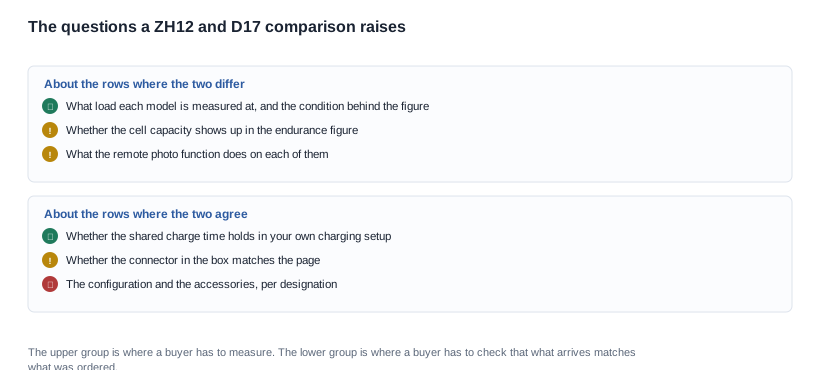
The way to use a comparison like this one is to take the requirement a channel actually has and push it down onto the published rows until it either lands on a row or it does not. The steps in the image are that process, and the reason it is worth doing before a sample is ordered is that most requirements for this pair land on a shared row and therefore need no sample at all.
The method, in six steps
Write the requirement as a measurable line. Not "good battery life" but "a published runtime figure that a buyer can print with its condition attached", and not "a fast charger" but "a charge interval that fits the restocking rhythm of the channel". A requirement written as a preference cannot be mapped, and a comparison cannot be made against it.
Map it onto the published rows. The rows for these two models are the cell, the endurance figure, the charge time, the charging method, the radio version, the category, the feature entries and the empty weight row. Every requirement either lands on one of them or it needs a measurement.
Check the shared rows first. If the requirement lands on the charge time, the connector, the radio or the category, the two models answer it identically and the requirement has told the buyer nothing about which to take. That is a useful result, because it removes a row from the shortlist instead of adding an argument to it.
Check the differing rows and ask whether the difference is decisive. The cell and the endurance differ, and the endurance difference runs against the intuitive direction of the cell difference. A requirement written in terms of a published energy figure lands cleanly; a requirement written in terms of runtime has to be measured; a requirement written in terms of what a customer experiences cannot be answered from either page.
Put the remaining question in writing. The questions in the checklist above are the ones that survive, and each of them names the party who can answer it and the method the answer will have been produced with.
Record the answer against the row it applies to. A requirement is closed when the row it was written on has an answer with a date against it, not when somebody has said something plausible in a meeting.
What a buyer can publish, and what has to be measured
The rows are publishable as they stand, with their wording intact: the category, the cell figure, the endurance figure as a rating, the charge time as a bound, the charging method, the radio version, and the two feature functions as they are described on the page. The weight is not publishable for either, and neither is anything about what the unit does in a customer's day.
Everything else has to be produced: the day profile, the behaviour of the two functions, the configuration and the accessories, and the conditions behind the endurance figure. That is a short list, it is the same list for most buyers in this category, and it is the list that turns a catalogue comparison into a specification.
The commercial shape of the decision
Two models that agree on five rows and differ on three are an unusually well-behaved pair, and the practical consequence is that a channel can carry both without designing twice. One charging routine, one radio story, one category, one set of feature functions, and the three differing rows handled as three specific questions rather than as a general preference.
The cost of that structure is three open items, and they have different owners and different elapsed times. The endurance condition is a measurement. The function behaviour is a document. The configuration and the accessory set is a conversation with the supplier. A buyer who prices those three into the schedule gets a two-model range that a support desk can actually answer, and a buyer who does not will find the same three questions arriving in the first quarter, one at a time, from customers.
Use-case fit is a question about the programme, not the model
The rows our catalogue prints for these two products are the whole of what we can put in front of a buyer, and they will not be turned into a verdict about which one fits a use case, because a use case is a property of a programme and the record does not describe programmes. We will not describe either model as the faster-charging one, because the one-hour figure is shared by both of them, and we will not describe the cell difference as an endurance advantage, because the endurance rows run the other way.
What we will do is take the requirement your programme actually has, map it onto the eight rows above, and tell you which rows settle it, which rows are identical and therefore silent, and which questions have to be put to the supplier before anything goes on a specification sheet.
Give us the requirement in one sentence, the market sequence you plan to work in and the configuration you are considering, and we will set the rows against those three answers, then hand back the questions that remain.


