

Two products, two charging answers, and a difference in what each answer costs a channel. That is the shape of this comparison. The sport model publishes a hundred milliampere-hour cell, an endurance figure of about eight hours, a charge time of about an hour and a Type C lead. The camera model publishes two hundred and sixty milliampere-hours, a band of five to eight hours, a charge ceiling of two hours or less and a magnetic contact. The cell, the endurance and the charge interval all differ, and the interface differs, and those differences land in a channel's accessory order, its freight model and its customer instructions in three different places.
Two of the four rows are not what a buyer expects them to be, and both are worth opening before anything else. The endurance figures are not two versions of the same quantity: one is a single rating and the other is a band, so they cannot be put next to each other and read as a comparison. And the charge interval is a bound on an interval in both cases, with the starting state unpublished for both, so the shorter interval is not a promise that a customer can top up over lunch.
The subject of this article is the charging and the power, because that is where a channel spends money and where a specification can actually be written. The camera entries, the removable part and the rating marking are covered elsewhere in this batch, and they are mentioned here only where they touch the accessory order.
This article describes neither product's behaviour in use, and it estimates nothing.
Zh12 smart glasses vs V06 battery and charging: two different charging answers
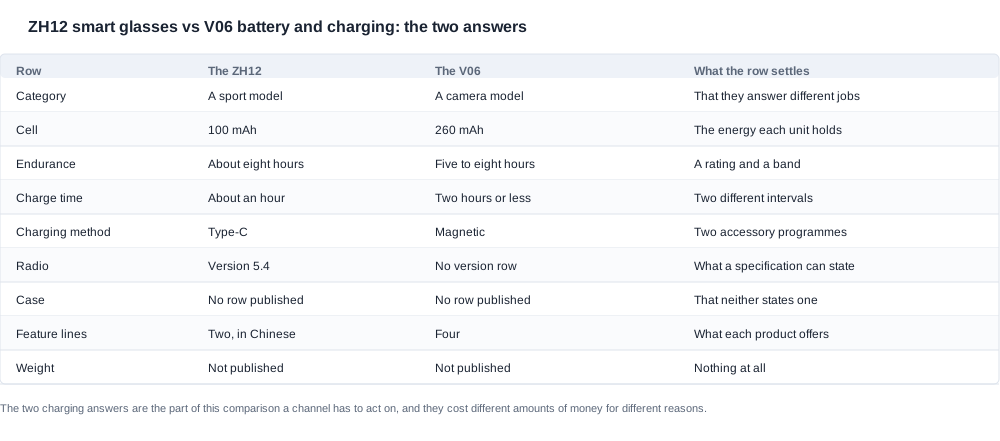
The four rows that differ, and the two that do not
The cell. One hundred milliampere-hours on the sport side, two hundred and sixty on the camera side. Both are single cells, and neither is a figure that predicts anything by itself, because the load behind each is unpublished and the two products are in different categories. A camera product with an imaging entry is doing a different job from a sport model, and a larger cell in one does not make the other one unnecessary.
The endurance. About eight hours against a band of five to eight hours. This is the row where a comparison is most often attempted and least often valid, because a single rating and a band are not the same kind of measurement. The band already contains a figure of eight hours somewhere inside it, which makes the two rows look like they overlap, and the appearance of an overlap is exactly what makes the comparison attractive and wrong. What the catalogue does not publish is the condition behind either figure, and the conditions are the whole of the comparison.
The charge interval. About an hour against two hours or less. Both are bounds, both are the kind of figure the range publishes, and neither says what state the cell started in or what it has at the end. The shorter one is published for two models in the sport group, so it is a shared property of that group rather than something that separates one product from another.
Charging interface. The sport model takes a Type C lead, the camera model a magnetic contact, and this is the row that reaches into a channel's operations.
The radio version. Published for the sport model and not for the camera model, so a specification written across the two has a row on one side and a blank on the other. A blank is not a defect; it is a question.
The weight. Not published for either of them, and neither is it published for any other model in the range apart from one. There is no comparison of how these two sit in the hand, and a channel that wants one has to weigh a sample of each.
The two rows that decide a programme rather than a specification
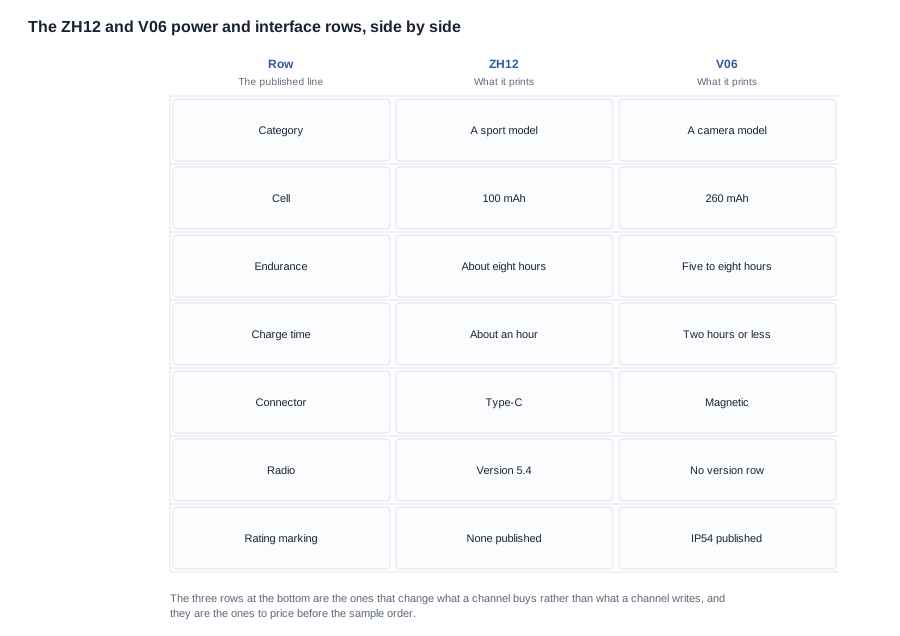
Read the matrix from the bottom and the order of the cost is clear. The rating marking on the camera model is a published fact that becomes a claim the moment it is printed, and it needs a report behind it before it goes anywhere near a carton. The connector decides the accessory programme. The radio version decides whether a specification can say anything at all.
Those three, in that order, are what a first order has to settle. The other rows are specification work, and specification work is comparatively cheap because it is a number in a document that somebody has to write down.
What the two charging answers mean commercially
A channel carrying both models carries two charging routines. One is a lead, which is a commodity that a customer can replace from any supplier and that most customers already own. The other is a contact, which implies a proprietary source and therefore a spare-parts question, a replacement programme and a customer instruction that a customer cannot satisfy themselves.
The restocking rhythm is a commercial decision, and it is the buyer's alone. A channel whose customers top up over a break needs the shorter interval; a channel whose customers charge overnight does not. Nothing in the catalogue decides it, and the decision is worth making explicitly rather than inheriting from whichever product was sourced first.
The freight model is where an unknown object becomes a cost. The packed dimension and the shipping weight of the box with its charging object inside are not published, and they are the two numbers that decide what a unit costs to move. A channel that quotes a landed cost before it has them is quoting an estimate, and the estimate is usually wrong in the direction that hurts.

The 100 and 260 milliampere-hour cells, and the bands around them
The cell comparison is the part a buyer reaches for first and the part that settles the least, so it is worth taking in order.
What the two figures are. An amount of energy each unit holds. Both are single cells, published on their own rows, and neither is a runtime.
What they cannot do. They cannot be turned into a working day, because the load behind each is unpublished. They cannot be compared with each other as a performance measure, because the two products are in different categories and are doing different work. And they cannot be turned into a statement about the customer's experience, because nothing in the record says what either unit spends its energy on while it is running.
What can be done with them. A published energy figure is a legitimate line on a specification sheet, and it is a legitimate line in a range plan, because it tells a buyer what has been fitted and it lets two units of the same category be set beside each other. What it will not do is settle the endurance question, and the endurance rows are the ones a customer reads.
The band, and why the two figures look closer than they are
The sport model publishes about eight hours. The camera model publishes five to eight hours. Read as two numbers on a chart, they appear to overlap, and the chart would suggest the difference is small.
The chart is misleading in a specific and important way. A band is two published outcomes, and a single rating is one. When a band contains the figure a single rating happens to show, the two products have not been measured under the same conditions, and the proximity of the numbers carries no information about whether the products behave alike. The only thing that would settle it is the condition behind each figure, and the condition is not published for either model.
So the honest reading of the two rows is: one product publishes a rating, the other publishes a spread, and the two are not comparable until a measurement programme has been run. That is an unglamorous conclusion and it is the correct one, and it is also the one that saves a channel from publishing a runtime figure it cannot defend.
The three questions that close the power axis
- What was each model running when its endurance figure was produced, and at what volume, connection state and setting?
- Does the difference in cell size show up anywhere else in the published record, or is the endurance row the only place it appears?
- Is the endurance figure a rating of a single unit, of a sample, or a band across a sample?
The criteria for a usable answer are unchanged: a figure with a unit and a method, a condition somebody else could repeat, and a date. A buyer who has those three for each model can compare them; a buyer who has the two figures alone is holding two numbers and no comparison.
How to read the two endurance rows without comparing them
There is a way to use both rows that does not require them to be the same kind of measurement, and it is worth having because it is free.
Read each row as what that product is being described as. The camera model's row is a band, which is what a catalogue publishes when the outcome varies across units or conditions, and the honest consequence is that a channel cannot promise a single runtime for it without a measurement. The sport model's row is a single figure, which is what a catalogue publishes when one outcome was recorded, and the honest consequence is that a channel cannot assume the same outcome across a batch without a spread.
Let the shape of each row set the standard of proof for that product. A band needs a sample and a spread before it can be reduced to a figure a customer will be told. A single rating needs a sample before it can be published as a typical result. Two rows, two different standards of proof, and neither of them requires the other.
Keep the two out of the same column of the same table. A comparison sheet that puts a band and a rating in the same column is asking the reader to do the arithmetic that the catalogue refuses to do, and the reader will do it, and it will look reasonable. Splitting them into two rows labelled with what each one measures costs nothing and prevents a whole category of error.
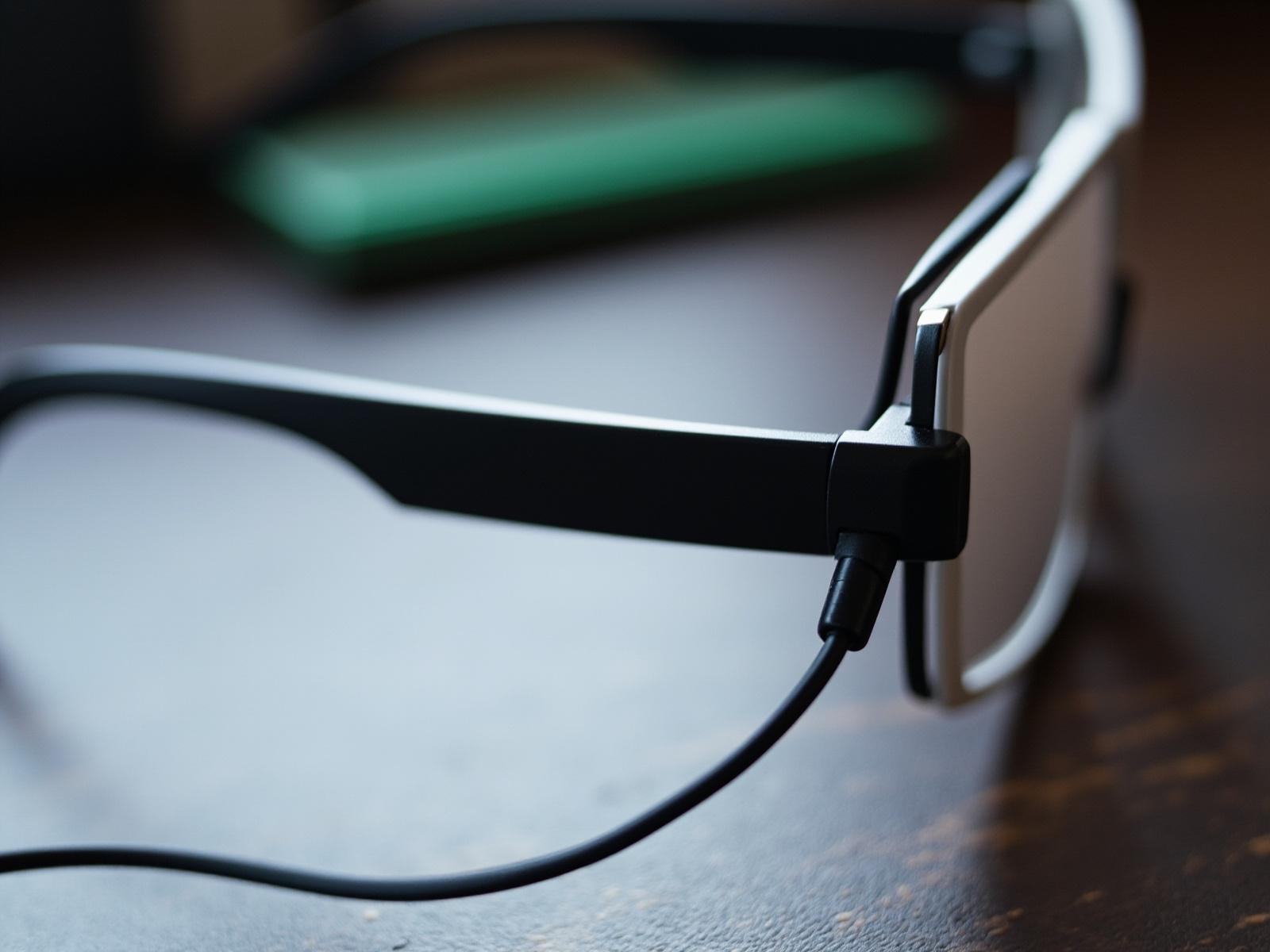
About an hour against two hours or less
The charge interval row is the one a buyer is most likely to put on a listing, and it is the one that most needs its condition attached.
Both are bounds, and a bound is not a schedule. Two hours or less says the interval does not exceed two hours. About an hour says something close to an hour, and "close" is doing a lot of work in that sentence. Neither row states the state the cell starts in, what the interval restores, whether the two models restore the same proportion of what was taken out, or whether a partially charged unit behaves differently from a flat one.
The short one is shared. The one-hour figure is shared by a pair of sport models, so it is a property of that group rather than a distinguishing feature of one product. A channel that writes the short interval into a listing as a differentiator is describing something another product in its own range also does.
The two rows are not the same kind of statement. A bound of two hours or less and a figure of about an hour are different in kind, not only in value, and a reader who sees them side by side will read the first as a precise figure and the second as a loose one when the reverse is closer to the truth: the first is a ceiling with no defined end point, and the second is an approximation of a measured interval.
What to write, and what to ask
A listing line that a buyer can defend looks like this: a charge interval published as a bound, with the model named, and no promise about when a customer can use the unit afterwards. A channel that wants to promise a turnaround has to ask for the state, the restoration figure and the behaviour of a partial charge, and it has to ask for them per model, because a Type C lead and a magnetic contact are not the same circuit and the manufacturer may not have measured them the same way.
The red flags in a draft listing are easy to recognise. A number where a bound belongs. A promise about the customer's schedule. A single figure covering two models whose conditions have never been compared. And a turnaround time that has no measurement behind it, which is the one that comes back as a complaint.

What the interface difference asks of a first order

The six questions a first order has to settle
- What is the charging object for each model? The catalogue prints the method and not the object. A contact, a lead, a lead with a contact at one end, a pad and a dock are five different things to put in a box, to photograph for a product page and to explain to a customer.
- Can a replacement be obtained separately, and at what lead time? For a contact-based model this is the question that settles whether the interface becomes a convenience or turns into a dependency, and for a lead-based model the answer is usually easier, which is part of why the two models carry different operational loads.
- What are the packed dimensions and the shipping weight with the object in place? Two figures for every model, and both belong in the freight model before the first shipment.
- Does the rating marking appear on the carton, and on what evidence? The camera model publishes an IP54 marking, and our catalogue publishes the marking and not a report behind it, so a channel that wants the marking on the packaging has to obtain the report first. A marking printed once is very hard to take back.
- How many charging routines does the channel have to support? If both models are carried, the answer is two, and the support desk, the customer instructions and the spare-parts shelf all have to reflect that.
- What is written in the customer instructions? A charging routine with a stated starting condition is worth a customer support contact a week; a charging routine without one is worth a ticket every time the unit is picked up.
The checklist, and what each line costs to close
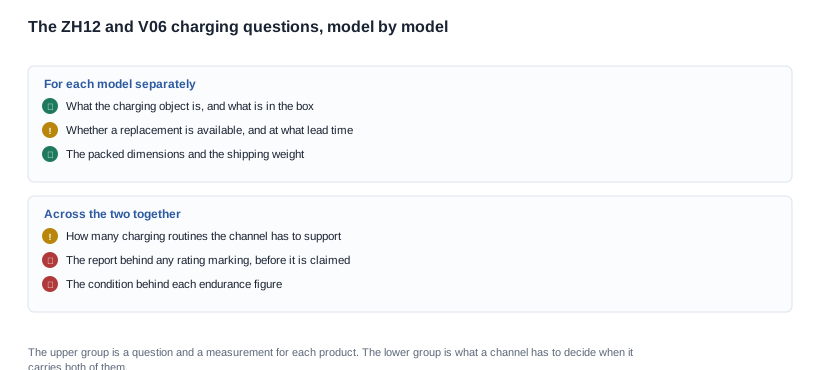
The upper group of the checklist is per model, and the lower group is per programme. A buyer who closes the upper group has two products that can be described accurately and packed accurately. A buyer who also closes the lower group has a range that a support desk can answer questions about without escalating to the manufacturer every time, and that is the difference between a range and two products that happen to share a carton.
The trade-off a buyer should evaluate before ordering
The camera side of this comparison carries three cost-side variables that are worth pricing rather than discovering. It carries a larger cell and a wider endurance band, which means a measurement programme rather than a quoted figure if a runtime is to be published. It uses a proprietary charging contact, which means a spare-parts question and a customer instruction that the customer cannot satisfy themselves. And it carries a rating marking that needs a report before it can be repeated.
Against that, the sport side is simpler in all three respects, and it publishes a radio version where the camera side publishes nothing, which is a small but real advantage for a specification sheet. Neither side of that comparison is a product verdict; it is a list of what a channel has to fund on each side, and the buyer who can name the total cost of each side before the order is the one who will not be surprised by it.
The power question this comparison cannot answer
What our catalogue prints for these two products is the whole of what we can put in front of a buyer, and we will not convert those rows into a verdict about power, because the endurance figures are not comparable and the cell figures do not predict a working day. We will not describe the sport model as the faster to charge in the range, because the one-hour figure is shared by a pair of sport models in its group, and we will not present the camera model's rating marking as a claim, because we publish the marking and not a report behind it.
What we will do is take the charging routine your programme assumes, mark it against the two sets of rows above, and tell you which of the six questions above is already answered, which one is a measurement, and which one is a request that has to go out today.
Give us the restocking rhythm your channel actually runs, the sequence of markets you plan to enter and the configuration under discussion, and we will hand back the open items with an owner against each one and the freight model gaps in the order they will hurt.
The useful thing about the six questions above is that five of them cost nothing but a message, and the sixth costs a sample. A programme that sends the five on the first day discovers the sixth early enough to size the sample properly, and a programme that discovers the sixth late discovers it on a unit that turns out to be the wrong configuration. That ordering is the cheapest part of the whole exercise, and it is the part a buyer can decide before anyone has quoted anything.


