

Our children's range has three models with published rows, and comparing them produces an odd result: the model with the largest battery is the one whose function set is documented least, and the two models with identical rows differ from it in a way the documentation does not resolve. That is the whole of the a07 smart glasses how it compares story, and it is worth stating plainly rather than dressing it up.
The published row for the A07 reads: Bluetooth V5.4, 70 mAh for the cell, a charge ceiling of two hours, roughly twenty hours of rated use, magnetic charging.
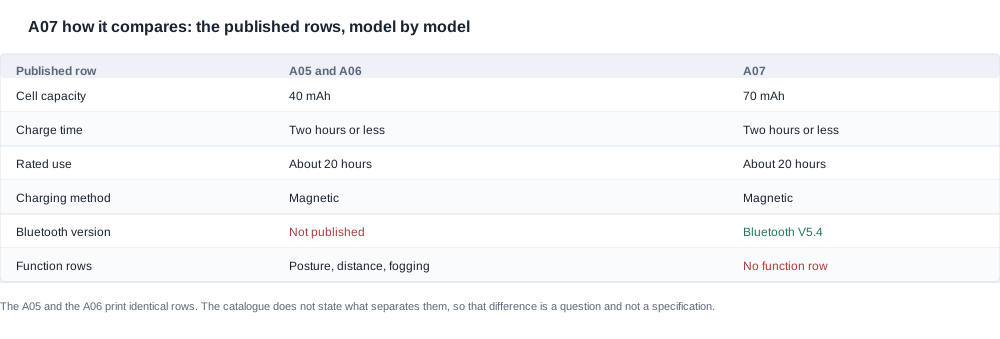
How the A07 compares: the published rows that differ
Six rows describe the three children's models, and only two of them separate them.
Cell capacity. The A07 carries 70 mAh. The two sibling models each carry 40 mAh. That is a seventy-five per cent difference and it is the only unambiguous hardware difference in the range.
Bluetooth version. The A07 publishes Bluetooth V5.4. Neither sibling publishes a radio version at all. This is the row that makes the A07 the only connected model in the range, and therefore the only one whose runtime figure describes a product with a radio in it.
The other four rows are identical across all three models: a charge time of two hours or less, a rated use of about twenty hours, magnetic charging, and a charging method with no row describing what the physical charger is.
The runtime figure is where the comparison stops being unambiguous. All three are published at roughly twenty hours. A smaller cell producing the same runtime as a larger one is not a small discrepancy. It implies that the two figures were produced under different conditions, or that one of them describes a scenario the other does not — and neither test condition is published. So for a buyer, the twenty-hour headline is available for all three models and means something undefined for all three, and the one number that does differ is the one nobody puts on the front of a box.
The function rows. The two sibling models publish a lens-type electronic fogging arrangement and a posture and viewing-distance indication. The A07's row carries no function note at all. That absence is the substantive difference between the models and it is the one a channel has to decide on, because it is the difference between a behaviour product and an audio product.
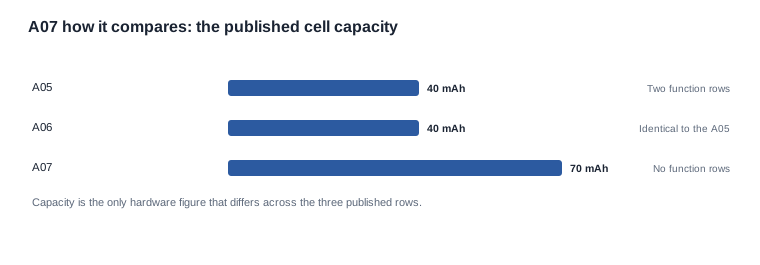
Charging and charge time are identical across all three, which is worth noting for a different reason: it means the charging programme is common to the range and does not need to be designed per model. What differs is not the interface but the accessory and packaging scope, and that is a decision you take once for the family.
How to build a comparison sheet that will not mislead you. A comparison table is a promise: it tells the reader that the columns are the things that differ and that the rows cover the decision. Three rules make that promise honest. First, only compare rows that exist for every model you are showing, and drop the ones that do not rather than filling them — a cell reading "not published" next to a cell reading "40 mAh" is not a comparison, it is a reminder that the table is incomplete. Second, never present a rating and a measurement in the same column without labelling them, because a runtime of about twenty hours and a measured eighteen hours look like the same kind of fact and are not. Third, keep the open items visible below the table rather than omitting them, because a comparison sheet that shows only the settled rows invites a reader to assume the unsettled ones are settled too. The criteria for a sheet that can go on a channel's page are simple: every cell traces to a catalogue row, every derived number is labelled as derived, and every open row is named.
What the identical A05 and A06 rows leave unresolved
Two of the three models in this range publish rows that are identical to each other, and the catalogue does not state what separates them. Compare the two rows below and the unresolved item is immediately visible.
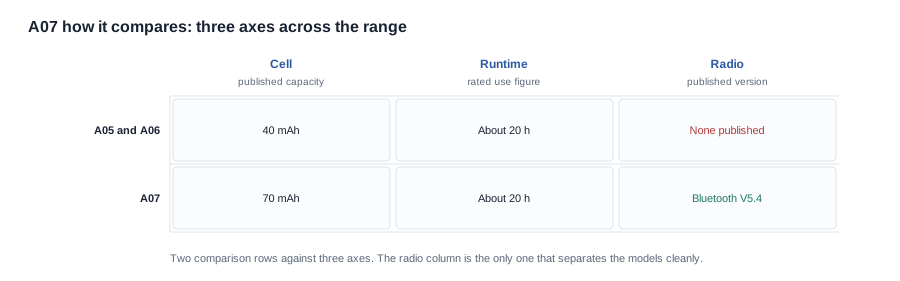
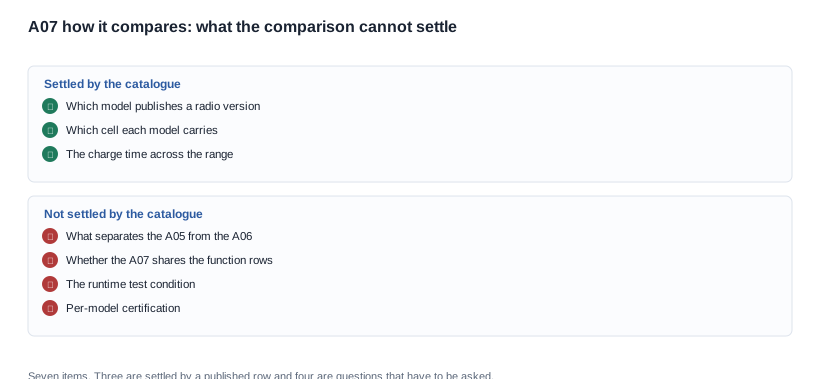
What the comparison resolves. Which model publishes a radio version. Which cell each model carries. And the charge time, which is common across the range. Three questions, answered from the catalogue, with no request needed and no ambiguity.
What the comparison cannot resolve, and this is the part that costs money.
What separates the A05 from the A06. The catalogue prints the same 40 mAh cell, the same charge time, the same rated use, the same magnetic charging, the same lens-type electronic fogging arrangement and the same posture and distance indication for both. There is no row anywhere that distinguishes them. For a range plan, that question decides whether you are buying a three-model line or a two-model line, and the per-model cost of a conformity file is multiplied by the answer. It also decides whether your product pages show two models that a customer can tell apart or two models with different names and identical published specifications.
Whether the A07 shares the function rows of its siblings. The A07 publishes no function row, and the catalogue's silence is not a statement that the function is absent from the hardware. It is a statement that the catalogue does not record it. A buyer who assumes the hardware is identical across the family is making a claim that no document supports; a buyer who assumes the hardware differs is also making a claim that no document supports. This is a question for the supplier in writing, and it is a question worth asking even if you have already decided not to list the function, because the answer changes the classification route.
The runtime test condition, which decides whether three identical figures mean anything comparable at all.
Per-model certification, which our documentation does not carry for any model in this range.
The commercial consequence of the unresolved pair, in one line. A file is priced per model per market, so narrowing this range from three models to two does not just halve the documentation cost — it halves the number of artwork sets, the number of labelling approvals and the number of per-SKU minimum order quantities, while leaving the cell, the charge time and the charging programme exactly as they were. That is why the A05 versus A06 question is worth more attention than the A06 versus A07 question it sits behind. The A06 versus A07 question decides which product you sell. The A05 versus A06 question decides how many products you have to support while you sell it.
One caution about the per-model file arithmetic. The saving from a reduced range is real, but it is not free of a dependency: it depends on getting a written answer to a question the catalogue does not answer. If the answer arrives late, you may have planned a two-model range and paid for a third model's artwork in the meantime, and the cost of that is not recoverable. Before you order, fix the range assumption in writing — even as an assumption — so that the documents, the artwork and the minimum order quantities all point at the same number of models. A range plan that carries a stated assumption and a date for replacing it is usable; a range plan that carries a hope is not.

A07 how it compares against the wider catalogue
Placing the A07 inside the whole catalogue is more informative than placing it inside the children's range, because it shows which rows are unusually well documented and which are normal.
The catalogue covers eight audio models, three sport models and eleven camera models, alongside the three children's models at the front of it. Comparing the A07's published rows against those groups shows where it sits.
Against the audio models, the A07 is under-documented and under-specified. All eight audio models publish a radio version — V5.3 on the K01 and the K02, V5.4 on the D11 and the LC-105-1, the D12 and the G07, and the LC-105-2 and the YK12 — and all of them publish a cell count, which the children's models do not: the K01 and the K02 at 90mAh2, the LC-105 pair and the G07 and the YK12 at 55mAh2, the D11 and the D12 at 100mAh. Two consequences follow for a buyer. First, the A07 is the least radio-transparent model in the catalogue for a connected product, and if your channel compares it against an adult audio line, the comparison will expose the gap. Second, the children's models are the only connected models in the catalogue whose cell count is not published, which is a reasonable thing for a consumer line to leave out and a strange thing for a procurement file.
Against the sport models, the A07 is comparable on capacity. The three sport models publish 70mAh*2 for the YKC02, 115 mAh for the D17 and 100 mAh for the ZH12 — the YKC02 figure is two cells totalling 140 mAh, which is a derived number rather than a published one. The A07's single 70 mAh cell is smaller than each of those, and the two sport models with the shortest published charge time are the D17 and the ZH12, both at about one hour. The A07's two hours or less is a ceiling like every other model's, and it is a longer task than those two.
Against the camera models, the A07 is a different product entirely. Eleven models carry a camera. Eight of them publish 8 MP and three publish 13 MP — the S7 and the L1 Pro, and the L2 Utral. The A07 has no camera row at all, which makes it the simplest product in the catalogue from a data and privacy point of view and simultaneously the least useful for any proposition that needs capture. Two other rows in that group are worth knowing about: only two models in the entire catalogue carry an ingress marking, the V06 and the S7, so there is no ingress position to borrow from any other model; and exactly one model publishes a weight, the MT6 at 158 g for the glasses body including its cell and camera and excluding its folding charging case, so there is no weight figure anywhere to compare against for the A07.
The pattern across all of this. The catalogue is strongest where the products are differentiated by hardware and weakest where they are differentiated by configuration. Camera resolution, ingress marking and weight are published where a specification buyer would expect them. Cell counts, radio versions and per-model certification are patchy across the catalogue as a whole and absent in this family. That is a useful thing to know before you build a comparison sheet that implies the catalogue is complete.
And a warning about comparing across categories. It is tempting to place this model next to an audio model because both are connected and both charge magnetically, and the comparison flatters the A07 because the audio models publish more rows. But the flattery is an artefact of documentation, not of capability, and a buyer who reads it that way will draw the wrong conclusion about the product. A more useful discipline: compare within a category, and compare across categories only on rows that are published identically for both. That gives you a small set of comparable facts — the charge time, the charging method, the radio generation, the rated runtime — and it keeps the inference honest about what it rests on.

A07 comparison: what a buyer can list today and what they cannot
Seven items split into three that the catalogue settles and four that it does not, and the practical question is which side of that line each of your listing claims falls on.
You can list today, with the catalogue as your source. The cell capacity of 70 mAh. The charge time of two hours or less, as a ceiling. The rated use of about twenty hours, as a rating. The charging method, magnetic. And the radio version, Bluetooth V5.4, with the important caveat that the version tells you the generation and not the connection target or the application.
You cannot list today, and each one needs a different route. What separates the A05 from the A06 needs a written answer from the supplier. The runtime test condition needs a measured protocol on a sample. The per-model certification position needs a testing body in your destination market. The frame weight, the dimensions and the recommended age band need a measurement and a size-range programme. The charging-case and charger detail needs an accessory question answered and priced. The charge indicator behaviour needs a specification line. And the function set of the exact model needs a written confirmation before the packaging describes anything.
On compliance, stated once for the range. Children's products typically attract additional requirements in major markets that adult electronics do not. Our documentation holds no certificate numbers, no issuing bodies, no validity periods and no covered model schedules for this category, and we will not estimate them. Our catalogue holds one export certification page, and that page is pictures rather than words — ten patent certificates in total, of which eight are appearance designs and two are utility models — and the catalogue text names no conformity framework at any point. A patent certificate is not a conformity position, and a page of certificate images is not a per-model file.
We will also restate the line we hold on every model here: we make no claim about myopia, about vision development or about eye health. A product with posture and distance indication sits close enough to that line that the wording of your listing matters, and that is a legal question in your market rather than a specification question.
The pitfalls in a comparison listing, and what they look like in practice. The first is the implied completeness trap: a three-column table with no gaps reads as though the products have been fully specified, and a customer service agent will be asked about the gaps. The second is the category comparison, where a children's model is set against an adult audio model on cell capacity and the reader concludes the wrong thing because the published rows differ in kind. The third is the borrowed specification: a figure taken from a different model in the range and applied to this one, which is easiest to do with the camera models and the only two models in the catalogue that carry an ingress marking. The fourth is the derived total: adding two cells together and presenting the sum as the catalogue's capacity, when the catalogue publishes the cell value and the cell count separately. Each of these is a red flag a reviewer can catch, and each of them is cheap to avoid by keeping the comparison sheet inside the published rows.
The position we take on this comparison
We can lay out the published rows for all three models and tell you three things: the capacity difference is real, the runtime figures are not comparable as stated, and the function difference is unresolved in our documentation. We will not guess at the test conditions, we will not assume a category function is present on this model, and we will not fill in a frame weight or a certification status. Where the catalogue prints a row we will use it; where it prints nothing we will say so, and where it prints a row without a condition we will keep the row and note the condition as open.
What we will not do is turn the range comparison into a recommendation that the documentation cannot carry. A comparison sheet implies that the catalogue describes the products completely, and for this family it does not. The honest version of the comparison is the version that names the four rows it settles and the three it does not, because that is the version a buyer can act on without discovering a gap in week three.
Send us the market, the channel, the age range and the wording you intend to use, and we will tell you which of these three models you can list and what has to be answered first. The category these models belong to is on our kids smart glasses range page, how certification is actually verified is in the certification checks note, and the model-level specification for this one is in the A07 specifications and features breakdown.
What we can answer today, in one paragraph. We can tell you the cell capacity of each of the three models, the charge time each of them publishes, the charging method each of them publishes, the rated runtime each of them publishes, the radio version where one is published, and the function rows where they exist. We can tell you that the two sibling models publish identical rows, and that our documentation does not say what separates them. We can tell you that no conformity framework is named in the catalogue text, that its export certification page carries ten patent certificates, and that there is no per-model certification row for any model in this range. We cannot tell you what separates the A05 from the A06, what the runtime test condition was, what the frame weighs, what the ingress position is, or whether this model carries any function beyond the rows it publishes — and rather than guess at those, we will mark them open and tell you who has to close them.
Related reading
- The category these models belong to — kids smart glasses
- The model-level rows in detail — A07 smart glasses specifications and features
- How a certification check is actually carried out — certification checks
Send the market, the channel and the wording, and we will tell you which model you can list.


