

The A07 is the simplest product in this catalogue and the one with the fewest open questions about what it is. It publishes Bluetooth V5.4, a 70 mAh cell, a charge time of two hours or less, roughly 20 hours of rated use and magnetic charging, with no camera, no lens arrangement and no detection hardware at all. For a buyer who has ruled out a behaviour tool, that simplicity is the argument.
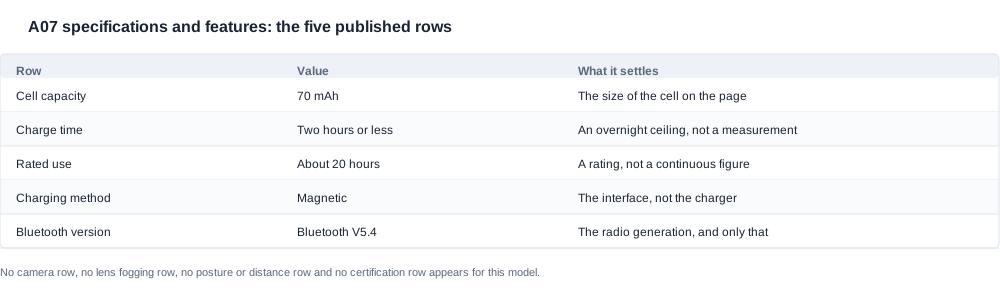
This article decodes those five rows one at a time, shows what the row set deliberately leaves out, gives a reading order that stops each row being quoted on its own, and turns the whole thing into a datasheet template you can hand to a supplier or to a reviewer.
A07 specifications and features: the five published rows
Cell capacity: 70 mAh. The size of the cell on the page. The catalogue prints a single capacity value and does not state a cell count, a chemistry or a rated discharge profile, so a file that quotes the number quotes a number whose measurement conditions the supplier has not declared. Ask what discharge profile the cell was rated against: the same cell reports more usable capacity at a light drain than at a heavy one, and this is the first question to ask about any cell figure.
Charge time: two hours or less. An overnight ceiling, not a measurement. The catalogue publishes an upper bound on the charging task, and the correct claim in a listing is that the charge completes in two hours or less. Writing that it charges in two hours turns a bound into a measurement; writing that it charges under two hours makes a stronger assertion than the catalogue makes, because it excludes the two-hour case itself. The catalogue publishes no start state and no completion criterion, which is the reason the row can be published and still not be usable for planning.
Rated use: about 20 hours. A rating. No start state, no radio state, no volume, no ambient temperature and no sample count are attached to it anywhere in our documentation. It belongs on a page as a rating attributed to the manufacturer, and it does not support a claim of continuous operation. The A07 battery life analysis covers the reasoning in full, including why the same figure on a smaller cell elsewhere in the range tells you the number describes a duty cycle rather than an active load.
Charging method: magnetic. An interface, not a description of what physically ships. The catalogue prints the method and does not say whether the charger is a pad, a case or a cable-ended puck. It prints no charge-indicator row for this model, no accepted input current and voltage, and no charging-case row at all. The distinction between an absent row and an unpublished one matters commercially here: a row that says "no case" is a decision you can price, while a row that says nothing is a question you have to ask before you can price the box.
Bluetooth version: Bluetooth V5.4. The radio generation, and only that. It tells you the device contains a radio, which generation of the protocol it speaks and therefore which class of host it can interoperate with. It does not tell you what the radio connects to: the catalogue publishes no application, no companion device, no host requirement and no connection name for this model, and the app and firmware position for this tier is recorded as awaiting verification.
Two features are absent, and their absence is a specification too. There is no camera row, so in this category that is a feature rather than a gap: a camera-free product removes the largest single source of household and institutional concern, and it removes the data question with it. And there is no lens arrangement and no detection row, so the product is an audio wearable with a children's frame, and it is the only model in the range where that is unambiguously true.
How to evaluate the row set as a whole rather than row by row. There is a pattern across the five rows that is worth naming, because it tells you what kind of product this is and what kind of evidence you will need. Three of the five rows describe the electrical system — a cell, a charge ceiling and a charging interface — and they are the rows with the most room for interpretation, because a ceiling is not a measurement and an interface is not a description. One row describes time, and it is a rating without a condition. One row describes the radio, and it is the only row in the set that is fully determinate: a protocol generation is a fact that can be checked against a unit. So the determinacy of this model's documentation runs in one direction only. Where a buyer needs certainty for a contract, it exists in one row and nowhere else, and everything else in the set has to be closed by measurement or by a written answer.
What the A07 specification set deliberately leaves out
Nine items sit outside the five published rows, and they divide into four groups: three absent from this model, four absent across the range, one awaiting verification and one documented as available.
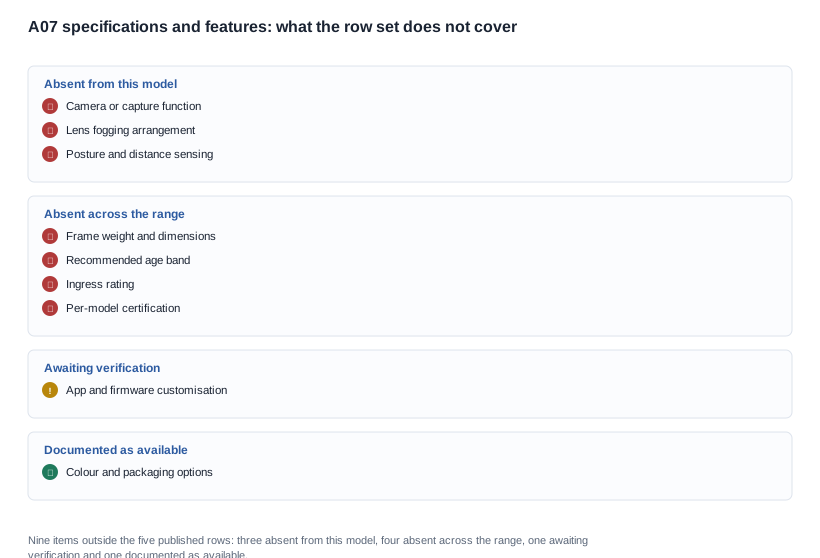
Absent from this model are the camera or capture function, the lens fogging arrangement, and the posture and distance sensing. Each of these three is published on the two neighbouring models, which is what makes their absence here informative rather than merely quiet. Their absence defines the product category: an audio wearable, not a behaviour device, and not a capture device.
Absent across the range are the frame weight and dimensions, the recommended age band, the ingress rating, and the per-model certification. The first two are the ones that matter most in this category, because a fixed frame with no published dimensions and no published band is a product with a narrower audience than a buyer might assume, and because weight on a growing head is a direct driver of both the household's experience and the return rate. The ingress rating matters because it is the difference between being able to say nothing about water, sweat and rain and being able to say something. The only two models in our whole catalogue that carry an ingress marking are the V06 and the S7, so there is no figure anywhere to borrow. The per-model certification is a document, and it is discussed in the A07 certification status article.
Awaiting verification is the app and firmware customisation row. This is the wording our documentation uses for a row that exists and has not been confirmed, and it is deliberately different from a row that does not exist. A buyer who reads it as "there is no application" may design a proposition around a device that turns out to have one; a buyer who reads it as "there is an application" may design a proposition around a device that does not. Either reading is a guess, and the useful question is which one you need to be right about.
Documented as available is the colour and packaging customisation row. That one is settled, which is worth saying explicitly in a category where so much is not: a brand can choose a colour and a package for this model without a further request.
And the distinction between the last two groups is worth making carefully, because it changes what you build. A row that is documented as available is an option you can put into a range plan today and cost today. A row recorded as awaiting verification is an option whose existence is recorded but whose terms are not confirmed — so it can shape a proposition, but it cannot be quoted, costed or promised until somebody confirms what is actually on offer. A brand that treats the two as the same will build a plan around an application branch it cannot describe, and will discover the gap at the artwork stage. The red flag to watch for is a range plan that lists an application as a feature of the line without a line in the specification that says who confirmed it and when.
Reading order: how to use the A07 rows so they are not misread
The five rows are correct, and they will still be misread — because a row quoted on its own becomes a claim the documentation never made. The order below is the order that prevents that.
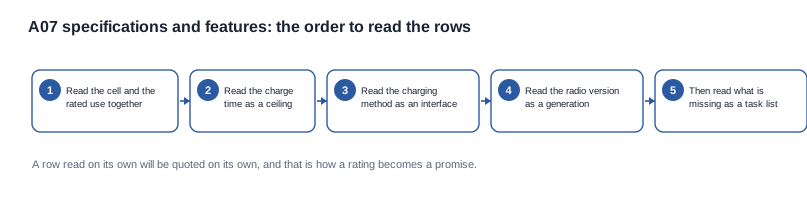
Read the cell and the rated use together, never separately. A cell on its own is a component; a runtime on its own is a headline. Read together they become a power budget, and the budget is what tells you whether the runtime is plausible for the job. On this model the combination is a larger cell with the same rated runtime as its two smaller siblings, which is the clearest single indication that the figure describes a duty cycle rather than an active load.
Read the charge time as a ceiling. Two hours or less is a bound on an overnight task. It is not a measurement, it is not a promise about a specific charger, and it says nothing about how much of a day is lost to charging.
Read the charging method as an interface. Magnetic tells you how the device mates with its charger. It does not tell you what the charger is, whether there is a case, whether there is an indicator, or what input the device accepts.
Read the radio version as a generation. Bluetooth V5.4 tells you the protocol generation. It does not tell you what the device connects to, and it is not a substitute for a compatibility statement.
Then read what is missing as a task list. The absent rows are not gaps in the documentation to be papered over; they are the specification items you have to obtain. A datasheet that hides them invites somebody to fill them with a typical value, and a typical value is a commitment that will be tested against reality by a child in a household.

A07 specifications as a template for your own datasheet
The five published rows are a workable skeleton for a datasheet, and the structure they impose is more useful than the values. Build yours in this order.
Section one, the identity rows. The exact model designation, the designation the conformity file names, the product name as it will appear on the packaging, and the colour and packaging configuration. The first thing a datasheet has to do is make sure that a certificate, an artwork file and a purchase order all refer to the same string. In this range that is not a formality, because two of the three models publish identical specifications and a designation that is ambiguous is a designation a document cannot name.
Section two, the power rows. Cell capacity, the cell count if it exists, the charge time as a ceiling with its start state and completion point, the charging method, and the rated use with its condition. Where the condition is not published, write the condition as an open line rather than leaving the figure bare.
Section three, the interface rows. The radio version, the connection name, the application and firmware position, the accepted charging input, the charge indicator behaviour, and the accessory set with its minimum order quantities.
Section four, the physical rows. Frame weight, dimensions, the size range, the recommended age band, and the ingress position. All four are absent today across the range, which is why they are listed as a section rather than as a footnote: they are the section that will take the most work and the one most likely to be skipped.
Section five, the compliance rows. The conformity file reference per model per market, the standard names with their edition numbers, the certificate numbers with their issuing bodies and validity dates, the labelling scope, and the claim wording. That last one belongs in the datasheet rather than in the marketing brief, because the datasheet is the document that other people copy from.
And a closing note in every one of those five sections stating which rows are published, which are awaiting verification, and which are absent. A datasheet that marks its own uncertainty is a datasheet that can be used in a review. A datasheet with blank cells is a datasheet that somebody will fill in.
Two datasheets, not one, and the split between them matters. The supplier-facing datasheet is the document you send with a request: it lists what you need, and every row in it is a question or a criterion. The market-facing datasheet is the document that ends up in a listing or a tender response: it lists what you can state, and every row in it is a claim you are willing to defend. The trap is producing one document and using it for both, because the supplier-facing version is full of blank rows and the market-facing version is full of settled ones, and the same sheet cannot honestly be both. The rule that keeps them apart is simple: a row moves from the first sheet to the second only when a document, a measurement or a written answer is attached to it, and the transition is recorded. That is also how the total cost of a datasheet stays honest — you can see, at any point, how much of the document is still a request.
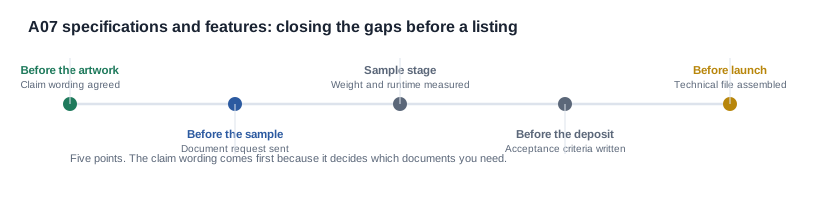
A07 specifications: closing the gaps before a listing goes live
The five points in the sequence above are not a project plan; they are the order in which the decisions have to be made so that the artwork is not waiting on a document.
Before the artwork, settle the claim wording. It comes first because it decides which documents you need. A listing that describes a connected audio wearable for children needs a radio file and a battery transport file. A listing that describes a posture reminder needs more, and ours cannot be written. Deciding this before the artwork is drawn costs nothing; changing it after the artwork is signed costs a round, a week and a new set of samples.
Before the sample, issue the document request. The conformity file per model per market, the application and firmware position in writing, the function list for the exact model, and the accessory scope with its minimum order quantities. These are the requests with lead times attached, and the requests themselves cost nothing.
At the sample stage, measure what is missing. Weight and dimensions across a spread of units, the charge time from a stated start state, the runtime under your own usage pattern, the size range across real children, and the charging routine completed unaided. Each measurement becomes an acceptance criterion, and each criterion becomes something you can hold a delivery against.
Before the deposit, write the acceptance criteria into the order. The published rows for the configuration ordered, the measured figures with their conditions, the tolerances you will accept, the warranty period with a stated response, and the payment node against inspection.
Before launch, assemble the technical file. Product description, component list, supporting reports, the user-facing instructions and markings, and batch traceability. This is the file that has to survive a question from a distributor, a marketplace reviewer or an institutional buyer two years after the first shipment.
The position we take on this model's published rows
The A07 is the easiest model in this category to qualify and the hardest to differentiate, and a brand choosing it should be doing so on the strength of an uncomplicated documentation story rather than on a feature claim. We will publish the twenty hours as a rating and not as an active-use figure, we will publish the charge time as two hours or less and not as under two hours, and we will not quote a weight, an age band, a size range, a case capacity, a charge indicator or a certificate number that the documentation does not contain.
We will not describe this model as carrying the camera, the lens arrangement or the detection rows of its siblings, because those rows are not published for it, and we will not describe a catalogue page of patent certificates as a conformity position for a model. The export certification page in our catalogue carries ten patent certificates, eight appearance-design patents and two utility-model patents, and the catalogue text contains no reference to CE, FCC or RoHS anywhere — which means we will not tell you this product is certified, and we will not let a listing imply it either.
We will also not fill a blank cell with a typical value, and we will not publish an ageing figure for a cell we have not tested. And we make no vision, hearing or eye-health claim for this model or any other, because there is no claim to attach to a specification sheet.
What we will do is tell you which of the nine items outside the five rows our documentation answers today, which are awaiting verification, and which are yours to close. Send us the buyer, the age band, the markets and the volume, and we will tell you whether the A07's simplicity is the reason your channel can take this category on. The published A07 specification list is the honest baseline, the A07 buyer review checklist covers the sample-stage work, and the kids smart glasses range page holds the family.
Related reading
- The functional split in this category — A06 smart glasses versus A07
- The commercial grounds — A07 smart glasses value for money
- Deciding the range — kids smart glasses which model to pick
Send us the buyer, the age band and the markets, and we will tell you whether the A07's simplicity is the reason your channel can sell this category.


