
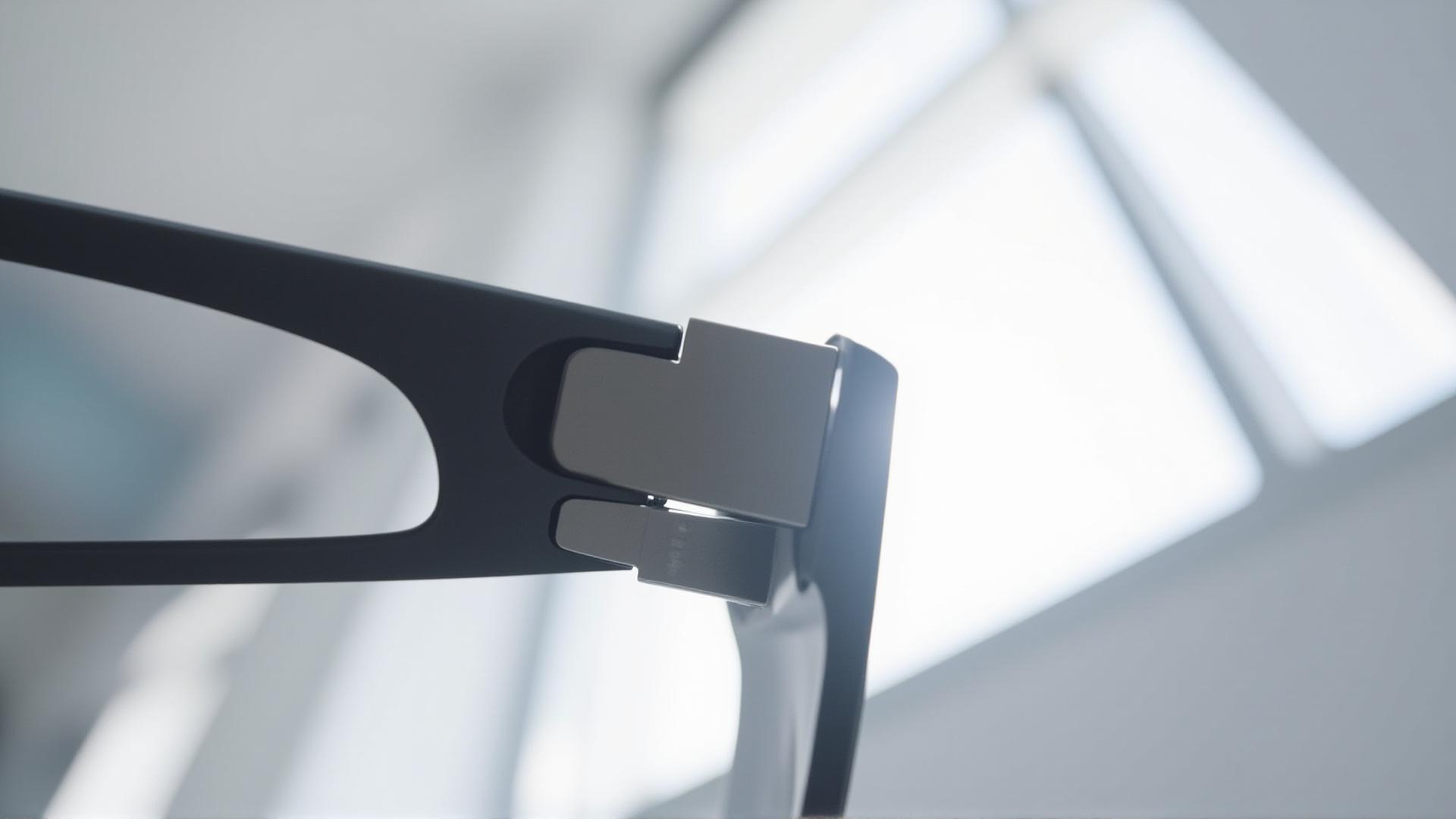
The A07 is a children's model, and that single fact changes the order in which a buyer has to evaluate it. Adults buy audio glasses for themselves and can absorb an imperfect fit or a short battery. A household buying for a child is buying a product that a third party will use all day, that will be handled roughly, and that may attract requirements which the adult equivalent does not. The published specification for the A07 is short and attractive. The limitations are in everything the specification does not say, and they are the parts worth reading first.
Before anything else: in this category the compliance position is part of the product. No certification information for our children's models has been provided to us, and children's products typically attract requirements that adult electronics do not.
This article is organised as a register. First the assumptions that buyers carry into the evaluation without checking them, then the limitation that decides which markets the product can be sold into at all, then the register of rows that are not published, and finally who can close each one of them.
A07 limitations: four assumptions buyers make without checking
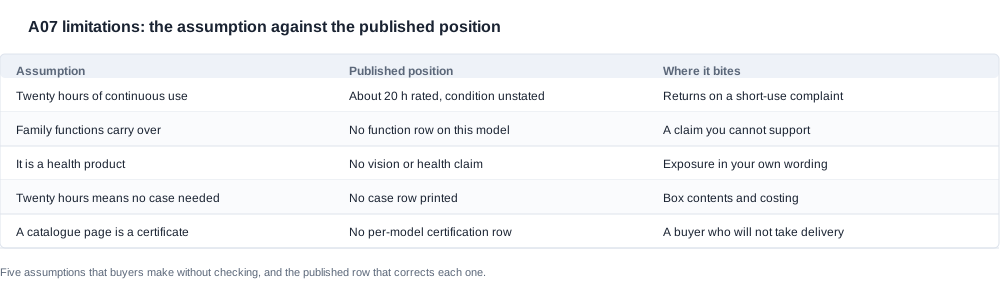
Five assumptions do most of the damage in this category. Each one sounds reasonable, each one is contradicted by a published row, and each one costs money if it reaches a product page.
The twenty-hour figure describes general use. The A07 is published with roughly twenty hours of rated runtime, from a 70 mAh cell, over Bluetooth V5.4, with magnetic charging. Twenty hours from 70 mAh is a striking ratio, and it should prompt the question every runtime figure prompts. What was the product doing during those twenty hours? A 70 mAh cell running a connected audio product continuously for twenty hours is at the edge of what is plausible. If the figure reflects intermittent use, or a low duty cycle, or a category of activity narrower than a buyer will assume, then twenty hours is a correct number describing a narrower situation than the one the listing implies. The test condition is not published, we will not estimate it, and we would treat the figure as a rating until the supplier explains it.
The functions of the family carry over to this model. Our category documentation describes two technical features for children's models: a lens-type electronic fogging arrangement, and posture and viewing-distance indication. Those descriptions are written at the category level. The A07's own published row does not list them. It carries a radio version, a cell, a charge time, a runtime and a charging method, and nothing else. Two other models in the same family publish rows identical to the A07's, which means the category functions may well apply, or may not, and the catalogue does not distinguish between those two possibilities. This is not a small point: a product page built around posture or viewing-distance indication is making a functional claim about a child's eyes, and it needs written confirmation for the specific model first.
This is a health product. This is the assumption we want to be bluntest about, because it is where the exposure sits. A product aimed at children, with sensing functions related to viewing distance and posture, sits close to the line where marketing language becomes a health claim. We make no health claim of any kind here — not about myopia, not about vision development and not about eye health, for this product or for any other — and we will not support a listing that does. We hold no clinical data, no test protocol and no regulatory assessment for it. What the product does and does not do in that context is a question for your own legal counsel in your own market. The practical consequence for a supplier is simple: the certification position for this product has not been provided to us, and a supplier who says a children's product needs no market-specific approval is describing their process, not your exposure.
A twenty-hour product needs no charging case. The A07 charges magnetically, and that raises the same dependency as every other magnetic product in the range — a proprietary dock that the household has to keep, and possibly a case. Whether a case is included at your quantity, and what its own capacity is, is not published for this model. A twenty-hour runtime reduces how often the case matters, which is one reason the format makes sense here. It does not tell you what ships in the box, and that is a costing question before it is a product question.
A catalogue page is a certificate. What the catalogue holds on this subject is one company-level export certification sheet, and the sheet is photographs rather than extractable text. Ten certificates appear on it, eight of them appearance-design patents and two utility-model patents. No CE, FCC or RoHS mark is named anywhere in the written catalogue, and no model in the range — this one included — carries a certification row of its own. An institutional tender cannot be answered from a catalogue page, and a listing that implies otherwise creates a problem at the moment somebody asks for the document.
How to write an assumption down so it stops being one. The reliable method is to convert each assumption into a pair of lines: the claim a buyer would make, and the catalogue row that either supports it or contradicts it. "Twenty hours of use" against a published row of about twenty hours rated, with no condition stated, is a claim that the documentation does not support in the form a buyer will read it. "The functions of the range apply to this model" against a published row with no function entries is a claim the documentation contradicts. "The product is certified" against a catalogue text with no reference to CE, FCC or RoHS anywhere is a claim the documentation cannot reach at all. Written that way, each assumption becomes a checkable item rather than a background assumption, and the criteria for whether to proceed become obvious: an assumption that survives only because nobody wrote it down is the one most likely to reach a product page.

The A07 limitation that decides the market rather than the product
Most of the limitations in this register are product limitations, and they are handled by measurement. One is not, and it changes the programme before a sample is ordered.
The certification position decides the market, not the product. Everything else in the register can be closed by a measurement, a written answer or a priced accessory. This one cannot be closed by a factory, because the route is a question about the destination market and the factory is not qualified to answer it in your market. What is required to sell a children's connected product with particular wording in a particular market has to be established with a testing body in that market.
That makes it a scheduling constraint rather than a quality constraint. The elapsed time sits in the testing body's queue, not in your quality programme, and nothing you do on the hardware side shortens it. The artwork depends on the label scope, the label scope depends on the classification, and the classification depends on the route. So the dependency runs backwards from the usual order: the file is upstream of the packaging, not downstream of it. A buyer who designs the packaging first and commissions the file afterwards will pay for the packaging twice.
The second market decision is narrower and easier to make. The A07 publishes no function row. If it genuinely carries no sensing function, the requirement profile for a children's product is simpler than it would be for the models that do publish one. If it does carry one, the profile is closer to the line you would not want to be uncertain about. The catalogue does not record the function set for this model, and classification depends on what the product is, so the written function confirmation has to come before the file is scoped rather than alongside it.
And the third market decision is about wording rather than hardware. The wording on the packaging is part of what a regulator examines, and the wording is decided by the channel. A claim about eyesight changes the product's legal category. We will not help write one, and we hold nothing that would support one.
What to ask a testing body, and three red flags in the answers. The questions are: which frameworks apply to a children's connected product with this wording in this market; whether the radio element and the children's requirements are handled as one engagement or two; what sample quantity is needed and whether it can be drawn from a production batch; how long the report takes to issue; and whether the certificate can be issued in your company's name. Three answers are warning signs. An answer that quotes a cost without a scope is pricing something unspecified. An answer that confirms the framework without naming the edition is confirming something that may already be superseded. And an answer that says the children's requirements do not apply because the product has no camera is confusing one classification question with another, since the questions are asked independently and the answer to one does not settle the other. Ask before you order, and ask in writing, because all three of those answers are perfectly acceptable in a conversation and unusable in a file.

A07 limitation register: the rows that are not published
Ten rows make up the register, and only two of them are usable as they stand. Listing them explicitly is more useful than describing them in general terms, because each one has an owner and a route.
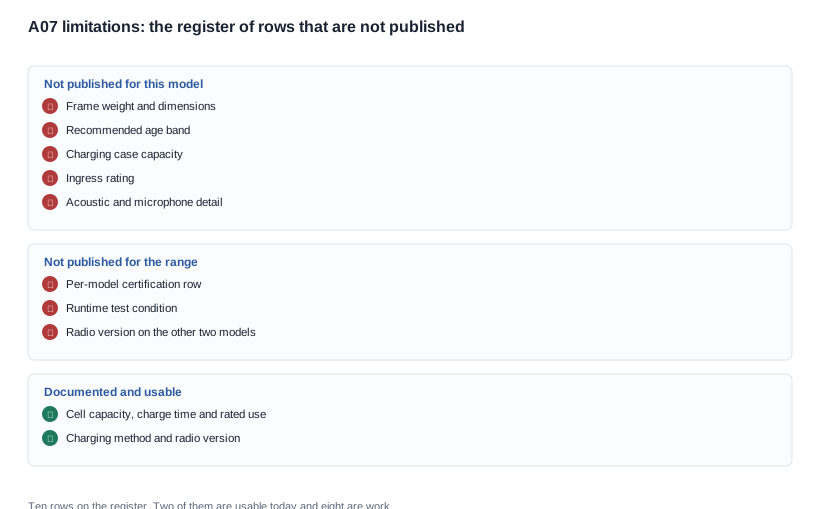
Five are not published for this model. Frame weight and dimensions. The recommended age band. The charging case capacity. The ingress rating. And the acoustic and microphone specification. Each of these can be closed on a sample or in writing, and each one has a commercial consequence that is larger than its size suggests: weight and the size range decide the audience and the return rate, the case capacity decides what ships in the box, the ingress rating decides whether any outdoor statement is possible at all, and the acoustic specification decides whether the product can be described as an audio product in a technical sense.
Three are not published for the range. The per-model certification row. The runtime test condition. And the radio version on the other two models. The first is a document you obtain elsewhere, the second is a protocol you write and run, and the third is a question for the supplier that also happens to answer the question of why only this model in the range publishes a radio version — which is worth knowing, because a catalogue row that appears on one model out of three is doing more work than it looks like it is doing.
Two are documented and usable. The cell capacity, charge time and rated use, and the charging method and the radio version. These can go onto a page today, provided each keeps its own grammar: a cell size, a ceiling, a rating, an interface, a generation.

Who can close each A07 limitation
The register is only useful if it carries an owner. Five layers, and they divide cleanly by who has to act.
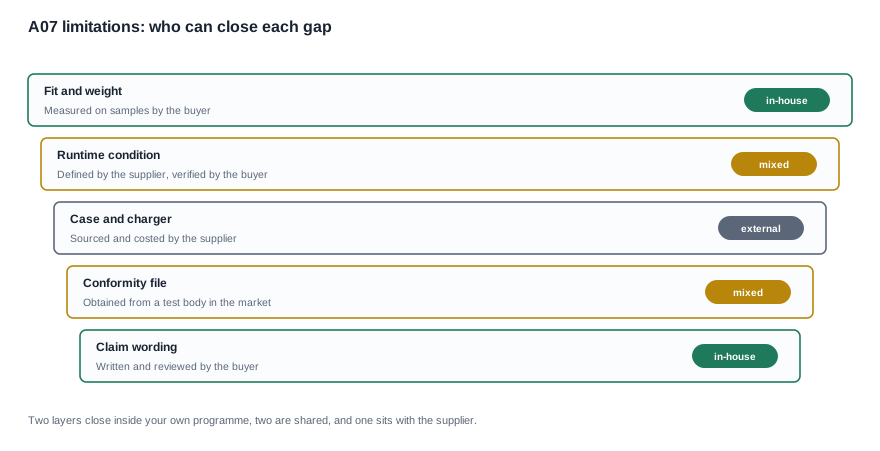
Fit and weight close inside your own programme. You commission the measurement, you run the size-range check across real children, and you set the acceptance criterion from the result. Nothing here depends on a third party's calendar, and it is the layer most likely to be left undone because nobody outside the organisation is waiting for it.
The runtime condition is shared. The supplier has to define what was running during the twenty hours, and you have to verify that the definition survives your own protocol. Neither half is sufficient alone, and the shared ownership is the reason this row gets closed late: it needs a scheduled conversation rather than a document request.
The case and the charger sit with the supplier. Sourced, costed and quoted, with their own minimum order quantities and lead times. This is a straightforward commercial workstream, but it is on the critical path for the packaging, because the box cannot be drawn until the accessory scope is fixed.
The conformity file is shared in a different way. The route is established in your market, the report and declaration come from the testing body, and the assembly of the technical file is yours. The shared ownership sits between you and a third party rather than between you and the supplier, which is why the elapsed time here is the longest item in the whole programme.
The claim wording closes inside your own programme. Written, reviewed and frozen before the artwork is signed. It is the cheapest layer to close and the most expensive to get wrong, because a claim that survives to the packaging stage gets printed, distributed and then has to be withdrawn.
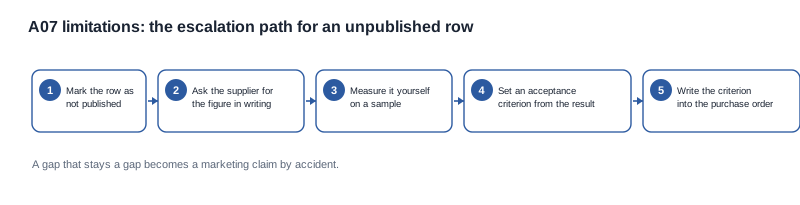
The escalation path is worth setting out as a method, because it is the same for every row in the register. Mark the row as not published rather than leaving it blank, because a blank row in a specification is read as an oversight and a marked row is read as a task. Ask the supplier for the figure in writing, so the answer has a date and a source attached to it. Measure it yourself on a sample where the answer is a physical quantity. Set an acceptance criterion from the result rather than from the answer, because the criterion is what you will hold the delivery against. And write the criterion into the purchase order, because a criterion that lives in an email is not binding. The trade-off this path makes is time for enforceability: every row closed this way costs a round of conversation, and every row closed by writing a typical value into the specification costs you the ability to reject a delivery later. The total cost of the second option is invisible on the quotation and visible in the returns ledger, which is why it is worth paying the first one in full.
A07 limitations: what we will not estimate
We can tell you what the A07 is published as: Bluetooth V5.4, a 70 mAh cell, a charge time of two hours or less, roughly twenty hours of rated use, and magnetic charging. We can tell you that the catalogue prints no function row and no per-model certification row for it, and that the catalogue text contains no reference to CE, FCC or RoHS anywhere. We can tell you that the only two models in our whole catalogue carrying an ingress marking are the V06 and the S7, so there is no figure to borrow for this one. And we can tell you that the app and firmware position for this tier is recorded as awaiting verification, which is a row that exists and has not been confirmed rather than a row that does not exist.
What we will not do is fill any of the ten register rows with a typical value. We will not estimate the frame weight, the age band, the case capacity, the ingress rating or the acoustic figures. We will not estimate the runtime test condition or the charge indicator behaviour, and we will not estimate the accepted charging input. We will not convert the twenty hours into a continuous-use claim, and we will not convert the two-hour ceiling into a measured figure or into a claim that the charge takes less than two hours, because those are two different assertions and only one of them is the one our catalogue makes. We will not present a sensing function from a sibling model as though it applied here, and we will not support a listing that implies a health or vision benefit.
We also publish no ageing data for the cell and we will not estimate a service life for something we have not tested, and we make no hearing-related claim for any model in our range.
What we will do is tell you which of the ten register rows our documentation answers today, which need a sample and a protocol, which need a written answer from the supplier, and which need a testing body in your destination market. Send us the market, the channel and the age range you intend to serve, and we will be direct about which rows we can support and which ones have to come back to you as open. The rest of this category is on our kids smart glasses range page, a runtime claim is read in more detail in smart glasses battery life, and the sample-stage procedure is set out in the A07 buyer review checklist.
How to use this register at the review stage, and how to tell when it has stopped being useful. The register earns its place by being carried into the acceptance review as a checklist, one line per row, with a status against each one. A row is closed when a document, a measurement or a written answer exists and has been attached. A row is open when it has a request outstanding with a date. A row is blocked when it cannot be closed without a decision that is not yours to make — the classification route and the claim wording are the two most common. Once a row has been blocked for more than one review cycle, the useful question is no longer what the row says but whether the programme needs it, and that is a range decision rather than a product one. A register that nobody reviews against is a document, and a document does not prevent a purchase order from being signed with a number in it that nobody ever committed to.
Related reading
- The rest of this category, and where the feature descriptions differ — kids smart glasses
- How to read a runtime claim — smart glasses battery life
- Checking certification rather than taking a claim — certification checks
Send the market, the channel and the age range, and we will be direct about what we can support.


