

The A07 publishes Bluetooth V5.4, a 70 mAh cell, a charge time of two hours or less, a rated use of about twenty hours and magnetic charging. It publishes no per-model certification status, no frame weight and no radio version for its two siblings in the range. For a children's product that ordering is deliberate, and it is the opposite of how a hardware review usually runs.
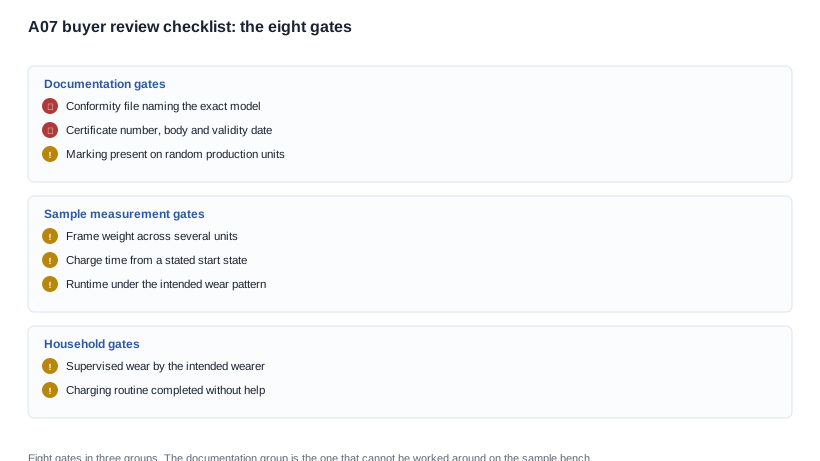
This checklist is written for the person who signs the acceptance decision, not for the person who unpacks the carton. It runs in the order that protects the buyer: the file first, the measurements second, the household evidence last.
A07 buyer review checklist: why the documentation gates come first
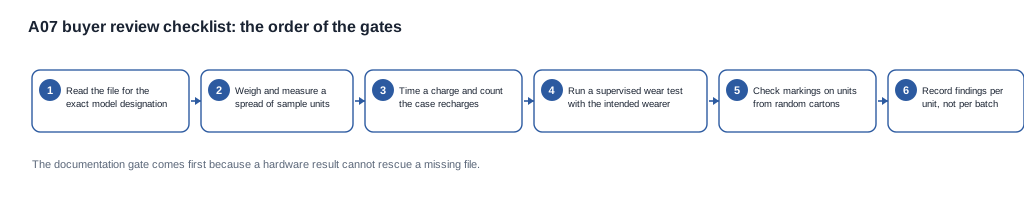
Most hardware reviews start with the unit in the hand because the unit is the thing that is physically present. For a children's wearable the documentation gate has to come first for three reasons, and each one is a commercial reason rather than a procedural preference.
A hardware result cannot rescue a missing file. You can weigh every sample, time every charge and run every household trial you like, and none of it changes the fact that a school, a district buyer or a marketplace reviewer will ask for the conformity document. A device that passes a physical review and has no file is not a product you can ship into a channel that has a compliance function; it is a product you have to hold back while somebody starts a testing programme. Put the file first and the review becomes a qualification. Put it last and the review becomes a discovery.
The file determines which configuration you are reviewing. The A05 and the A06 publish identical rows in our catalogue and the catalogue does not state what separates them, so a document that covers a family rather than a model designation will not tell you which hardware you are allowed to ship. Get the model designation on the document first, then the physical review has something to be a review of.
The lead time sits in the file, not in the bench. Certification cost is fixed per model per market and the elapsed time is set by the testing body. A review schedule that starts the file after the sample measurements has already lost weeks it cannot recover, because the file is the item with a queue behind it.
There is a fourth reason, and it is the one that catches experienced buyers out. The catalogue carries a company-level export certification page whose content is images rather than text — ten patent certificates, eight appearance-design patents and two utility-model patents — and the catalogue text contains no reference to CE, FCC or RoHS anywhere. There is no per-model certification row for the A07. That means the only thing that can satisfy gate one is a document you obtain from a testing body in your destination market. A patent certificate is not a conformity declaration, and a page of certificate images is not a per-model file.
Four facts about the surrounding range shape the review scope, and it is worth fixing the scope before the samples arrive. The A05 and the A06 publish identical rows, so a document that names a family rather than a model will not tell you which of the three you may ship. The A07 publishes no function row at all, so a review of this model has no sensing function to verify and no sensing threshold to measure. No model in this range publishes an ingress marking, so there is nothing to test and nothing to claim about water, sweat or rain. And the app and firmware position for this tier is recorded as awaiting verification, which means a review cannot test an application flow that has not been confirmed to exist. Fixing these four facts at the start prevents the review from acquiring scope it cannot close.

Gate one: the A07 conformity file and what a certificate has to name
Gate one has four checks. They are cheap, they are all written questions, and any of them can be answered before a single unit is opened.
Check the model designation. A conformity document has to name the exact designation you will ship, not "smart glasses", not "children's smart glasses" and not a family. If the document names a family, it does not cover your product, and the review cannot proceed on the basis of it. This check is more than administrative in this category precisely because the A05 and the A06 publish identical rows: two designations with identical published specifications is exactly the situation in which a family-level document gets mistaken for a model-level one.
Check the issuing body and the standard names. In Europe the applicable frameworks for children's products include EN 71, which is separate from CE marking and separate from the General Product Safety Regulation; in the United States ASTM F963 and the Consumer Product Safety Commission rules apply, and neither is covered by an FCC filing. On the radio side the European framework is the Radio Equipment Directive (EU) 2014/53/EU. On the electromagnetic side the EN 301 489 series is a harmonised standard used to demonstrate conformity, which is a different kind of reference from a directive number, and a document that mixes the two is a document to question rather than to accept.
Check the edition dates and the validity dates. Standards work on an edition cycle. A file prepared against a superseded edition is a retest waiting to happen, and finding that in the second year of a programme is far more expensive than finding it now. Validity dates matter for a different reason: a product that sits in your warehouse for a year before it ships may arrive in a market where the document behind it has expired.
Check the label scope against your artwork. What the packaging may say is part of what the file has to support. We hold no clinical data, no test protocol and no regulatory assessment for this category, and we will not help write a claim about myopia, vision development or eye health. The artwork you approve should describe what the device does — a connected audio wearable for children, with a rated runtime and a charging method — and not what you hope it achieves.
Two questions belong to a testing body rather than to the factory. Which frameworks apply to a product of this type with this wording in your market, and what the route and the cost are. The factory can tell you what it has done for other customers in other markets; it cannot tell you what your market requires, and it is not qualified to. Establishing the route with a body in your own market costs nothing and removes the largest unknown from the schedule. The certification checklist covers how to ask for the numbers, the issuing body and the validity dates in a single request.
Gates two to four: the measurements you take on the sample
With the file in hand, three measurement gates follow. Each one exists because the catalogue publishes a figure for this model and no condition attached to it, so the condition has to be established by measurement before the figure can be used in an order or on a page.
Gate two: weight and dimensions. The catalogue publishes no frame weight and no dimensions for this model, and it publishes no recommended age band. That is three gaps on the same physical row, and for a children's product on a growing head it is the row that decides the returns rate. Weigh several units rather than one, and record the spread rather than the average: a supplier who will commit to a spread is making a different commercial offer from one who will commit to a single figure. Measure the unit as shipped, including the charger if the charger is the shipping configuration, and state the measurement method so the number can be reproduced.
Gate three: charge time and case recharges. The catalogue publishes a charge time of two hours or less and magnetic charging for this model, and publishes no charging-case row and no row describing what the physical charger is. Time the charge from a stated start state to a stated completion point, not from empty to full in an informal sense, and record both endpoints. Then count the recharges a case provides if a case is supplied at all. Because the case situation is unpublished, the recharge count has to be measured rather than calculated, and a measured recharge count is a number you can put in an acceptance criterion while a calculated one is a guess.
Gate four: runtime under the intended usage pattern. The catalogue publishes a rated use of about twenty hours with no test condition — no start state, no radio state, no volume, no ambient temperature. Measure it under the pattern you actually intend to sell, on more than one unit, and log the state at the end of each block rather than only at the end of the day. Block-level readings separate the radio cost from the audio cost, and that separation is what lets you describe the duty cycle honestly to a channel that asks. The A07 battery life analysis sets out the protocol in full, and the how to compare battery life method covers the general case.
One question in gate four belongs with the supplier rather than with the bench. The catalogue publishes no touch row for any model, so whether the temple carries a touch surface and how it is configured has to come from the supplier. It is also a question with a compliance dimension, because a touch control on a children's device changes the physical interaction the user-facing instructions have to describe.
How many units, and which ones. A review that looks at the units the factory puts in the sample box has measured the factory's best units. Pull the review sample yourself, or specify the pull in the sample order: a stated number of units drawn from more than one carton, from more than one production date where that is possible, and never from the first carton alone. Three units is a workable minimum for the weight and charge gates and a weak sample for anything with a tolerance. Record the carton and date identifiers for each unit tested, because they are what lets you attribute a failure to a batch later, and the attribution is the thing that makes a batch claim enforceable against a supplier. Where a unit fails, keep it. A failed unit is physical evidence; a note saying a unit failed is an assertion, and the difference matters at the moment you claim against a delivery.

Gate five: the A07 household trial and the record it produces
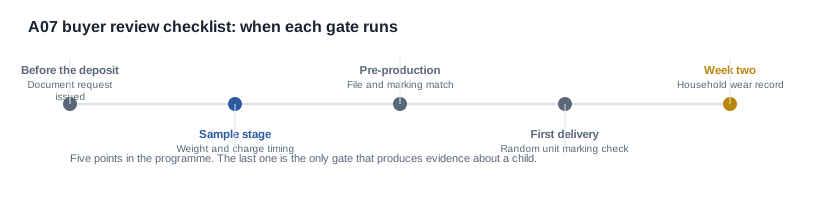
The last gate is the only one that produces evidence about a child rather than about a unit, and it is the gate most often skipped because it needs time rather than equipment.
What the trial is. Put the device into a real household for a real period and record what happens on the sixth day rather than on the first. Day one tells you that the packaging was understandable and the charger worked. Day six tells you whether the routine holds: whether the charging routine completes without help, whether the device goes back on the charger at the right point in the evening, whether a sibling or a parent turns it off because it keeps announcing something, and whether the size range is still appropriate.
Why the sixth day matters. Every children's device has a novelty period. The failure modes that produce returns are habit failures — a charging routine that a busy adult forgets, a device that is too easily knocked off and then not replaced — and habit failures are not visible in a demonstration. A trial that ends on day two produces a result that looks like a pass and predicts a return rate that is wrong.
What to record. Write the findings down as you go rather than reconstructing them. Per unit, not per batch: the unit identifier, the date, the state observed, the action taken and the category assigned. The quality consistency note covers why a batch-level finding is worth much less than a unit-level one, and the sample evaluation note covers how to structure the sample so the result is worth something.
Who signs. The review decision should be taken by the person who owns the returns consequence, which is usually not the person who opened the carton. A review that produces a list and a list without an owner is a review that will be re-read in six months by somebody who has to reconstruct what was decided.

A07 review recording: findings per unit, and the defect taxonomy
A review produces two deliverables, and the second one is the one that has commercial value afterwards.
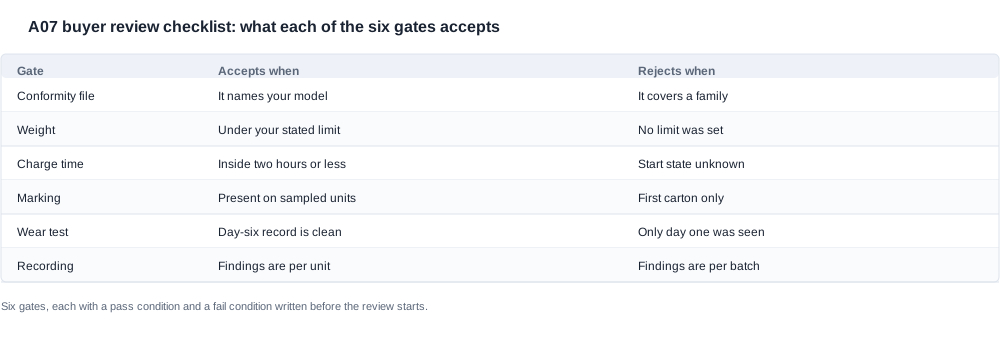
The findings record. Six of the eight gates, each with a pass condition and a fail condition written before the review starts, each finding attached to a unit identifier and a date. Written in advance, the pass conditions are what stop a review from becoming a discussion about how bad a fault has to be before it matters.
The defect taxonomy. Ask the factory which defect categories it works to and how it classifies them. What counts as a functional failure rather than a cosmetic one, what is scrapped rather than repaired, what is within the acceptable quality limit and what is not. Your returns terms, your warranty claim and your acceptance criteria all depend on that vocabulary, and it is almost never the vocabulary already in use inside your own customer service team — which is why a returns problem appears later as a data problem rather than as a product problem.
Three commercial terms to settle while the review is open. The accessory and spare-parts scope: a magnetic charger is a small object that gets lost, and whether a replacement can be ordered separately, at what price and at what minimum order quantity, is worth settling before launch. The warranty period with a stated response time, which is a term rather than a price and which your support cost model depends on. And the payment nodes against inspection, because a review that finishes after the balance is due has no leverage and no evidence.
What this review cannot settle, and it is worth stating so the team does not wait for it. The roughly twenty-hour rating has no stated condition, so the review produces a measured figure under your own protocol rather than a confirmation of the catalogue's. The frame weight and the recommended age band are not published, so the review produces a measurement rather than a specification. The A07 publishes no posture or distance detection, so it cannot support a behaviour argument in a school or parent-facing channel, and the sibling models that can still may not support a health claim. No ingress rating is published for any model in this range, so there is no basis for any claim about water, sweat or rain. And the certification position is a document, not a measurement — which is why gate one is a gate and not a formality.
What happens when a gate fails. Three routes, and the route has to be chosen deliberately rather than by default. A rework route sends the failed unit back with a written description of the fault and expects a corrected unit, and it works for a cosmetic or a configuration fault. A concession route accepts the fault against a recorded allowance, and it is the right route for a small measured deviation that falls inside a tolerance you have already agreed. A rejection route treats the finding as a batch question and moves it into a claim against the delivery, which is the correct route when the same fault appears across units or when the fault touches a safety-relevant behaviour. Recording which route was taken, and why, is what keeps a review from turning into a series of one-off negotiations. The quality consistency note covers how a batch-level finding is assessed against a supplier's own acceptable quality limit, which is a figure that belongs in the purchase order rather than in a conversation after the first rejection.
The line we hold on this review
The compliance file is the review for this product category and hardware verification follows it. We will not estimate an absent certification status, and we will not present a physical sensing function on a sibling model as a health benefit. We will not quote a frame weight, a recommended age band, an ingress rating, a charge indicator behaviour or a certificate number that our documentation does not contain, and where a row is absent we say so rather than supply a typical value.
What we will do is tell you which of the eight gates our documentation closes today, which need a testing body in your destination market, and which need a sample and a protocol. Send us the market, the age range, the volume and the required configuration, and we will tell you which of the eight we can support in writing today and which are outstanding on your side.
The range is on our kids smart glasses page, the supplier-side checks worth running before a review are in the factory audit note, and the sample-stage work for this model is set out in the A07 battery life analysis.
Related reading
- The six steps as a repeatable method — kids smart glasses
- The supplier-side checks worth running before a review — factory audit
- What a batch acceptance finding is worth as evidence — quality consistency
- The unit a review decision should be taken on — sample evaluation
Tell us the target market, the quantity and the configuration required, and we will answer with what is available and what is not.


