
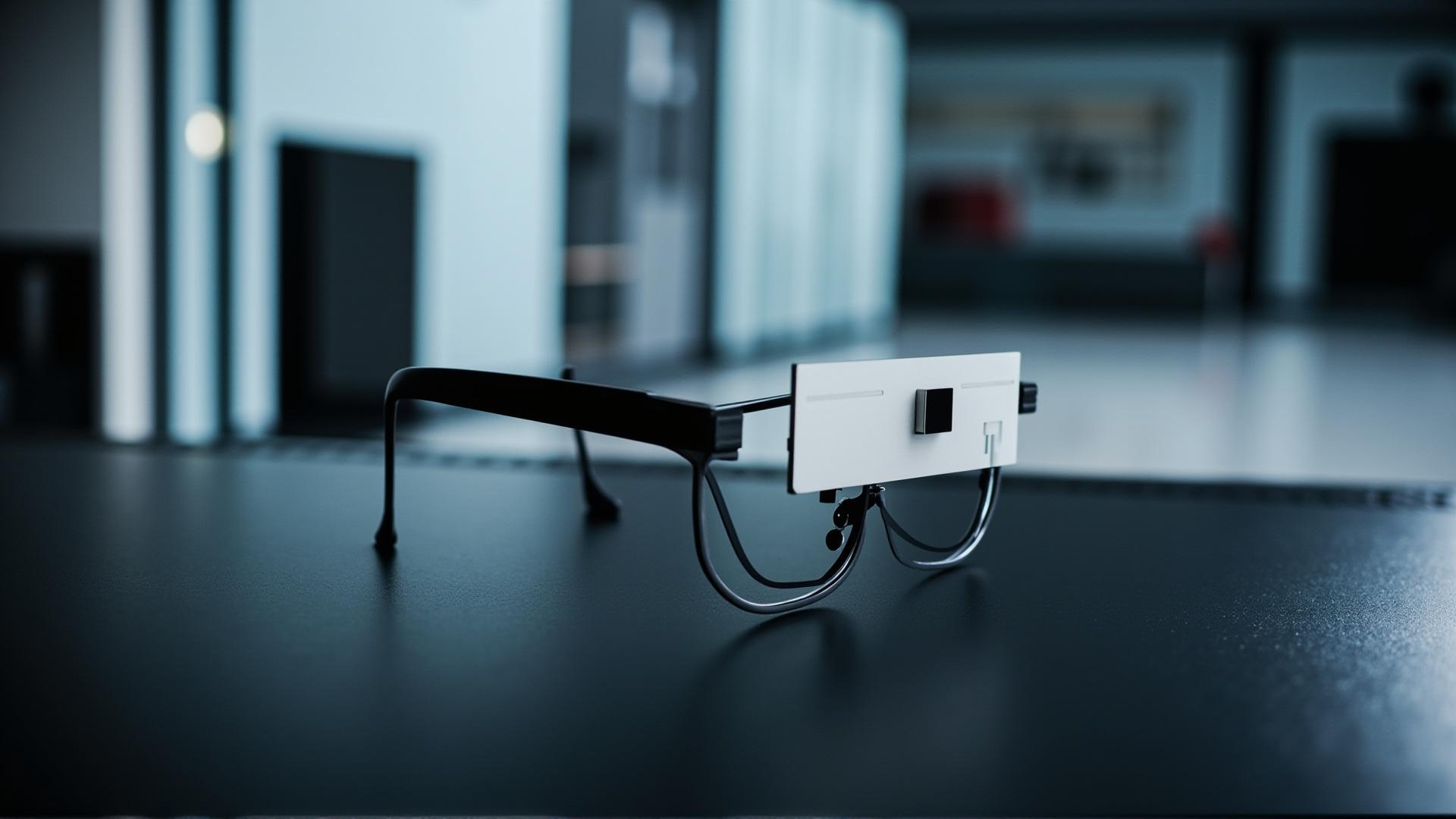
Support is the part of an OEM relationship that nobody negotiates at the start and everybody depends on at the end, and it is also the part that is hardest to judge from a sample, because a sample tells you nothing about how a factory behaves in month nine when a customer reports a unit that will not connect. After sales support and technical support are two different functions with two different owners, and the arrangement between them is what determines whether a fault becomes a dispute or a replacement.
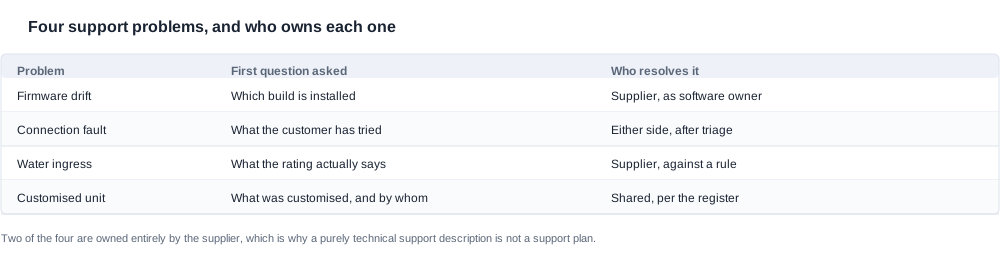
After sales support and technical support: the four problems they must solve
Firmware and software drift. A smart glasses product is hardware running software that keeps changing. A customer reports a problem; the first question is which firmware build they are on and the second is whether that build still exists. A support arrangement in this category should include a release history, a rollback path and a stated policy on how long a build is kept available. A supplier that cannot tell you which builds are still in the field cannot support the units in the field, because it cannot reproduce the condition in which the failure occurred.
Connection and re-connection problems. This is the most common fault and the least interesting to diagnose, because the symptom is identical whether the cause is the firmware, the phone operating system, a stale connection record on the phone, or a genuinely defective unit. The triage question that separates them is what the customer has already tried, and a process that opens by asking that saves days on every claim that was never a hardware fault.
Physical damage and water ingress. Here the honesty requirement is sharper than usual. An ingress rating is a laboratory result on a new unit, and a product rated for splash protection is not a waterproof product. If a customer immerses it, that is not a warranty case, and the support material has to say so plainly before the customer decides otherwise. On our own side, the IP54 marking appears on the V06 and the S7 as a catalogue annotation with no third-party test report number behind it, so we will not write a stronger water statement than the annotation supports.
Customised units. A private-label product with custom firmware, a custom device name and a custom interface cannot be supported by a generic process, because the generic process was written for a product somebody else specified. The arrangement has to be explicit about what was customised, which part of that customisation the supplier owns, and which behaviour the customer configured.
Four problems, four different owners, and only the first two are software. Most support failures in this category come from the third and fourth, which is why a purely technical support description is not a support plan.
It is worth naming a fifth condition that is not a fault at all but behaves like one: a unit that works and a customer who says it does not. This arises most often after a phone change, a new operating system release or a fresh install of the companion application, and it is indistinguishable from a hardware failure by symptom alone. Because the causes are indistinguishable, the only way to separate them is procedural — which is why the reset procedure has to be the first step of any claim path rather than the last resort offered by the support desk.
A sixth condition completes the picture: a batch effect. When the same symptom appears across units sharing a batch or production period, it stops being a support case and becomes a corrective-action case. The supplier's obligation should change shape at that point, because the question is no longer how to fix this customer's unit but how many more units in the field share the cause. Decide in advance what evidence triggers that escalation — typically three or more units with the same cause code within a defined window — and what the supplier will send back. Without a defined trigger, batch effects are discovered by customers rather than by the factory, which is the worst possible way to find out.

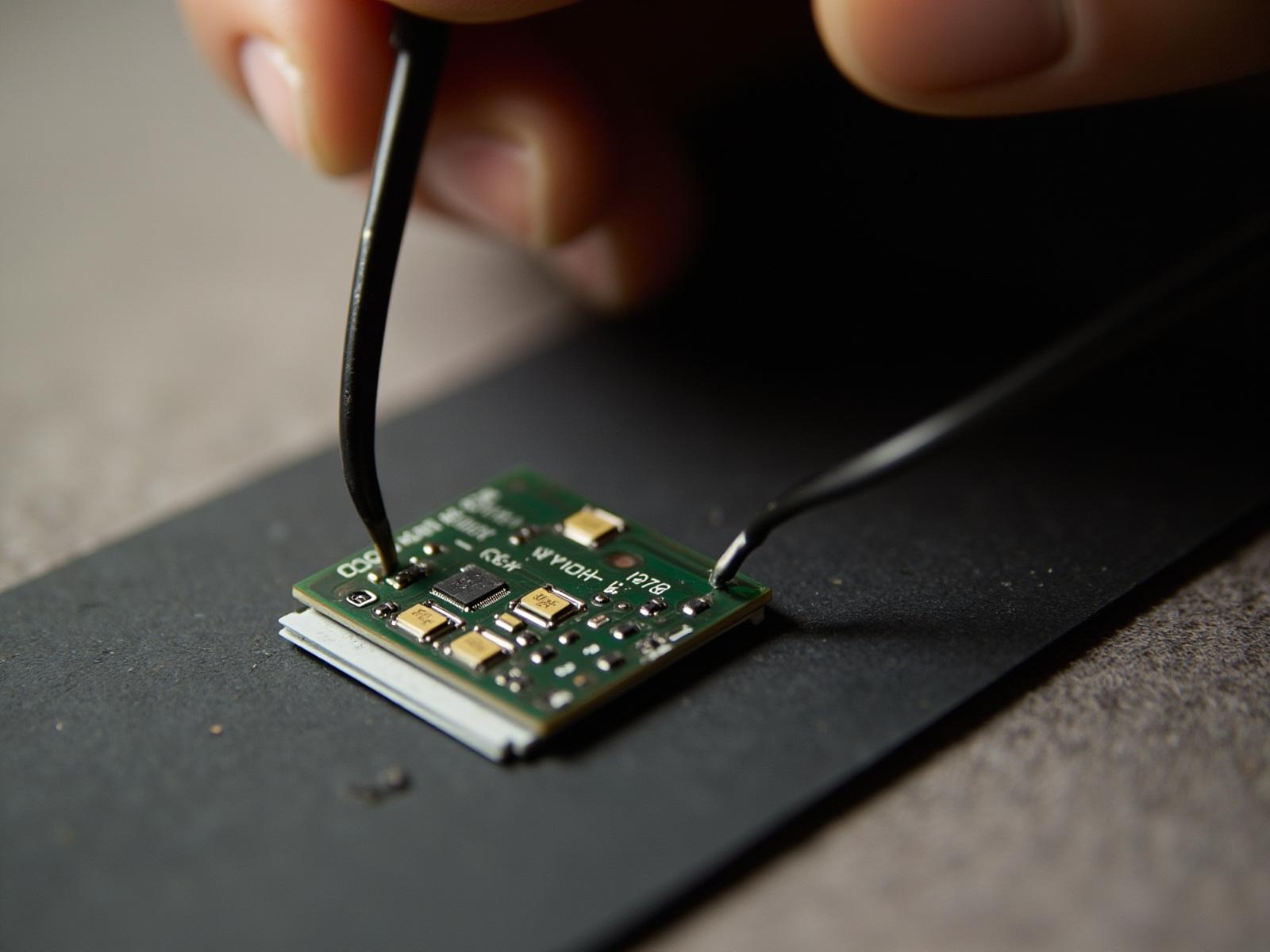
Triage: separating the unit from the environment
The single highest-leverage thing a support arrangement can do is stop the hardware queue absorbing software faults. A simple decision path applied before any unit is authorised for return resolves the majority of claims without a return at all.
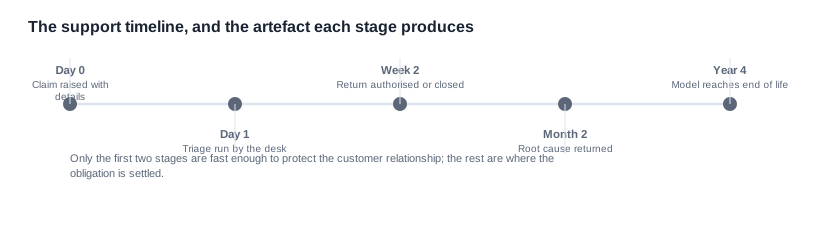
Start with what the customer has already tried, because a customer who has done nothing has told you nothing. Then establish the firmware build and the phone environment, since a changed phone operating system is a frequent trigger on its own. Then reset the connection record, which is a two-minute procedure that eliminates a large share of reported faults. Only after those three steps should a unit be treated as a possible hardware failure, and only then does a return authorisation make sense.
The reason to insist on this order is cost and trust. Each unit returned for a software cause costs freight, handling labour and a customer who now believes the product is unreliable. A support process that authorises returns before triage converts a two-minute fix into a three-week exchange, and it does so in the direction where the customer is least forgiving.
What to ask for is the reset procedure in writing, in the language your support team works in, and confirmation that it is the same procedure the factory's own desk runs. A document that differs from what the factory actually does is worse than no document, because it will be followed by your team and it will fail.
Two further rules make triage stick. The first is that triage results are recorded, even when the result is "no fault found", because a pattern across closed claims is the earliest warning of a batch effect. The second is that the customer is told what was tested, in plain terms, before any return is discussed; a customer who feels the claim was handled procedurally rather than investigated is the one who escalates publicly.
The cost of getting this wrong is measurable even when nobody tracks it. Every return authorised before triage consumes freight in both directions, consumes handling labour at both ends, and produces a replacement unit that then enters your stock as a second-hand item. The saving from a two-minute reset is not primarily financial; it is that the customer keeps working product instead of waiting.
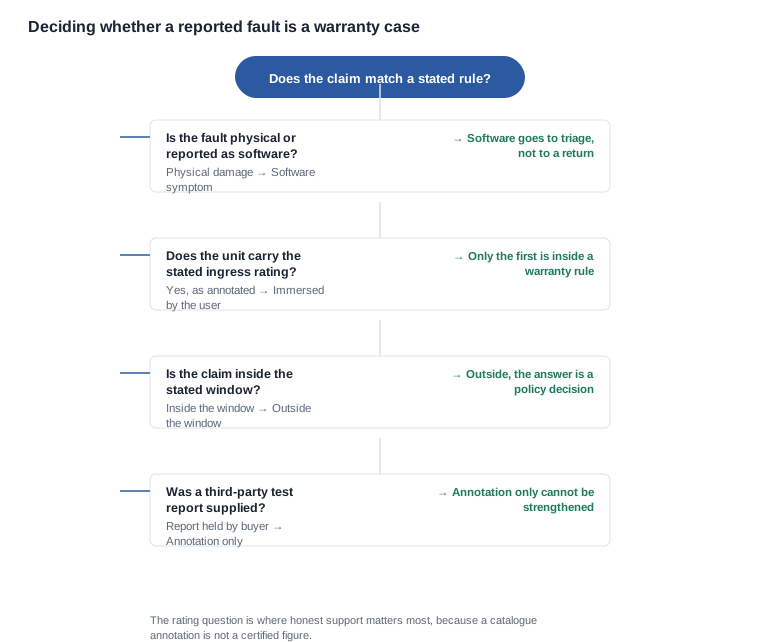
Dividing responsibility so support does not become a dispute
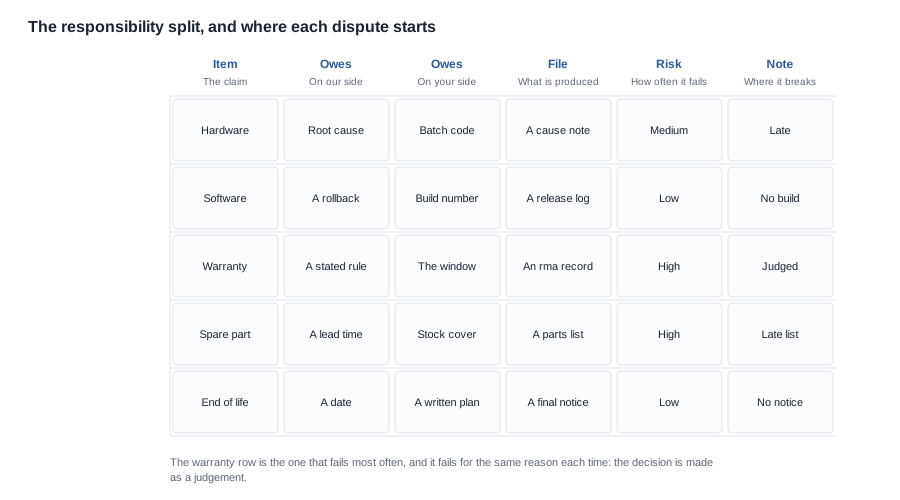
The principle behind a workable split is simple: the supplier owns what the supplier made, and the customer owns what the customer did. Both sides of that sentence need to be written down, because the default in an unsigned arrangement is that everything is yours.
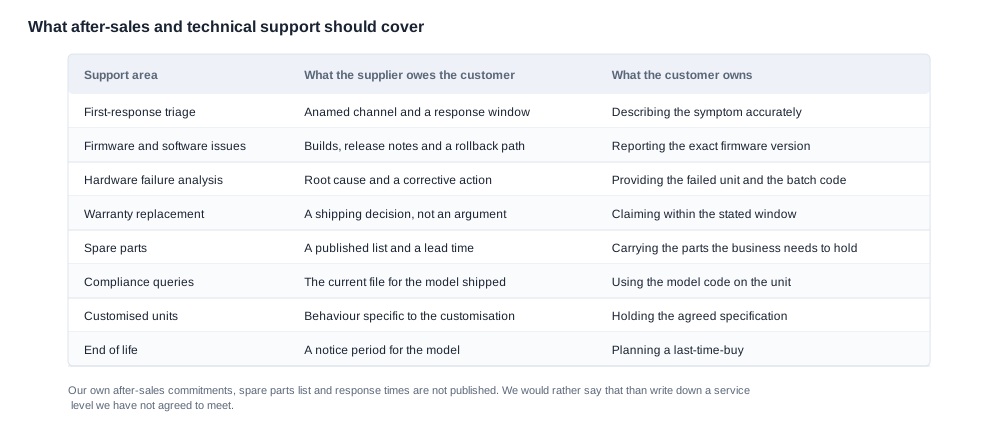
The supplier owes a named contact route, a response window, a root cause on hardware failures rather than only a replacement, a corrective action where a pattern emerges, the current compliance file for the model that shipped, and a notice period when a model goes to end of life.
The customer owes an accurate symptom description in the customer's own words rather than a diagnosis, the exact firmware build, the batch or serial code, photographs where damage is claimed, and a claim raised inside the stated window.
Two rows are where most disputes actually happen. Warranty replacement fails when the process is an argument about whether a case qualifies, and it works when the decision is a shipping decision against a stated rule — the claim is either inside the rule or it is not, and the argument is about the rule rather than about the particular unit. Spare parts fails when a customer discovers after eighteen months that a temple, a nose pad or a charging case is not available, and it works when the parts list and the lead time were published up front and the customer chose to hold stock accordingly.
A third row deserves attention because it is new in customised programmes: who owns a firmware change the customer requested. If a change is implemented and later causes a field issue, the answer depends entirely on whether the change was written down as a customer requirement or as a supplier decision. Both are legitimate; only one of them is discoverable six months later.
A fourth row is the one most arrangements never reach: responsibility for a claim that crosses a border. The unit returns to one address, the decision is made in another, and the customer is in a third, with different expectations about who was told what and when. The arrangement should state which party communicates with the customer during an open claim, because the answer is rarely the party that physically holds the unit.
There is also a cost allocation question hiding inside the split. When a claim is resolved by replacement rather than by repair, the replaced unit has a value and a destination, and the arrangement should say whether it is returned, restocked or destroyed. It is a small line that prevents an argument at scale, because an unreconciled replacement unit is also an unreconciled accounting entry.

What is often left out and should not be
End of life. A product that leaves a current Bluetooth profile behind cannot be supported indefinitely, and a customer who discovers this at the point of failure has no recourse. A notice period, a last-time-buy window and a clear statement of how long firmware will be provided are worth more to a serious buyer than a slightly lower unit price.
The customisation register. Every private-label programme accumulates a set of decisions, and if those decisions live only in somebody's head the product becomes unsupportable the moment that person leaves. A register of what was customised, in which firmware build, against which model code, is a deliverable in its own right and should be handed over with the production documentation.
Knowledge transfer to your own team. A support arrangement that only works when you call the factory stops working when the factory is busy. At minimum your team should be able to identify the firmware build, run the connection reset, and determine whether a fault is hardware or software before it escalates. This is a small amount of training and it is the difference between a five-minute resolution and a five-day escalation.
The escalation contact in your own timezone. A single route that follows the sun is rarely a single route; it is usually one inbox read at the end of someone else's day. Ask how a claim raised late in your working day is actually handled, and get the answer in terms of the working pattern rather than the stated coverage.
The language the support material exists in. Technical support documents are frequently written once in a single language and then translated by whoever is available, which is how a reset procedure quietly becomes wrong. Ask whether the procedure you hold was reviewed by the engineer who wrote it, and whether it has changed since the last revision.
What happens to a claim that is valid but outside the window. This is the case that generates the worst reviews relative to its value, because the customer is right about the defect and wrong about the timing, and both parties know it. Agree in advance whether goodwill replacements happen, who authorises them, and whether they count against any internal claim rate — because if they do, the data you collect will actively discourage you from doing the right thing.

What to ask before you commit
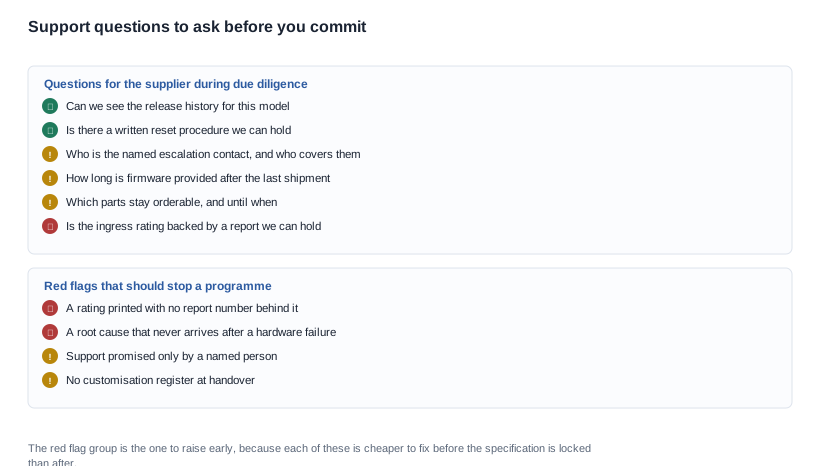
These are the questions that decide whether the arrangement works, and every one of them can be asked during due diligence at no cost.
- Can you see the firmware release history for the model we would buy, including which builds are still downloadable?
- What is the written reset procedure for a connection fault, and does your own desk follow the same one?
- Who is the named escalation contact, what is their working pattern, and who covers their absence?
- What artefact is produced for each claim, and how long is it retained?
- What is the stated ingress rating for the exact model, and is it backed by a test report we can hold?
- How long will firmware be provided after the last shipment, and how much notice will we get before it stops?
- Which parts remain orderable separately, for how long, and at what minimum quantity?
- Will you provide the customisation register for our programme, and when?
The fifth question is the one buyers most often skip and later wish they had asked. A rating printed on a product page is a claim; a test report with a number on it is evidence. Until we publish report numbers, we will say plainly that IP54 on the V06 and the S7 is a catalogue annotation and not a certified figure, and we would rather you knew that before the specification was locked than after a customer immersed a unit.
The eighth question is the one that protects the programme rather than the customer. A customisation register delivered at handover means the product remains supportable when the person who agreed the customisation has moved on; a register delivered only on request means it exists somewhere, if it exists at all. Ask for it as a line in the delivery schedule, not as a favour.
Run the eight in a single call with engineering present rather than with the account manager. Roughly half of them cannot be answered accurately by someone who does not build the product, and the answers that come back from engineering are usually more specific and more conditional than the ones in the quotation — which is exactly the information a buyer needs in order to decide what to put in the contract.
What we can meet today, and what is still open on our side
We would rather tell you plainly that our own after-sales commitments are not yet published than write down a service level we have not agreed to meet. Our documentation does not currently publish a response time, a warranty period, a spare-parts list, a replacement procedure or a return address, and the minimum order quantities, capacity figures and lead times behind all of that remain open internally. A buyer who signs an OEM agreement without those rows has accepted an unknown, and it is an unknown that surfaces at the worst possible moment.
What we can do is tell you which of these areas we can currently support, where the gap is on our side rather than yours, and what has to be closed inside the company before we put numbers in front of a customer. If you need a support structure written into the agreement, say so and we will be explicit about which clauses we can meet today and which we cannot.
The dividing line is consistent. We can commit to the mechanical parts of support — the returns route, the reset procedure, the customisation register, the root-cause feedback on a hardware failure — because those depend on how we run. We will discuss rather than promise in advance anything tied to component availability or to a configuration staying open, because those answers are only meaningful against your actual product and volumes.
That distinction is the same one we draw elsewhere in this category, and it is the reason we would rather have the conversation early.
There is a second honesty point worth making directly. The most common failure we observe in this category is not a refusal to support; it is a support description written by a sales team that describes an organisation nobody has built yet. The words are usually reassuring and the commitments are usually absent, and the gap only becomes visible when a claim arrives in a month when the factory is busy with a larger order.
That is why we prefer to publish less than we could. A shorter commitment that is resourced is worth more to a buyer than a longer one that is not, and it is worth considerably more to a customer whose unit has stopped working. If a supplier's published material reads as a gap, that is a legitimate thing for a buyer to ask about directly during due diligence — and a supplier who cannot answer will have told you something useful before you sign anything.
For the wider structure of this category, the after-sales support pillar sets out the commitments that belong in an agreement rather than in a conversation, and the remaining questions above are best resolved against your own volumes, markets and configuration count rather than in the abstract. For the commitments that belong in the agreement rather than in a call, see after-sales support; for the physical limits that decide a damage case, see IP ratings; for the file you need when a compliance question arrives, see the certification checklist; and for the stage where support problems are cheapest to prevent, see sample evaluation.
Related reading
- Where a claim actually goes, and who authorises it: after sales support returns and RMA.
- The parts that a service operation consumes: after sales support spare parts.
- The channels that have to exist before the first shipment: after sales support channels.
Tell us the volume, the markets and the number of distinct configurations you plan to run, and we will say which support rows we can meet today and which are still open on our side.


