

An RMA process is usually written before launch and exercised after, and the two are usually designed by different people. The version written before launch is a diagram of ideal flow. The version exercised after is a queue of units arriving with the wrong accessories, from the wrong channel, with a description of the fault that could apply to any model in the catalogue. After sales support returns and RMA work is largely a question of whether those two versions were ever reconciled, and the reconciliation has to happen before the first order rather than during the first difficult month.
The parts that matter most are unglamorous: what the RMA number is for, who authorises a return, who pays the freight in each direction, what happens to a unit on arrival, and what record closes the case. Get those five right and the process is close to self-running. Get them wrong and no amount of software fixes it.
The reason this matters more in this product category than in most is the ratio between the cost of a return and the value of the unit. These products are small, the packaging is a meaningful part of the shipped value, and the accessories frequently carry as much of the purchase decision as the electronics do. That means a return is expensive per event, that an incomplete return is expensive per event, and that a process which improves the evidence per return pays for itself faster than it would in a category with a higher unit value.

After sales support returns and RMA: what has to be decided before launch
Seven decisions, all of which are cheaper to make before the first shipment than during the first cluster of claims.
The eligibility rule. What is returnable, under what condition, and for how long after delivery. The rule needs to be stated once and applied consistently, because the alternative is a decision made per case by whoever is available, and that produces a different answer on a Friday from the answer on a Monday.
The evidence requirement. What a claim has to contain before a return is authorised. This is covered in detail in quality claims, and the short form is that a claim without identification and symptom cannot be routed.
The RMA number and what it does. Whether it authorises a return in advance, whether it labels a parcel for internal tracking, or whether it is only a case reference. These are different things with the same label, and confusing them causes most of the friction described below.
The freight direction. Inbound, outbound, or split, and at what rate basis.
The disposition. Analyse and retain, return to the buyer, refurbish, or scrap — and for how long a retained unit is kept.
The data-clear step. A unit going back may still be carrying whatever its last owner recorded. What gets wiped, who does it, and whether the wipe is written down. In a category with a camera this is not a refinement.
The closure record. What is written when the case closes, and where it lives. A case that closes with a credit note and no cause is a cost with no memory.
A ninth item applies specifically to programmes shipping across borders: the customs treatment of a returned unit. A unit returning to the country of manufacture is a different transaction from one returning to a regional hub, and the paperwork required depends on who is the importer of record in each direction. Getting this wrong stalls a return at a broker for days, which is invisible in the supplier's own process and obvious to the customer. The question to ask is simply which party holds the documents the return needs, and the answer is usually the party that arranged the original shipment.
The point of listing them together is that they interact. Freight terms determine whether units come back. Disposition determines whether the units are worth anything. Evidence determines whether the case can be routed at all. Deciding them separately is how programmes end up with a returns process that transports units it cannot use.
There is an eighth decision that is frequently deferred and should not be: what happens to a return that arrives outside the eligibility window. Either it is refused, which requires somebody to refuse it, or it is accepted and worked, which creates an unlimited obligation. The middle position — accept it, work it, and decide afterwards whether it was eligible — is the most common and the most expensive, because it puts a judgement call in front of a warehouse at the moment a unit has already been shipped.

The RMA number and what it is actually for
An RMA number is usually described as a return authorisation, which sounds procedural and is usually operational. Three different things get called an RMA number, and only one of them is a real authorisation.
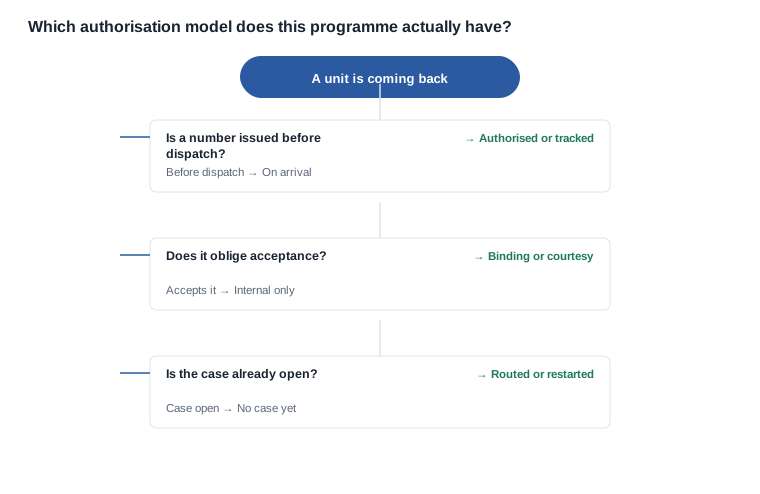
The authorisation model. The number is issued before the unit is sent and the supplier is obliged to accept a unit that arrives carrying it. This is what buyers usually assume they are getting, and it is genuinely useful because it removes the argument about whether a parcel will be accepted.
The tracking model. The number is issued by the buyer for internal reference and does not oblige anybody to accept anything. It is a case reference that happens to look like an authorisation.
The receipt model. The number is issued by the supplier on arrival. Nothing is authorised in advance, and the number exists only once the unit is already in the warehouse.
The consequences are concrete. Under the tracking model, a parcel sent without a number can be refused at the door, and the buyer learns that at the courier rather than at the desk. Under the receipt model, a unit can arrive with no reference at all and be stored indefinitely because nobody can identify the case it belongs to. Both failure modes are common, and both are avoided by one sentence in the agreement stating that the number authorises the return and what happens if it is missing.
The fourth variant, which is uncommon and worth knowing about, is a number issued by the channel rather than by either trading party. It exists in programmes where the retailer runs the return and the factory never sees the customer. It works for speed and it fails for analysis, because the case data stays with the channel unless somebody requires it to be shared. Where that variant is chosen, the agreement should say explicitly that the case data reaches the factory, because otherwise the brand owns the product and has no record of how it fails.
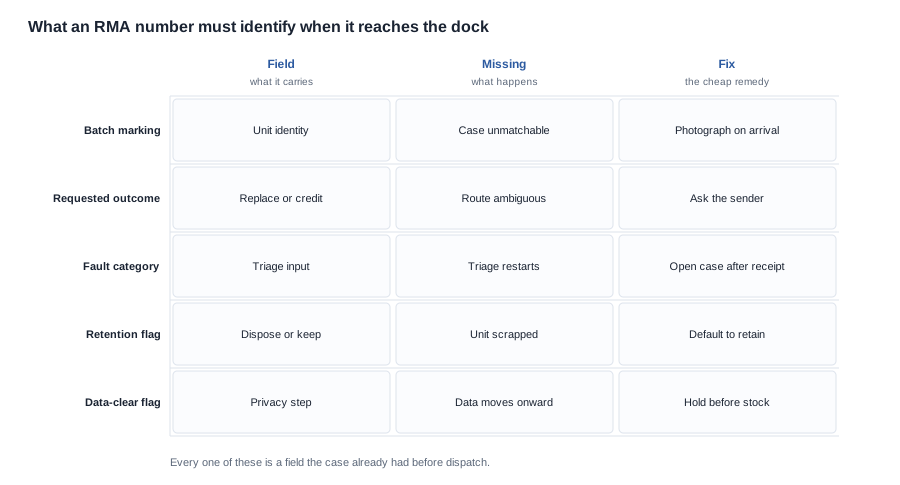
The other half of the number is what it carries. A useful RMA number maps to a case that already contains the identification, the symptom and the requested outcome. A number that only identifies a parcel forces the same conversation again on arrival, which is the single most common reason a returns process feels slower than it should.
That leads to a design choice buyers make more often than they realise: whether the RMA number is issued by the buyer or by the supplier. A buyer-issued number means the buyer has to staff an authorisation function, and it gives the buyer the case data before the unit moves. A supplier-issued number means less buyer administration, and it means the case data arrives with the unit rather than before it. For low volumes in a single market the supplier-issued model is usually simpler. For a multi-channel programme where the same fault arrives from several directions at once, the buyer-issued model is the only one that produces a single dataset, and a single dataset is the precondition for batch analysis.
Authorisation, freight and the disposition of a returned unit
Authorisation should be a rule rather than a judgement. The rule states who may authorise a return, on what evidence, and up to what value. What it should not contain is a discretionary element, because a discretionary authorisation is a commercial conversation performed by whoever is on shift, and the buyer cannot plan against it.
A useful way to write the rule is as a lookup rather than a sentence: an evidence list, and an outcome for each combination of evidence present. That way the person on shift is applying a table instead of interpreting a paragraph, and the interpretation disappears as a source of delay. It also makes the process auditable, because the decision taken can be matched against the table row that produced it. Value limits belong in the same table, since the cases that most often stall are the expensive ones where nobody is sure who may approve.
Freight deserves its own paragraph because the terms are genuinely varied in practice. Four arrangements are common. The supplier pays inbound only, which is the most frequent and the least generous to the buyer. The supplier pays both directions, which is rare and which usually reflects a supplier that wants the units back for analysis. The buyer pays inbound and the supplier pays outbound, which is the one that works best in a warranty case because each party bears the leg it controls. And a shared arrangement at a stated rate, which works if the rate basis is stated and is usually the cheapest to administer.
The trade-off is worth naming because it is rarely discussed explicitly. A buyer that ships returns at its own cost produces a higher volume of marginal returns, because the decision to send a unit back is cheap. A buyer that makes returns expensive gets better evidence per unit and fewer returns overall — which is usually the better outcome, but only if the returns process has been designed to cope with a smaller number of better-documented cases.
Disposition is the term with the longest-lasting consequences. Analyse and retain with a stated period is the option that preserves everything downstream: batch analysis, cause recording, and the possibility of showing a channel partner why a fault is not spreading. Scrap on arrival destroys all three and is the option most likely to be selected by default, because it is the one nobody has to decide.
Retained units have a cost that should be stated rather than discovered. Storage, and the obligation to clear the data on every unit before it can be reworked or destroyed. Where the volume of retained units is significant, a stated period with a defined end state — analysed then destroyed, or analysed then reworked into refurbishment — is much cheaper than open-ended retention, and it removes the privacy exposure that indefinite storage creates.

What to put in the buyer's return workflow
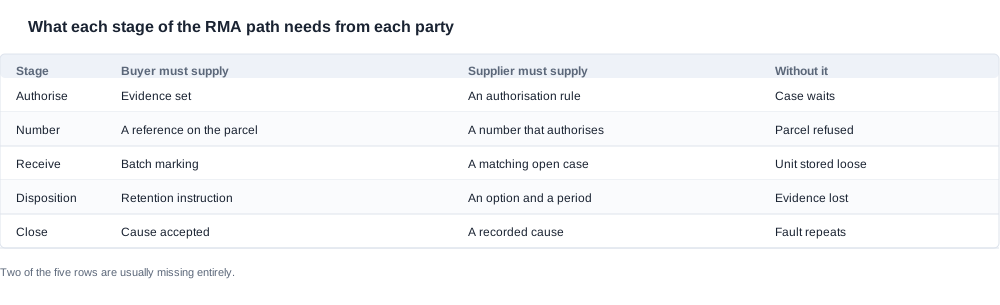
The supplier's process only works if the buyer's side can feed it. Four things belong in the buyer's own workflow, and all four are process rather than capital.
A one-page evidence instruction for whoever receives returns — the counter staff, the distributor's returns desk, or the warehouse. Four fields, a photograph, and an instruction to leave a field blank rather than guess.
A reference on the parcel. The RMA number, printed, on the outside, with the case reference field on the return instruction panel. The packaging side of this is in packaging for returns.
A batch capture step. When a unit comes back, the batch marking is read and recorded against the case. This is the step that determines whether batch analysis is ever possible, and it takes seconds if done at receipt and is impossible if not done at all.
A closure discipline. Nothing closes until the cause field is either filled or explicitly marked inconclusive. Without it, the dataset accumulates a large number of closed cases that say nothing, and every later analysis has to exclude them.
Worth adding to that list, because it costs nothing and removes an entire category of argument: a written statement of what is not a fault. Configuration confusion, a missing accessory, a unit that was never charged, a customer expectation the product description did not set. Those cases belong in the return population and they must be classified, otherwise they dilute the fault signal that the whole process exists to produce.
There is a fifth item that is easy to add and often skipped: a periodic reconciliation between cases opened and units received. A backlog of open cases with no units against them usually means customers who were authorised, never shipped, and stopped replying. That backlog is invisible in most systems and it distorts every count the buyer reports, including the return rate used in channel reviews.
The sixth is a rule for the opposite case: units received against a case that nobody opened. Those are the parcels that arrived with a number that no system recognised, and in a process without a reconciliation step they accumulate as unidentified stock — which is simultaneously an accounting problem, a privacy problem and the loss of the evidence that would have made the case actionable. One query a month catches all of it.

Criteria for judging an RMA process before you commit
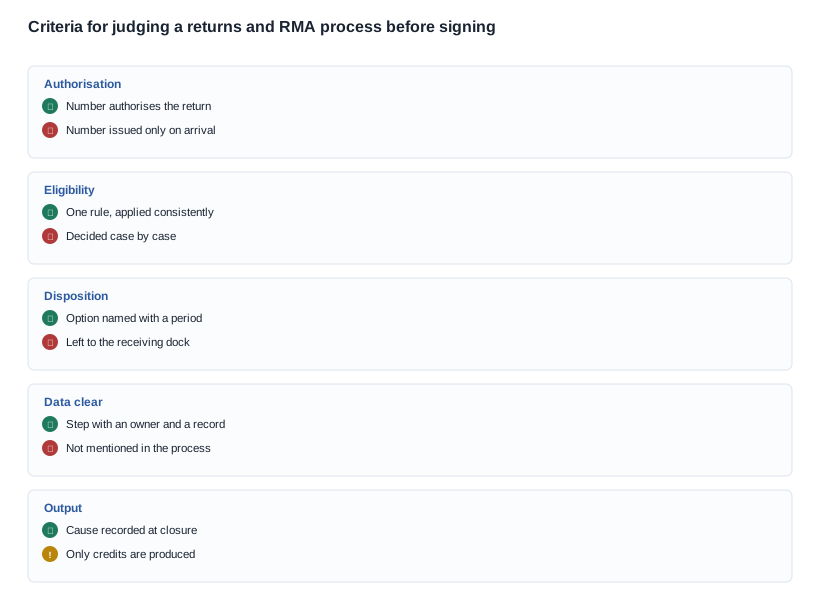
Five criteria, all of them applied to the supplier's answer rather than to their policy document.
Does the number authorise the return in advance, and what happens if it is missing? If the answer does not cover both parts, the freight will be refused at some point.
Is the eligibility rule a rule? Stated once, applied consistently, and not per-case discretionary.
Does the disposition name an option and a period? "As appropriate" is not a disposition.
Is the data-clear step named, with an owner and a record? In this category this is a compliance gap rather than a service preference.
Does the process produce a cause, or only an outcome? A process that can produce only credits is a returns counter.
The two red flags worth naming are both about timing rather than content. A process that starts its obligations when the unit arrives has already conceded the freight leg, which is often the largest single cost in a return. And a process with no stated period for a retained unit has effectively agreed to keep the evidence indefinitely, which is a storage and privacy problem that nobody costed.
A third flag is subtler: an eligibility rule written in terms the supplier cannot verify. "Units in good condition" is not a rule unless somebody defines the condition, because the two sides will disagree about it on the unit that has a scuffed temple and a working battery. Rules written in verifiable terms — a stated period from delivery, a stated set of required accessories, a stated absence of physical damage — are rare, cheap to apply, and remove the argument entirely.
Our published position and what we will write for a programme
The honest way to present this is to separate what we can measure from what has never been established.
No return address is published. No returns freight policy is published. No warranty duration is published. No replacement rate is published. No RMA issue process is published. None of those is a stance we have taken; each is simply a hole in what we hold, and an RMA process printed on a website is a promise a customer can enforce.
The specification gaps fall on the same process. A published weight exists for one model only, the MT6 at 158 g, and the weight of every other model is Not published. Neither the sensor model nor the field of view nor the video specification nor the microphone specification is published. No ingress test report numbers are published for this range. On certification, the catalogue publishes no CE, FCC or RoHS text and no per-model certification row, so the documents behind any model await a written request, and the children's models carry no regulatory position in anything we publish. The catalogue designations are not fully settled. One entry is given as "L2 Utral", with a note that this is a typographical rendering of "Ultra", and another as "Utral Pro Max", for which nothing has been published about its meaning. The light-responsive and bone conduction entries are left without a designation altogether. Software support per model and where the data is stored are Not published, and for an RMA that is a direct question rather than an aside, because it decides what a returned unit has to have cleared before it goes back into stock.
What we will do for a named programme and a named configuration is write the seven decisions into the agreement: eligibility, evidence, the RMA number and its effect, freight direction, disposition with its period, the data-clear step, and the closure record. We will also state which of the seven we can operate today for that configuration and which would need to be built first, and we will say so at the point rather than afterwards.
Send us the channel, the target market, the expected volume and the markets you sell into, and we will produce that as a written proposal against your own returns workflow rather than a generic document.
One thing we will not do is offer the process as a template that transfers between suppliers. An RMA arrangement binds two parties who each have to operate it, and the version that works with a factory that receives units twice a week is not the version that works with a factory that receives them twice a year. What transfers is the structure — eligibility, evidence, authorisation, freight, disposition, data clear, closure — and not the numbers.
Related reading
- The evidence the process needs — quality claims
- The packaging that carries it — packaging for returns
- The clock the process runs on — response times
Send the channel, target market and expected volume and we will write the seven decisions against your own returns workflow.


