

Spare parts are the part of an after-sales agreement that is cheapest to write and most expensive to omit. A factory that has never been asked to supply a part eleven months after a product has shipped will not have a price for it, a lead time, or a process for producing it at all — and a buyer that discovers this during its first warranty crisis has already lost the argument. After sales support spare parts commitments have to be made while the product is still being designed into a programme, which is earlier than most buyers want to think about it.
The list below is the one we would put in front of a buyer before the first order. It is deliberately a list rather than a policy, because the useful output of this conversation is a set of named parts with stated terms, not a document that describes an intention.
The reason the list is longer than most buyers expect is that a spare-parts request is not a single question. It is a request to produce something that has not been produced before, at a volume nobody has forecast, on a date that has already passed. Each of those three problems has its own answer, and a parts commitment that solves only the first of them fails on the other two at exactly the moment the commitment is being relied upon.
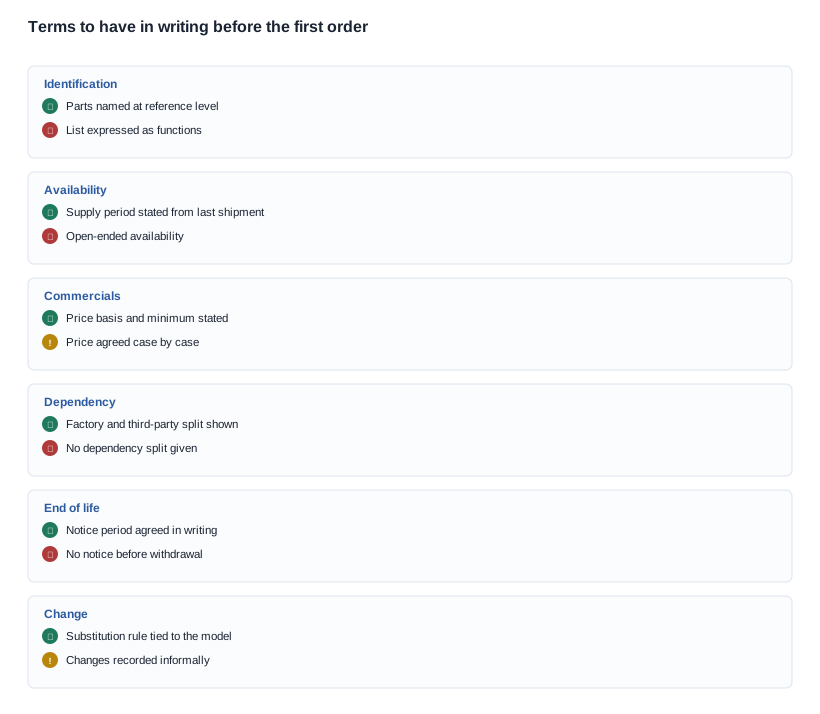
After sales support spare parts: the list to agree before the first order
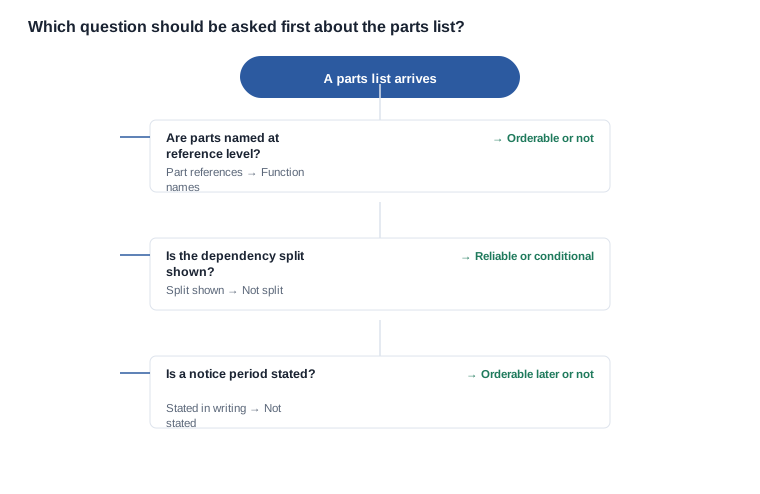
The part names, at part-number level. Not functions. A charging case, a charging cable, a battery cell, a hinge, a temple pad, an ear hook, a port cover, a tray, a quick-start card. Each with a part reference or a drawing reference that somebody can order against. A list expressed as functions cannot be turned into an order.
The supply period. For how long the supplier commits to accept orders for each part. A period measured from the last shipment rather than from a calendar date is the more useful form, because it is tied to something the buyer can observe.
The price basis. Whether the price is fixed, indexed, or a formula, and what it is indexed to. A price basis that is "at prevailing prices" is not a basis.
The minimum quantity. For made-to-order parts this is often larger than the factory's normal run size, which is why it needs to be agreed in advance rather than discovered.
The lead time. Stated separately for stocked parts and for made-to-order parts, because the two differ by an order of magnitude in this category.
The dependency. Which parts the factory controls and which depend on a component supplier outside it. This is the single most useful line in the list, because it tells the buyer which of the commitments can be relied on and which are conditional.
The end-of-life notice. How much notice the supplier will give before a part becomes unavailable. Without a notice period, the parts list is valid only until the next design review.
The substitution rule. What happens when a part changes. A substitution that is not recorded against the model designation silently invalidates the buyer's technical file.
The tooling position. For any moulded part, who owns the tool, where it is, and whether it can be moved to another supplier.
The payment and ownership terms. Incoterms, payment terms, and who takes title. These belong in the same schedule because a parts order that has been agreed commercially and not operationally is the part nobody can expedite.
Two further items are worth adding for programmes that ship into more than one market. Who holds the stock — whether it sits with the factory, with a regional distributor, or with the brand, changes both the lead time and the customs position. And whether spares orders follow the same incoterms as production orders, which is routinely assumed and rarely checked, and which determines who pays the freight on exactly the part everybody is in a hurry to receive.

Which parts are worth holding and which are made to order
Not every part deserves the same treatment, and treating them identically is how a spares programme becomes unaffordable.
Parts worth holding as stock are the ones that fail often, are cheap, and are physically distinct enough to be swapped without judgement. Consumables and wear items belong here — cable, ear tips, pads, and in configurations that have them, the charging case. The test is whether the failure can be identified by the customer without a diagnostic step. If it can, the part will be demanded and should be available; if it cannot, stocking it wastes money.
Parts made to order are the ones that are structural or that fail rarely but expensively — hinge assemblies, port assemblies, main assemblies, anything bonded. These need a price, a lead time and a minimum quantity, and they should not be stocked until the field data says which ones actually fail.
Parts that should never be listed at all are the ones where a replacement changes the product. A substituted cell with different characteristics, a different radio module, or a revised lens assembly are not spare parts; they are new configurations. They belong in a change-control process, not in a spares list, and the reason is that a spare part that is not identical to the original quietly creates a second version of the product in the field.
The cost of getting this wrong is easy to underestimate. A distributor holding a "spare" main assembly that behaves slightly differently from the original will produce returns that cannot be diagnosed, because every unit in the field now has two possible behaviours and only one of them is documented. The symptom presents as an intermittent fault, the investigation is expensive, and the eventual cause is found to be a substitution that was recorded somewhere and communicated nowhere. This is a change-control failure dressed up as a quality problem, and it is why the substitution rule belongs in the parts schedule rather than in a separate process that nobody opens.
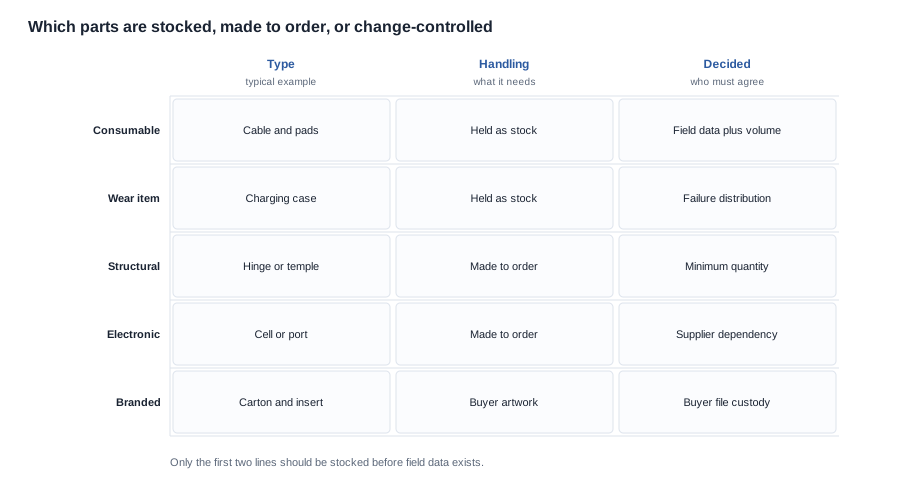
The sequencing matters. A first programme has no field data, so the honest list is short: the consumables, plus a written position on the structural parts. The list should then be extended once at least two quarters of field data exist, and it should be extended by evidence rather than by the volume of requests the support desk happens to receive, which is a different number.
There is a third category that sits between the two above and that a lot of programmes get wrong. Parts that are interchangeable without judgement — an ear tip, a pad, a cable — are not really spare parts at all; they are consumables, and they should be managed as inventory in the buyer's own warehouse rather than ordered from the factory at spares prices. Confusing the two is what produces a distributor holding several months of cable stock bought at a spares price with a lead time attached, when the same cable could have been bought as a standard item in a week. Drawing the line at "does the customer have to make a technical judgement to fit it" is the test, and it puts the cheap interchangeable items on the buyer's side of the line.
Period, price basis and minimum quantity
These three terms carry most of the commercial weight and they are where a vague answer does the most damage.
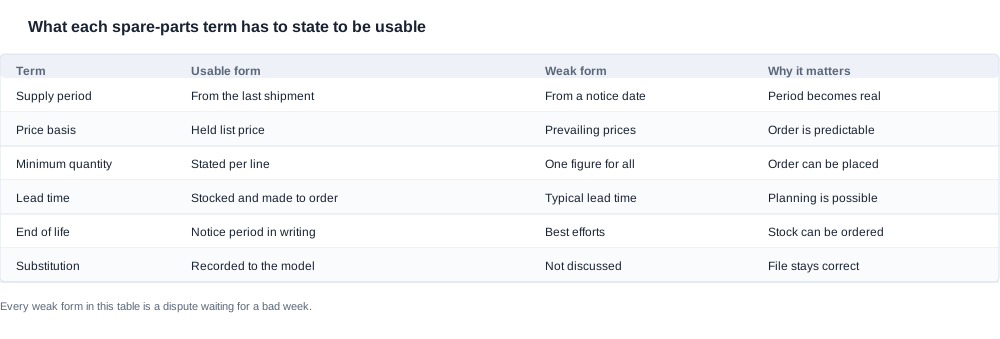
Period. Three forms are common, and only one is useful. A fixed calendar period is easy to state and tells the buyer nothing about whether the part will still exist. A period measured from the last shipment is operationally meaningful and is the form we would recommend. A period measured from the notice of discontinuation is self-fulfilling and is occasionally used to make an end-of-life clause look generous.
Whichever form is chosen, the period should be expressed per part rather than for the programme as a whole. A factory can usually hold a cable indefinitely and a hinge for two years, and a single programme-level period either promises too much on the structural lines or too little on the consumable ones. Splitting the period is one of the few places where a longer commitment on the cheap parts costs the supplier almost nothing and buys the buyer a genuinely dependable position.
Price basis. The practical forms are a fixed list price held for the period, a formula tied to a published index, or a price agreed per order. A fixed list is easiest to administer. A formula is fairer when component prices move. A per-order price is not a commitment at all and should be described as a quotation rather than a spares term.
Minimum quantity. For made-to-order structural parts, the factory's minimum is often a small batch, which is more than a distributor wants to hold and less than the factory wants to produce. The negotiation is genuinely difficult and the terms to push on are the price at the lower quantity and the lead time at the upper one. Where the parts are tooling-dependent, tooling ownership is often the lever that moves the minimum quantity.
The commercial logic on the buyer's side is worth keeping in view: a minimum quantity that is too high turns a spares arrangement into dead stock, and dead stock that is later written off costs more than a higher unit price ever would. Buyers who negotiate hard on price and not at all on minimum frequently pay for both.
A useful discipline for buyers is to ask for the parts list to state, per line, whether the price is held or quoted, whether stock exists, what the minimum is and what the lead time is. A list where every line says the same thing is usually a list that has not been filled in.
The same discipline applies to the reverse direction. Where a buyer expects to return unsold parts at the end of a programme, that has to be negotiated as a terms question — who pays the freight, what condition the stock must be in, and whether packaging artwork is returned with it — because it is a term that is assumed to exist and almost never does. End-of-programme returns are discussed in lifecycle support, and in most programmes the answer is that the stock is written off, which is a cost that belongs in the programme budget rather than in a surprise at the end.

Factory-controlled parts versus third-party parts
The distinction that matters most, and the one most suppliers will make if asked directly rather than obliquely.
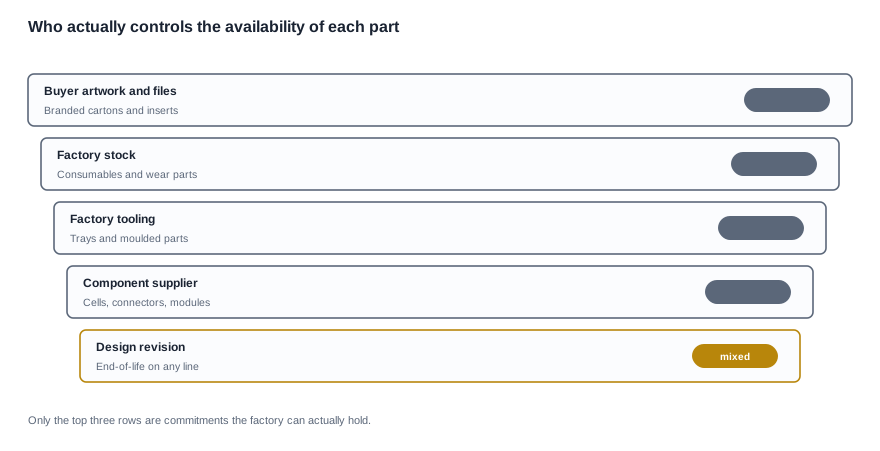
A factory-controlled part is one the factory can produce from its own process, tooling or stock: a tray, a printed card, an ear hook produced on an existing tool, an assembled hinge from parts the factory holds. A commitment on these is a statement of intent plus capacity, and it can usually be relied on for a stated period.
A third-party dependent part is one whose availability depends on a supplier outside the factory: a specific cell, a particular connector, a display or sensor module. A commitment on these is a statement about somebody else's business, and it should be presented as conditional rather than as a term.
The practical consequence is that a buyer who treats a mixed list as uniformly reliable will discover the conditional items first, usually at the worst moment, and will reasonably conclude that the whole list was unreliable. Splitting the list into two columns — factory-controlled and third-party — costs one column of effort and converts a future dispute into an expected condition.
There is a third category that is often forgotten: parts dependent on the buyer's own tooling or artwork. A bespoke carton, a printed insert with the buyer's logo, a branded quick-start card. These are usually held by the factory but are not really factory parts at all, and their availability depends on the buyer's own artwork files surviving. Where a buyer holds artwork with a previous supplier, that is a lifecycle risk in its own right.
The contractual form for the third-party lines is the thing to get right, because a supplier that will not commit to a part usually will commit to a process around it. A written undertaking to notify the buyer of a change of component supplier, with a defined period in which the old part can still be ordered at the old price, gives the buyer most of what a hard commitment would give — enough to plan a run-down — without asking anyone to promise something about a company they do not control. It is the position we would recommend for every conditional line on the list.

Criteria for judging a spare-parts commitment
Five criteria, applied to any supplier's answer including ours.
Does it name parts at reference level? If the answer is expressed as functions, it cannot be ordered and it is not a commitment.
Does it split factory-controlled from third-party? The absence of that split is itself information: either the supplier has not analysed its own dependencies, or it does not want the buyer to see them.
Does it state a period, a price basis and a minimum quantity per line? A single figure covering the whole list is not usable.
Does it include an end-of-life notice period? Without one, the list expires at the next design review, which in this category is usually sooner than the product's commercial life.
Does it say what happens on substitution? A written rule for recording a change against the model designation, rather than a silence.
Two red flags worth naming. A commitment expressed as "subject to component availability", which is not a commitment because every supplier has availability until the order is placed. And a spares list issued only on request by the distributor rather than as part of the agreement, which means it was written for one buyer rather than for the product, and will not survive a change of distributor.
A third, quieter flag is a parts list that stops at the end of the warranty period. It is not wrong — a supplier has no obligation beyond it — but it is a signal about how the supplier thinks about the product's life, and a buyer that expects the unit to be in the field for five years should note it. The same supplier will often extend the period for a stocked part at no cost, because the cost of stocking a cable is much smaller than the cost of a distributor losing a customer over one.
Our published position and what we will state for a programme
A spares position is easier to build on what is settled, so here is what is settled and what is not.
Our spare-parts programme is not published. Our parts list is not published. Our spares pricing is not published. Our spares lead times are not published. Our warranty duration is not published. Each of those reflects information we do not have rather than a decision to keep it back, and a parts price printed on a website becomes a commitment a customer can hold us to in three years' time.
The specification gaps narrow the spares answer as well. A frame weight is published for one model in the catalogue, the MT6 at 158 g, and Not published for the others. There is no published sensor model, no published field of view, no published video specification and no published microphone specification. No ingress test report numbers appear anywhere in the catalogue. No CE, FCC or RoHS reference appears in the catalogue text and there is no per-model certification row, with the certificate references not yet confirmed, and the children's models carry no regulatory entry in our published position. The designations are not settled either: an entry is listed as "L2 Utral" and the catalogue notes that this is a typographical rendering of "Ultra", a further entry appears as "Utral Pro Max" and carries no published meaning, and the light-responsive and bone conduction entries carry no designation at all. A parts list built on an unstable model designation is a list nobody can order against, which is why the designation question comes first.
Two further rows are Not published: which models run which software, and where the data is held. For a spares buyer that is not an IT detail. A replacement main assembly that turns up without a defined firmware position is not a spare part at all — it is an integration task wearing a part number.
What we will do for a named configuration is produce a written parts schedule with the fields this article recommends: part reference, supply period measured from the last shipment, price basis, minimum quantity, lead time, factory-controlled or third-party, end-of-life notice period, and the substitution rule. We will mark the lines we can commit to for a stated period and the lines that depend on a component supplier outside the factory, and we will tell you which of the two a given configuration produces more of.
Send us the model, the configuration, the expected lifecycle and the volume profile, and we will produce that schedule as a document rather than a description.
One thing we will ask you for in return, because it materially changes what the schedule can say: the expected programme length and whether the brand intends to continue past the first configuration. A schedule written for a twelve-month programme and one written for a five-year programme differ in almost every field, and the difference is a legitimate input rather than a negotiation tactic.
Related reading
- What the parts are for — repair options
- What happens when a part is not available — lifecycle support
- Who receives the returned unit — returns and RMA
Send the model, configuration, expected lifecycle and volume profile and we will produce a parts schedule.


