
A buyer's first questions about AR glasses display technology are almost always the same six, and they are worth answering in one line each before the detail starts. This article does that, and then does the part that the one-line answers cannot: it sets out the order in which those six questions should actually be asked, and what to do when the answer to the first one is that you are not buying an AR device from this supplier at all.
The reader is a brand-side product or sourcing manager, a channel buyer or an e-commerce selection team. What they are managing is a decision that is expensive to reverse: the display is a hardware commitment taken at the tooling stage, and the questions that determine whether it is the right commitment are the ones that usually arrive after the tooling has been paid for.
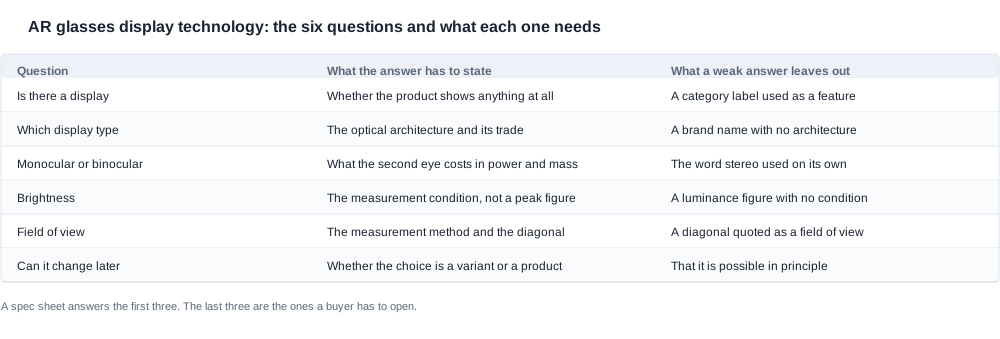
The six questions are these: is there a display at all; what type of display is used; monocular or binocular; how bright is it; what is the field of view; and can the display be changed later. The first three are answered by a product description. The last three are answered by a supplier, and the answers to them are the ones that determine whether a specification is realistic.
AR glasses display technology: the six questions and the order they belong in
Is there a display, and what is published about it
In our published range, no. We publish an AR category, and we publish no AR functionality for it — no display, no field of view, no resolution and no waveguide. The published rows are Bluetooth V5.4, a 100 mAh cell, charging at two hours or less, a runtime of about eight hours, magnetic charging, and an indicator light and button control.
That answer is the most useful thing this article can give a buyer, because it is a category label being used as a feature. A product published under an AR heading with no display rows is not an augmented reality device with a weak display; it is a connected audio product with a heading that creates an expectation. A buyer who knows the difference will not lose a week to an evaluation that was never going to succeed.
It is worth being equally clear about the rest of the range. We publish eleven camera models, of which eight are published at 8 MP and three at 13 MP; three sport models and eight audio models. The camera range is where the imaging capability sits, and the AR category in our catalogue is not a display product. We would rather say that plainly than let a heading do the selling.
What type of display is used
A microdisplay — an LCoS, OLED or similar small panel — with an optical element that delivers the image to the eye. The panel is a solved problem in the sense that the components exist; the difficult part is everything between it and the eye. The AR display types discussion covers the architectures.
The distinction that matters for a buyer is between the panel and the optical assembly. The panel is a catalogue component that can be substituted between suppliers; the optical assembly is the part that determines brightness, field of view, colour behaviour, thickness and weight, and it is the part that is specific to the product and expensive to change. A supplier's answer that names only the panel type has answered the easy half of the question.
Monocular or binocular, and what the second eye costs
Both exist, and both cost power, weight and social acceptance. One eye covered and one clear is cheaper and lighter; two eyes covered give real stereoscopic depth and read as a headset to the people around the user.
The trade is more than optical. A monocular device is usually a lighter, narrower product that people put on and keep on, which is what makes it commercially viable in most first applications. A binocular device is a different product category with a different price structure, a different channel, and a different regulatory treatment for the near-field optical output. A buyer who treats them as one decision is usually comparing two products that have different unit economics.
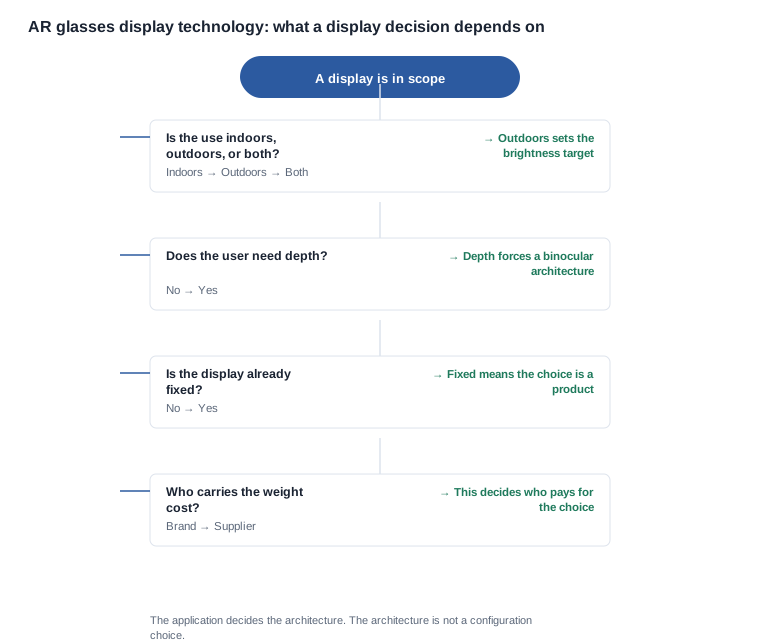
The decision tree above is the version to work through with the supplier. Four questions, and each of them removes an option: the use environment sets the brightness target, the need for depth forces an architecture, the tooling status decides whether the choice is a product or a variant, and the allocation of the weight cost decides who is actually paying for the decision.

Brightness and field of view: the two numbers that are not comparable
These two parameters decide whether the product works, and they are the two most commonly quoted in a way that cannot be checked.
Brightness. It is the parameter that decides whether the product works outdoors, and it is the one a spec sheet most often leaves out or quotes without conditions. Optical efficiency, the display's own brightness and the ambient light all combine, and a device usable indoors can be unusable in sunlight. A figure quoted without an angle of incidence, without a transmittance and without an ambient condition is not comparable with anything else, including another figure from the same supplier.
Field of view. It is the number that decides the application, because a narrow field of view is a small canvas and a wide one is a distorted, low-resolution one. And it is only comparable between products if the measurement method is the same — diagonal or horizontal, and at which reference point on the optical assembly.
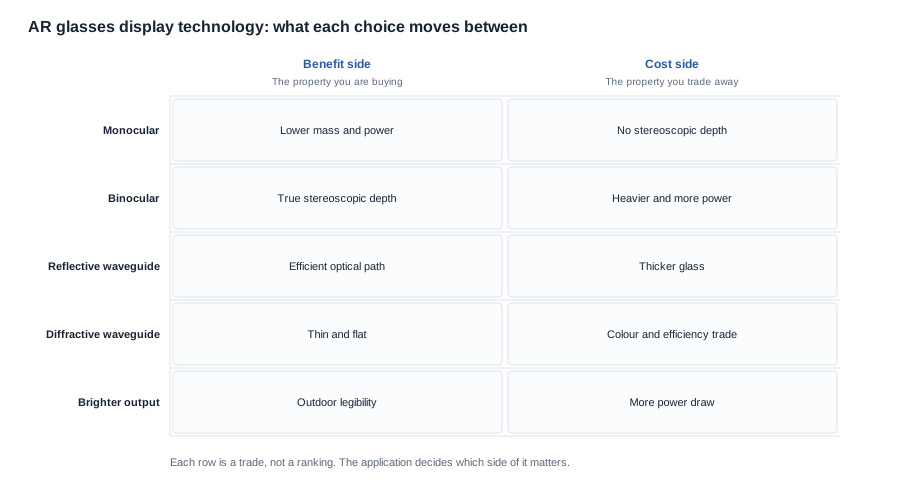
The matrix is the honest summary of the whole category. Every row is a trade rather than a ranking: monocular against binocular, reflective against diffractive waveguide, brighter against longer runtime. The buyer who asks for the best value in each column independently will get an incoherent product, because the columns are not independent of each other — brighter output consumes power, and a wider field of view costs effective resolution.
Two practical rules follow. First, ask for both numbers with their measurement conditions, and treat a supplier who cannot supply the conditions as unable to supply the numbers. Second, compare products against the condition the product will actually be used in, not against a laboratory condition. If the deployment is outdoors in daylight, the brightness figure that matters is the one at a stated angle with a stated ambient level, and a device that meets an indoor figure is not a device that meets that one.
Three ways a display specification is quietly wrong
There are three recurring forms of a specification that reads correctly and cannot be built, and all three are worth checking for before a sample is ordered.
The number describes a component rather than a product. A brightness figure taken at the panel, or a field of view taken at the waveguide, describes something real — and it is not the product. The product figure is lower, sometimes considerably lower, because the assembly between the two loses light and because the reference point for the field of view moves. A buyer comparing a component figure with a product figure will conclude that the product is better than it is, and will discover the difference at the sample.
The number assumes a condition the deployment does not have. Efficiency quoted at normal incidence is optimistic against a curved surface, and the error grows with the angle the user happens to be at. The relevant question is not what the specification says but what the specification holds at the edge of the use case.
The number is precise because it is measured on a different product. A supplier who has two closely related devices may quote the better one's figure. The way to catch this is to require the measurement to be stated against the configuration being quoted, and to require a sample of that configuration rather than of a demonstrator.
None of these is a matter of bad faith. They are the ordinary consequence of a category where the figures are quoted between suppliers who are not quoting the same product. The check is a question, and it is the same question in all three cases: measured on what, in what configuration, under what condition?
There is a related trap in comparing a display against the rest of the category. A camera product with no display can be compared with another camera product on the published rows. A product with a display can only be compared with a product that has a display, and that comparison is not possible from a catalogue at all, because display rows are the rows catalogues do not publish.
How to qualify a display before the tooling is paid for
Because the display assembly is a hardware decision rather than a configuration, the qualification has to happen before the design is frozen. This is the practical answer to the sixth question, and it is worth doing in a fixed order.

The order matters because each step constrains the next. Writing the application and the lighting conditions first prevents a specification being written around a component that was chosen first. Asking for the optical architecture rather than the display brand prevents the substitution of a panel that is cheaper and optically incompatible with the assembly it sits in. Asking how brightness and field of view are measured prevents the comparison of two numbers that describe different things. And asking what changes if the display is swapped at the next revision produces the commercial answer to the sixth question, which is generally that the swap is a new product.
The five parameters a display quotation has to contain
A display quotation is usually short, and it is usually short because the parameters that matter were not asked for. What to request:
- The optical architecture, not only the display panel — including the waveguide or other optical element and the reference configuration.
- Brightness, with the measurement condition stated: the angle, the ambient level, and what the figure describes.
- Field of view, with the measurement method and the diagonal or axis it is taken on.
- The eyebox, and the tolerance across it — the usable region rather than a single figure.
- Stray light, with the unit and the measurement angle, because it is reported in different units by different suppliers and is not comparable without them.
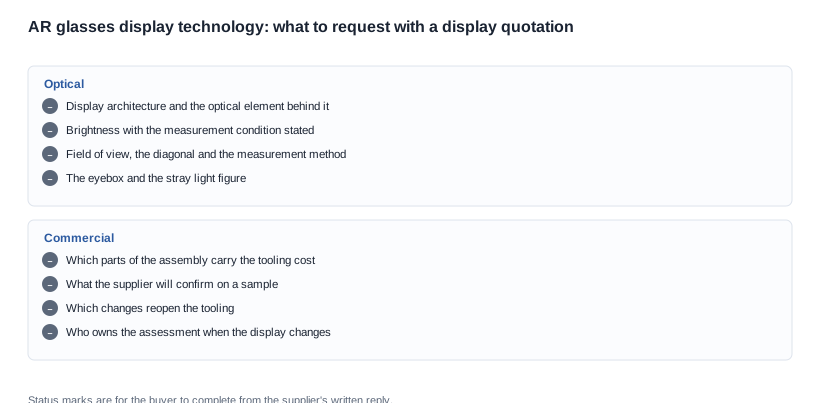
The commercial half of the request matters as much as the optical half. Which parts of the assembly carry the tooling cost. Which changes reopen the tooling. What the supplier will confirm on a sample. Who owns the assessment when the display changes. These are the questions that determine whether the specification you are writing can be built twice or only once, and they are the ones that a quote will not answer unless they are asked.
The verification step that closes the loop is a sample under the real lighting condition, not a sample on a bench in an office. The corner of the image, the transition between the display area and the surroundings, and the behaviour at the edge of the eyebox are all things that only appear when the device is used where it will be used. A supplier that will commit to those measurements on a sample, with the conditions written into the commitment, is a supplier whose quotation can be relied on.
What to ask a supplier when the answer is a sample
A display is the part of this category most often sold on a sample rather than on a specification, because a specification requires an architecture and a sample can be produced on an existing optical design. That is a reasonable commercial arrangement for a first order, and it is also the arrangement in which the trade-offs below have to be managed deliberately.
The criteria for judging a sample-based answer are simple. What the supplier will commit to in writing, on the sample, before you order. What they will not commit to. And what it would cost, in tooling and in assessment, to move from the sample configuration to the one you actually want.
What to ask, in this order:
- Which parameters are fixed on the sample and which are dependent on a later build. A supplier that has a fixed optical design and a variable final assembly has a real trade-off to price; one that has neither is working from a brochure.
- What the sample demonstrates and what it does not. A demonstrator may be a different configuration from the production unit, and the differences are rarely on the label.
- What would have to change to reach your specified brightness or field of view. The answer is the real content of the quotation, and it usually arrives as a list of items rather than as a number.
- What the tooling cost is, and which changes reopen it. The tooling line in a quotation is the part that makes the display a product decision rather than a component decision.
- Who owns the assessment if the display changes, and what reopens it. This is the question that connects the optical decision to the compliance work, because a change of display is a change of configuration.
The red flags in a sample-based quotation are few and they are all the same shape. A sample with no written parameter list. A supplier that will not say what the sample is not. A tooling figure with no scope attached. And a quotation that treats the display as a configuration, which means it has not priced the possibility that you will want to change it.
The trade-offs a buyer is managing here are not only technical. A sample-based route is faster to start and slower to change, which suits a programme that has not yet settled its application and does not suit one that has. Which of those you are is a decision about the programme, not about the supplier, and it is the decision that the six questions are really asking.

Why the display decision belongs at the end of the programme
What is the product for? The six questions above are the ones buyers ask, and the answer to all of them is determined by the application: a navigation aid, an industrial overlay, a training simulator, a translation aid and a camera product are five different devices, and the display architecture is the last decision rather than the first.
This is the part that a buyer reversing the sequence usually gets wrong. The order in which most programmes approach the display question — look at what is available, pick the cheapest that meets the headline brightness, and then design the application around it — produces a product whose application is constrained by the component rather than by the need. The product is then hard to differentiate, hard to price and hard to change.
The order that works is the reverse: the application and the environment, then the constraint that actually binds — brightness outdoors, depth for the task, thickness for the channel, or the absence of any display requirement at all — and only then the architecture. Most first projects in this category discover at the last step that they did not need a display, and that discovery is far cheaper at the specification stage than at the tooling stage.
The waveguide types article covers what the spec sheet omits about each optical approach, and the AR glasses explained article covers the position of the display-free architectures honestly.
What we publish, and what a buyer has to settle with a supplier
We will describe what our catalogue holds, that we will not imply a display capability we have not specified, and we will not print a field of view, a brightness or an efficiency figure that we do not hold. Our catalogue publishes no display rows at all, and where a product in our range has a photochromic lens configuration rather than a display — the V03 Pro is the camera model published with that lens configuration — the published rows say so.
That discipline is also the practical advice to a buyer, and it is the reason to treat an unquantified supplier answer as a reason to ask rather than as a reason to stop. In this category the total cost of a display decision is dominated by what has to be changed later — the tooling, the assessment and the documentation — and a supplier who will not put a number on those is asking the buyer to carry them without a price. The cheapest display in the category is not the one with the lowest quotation; it is the one whose commitment, measurement condition and change cost are all written down before the order.
What a buyer should take from this article is that the sixth question — whether the display can be changed later — is the one that turns a display decision into a product commitment, and it is worth answering before the design work rather than after it. The second is that the three numbers that decide whether the product works — brightness, field of view and the application — are only meaningful together, and a supplier willing to quote any one of them alone is telling you something about how the rest of the specification will go.
Related reading
- The category position — AR glasses explained
- The architectures — AR display types
- The optical trade-offs — AR glasses waveguide types
- The parameters and their measurement — AR display types
Tell me the application and the environment, and I will tell you which of the six questions has a published answer and which have to be settled with a supplier directly.


