
AR glasses display technology is the one part of a connected-unit quotation that cannot be evaluated on the numbers it arrives with. A supplier's sheet will list field of view, brightness, resolution and latency, and each of those figures can be entirely honest and still be useless, because the sheet does not say what condition the number was measured under. Two quotations can disagree by a factor of two on brightness and both be correct, if one figure was taken in a dark room and the other in daylight at an angle. The procurement consequence is direct: until every figure is attached to its condition, you are not comparing products, you are comparing measurement habits. This article sets out the display figures that routinely arrive without their conditions, what each one has to state, and how to get the missing information in writing before a deposit is paid.
AR glasses display technology: why two honest spec sheets can disagree
The short answer on AR glasses display technology
The figures that arrive unqualified are always the same five: brightness, field of view, resolution, latency and colour gamut. Each one is a valid measurement of something, and each one changes meaning when the geometry, the ambient light, the eye position or the method behind it changes. A brightness figure measured at the panel and a brightness figure measured at the eye are not two estimates of the same quantity; they are two different quantities that happen to share a unit. A field of view quoted as a diagonal and a field of view quoted as horizontal cannot be compared, and a latency figure that describes the display module rather than the motion seen by the operator cannot be used to judge whether an interface feels responsive.
The rule that follows from this is short enough to put in a purchase order: no display figure is accepted without the condition it was measured under. Brightness needs the ambient light and the angle. Field of view needs the geometry and the eye position. Resolution needs to say whether it is a panel figure or a figure delivered at the eye. Latency needs the method. Colour needs the temperature. Where a supplier cannot state the condition, the figure does not enter your comparison sheet at all — it is recorded as missing, which is a different thing from being recorded as bad.
Who is reading this, and what this article asks of them
The reader here is a procurement manager or a product lead who is already holding two or more quotations for an AR-capable unit, or who is opening a new programme and has to decide what goes into the specification before anyone quotes. The decision underneath is never the technical one. It is whether the product that arrives will do the job the product manager was shown in the demonstration, and whether the unit that ships is the unit that was evaluated. The AR display types page sets out the families; what follows is about the paperwork that surrounds them.
What such a reader is managing is not a specification gap. It is exposure. A display figure that cannot be reproduced is a figure that can turn into a returns argument at the end of a season, a re-quotation after tooling has been paid for, or a second sourcing round that costs more than the original order. The most expensive version of this is not the wrong product; it is a product that performs to the figure the supplier quoted and to nothing else, because the figure was a demonstration condition rather than a working condition.
That is why this article is organised around conditions rather than around technologies. Knowing that a waveguide is diffractive or that a display is reflective does not tell you whether two quotes are comparable. The waveguide types page handles the optical families. The decision you need to make is narrower and more mechanical: what condition is attached to each figure, and who signs it.
The commercial backdrop behind a display programme
The reason display figures arrive unqualified is structural, not careless. An optical programme at a supplier is organised around a display module that was qualified against one customer's requirement, in one environment, for one use. The figure that reaches you is that module's figure. When the module is re-used across customers, the condition is lost in the middle — the module supplier measured under one set of assumptions, the product supplier quotes the resulting number without the assumptions attached, and the buyer receives a bare figure.
This is also why two quotations can differ in price by a wide margin and both be defensible. The cheaper one may be using a module qualified for indoor use, while the more expensive one is quoting a figure measured against a daylight specification. The numbers read as comparable on the sheet, so the price gap reads as margin rather than as a specification difference. Unwinding it takes one round of questions and a comparison sheet with a condition column, which is a very small amount of work against the cost of shipping the wrong product into a channel.
A second structural feature deserves attention because it affects how the price will move. The coupler and the display panel are the parts of an AR device with the longest lead times, and they are usually the parts a buyer has the least visibility of. A programme that depends on one coupler has a cost ceiling that the supplier does not control and you do not control either. That is why the waveguide question set, covered in what to ask a supplier about waveguide types, belongs in the same conversation as the display figures rather than after them.
The third feature is the point at which the numbers are written down. If a figure is captured in a comparison sheet at quotation stage with its condition attached, the argument ends there. If it is captured without the condition, the argument moves forward into the sample stage, into the pilot stage, and eventually into the returns stage, where it is far more expensive for both sides. The cost of a condition column is close to nothing. The cost of finding out later is the whole programme.
The conditions that make an AR glasses display technology figure comparable
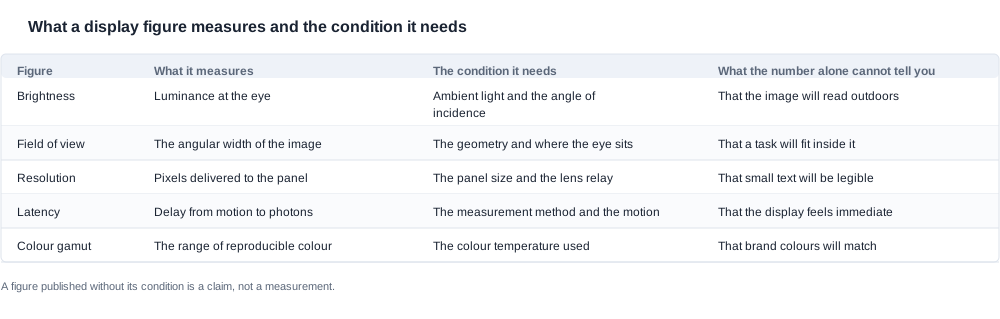
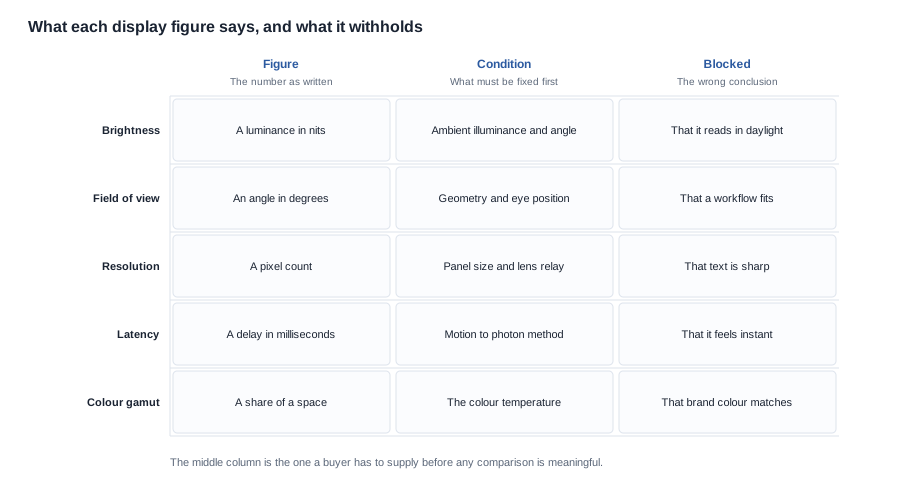
The table below is the core of the comparison. Each row names a figure that appears on a quotation, the condition that figure depends on, and the inference a buyer is entitled to block when the condition is missing. The last column is the point of the table: it is the mistake the bare figure invites.
| Figure | What it measures | The condition it needs | What the number alone cannot tell you |
|---|---|---|---|
| Brightness | Luminance at the eye | Ambient light and the angle of incidence | That the image will read outdoors |
| Field of view | The angular width of the image | The geometry and where the eye sits | That a task will sit inside it |
| Resolution | Pixels delivered to the panel | The panel size and the lens relay | That small text will be legible |
| Latency | Delay from motion to photons | The measurement method and the motion | That the display feels immediate |
| Colour gamut | The range of reproducible colour | The colour temperature used | That brand colours will match |
Read down the third column and you will notice that every condition is a physical fact about a test setup, not a request for proprietary information. Asking for the ambient illuminance and the angle does not require the supplier to open a file; it requires them to tell you what they did. That is the difference between a question that gets answered and a request that gets declined.
Condition one: the optical path the brightness was measured through
Brightness is the figure most often quoted and least often qualified, because the unit is familiar and the number appears objective. Three distinct quantities travel under the name "brightness" in AR equipment, and they differ by a large factor. There is the luminance of the light source, which is a property of the panel. There is the luminance at the eye, which is what the operator actually receives after the coupler has taken its share. There is the luminous output of the whole device, which is sometimes quoted in lumens instead of nits, and which carries the coupling efficiency inside the number.
The condition that has to accompany the figure is therefore not just the ambient light but the position in the optical chain. A figure quoted at the panel tells you nothing about what reaches the eye. The gap is not academic: coupler efficiency is one of the reasons two suppliers can quote brightness figures that differ by half while both describing a device that works.
The second half of the condition is the ambient light, and this is where a good comparison sheet earns its keep. A luminance quoted without ambient light may have been taken in a darkened laboratory, which is the friendliest possible condition and close to useless for a product sold for outdoor use. The useful answer states the ambient illuminance in lux, the angle at which the ambient source was placed relative to the operator, and whether the figure is a peak, an average across the field, or a figure at the centre only. Peak figures in particular are used more often than they are deserved: a bright spot at the centre of a wide field says very little about what a person sees when they turn to the side.
There is a third question worth asking, and it is about the number rather than the condition: whether the figure is a specification the supplier will warrant, or a measurement they performed for the demonstration. A specification is something that appears on the paperwork and can be called back. A measurement is something that happened once. The wording of the quotation usually distinguishes the two, and the distinction is worth more than the number itself.
Condition two: the geometry behind the field of view figure
Field of view is where buyer shorthand does the most damage, because the same word is used for several different measurements. Horizontal, vertical and diagonal fields of view are all quoted, and they are not interchangeable; a diagonal figure is larger than either of the others for the same device. Suppliers also quote the field of view of the display alone, the field of view of the display through the coupler, and the field of view of the complete assembly including the housing, and the three can differ considerably.
The condition that makes the figure meaningful is geometry. Is the figure quoted for one eye or for both? The monocular versus binocular distinction matters here, because a binocular product quoting a monocular field of view is describing half of the image area, and a buyer who reads it as the full figure will discover the discrepancy in a design review rather than in a quotation. Is the figure the total angular extent, or the area where the image is usable? Is the housing, the temple or the frame included in the measurement? And at what working distance is the eye expected to sit?
The eye position question is the one that is usually missing entirely, and it is the one with the longest consequences. A wide angular field means nothing if the usable region — the eyebox — is small, because the operator has to hold the head in a particular position to see the image. Suppliers who publish an eyebox or an eye-relief dimension are giving you the number that tells you whether a range of head shapes can use the product at all. Where that dimension is absent, the honest description of the product is that it may require a specific posture, and that requirement belongs in the instructions for use rather than in a datasheet.
The comparison is not difficult once the geometry is aligned, and the criteria are identical for every supplier on the shortlist. Set the two sheets side by side, confirm that both figures are horizontal and both cover the same optical path, then examine the eyebox. If the eyebox is published on one side and absent on the other, the sensible reading is that the wider figure belongs to a tighter eyebox, and the product with the narrower figure may be the one that works for a broader range of users. This is exactly the situation where a narrow figure can be the better purchase, and it is invisible on a sheet that lists field of view alone.
Condition three: the load behind the resolution and latency figures
Resolution is the figure most often inflated by omission, because a panel's native pixel count is a real, verifiable number that describes nothing about what the operator sees. The delivered resolution is the product of the panel's pixel density, the panel's physical size, and the relay optics that resample it. A high-resolution panel behind a wide coupler can deliver fewer resolvable cycles per degree than a lower-resolution panel behind a narrow one. The field of view explained material covers the optics; the procurement point is that the number on the sheet is a property of the panel, not of the product.
The condition that resolves this is a statement of where the figure was counted. Pixels per degree is the unit that survives a change of field of view, because it expresses resolution against the angle the eye actually subtends. Ask whether the figure is a panel pixel count, and if it is, ask for the equivalent figure at the eye under the quoted field of view. A supplier who knows the answer will give it in a sentence. A supplier who does not know the answer is telling you something important about the depth of the optical work behind the quotation.
Latency has the same structure with a different failure mode. The figure a user perceives is the delay from a physical movement to the photon that represents it, which includes the sensor, the processing pipeline, the radio link and the display. A module figure quoted for the panel alone excludes three of those four terms. The condition that makes latency comparable is the method: what motion was measured, from what sensor, and whether the figure quoted is the motion-to-photon figure or an internal processing figure.
There is also a version question attached to latency that is easy to miss. A firmware update can change the measured latency of a shipped product, which means the figure on the quotation describes a configuration rather than a product. Ask whether the latency figure is tied to a firmware version, and if so, whether that version is the one that will be in the units you receive. The same question applies to the display's power draw, which is why battery life and power and the display figures have to be read together: a brighter, faster display is a bigger battery, and a battery that grew without being published as a growth is a specification change.
Checking what an AR glasses display technology claim is based on
The sequence to run before a figure enters your comparison sheet
Verification of a display claim is not a laboratory procedure. It is a question sequence that produces one line per figure in a table you control, and it is the practical way to verify a claim that a demonstration cannot settle, and each step has a completion test that does not depend on the supplier's goodwill. Run it in this order, before you order a sample and certainly before a deposit.

- Establish what the figure belongs to. Ask whether the number describes the display panel, the panel through the coupler, or the assembled device. Record the answer in the figure column. A figure at the wrong level of the optical chain cannot be compared with anything.
- Ask for the condition, in one sentence, per figure. Ambient illuminance and angle for brightness; geometry and eye position for field of view; panel or eye for resolution; method for latency; temperature for colour. One sentence per figure keeps the answer inside a single email.
- Get the condition from a named party. A condition given by an unnamed contact is a conversation, not a commitment. A condition given in writing by the person who owns the display programme is something you can rely on when the programme changes.
- Align the two sheets before comparing anything. If one supplier quotes in nits at the eye in 1000 lux and the other quotes nits at the panel in darkness, the comparison table has one column and one empty cell. Write "not comparable" and go back rather than inventing a conversion.
- Record missing figures as missing. An empty cell is information. It tells you that a supplier has not measured something you will need, which is a materially different position from having measured it and found it acceptable.
The last two steps are the ones that get skipped under schedule pressure, and they are the ones that protect the order. A comparison sheet with a condition column is also the document you take to a sample review, and the document a supplier sees when they realise you are comparing like with like.
The questions that force a condition into the open
The questions that work are the ones that ask for something the supplier already knows, in a form that has a single defensible answer, and they are also the questions to ask when you are doing supplier due diligence on the optical side of a programme. The following eight are ordered by how much they usually reveal, and each is worth more in writing than in a meeting.
- What ambient illuminance and angle of incidence were used for the brightness figure, and is that figure a specification or a measurement?
- Is the brightness quoted at the panel or at the eye, and if at the eye, what coupler efficiency has been assumed?
- Is the field of view horizontal, vertical or diagonal, and does it cover one eye or both?
- What is the eyebox or eye-relief dimension, and at what working distance is the eye expected to sit?
- Is the resolution a panel pixel count or a delivered figure, and what is the equivalent in pixels per degree under the quoted field of view?
- How was latency measured, and does the figure describe motion to photon or an internal processing delay?
- Which firmware version does the latency and power figure correspond to?
- Which party signs these figures, and what happens to them if the coupler or the panel is changed?
The last question is the one that separates a supplier who controls the programme from one who is relaying somebody else's numbers, and it is the one most often skipped because it sounds procedural. It is also the question that determines whether the figures will still be true eighteen months later, when the part has changed and the conversation is about a warranty claim rather than a purchase.
What a hedged answer reveals about the programme
A hedged answer is not automatically a bad answer. It can mean the figure is a marketing number, that the programme is young, or that the supplier's own customer relations will not let them be specific. Each of those has a different commercial consequence, and the difference shows up in what you do next rather than in the quality of the prose.
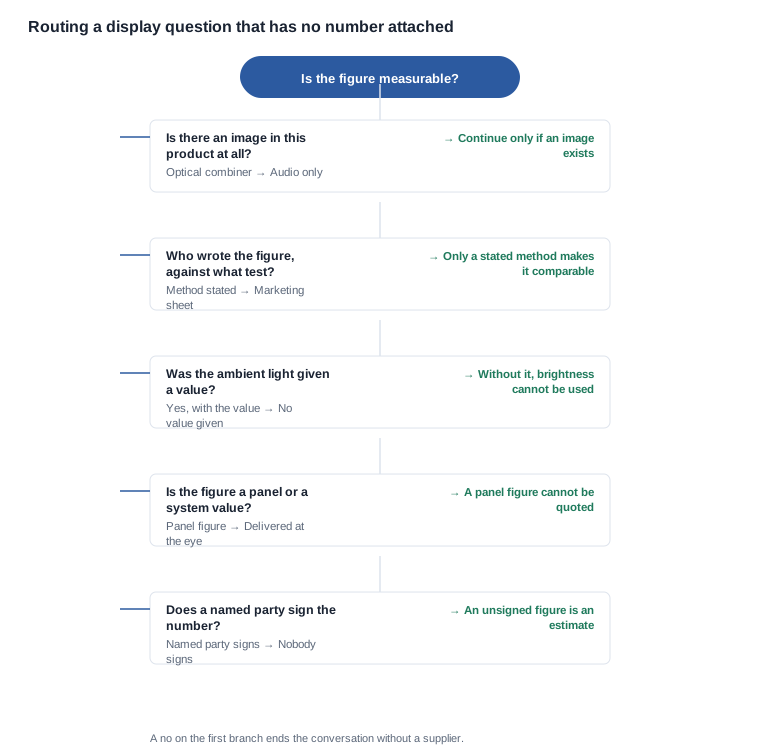
Two answers are red flags on their own. The first is a figure that arrives with no owner: when a buyer asks who signs it, the reply names a department rather than a person. The second is a condition that exists only for the demonstration: a brightness figure quoted for a darkened room at a meeting, and nothing else. Neither answer is a refusal, and both are informative.
If a supplier cannot state the ambient light for a brightness figure, the practical conclusion is that the figure cannot be compared, and the programme should be scored on the other figures with a stated penalty for the gap. If a supplier cannot state the coupling efficiency, the conclusion is stronger: nobody in that organisation has tracked how much light reaches the eye, which means the optical design has not been evaluated against a use condition. If a supplier will not state the eyebox, expect a product that requires a specific posture, and treat that as a usability constraint you will have to communicate rather than a specification detail you can ignore.
There is one pattern worth naming because it recurs: the answer that is always about the technology rather than about the configuration. "It depends on the application" is a legitimate answer to a design question and a non-answer to a procurement question. The follow-up that resolves it is to ask what the supplier would quote if the application were fixed to the one you are buying for. That question produces a number, a condition, or an admission, and all three are useful.
The signs that a supplier has a real measurement programme behind the quotation are simple to read. They quote a condition nobody asked for. They use the word specification where a measurement is meant, and measurement where a specification is meant. They will tell you which of the figures they are not prepared to warrant, because they know which ones they inherited from a module supplier. The common pitfalls for a buyer are to read a specification as a warranty, and to treat a figure that is missing as a figure that is small.
The five ways an AR glasses display technology programme loses money
Display failures are rarely dramatic. They are quiet, they happen at the volume stage rather than the sample stage, and they are expensive because they are discovered by the channel rather than by you. The five below are written as symptom, cause and prevention, because a failure you can name is a failure you can put a clause against.
The figure that was only true in the demonstration room. The symptom is a return rate that climbs after the first month rather than after the first week, and the units come back with comments about outdoor use. The cause is a brightness figure taken in darkness and quoted without the condition. The prevention is the condition column, applied before the first comparison, not after the first returns curve.
The field of view that fits the demonstration, not the task. The symptom is a design review where the operator cannot find the menu edge or the reticle. The cause is a wide angular figure combined with a narrow eyebox, with no postural requirement stated. The prevention is to obtain the eyebox dimension and to write the working distance into the instructions for use, which is also where the what weight is acceptable thinking applies, since a product held in a fixed posture is a product whose mass and balance matter more than usual.
The resolution that counted the panel. The symptom is that small type in an interface is soft while the specification sheet claims a high pixel count. The cause is that a panel figure was published as a product figure. The prevention is to require the delivered figure at the eye, or the equivalent in pixels per degree, under the quoted field of view.
The latency that changed with a firmware update. The symptom is that a pilot behaves worse than the demonstration, with no hardware change. The cause is that the quoted figure was tied to a firmware version that the supplier later replaced. The prevention is to attach the figures to a firmware version in the purchase order and to require notification of changes that affect them.
The coupler that could not be sourced twice. The symptom is a lead time that slips after the deposit, with no explanation the buyer can act on. The cause is that the programme depends on one optical part with a single qualified supplier. The prevention is to ask the second-source question early, and to treat the answer as a price input rather than as a technical detail.
None of these five requires you to become an optical engineer. Each requires you to insist that a figure arrives with the condition that makes it meaningful, and each becomes visible in a comparison sheet that has a column for it.

What moves and what is fixed in an AR glasses display technology quotation
The commercial conversation around a display programme divides into three parts, and only one of them is genuinely negotiable in the way a buyer usually expects. Component and assembly cost moves with volume, and a buyer who brings a firm forecast and a real number gets a real movement. The compliance and documentation work moves with the number of markets and the number of configurations, and the part of it that is fixed is the assessment per product family and per market. The display module itself sits between the two: it has a volume curve, but it also has a minimum order that the supplier cannot cross without changing terms.
The total cost of a display programme is driven by the schedule rather than by the unit price, and the part that deserves the hardest negotiation is scope, not price. A quotation that covers one configuration and one market is worth a known amount of money. A quotation that covers the configurations you might need over the life of the programme, and that can be reused when the product changes, is worth considerably more, and it is usually cheaper to buy than to re-negotiate later. The question to ask is not whether the assessment can come down but whether the scope is right, because an unnecessary market in the quotation is a cost you chose. The trade-offs are worth stating explicitly before the order rather than discovering them at the first change.
There is also a negotiation available on the display figures themselves that most buyers never attempt, because they assume the numbers are fixed. They are not, in the sense that matters: the brightness target, the field of view target and the latency target are design inputs, and they carry a cost and a schedule that the supplier can quote. A buyer who arrives with "bright enough for daylight at a stated ambient level, within a stated angular field, with a stated delivered resolution" gets a different quotation from one who arrives with three numbers and no conditions. The second quotation prices a demonstration; the first prices a product.
The clauses worth writing into the order are unglamorous and effective. Specify the display figures together with their conditions, and name the firmware version the latency and power figures belong to. Make any change to the coupler or the panel reopen the figure review rather than proceed silently. State that the quoted figures are the ones that will appear in the production documentation. Give the buyer a defined period to test the production units against the quoted figures, with the method agreed in advance rather than improvised at the factory gate. Ask for the AR glasses display technology checklist to be used as the acceptance form, so the comparison is done on the same basis as the quotation.
Where our own catalogue stops on AR glasses display technology
What we publish, and what we will not invent
We publish the electrical rows for every model in our catalogue, and for the AR entry that means the battery capacity, the runtime, the charge time, the charging method and the radio version, along with the control description the catalogue carries. We do not publish a display row, a waveguide row, a field of view figure, a brightness figure or a latency figure for that entry, and we are not going to produce one by inference. The AR glasses explained material describes the category; the catalogue describes our product, and where the catalogue is silent on the optical side, that silence is a real gap rather than a formatting choice.
This matters more than it might appear. A supplier who quotes a display figure without a condition is asking you to accept a number whose basis is unknown. We would rather say plainly that the optical specification for a given programme is something we obtain from the display and coupler suppliers and then confirm in writing for the configuration being built, and that the conditions travel with the figure. The catalogue also carries a company-level export certification page whose content is images rather than readable text, and the catalogue text itself contains no reference to CE, FCC or RoHS, so we do not treat those marks as evidence of anything. Any conformity claim you need for a display-bearing product has to come to you as a document with a number on it.
What we will do, without a laboratory and without inventing a figure, is give you the programme shape: which display family is realistic for the use case, what the lead time on the coupler does to the schedule, what a change of coupler costs and how long it takes, and which parts of the specification are fixed once tooling starts and which are still open. That is procurement information, and it is the part a buyer can act on before the first sample.
A display figure scenario, step by step
The scenario is hypothetical and no customer, project or figure is claimed; it is a reasoning walk-through, because the value here is in the order of the reasoning.
Suppose a brand-side buyer is opening a programme for a guided field service unit, to be sold into two markets, with a first order in the low thousands of units and a product manager who has been shown a demonstration unit outdoors in daylight. The display figures on the two quotations are both plausible. One supplier quotes 1000 nits; the other quotes 500 nits. The first is roughly double the second, and on the face of it the second appears to be the weaker product at a lower price.
Step one is to establish what each figure describes. The first supplier's number is a luminance at the panel, taken in a laboratory, with no ambient light given. The second supplier's number is measured at the eye with the coupler in place, under a stated 1000 lux at 30 degrees. Step two is to re-express the first figure. Applying a coupler efficiency and a reasonable ambient condition puts the first figure at roughly 450 nits at the eye in the same conditions as the second. The apparent 100 per cent advantage was a measurement artifact, and the price gap now has to be explained on other grounds.
Step three is the field of view, where the second supplier turns out to be stronger: their figure is horizontal, binocular and delivered at the eye, with an eyebox stated. The first supplier's 45 degrees is diagonal and monocular. Step four is latency, where the first supplier's 12 milliseconds is a panel figure and the second supplier's 20 milliseconds is motion to photon. Step five is the commercial consequence: the second supplier's programme is more expensive per unit and has a longer coupler lead time, but their figures can be written into the order with conditions, and the first supplier's cannot.
The decision that follows is not "buy the second supplier". It is: require both to restate their figures under one agreed condition, give them the same four-page format, and compare what comes back. In this scenario the second supplier's file survives that process and the first supplier's does not, which is a far more useful outcome than a price comparison would have produced. The supplier verification steps are the checklist that makes the process repeatable.
What to send us for a display programme
Send the use case, the target market and the quantity, and tell us what the display has to do rather than what it has to achieve — the environment, the duration of use and the task the image supports. We will tell you which optical families are realistic for that case, which parts of the specification will be fixed once tooling starts, where the lead time will sit, and what a change of supplier would cost in both schedule and money.
Where we have no published figure, we will say so and tell you what has to be obtained from the display and coupler suppliers, in what form, and by when. If you want to see the customer and industrial side of the same decision, the consumer versus industrial comparison is where the difference between a demo-grade and a deploy-grade device is set out.


