

AR glasses waveguide types are the least consequential line on most specification sheets and one of the most consequential decisions in the programme, because a type name tells you which set of compromises the product has accepted and tells you nothing about whether those compromises matter for the job you are buying it for. A sheet that says "diffractive" or "reflective" has answered a taxonomy question and left the engineering question open. The figures that follow are real, but they are the figures of one family under one set of conditions, and the sheet rarely tells you which set.
This article is therefore not about what a waveguide is. The waveguide explained material covers the mechanism, and the AR display types page covers the display families that sit behind it. What follows is about the specific thing a type name carries: a failure mode. Every family in this category has one, it is knowable before you commit money, and it is invisible on a datasheet.
AR glasses waveguide types: a category label is not a performance description
The short answer on AR glasses waveguide types
The practical rule is that a waveguide family is a statement about where the product will fail. Diffractive couplers split the incoming light into a spectrum of angles, which is what allows a wide field of view and high light output, and which is also why colour can separate at angles away from the centre. Reflective couplers fold the light through a partial mirror, which keeps contrast high and the image sharp, and which is why the usable region of the eye is small and the housing carries a visible seam. Reflective collimated paths reduce the volume of the optical assembly and pay for it with a small eye box. A folded display with a lens on an arm is not a waveguide at all, and it is quoted as one often enough to be worth separating out.
Once a buyer accepts that a family is a failure mode rather than a quality tier, the sheet becomes much easier to use. The question stops being "which family is better" and becomes "which failure mode can this programme absorb". A product used indoors on a desk absorbs colour separation at angle and cannot absorb an eye box that forces a fixed posture. A product used in daylight on a moving vehicle absorbs neither without difficulty, and the shortlist changes completely.
The second rule follows from the first. A family name on a sheet is not a specification, and it is not a warranty. It becomes a specification when it is attached to a figure, a condition and a signed party. Until then it is a category the supplier has chosen to describe the product with, and it is worth asking whether they would describe a different product differently.
Who this is written for, and what the reader has to decide
The reader is a brand-side product lead or procurement manager who has a display-bearing product in a plan, or who is comparing two quotations that both name a waveguide family without describing the trade-off. The decision on the table is which family the programme should be built on, and it is a decision with a schedule attached, because the coupler is usually the longest-lead item in the assembly and the part for which a second source is hardest to qualify.
What that reader is managing is not an optical preference. It is a risk that the product behaves well in a demonstration and poorly in a corridor, and it is a risk that is discovered late because the failure mode was always knowable. The related commercial risk is a locked architecture: choosing a family whose coupler has one qualified supplier converts a component decision into a supply-chain dependency for the life of the product.
None of this requires the reader to become an optical designer. It requires them to know which failure mode each family carries, to know which of those failure modes their use case cannot absorb, and to know which question converts a family name into a figure with a condition attached. That last question is in the supplier question set, and this article sets out the reasoning that makes the answer meaningful when it arrives.
Where the family decision sits in the supply chain
The reason the family question is often deferred is that it presents as a supplier's decision. In a display-bearing wearable it is not; it is a buyer decision that has been delegated by default. The coupler determines the field of view the product can offer, the light output it can deliver, the volume the housing needs and the eye box the operator has to work with. Change the family late and the mechanical design, the firmware assumptions and the marketing claims all have to change with it.
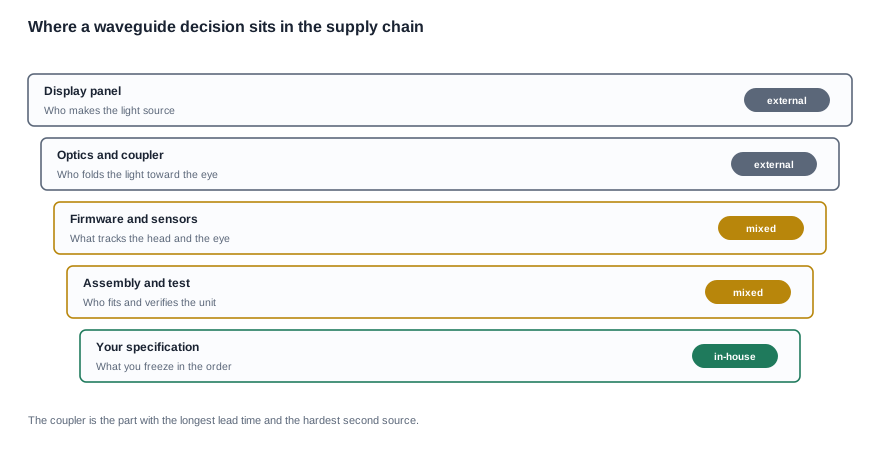
Reading the layers from the bottom up makes the ownership clear. At the bottom is the buyer's specification, and it is the only layer the buyer controls directly. Above it sit assembly and test, then firmware and sensors, then the optics and the coupler, and at the top the display panel itself. In most programmes the bottom layer is written last, because the market or the technology team decided the family before anyone asked what the failure mode would cost.
The layer that matters commercially is the optics and coupler, and it is where the lead time sits. A reflective family with a folding path is mechanically simpler to build and optically harder to source. A diffractive family offers more optical headroom and carries a coupler that is typically produced in far fewer qualified plants. Either way, the second-source question is worth asking before the family is fixed, because the answer changes the achievable price and the schedule exposure.

The trade-off each waveguide family places and where it breaks
The table below sets the four families against what each one optimises and what it costs. The birdbath row is included because it appears in quotations labelled as a waveguide, and separating it out at this stage prevents a category error that is expensive later: it is a display architecture with an arm, not an optical coupler, and it brings a volume and weight profile that no coupler-based product can match.
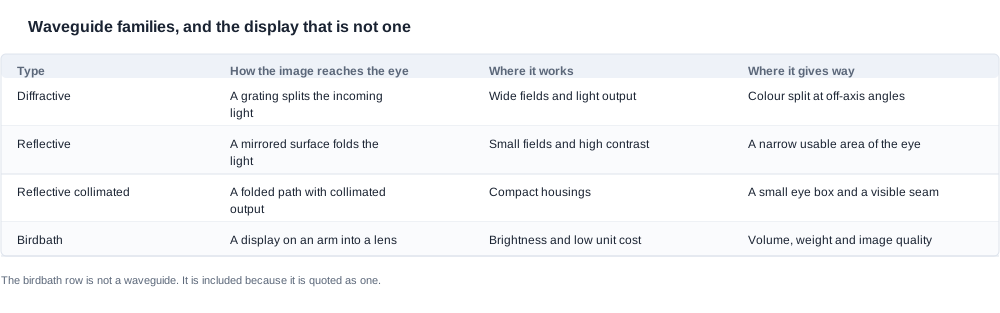
| Type | How the image reaches the eye | Where it works | Where it gives way |
|---|---|---|---|
| Diffractive | A grating splits the incoming light | Wide fields and light output | Colour split at off-axis angles |
| Reflective | A mirrored surface folds the light | Small fields and high contrast | A narrow usable area of the eye |
| Reflective collimated | A folded path with collimated output | Compact housings | A small eye box and a visible seam |
| Birdbath | A display on an arm into a lens | Brightness and low unit cost | Volume, weight and image quality |
Read the fourth column as a set of acceptance criteria rather than as a set of objections. Colour separation at off-axis angles is irrelevant for a desk-based tool and disqualifying for a head-mounted unit used while turning. A narrow usable region of the eye is irrelevant for a product used at a fixed workstation and serious for anything used in motion. There is no family that is best; there is a family whose failure mode matches the tolerance of your use case.
There is a second reason the type matters that is less discussed: it changes what the product can be sold as. A colour-splitting artefact visible at the edge of the field is a specification issue in an engineering review and a returns issue in a channel. The marketing claims for an AR product are usually written against the centre of the field, which is exactly where the artefact is least visible, and the returns arrive from the places the claims never covered.
The diffractive trade-off in procurement terms
Diffractive couplers are chosen when the programme needs a wide angular field and a lot of light, because the physics works in that direction. For a buyer this shows up as a favourable set of headline figures, and it is exactly why the accompanying conditions matter more here than elsewhere. A diffractive figure quoted without an angle is at its best at zero degrees and degrades away from it. Ask what the figure is at the edge of the quoted field, and ask whether the colour separation is described as a limit, a typical value, or not mentioned at all.
The commercial question for a diffractive programme is continuity of supply. The coupler is a specialised part with a narrower supplier base than a display panel, and a change of coupler is not a drop-in replacement because the field, the eye box and the colour behaviour all move with it. If the programme is likely to run for more than a couple of years, the second-source question is not a procurement nicety; it is the question that decides whether the product can be re-ordered in year three at a price you can defend.
The reflective trade-off in procurement terms
Reflective approaches keep the image contrast high and the optical path shorter in terms of pupil splitting, and they pay for it with the geometry: the usable region of the eye is small, so the operator has to hold the head in a particular place for the image to be where it is described. This is the same class of constraint as what weight is acceptable, and it is worth noting that the two interact. A unit that must be held at a particular angle should not also be heavy, because the position is being held rather than rested.
The procurement question here is about the assembly, not the coupler. A reflective path with a folding geometry tends to produce a housing with a seam, a hinge line or a step, and that mechanical feature then has to be reconciled with the materials and manufacturing choices the rest of the product makes. Ask whether the seam is visible in the marketed form, and whether the product photography can show the product honestly without a retouched join. The materials and ergonomics page covers the wider set of decisions that a folding path constrains.
Why a birdbath quotation needs to be read differently
A folded display with a lens on an arm is sometimes listed among waveguide types because it achieves the same end result by a different architecture. It is worth separating, because the cost structure is completely different. A birdbath delivers brightness at a low component cost, and it delivers it by putting a display module at a distance from the eye and folding the light through a lens. The consequences are a housing with a real volume and a real weight, and an optical path where the module is a serviceable item rather than a sealed optical element.
For a buyer this changes three things. The unit price is lower per unit of image quality and the bill of materials is different in kind. The mechanical design has to accommodate an arm and a lens, which constrains the headband and the temple. And the failure mode is different: a folded path can be knocked out of alignment, and the service procedure has to account for that, which is a returns-cost question rather than a design question.
None of this makes a birdbath a poor choice. It makes it a choice with a different failure mode, and a buyer who has decided the failure mode can live with is often better served than one who has decided that a waveguide is simply the more advanced option.
What a waveguide datasheet usually omits about the coupler
The coupler is the part most likely to be described rather than specified. Here is what a sheet normally carries, what it usually leaves out, and what has to be obtained in writing before a quotation can be compared with another one.
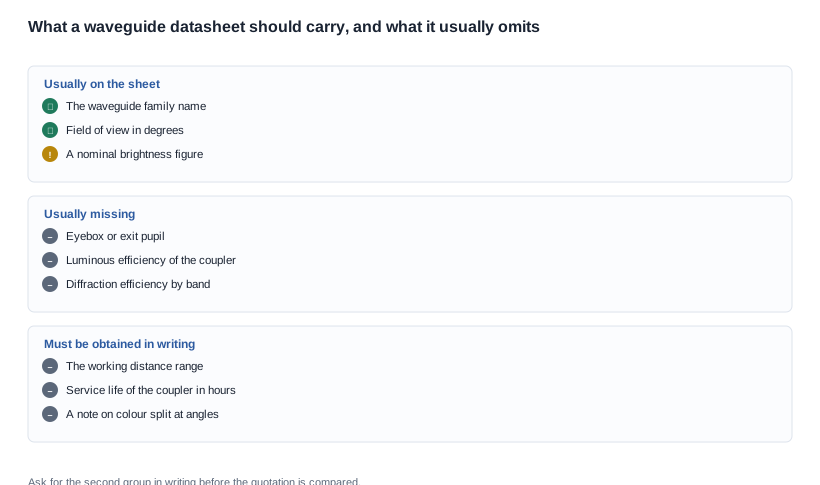
Four omissions dominate, and they are worth collecting as a checklist before the quotation round rather than during it:
- The eye box or eye-relief dimension. This is the number that tells you whether the product can be used by a range of people at all, or only by people with one head shape and one posture.
- The coupling efficiency. This is the difference between the light the panel makes and the light the eye receives, and therefore the difference between a quoted brightness figure and a usable one.
- The working distance range. This determines whether the product works for a given head shape and for a given set of optical prescriptions.
- The rated service life of the coupler, in hours. This is the number that most often turns out to be shorter than the amortisation period the programme assumed.
A fourth omission is more awkward to raise because it is a commercial fact rather than a technical one: the service life of the coupler, expressed in hours. A coupler has a rated life, and the rating is normally far shorter than the life a buyer imagines for a connected product. It is not unusual for the rated life of an optical element to be well below the amortisation period a brand assumes, and finding that out after the product is in the channel is expensive.
Ask for these four in writing, with the numbers, before the comparison rather than after. The rule is not that a supplier must disclose everything about a component. It is that the four numbers above determine whether the product works and how long it works, and a supplier that cannot state them has not evaluated the product against a use condition.

Reading a coupler specification as a commercial commitment
A coupler specification is a description of a component. A commercial commitment is a description of a product. The bridge between them is the question of who is accountable when the product does not perform as described, and it is worth asking explicitly because the answer is rarely the same as the answer to "who made the coupler".
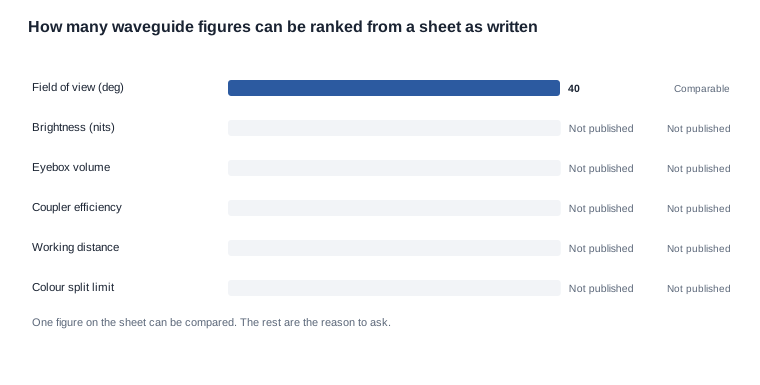
The bar chart above is a deliberately unflattering picture of a waveguide datasheet. Of the figures a buyer would want to rank two suppliers on, a sheet as written commonly contains one that can be compared directly. The rest are either absent or meaningless without a condition. This is the reason the comparison process stalls: a buyer with two sheets and one comparable figure has a spreadsheet, not a decision.
Three commitments are worth having in the purchase order, and each costs nothing to ask for. First, that the coupler part number and its revision are stated, so that a change of part is a visible event rather than an invisible one. Second, that a change of coupler or of the optical path reopens the field of view and the brightness review rather than proceeding silently. Third, that the figures in the order are the figures that will appear on the production documentation, which is what makes them enforceable.
The supply chain question deserves its own line. A coupler with one qualified source is a pricing ceiling that neither side controls, and it is better discovered during the supplier evaluation than during the first price negotiation for a second year of production. Ask how many qualified plants exist for this coupler, what the minimum order on the part is, and what the lead time amounts to in weeks. Those three answers are worth more than any discount on the finished unit.

Where a waveguide decision costs more than it appears
The costs that surprise buyers in this category are almost never the optical ones. They are the costs of changing a decision after it has been made. Each is foreseeable at the point where the family is chosen, and each becomes expensive in a predictable way.
The optical rework after a family change. If the programme moves from one family to another, the housing, the alignment process and the firmware assumptions all move with it. The cost is not the new coupler, which is priced; it is the engineering and tooling time to re-qualify alignment and the scrap risk on parts already ordered. This is why the family should be settled before tooling, and the cost of settling it late is a schedule cost rather than a unit cost.
The marketing claim that outruns the device. Claims are usually written from the centre of the field and from a demonstration condition. A coupler family with a known off-axis artefact will produce returns from operators who use the product differently than the demonstration did. Building a condition into the claims, rather than a number, is the cheapest protection available.
The servicing assumption. A coupler is an optical element in a sealed assembly, and the procedure for a unit returned with an image fault is usually a replacement rather than a repair. At the volumes a consumer channel generates, that procedure is a material line in the returns budget and it should be costed before launch, not discovered in the first quarter.
The second-source premium nobody budgeted. Qualifying a second coupler for the same family is possible and is priced as a project. It is usually cheaper than a second family, because the housing and the firmware stay the same, and it removes the single largest continuity risk in the programme. The alternative is to accept the dependency and price it, which is a legitimate choice as long as it is a choice.
The firmware assumption built on the optical behaviour. A display that needs calibration on assembly inherits the alignment sensitivity of its optical path. If the coupler is sensitive, the production test time and the field failure rate both follow it. Ask how each unit is calibrated and what the acceptance test measures, because that answer tells you more about the real cost of the optical decision than the coupler price does.
None of these is a reason to avoid a waveguide programme. They are the items that a comparison sheet should carry alongside the optical figures, and they are the reason a family name on a datasheet is not the end of an evaluation.
What a factory can and cannot tell you about AR glasses waveguide types
Where our own boundary sits
We build audio, camera and connected products, and our catalogue publishes the electrical rows for every model: the cell configuration, the runtime, the charge time, the charging method and the radio version. For the one AR entry we publish, the catalogue carries the electrical rows and the control description. It does not carry a waveguide row, a coupler part number, a field of view figure or an eye box dimension, and we do not produce those figures by inference. The field of view explained and AR glasses explained material describes the category; the catalogue describes our product, and where the catalogue is silent on the optical side, that silence is a real gap.
What we can tell you without inventing anything is the shape of the decision: which families are realistic for a given use case, where the lead time sits, what a change of coupler costs in schedule and money, which parts of the specification become fixed once tooling starts, and what a second source would involve. We can also tell you which questions are worth putting to a display or coupler supplier, and in what order, because the order is what determines whether an answer arrives with the condition attached. That is procurement information, and it is the part that can be acted on before a first sample.
A procurement scenario, worked through
The scenario is hypothetical. No customer, project, supplier or figure is claimed; what follows is a reasoning walk-through, because the value of the reasoning is the sequence.
Suppose a channel buyer is opening a programme for a hands-free training product sold to technical trades, used indoors in a workshop and occasionally outdoors on a site. The first order is in the low thousands of units, and two suppliers have quoted. Both name a diffractive coupler. One quotes a wide field with a generous eye box; the other quotes a narrower field and a smaller eye box, at a lower unit price.
Step one is to establish which failure mode the use case can absorb. Indoor workshop use with a head-mounted unit means the operator's head position varies constantly, and a small eye box will be interpreted as a product fault in the field even when the unit is within specification. Colour separation at the edge of the field matters less, because the tasks are short and central. The use case therefore rules out the small eye box and leaves the colour behaviour as an acceptable trade.
Step two is to check whether the wide-field quotation is actually wide, or whether the figure is diagonal where the application needs horizontal. Applying that check, the first supplier's figure is diagonal and the second supplier's is horizontal, which reverses the apparent gap. Step three is to test whether the eye box survives the arithmetic once the field is expressed consistently, and it does not: the first supplier's eye box is workable only within the narrower horizontal field.
Step four is commercial. The wide-field product is more expensive per unit, but it is also the product whose specification can be written down, because its figures carry conditions and its coupler has a named part number and a stated lead time. The cheaper product's figures are comparative only. The decision that follows is therefore to pay more per unit for a programme that can be specified and re-ordered, and to write the eye box, the field geometry and the coupler part number into the order.
Step five is the step most programmes skip: agreeing that a change of coupler reopens the figure review. That clause is what makes the specification a live document rather than a description of the first production run.
What to send us for a waveguide decision
Send the use case, the environment, the duration of use and the quantity, and tell us what the image has to support rather than what it has to show. We will tell you which optical families are realistic for that case, what the lead time on the coupler does to the schedule, what a change of supplier would cost, and which parts of the specification become fixed the moment tooling starts. Where we have no published figure, we will say so and tell you what has to come from the coupler supplier, in what form, and by when.


