

Battery transport compliance is not a certificate a supplier either holds or does not hold. It is a chain of documents, one per question, and a consignment fails when any link in that chain is missing or disagrees with the link beside it. The reason buyers waste time on this subject is that the word "compliance" suggests a binary status. In practice the status belongs to a cell, inside a configuration, inside a carton, on a mode, into a destination — so the honest answer to "are you compliant for battery transport" is always a short list rather than a yes.
The practical consequence is that the first question to put to a supplier is never "are you compliant". It is "which cell is fitted to this model, what does it rate at, and does a charging case travel in the same box". Answer those and the rest of the file follows a known sequence. Leave them open and you are managing a carrier's refusal rather than a rule.
The five answers that decide whether a consignment moves
What to settle before the next quotation arrives
For a buyer working on a wearable product with a rechargeable cell, three conclusions are worth taking before the next round of supplier discussions. First, battery transport compliance attaches to a specific cell design type, never to a product family and never to a brand, so any question that does not name a cell part number will be answered with a statement about a range. Second, the number of cells in the carton is a commercial decision rather than a technical one, because a charging case adds a second cell and a second set of documentation, and deciding to ship the case as a separate accessory removes that scope before anyone pays for it. Third, the published charge time in a catalogue is a ceiling and not a measurement — our own catalogue publishes a charging time of two hours or less for twenty-six of the twenty-eight models and about one hour for the D17 and the ZH12, and neither figure tells you the starting state of charge or the point at which charging is treated as complete.
The practical instruction is short: request the test summary as a document for the cell design type in your configuration, and compare the model designation on it against the model on the carton artwork. That check takes two minutes and it is the one that most often finds a mismatch, because summaries are habitually written for an earlier build of a product that has since changed.
Who is doing this reading, and what they are actually managing
The reader is a buyer working for the brand, a channel buyer or an importer who is already holding two quotations and has to choose between them, or who is opening a new programme and has to decide what goes into the specification before anything is quoted. The general question is never really the one in front of them. The real question is whether the configuration in the quotation can be built, documented, booked and defended after it has left the factory, and whether the supplier can show the evidence for that rather than assert it.
What such a reader is managing is not a price difference. It is a schedule that a missing document can stop, a launch window that a border can close, and a channel relationship that a defective file can cost twice — once in the units that come back, and once in the confidence that does not. This is why transport documentation gets paid for reluctantly. It produces nothing visible, it is invisible in the price comparison, and it is the only thing standing between a booked consignment and a refused one.
There is a second audience for this material, which is the person inside the buying organisation who has to defend the shipment later. That person rarely gets asked for a certificate; they get asked what was in the box, which cell it was, who signed the declaration, and whether the file still exists. A buyer who can answer those four questions in one email has bought something more durable than a document.

The cell population behind the catalogue numbers
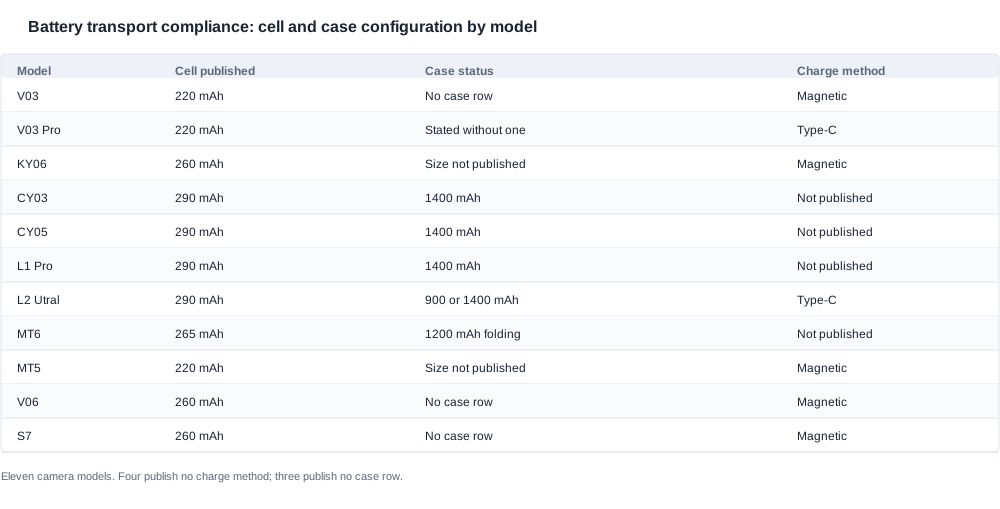
Our catalogue describes twenty-eight models, and the cell population behind them is not uniform. The eleven camera models sit in four capacity bands: 220 mAh for the V03 Pro and the MT5, and the V03; 260 mAh for the V06 and the KY06, and the S7; 290 mAh for the L1 Pro and the CY03, and the L2 Utral and the CY05; and 265 mAh for the MT6. Every one of those eleven publishes a charging time, a runtime and a charging method, and the pattern in those rows is what makes the transport question tractable rather than mysterious.
The charging method splits into three groups across the full range, and the split matters to a buyer who is writing a packing instruction. Seventeen models publish magnetic charging, seven publish a Type-C port, and four — the MT6 and the CY05, and the CY03 and the L1 Pro — publish no charging method row at all. Those four are not magnetic and they are not Type-C; the catalogue simply carries no such line for them, which is an absence of published information rather than a statement about the hardware. All four do publish a charging case capacity, which is a useful reminder that an open charging row does not mean an absent accessory.
The charging case column is the one with four states, not two, and a buyer who assumes two will mis-count. Five camera models publish a case capacity: the CY05 and the CY03, and the L1 Pro — each at 1400 mAh, the L2 Utral at 900 or 1400 mAh, and the MT6 with a 1200 mAh folding case. Two more, the KY06 and the MT5, publish a charging case without publishing its capacity. Three — the S7 and the V06, and the V03 — publish no charging case row at all, which again is an absence rather than a statement that none exists. One, the V03 Pro, is published explicitly as having no charging case. Those four states are not interchangeable, and the difference between "the catalogue lists no case row" and "the catalogue states there is no case" is the difference between a question to ask and an answer you already have.
Why two quotations for the same product can differ by a factor of two
The freight is rarely where the money is, and a quotation comparison built on unit price alone misses the largest variable in this category. A factory that has already run the transport assessment for a configuration can hand the document over as a routine part of a shipment. A factory that has not is selling a product that cannot yet be booked, and the quotation for that product looks lower than the one that can ship, because the compliance work is not in it yet. That gap is the mechanism behind most of the price spread a buyer sees, and it is why two quotations cannot be compared until the documentation scope has been aligned on both sides.
The second variable is the number of cells. A product that ships with a charging case carries a second cell, and that second cell changes the declaration, the packaging, the declared shipping weight and the classification question. The same device shipped bare and shipped with a case are two different transport products, and a buyer who collapses them into one purchase order line inherits a file that only covers one of them.
What our own catalogue does and does not settle here
It is worth being precise about the boundary of what we publish, because a reader who assumes a catalogue row is a certification will over-read it. The catalogue carries a company-level export certification page whose content is images rather than text — ten patent certificates, eight appearance-design patents and two utility-model patents. The catalogue text itself contains no reference to CE, to FCC, to RoHS, to REACH, to UKCA, to GPSR, to the Radio Equipment Directive or to EN 18031, and there is no per-model certification row anywhere in it. No UN 38.3 test summary is published for any model either.
That is not a weakness in the range; it is the honest description of where the catalogue stops and the supplier's file begins. The correct reading is that certification scope for a given model is written material you have to request from the supplier, and that a request which cannot be answered with a document is itself the finding. Where the catalogue does speak, it speaks in published electrical rows — cell capacities, charge times, rated runtimes and the charging method per model — and those rows are the input to the transport file rather than a substitute for it.
Battery transport compliance: the testable lines, and what an inflated answer looks like
A transport file is only as good as the criteria it was tested against, and the criteria below are written for the buyer rather than for the laboratory. Each line states how the thing is measured, what it has to meet, and what a weak answer looks like in practice, because a transport question answered verbally is a transport question that will be re-asked at the dock. Two of the rows are about documents rather than hardware, and those two are the ones that most often decide whether a consignment moves.
| Line to test | How it is measured | The line it has to meet | How a weak answer shows up |
|---|---|---|---|
| Test summary applicability | Read the model designation printed on the summary and compare it with the unit and the carton artwork. | The designation on the summary is the designation in the order. | A summary written for a sibling model with a similar name and a different cell. |
| Cell part number | Ask for the part number behind the summary rather than the brand name. | A part number is given and it can be compared with the bill of materials. | A brand name with no part number, which cannot be checked against anything. |
| Energy content | Take the capacity in milliamp-hours and the rated voltage, and calculate watt-hours yourself. | Both figures agree to the rounding shown on the summary. | A watt-hour value copied across from an older cell of the same nominal capacity. |
| Cell or pack figure | Ask which level the quoted capacity describes. | The level is stated on the document being quoted. | A brochure capacity for the pack compared with a cell-level number on the summary. |
| Case coverage | Ask whether the charging case ships in the carton and which cell is fitted to it. | The file names every cell that travels in the carton. | The device cleared on its own and the case added later as an accessory decision. |
| Documentation retention | Ask how long the file is kept, where the copies live, and who can produce it. | The file is retained for a period that covers the destination market's expectation. | A file held on one person's machine and nowhere else. |
| Assembly responsibility | Ask who signs the declaration for a unit assembled from a qualified cell and a bought pack. | The signing party is identified by name in the file. | A declaration signed by a party that never saw the finished unit. |
| Damaged cell handling | Ask what the documented procedure is for a unit returned with a damaged cell. | A written procedure exists and the returns channel applies it. | A returns process that treats a swollen cell like any other return. |
| Charge state at despatch | Ask what state of charge is declared and how it is set. | The declared state matches the paperwork and the setting method is written down. | An assertion that the state is partly charged with no procedure behind it. |
| Marking and labelling | Inspect the markings on a physical unit against the document. | The unit carries the marks the destination market expects for that mode. | A marking applied to the carton but not to the unit inside it. |
| Sample against shipment | Compare a shipped unit with the sample the file was written for. | The shipped unit matches the filed configuration part for part. | A file written for an earlier build and never revisited after a change. |
Three of these rows cannot be compared between suppliers without care, and treating them as directly comparable is where a specification gap gets invented. A watt-hour figure from one supplier may describe the cell while the same figure from another describes the pack, because the pack adds a protection circuit and a housing. A capacity quoted in a brochure may be the device total rather than the cell. And a published charging time is a ceiling — two hours or less for twenty-six of our models — so it cannot be used to infer that a charge is finished inside a shift unless a starting state and a completion criterion are attached to it.
The five answers, in the order they are usually needed
The transport question reduces to five answers for a given configuration: which cell is fitted, what its energy content is, which test summary covers it, which packing instruction follows from that energy content, and what the declaration will say. Any two of them can be answered while the third is open, and that is exactly how a shipment comes to be booked with a gap in it. The order matters because each answer narrows the next: the cell gives the energy band, the energy band gives the packing instruction, and the packing instruction gives the marks and the paperwork.
Timing is as much a part of the criteria as the content. The document question is cheap in the first week of a specification cycle and expensive in the fifth, because a change to the cell part number after the file has been written reopens everything downstream of it. A buyer who wants to know how to choose the order in which to spend effort on this should run the sequence backwards from the booking date and treat every date on that line as a decision with a named owner.
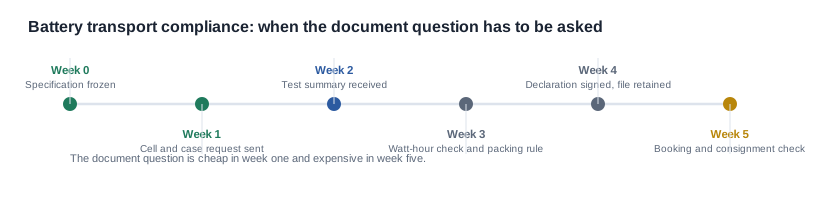
Two questions are worth settling before you order anything. Should you treat a missing cell specification as a blocker or as a request? The answer is a blocker, because without a rated voltage the energy content cannot be calculated and therefore the packing instruction cannot be identified. And which model in a range should carry the transport file first? The one with the most configurations attached to it, because a file written against that model is usually reusable for the others.
Where the case decision quietly changes the scope
The charging case is the single most consequential packaging decision in this category, and it is worth separating from the technical work. A case adds a cell, a capacity, a classification question and a marking requirement, and in the case of a folding case it also adds a mechanical interface that has to survive the transport drop. Taking the case out of the carton and selling it as a separate accessory removes all four at a stroke, and it costs nothing to decide before the packaging artwork is printed.
The four published states make the point precisely. Where a case capacity is published, you have the inputs to calculate the second cell's energy content. Where a case is published without a capacity, you have a request to make and an answer to insist on. Where no case row is published, you have an open question that only the supplier can close. Where the catalogue states that there is no case, that question is already closed and should not consume negotiation time.

Turning a supplier answer into a file you can defend
The request sequence that produces documents rather than assurances
Verification in this category is a document exercise with a physical check at the end, and it works best in the order set out below — before the configuration is frozen, before the deposit is paid, and before the carton is sealed. Each step has a completion test: a document with a date, a number or a named owner behind it, never a verbal assurance.

-
Ask for the cell specification behind the configuration, and require it as a document with a rated voltage on it, because a capacity without a voltage cannot be classified.
-
Ask for the test summary naming your model designation, and check that designation against the unit and the carton artwork before the reply is filed anywhere.
-
Calculate the watt-hours yourself from the capacity and the rated voltage, and compare the result with the figure declared on the summary. Where they disagree, establish which figure the declaration will use before anything else is agreed.
-
Establish the case decision in writing, and where a case ships, ask for the case cell specification and for evidence that the case designation appears in the same file as the device.
-
Ask for the packing instruction that follows from the energy band and the shipping mode, and check that the markings it requires are present on the physical unit rather than only on the carton.
-
Ask what state of charge will be declared and how it is set, and have that written into the order, because the broker is the party who has to defend it at the dock.
-
Ask how the file is retained, where the copies live and who can produce it after the goods have left. A file on a single laptop is not a record; a file in two places with a named owner is.
-
Ask for the returns procedure for a unit returned with a damaged or swollen cell, and confirm the returns channel has been told about it.
Running these against the documents you intend to sign, and running them before the order rather than after the first shipment, is what converts a transport file from something you hope exists into something you have seen. The value of the sequence is not that it is thorough; it is that each step produces an artefact that can be attached to a purchase order line.
The request list you can send as one document
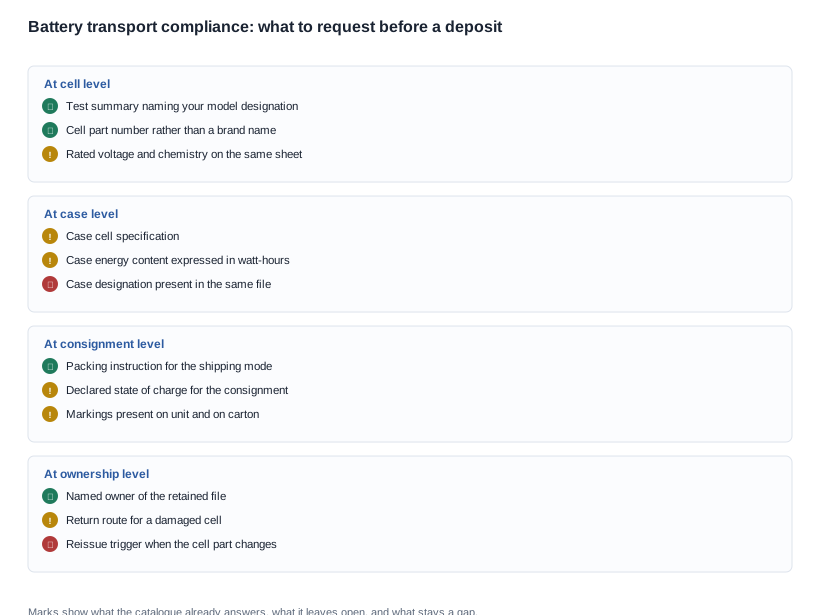
The list above is deliberately arranged by level rather than by supplier, because the levels fail independently. Cell-level documents fail by pointing at the wrong cell. Case-level documents fail by being absent from a file that covers only the device. Consignment-level documents fail by describing a carton that has since changed. Ownership-level documents fail by existing only as an assurance that somebody will look for them.

Where the order goes quiet, and what the commercial conversation can still recover
Four ways the transport file fails after the deposit
The summary that exists but covers another model. The test summary was written for an earlier build of the same product, and the cell or the pack changed afterwards without the document being reissued. The symptom is a rejection at the carrier's acceptance point rather than at the factory. The cause is a change control that does not treat the cell part number as a controlled item. The prevention is a line in the order making reissue a condition of any change to the cell part number, and a two-minute comparison of the designation on the summary against the designation on the carton.
A case in the box that is not in the file. The device was cleared on its own and the charging case was added later as an accessory decision that nobody took back through the documentation. The symptom is a declaration that understates the energy content of the consignment. The cause is the packaging and the compliance work being managed by different people. The prevention is to freeze the box contents together with the cell configuration, and to require the file to name every cell that travels in the carton.
A capacity that belongs to the pack. A brochure figure for the whole battery was compared with a cell-level number on the summary, and the difference was read as a specification gap between suppliers. The symptom is a supplier you have excluded on paper for no reason. The cause is asking which level the figure describes. The prevention is to write the level into the request, so the answer is unambiguous.
A swollen cell treated as an ordinary return. The returns desk was never told that a lithium cell may be damaged, and the unit was collected, repackaged and shipped without the special handling that applies. The symptom appears weeks after the shipment, at a customer, not at a port. The cause is a returns process written for general merchandise. The prevention is a named contact in the returns instruction who is authorised to refuse a unit where the instruction has been missed.
None of these is exotic, and none of them is a reason to change supplier. They are reasons to put a line in the order and a name against a document.
What is negotiable in a transport scope and what is not
The commercial conversation in this category separates into three parts, because only one of them is genuinely negotiable and the other two are frequently mistaken for it. Component and assembly cost moves with volume and with the component market, so it responds to a buyer who brings a specific configuration and a specific quantity. The packaging, the artwork and the documentation handover are soft, because they are items a supplier can redesign to fit a budget rather than defend as a cost. The testing, the registration and the assessment of the model against each destination market are close to fixed per product family and per market, and the useful question about them is not whether the fee can come down but whether the scope is right, because an unnecessary market in the quotation is a cost the buyer chose.
The scope question is the one to press on. A file that covers one configuration, one mode and one destination is worth a known amount; a file that covers the whole programme and can be reused across the range is worth considerably more. When a supplier quotes a single market because it is the easiest to price, ask what the marginal cost of adding the second market is once the assessment exists — that conversation favours the buyer, because the second market is the one that would otherwise be charged at full price later.
Where the buyer has leverage of their own is in the cell configuration and the case decision. Both are decisions the buyer controls before the specification freezes, and both change the scope of the compliance work without changing the hardware. Deciding to ship the case separately, or to hold the cell part number steady across two product variants, reduces the documentation scope that has to be bought. That reduction is the most valuable commercial move available in this category, and it costs nothing but a decision made early.
The part of the price that is hardest to argue about is the one that is genuinely fixed. A buyer who argues hardest about the testing fee usually loses the larger prize, which is the scope.
What the buyer should hold the supplier to
Hold the supplier to a document with a date, a number and a named owner. Hold them to the model designation on the summary matching the model in the carton. Hold them to a declared state of charge that the packing instruction permits. Hold them to a reissue trigger when the cell part number changes. None of these asks for anything that is not already the supplier's own file, and every one of them converts a verbal assurance into something a colleague can check without you in the room.
One configuration walked through, and the limit of what we can tell you
A hypothetical sourcing decision, step by step
The example below is a reasoning exercise rather than a customer story, and it is written that way on purpose. No client is described and no figures are claimed; the model, the configuration and the destination are assumed so that the order of the reasoning can be followed.
The scenario. A brand-side buyer is opening a programme for a camera-equipped smart glasses product, intended for sale into two markets, with a first order in the low thousands of units. The charging case ships in the box. The decision to work through is which supplier to shortlist and what to require before a deposit.
Step one, the configuration. The first question is not about the supplier. It is which cell configuration ships and therefore whether the transport file has to cover one cell or two. Reading the published rows settles part of it: the CY03 and the CY05, and the L1 Pro each carry a 290 mAh cell with a 1400 mAh case published, and the L2 Utral carries a 290 mAh cell with a 900 or 1400 mAh case and a published Type-C port. The buyer now knows that the case is in the box and that the second cell's energy content has to come from a case specification that the catalogue does not carry.
Step two, the document request. The request goes out naming the model and the configuration and asking for the test summary as a document. A supplier who replies with a document naming a designation moves forward. A supplier who replies with a statement about the range does not, and is asked again in a form that leaves no room for a family-level answer.
Step three, the arithmetic. The 290 mAh cell is converted to watt-hours against the rated voltage on the cell specification, and the result is compared with the figure on the summary. A disagreement here is worth more than any unit-price conversation, because it is the first point at which the buyer learns whether the file was written for the cell in this unit.
Step four, the commercial close. Having established what the file must cover, the buyer asks what the scope is in the quotation, which documents are included, which are charged separately, and which are held for a different configuration. The negotiation then happens on scope and on the case decision, rather than on the testing fee.
The boundary of what we will tell you
We publish the rows our own material supports — cell capacities, charge times, rated runtimes and the charging method per model — and we mark the rows that are open rather than filling them with an industry norm. We do not publish a test summary we cannot reproduce, an energy content we have not calculated against the cell actually fitted, or a certification scope that has not been confirmed in writing for the specific configuration.
That is a narrower claim than it sounds, and it is deliberate. A buyer who builds a listing, a tender or a compliance file on an estimated number finds the error in the field, where the correction costs far more than the question would have. We would rather hand over a shorter list that holds up than a longer one that does not. And where the catalogue genuinely has nothing to say — the certification scope of a particular model, the weight of a case, the charging method for the four models whose rows do not carry one — the useful answer is a specific question rather than a plausible number.
The handover list for this week
If you are working on this now, the next step is short and specific. Send the model, the configuration, the quantity and the destination, and ask for the documents in the list above for that configuration rather than for the range. We will tell you which of them exist, which are held for a different configuration, and which have to be commissioned.
The order below is the part of battery transport compliance that can be actioned in a single sitting:
-
Write the configuration on one line. Name the model, the cell capacity, the charging method and whether the charging case travels in the carton, because the fourth of those changes the transport scope of the whole programme.
-
Request the cell specification and the test summary as documents. Check the model designation on the summary against the carton artwork, and check the watt-hour figure against the capacity before the reply is filed.
-
Put the scope in the quotation. Ask which documents are included, which are charged separately, and which are held for a different configuration or a different destination market.
-
Put a damaged-cell route into the returns pack. Name the person who is allowed to refuse a unit where the handling instruction has been missed, and leave the instruction where the people collecting returns will actually see it rather than in the purchase order where only the buyer reads it.
The battery transport framework sets out the documents behind each answer. The battery transport buyer checklist expands the request list, battery transport compliance and how it interacts with other rules shows where this file meets the radio and chemical regimes, and how to comply with battery transport in practice covers the operational sequence once the documents are in place.
Tell us the model, the configuration and the destination, and we will tell you which of the five answers we can give you today and which ones have to come from the supplier's file.


