

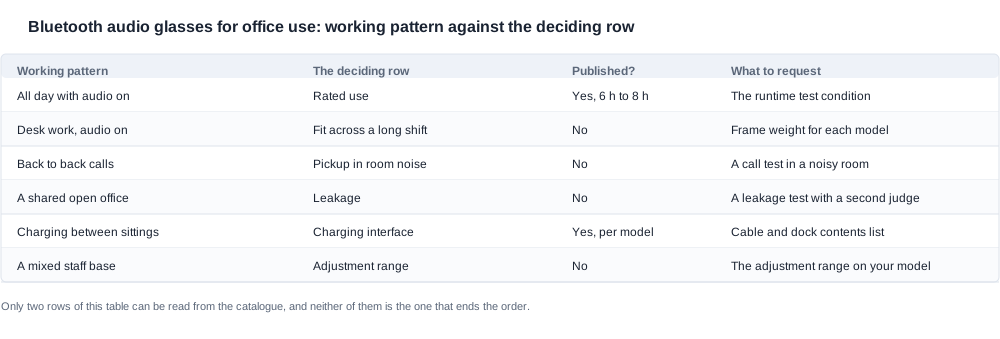
An office purchase turns on two things that an open-ear design makes hard: whether a call works in a noisy room, and whether the people at the next desk can hear what the user is listening to. Neither question has a published answer for any model in this range. No microphone pickup distance and no leakage figures exist anywhere in our catalogue for the audio models. What does exist is a set of electrical rows that settle the shape of the working day — the duration of a charge, the interface that charges it, the radio a phone has to speak — and that set is enough to plan a deployment. It is not enough to select a product on its own, and this page is written to show a procurement manager exactly where the line between the two sits.
Bluetooth audio glasses for office use turn on a working day, not a spec sheet
An office day is roughly eight hours, most of it with the product active. That single fact reorganises the whole comparison, because the rows that dominate a general-audio shortlist — how it sounds, how it presents, what it pairs with — are not the rows that dominate here. What dominates here is the duration of a single charge, the interface that recharges it, and the two acoustic questions that no supplier publishes.
The two questions you have to test, not read
Call quality in noise. Open-ear designs are most often criticised here, and it is the most common complaint pattern in the product category. The reason is geometric: the microphone has to pick up a voice that is not being projected towards it, in a room that also contains air handling, telephones and other people. No model in this range publishes a microphone pickup distance, so there is no specification to compare against and no threshold to hold a supplier to. The design context is in noise control and microphone pickup.
Audio leakage. An open-ear design does not seal, so some sound escapes. How much depends on the volume and on how the frame sits against the wearer's head, which is why leakage cannot be reduced to one published number that applies to every user — and why no model publishes one at all. The format itself is covered in open-ear audio.
Both of these are sample questions. Neither is a specification question, and a buyer who treats them as specification questions will either wait for a document that never arrives or accept a claim that cannot be defended.
What an employer buyer adds to the list
An office deployment is not a retail purchase, and three constraints come with it that a channel buyer does not have.
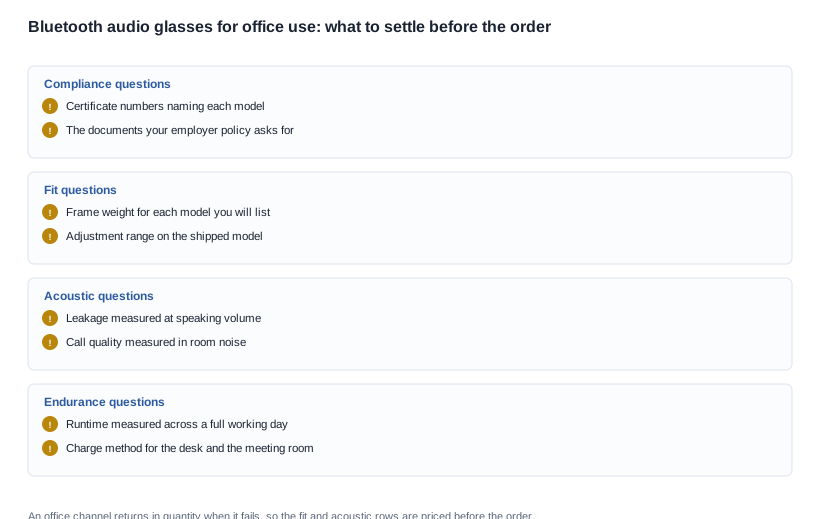
A compliance request that may be policy rather than law. No certificate numbers are published for any audio model, and our catalogue's export certification page is a company-level page whose content is images rather than text, with no per-model certification row anywhere. An employer's procurement office may still ask for the documents as a matter of internal policy, independently of any legal requirement. The commercial consequence is that the request has to be put into the request for quotation early, because a document that arrives after the order is a document that arrives too late. The process is in certification checklist.
A long continuous use period. The longest unbroken session in any use case sits in an office, and no frame weight is published for any audio model in this range. The only weight published anywhere in our catalogue is 158 g for the MT6, a camera model with a different cell and a foldable case, and it cannot stand in for an audio frame. That leaves the sizing question to a sample, and the sample has to be used for the length of a shift rather than for a few minutes.
A presentation question that the data does not address at all. Nothing published for this range speaks to how the product presents in a client-facing setting, and it is a real consideration for a corporate buyer. Samples, used by the actual people who would carry them in the actual setting, remain the only way to assess it.
Five unpublished rows, and the checks that close each one
The published rows are not decorative; they are simply narrower than buyers expect, and a buyer who knows the width of each row avoids a whole class of mistake.
The rated use figure orders the candidates. The LC-105-2 and the K02, and the LC-105-1 and the K01 publish roughly eight hours; the D11 and the D12 publish roughly seven; the G07 and the YK12 publish roughly six. None of those figures carries a stated test condition, which means they are ratings rather than measurements, and it means the office buyer should treat roughly six hours as a planning floor and roughly eight as a ceiling under favourable conditions rather than treat any of them as a promise.
The charging interface decides the desk. Six of the eight audio models charge magnetically and the D11 and the D12 charge over a Type-C port. In an office this is not a cosmetic difference: it decides whether the deployment needs a dock at every desk, whether it needs a cable, and whether the accessory stock in the supply room is one item or two.
The cell configuration sets the recharge pattern. Two 90 mAh cells on the K01 and the K02, two 55 mAh cells on the LC-105 pair, the G07 and the YK12, and a single 100 mAh cell on the D11 and the D12. A dual-cell frame and a single-cell frame do not behave the same way when they are partly used and put back on the charger, which is the actual pattern of an office day.
The radio version is the fleet question. The K01 and the K02 publish Bluetooth V5.3; the D11 and the LC-105-2, the D12 and the G07, and the LC-105-1 and the YK12 publish V5.4. For an employer the relevant question is what the company phones and laptops are running, because a compatibility problem is attributed to the product and reaches the buyer as a quality complaint.

The rows an office buyer can read and the rows they cannot
| Row | Published for the audio range | What it settles in an office deployment | The caveat or the criterion to write |
|---|---|---|---|
| Rated use | Yes, about 6 h to 8 h | How many sittings a charge covers | No test condition is published |
| Charge time | Yes, two hours or less | Turnaround between sittings | A ceiling, not a measured result |
| Charging interface | Yes, per model | Dock or cable at the desk | Six magnetic, two over Type-C |
| Cell configuration | Yes, per model | The recharge pattern across a shift | Two cells and one cell differ |
| Bluetooth version | Yes, per model | Which company devices can pair | A compatibility row, not an acoustic row |
| Frame weight | Not published | How the frame sits across a shift | Weigh a sample unit |
| Microphone pickup | Not published | Whether calls work in room noise | A call test in a noisy room |
| Leakage | Not published | Whether the product is usable in an open office | A leakage test with a second judge |
| Sizing across a staff base | Not published | Whether one model suits everyone | A sample on the actual users |
| Certificate numbers | Not published | Whether an employer's policy can be satisfied | Request in writing, early |
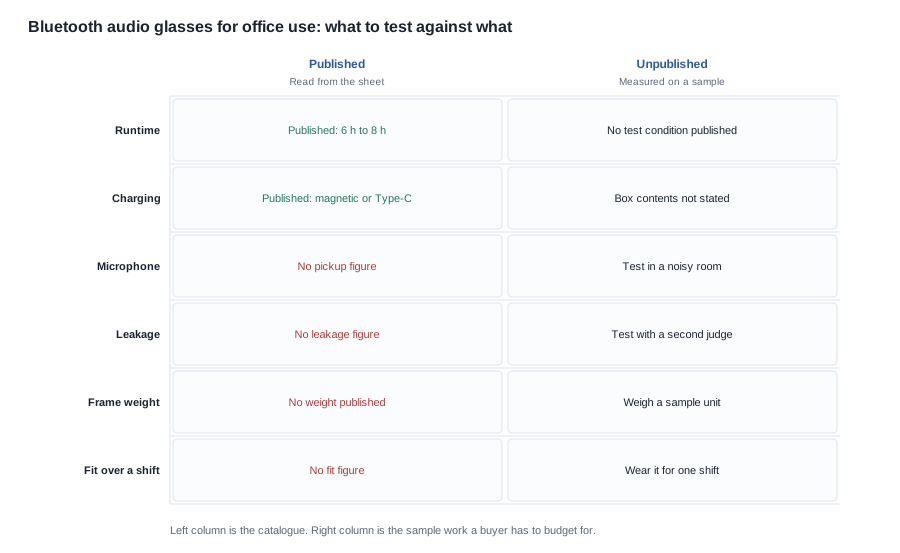
The matrix above is the fastest way to see where the money goes in an office programme. Everything on the left-hand side is free to establish — it is published and it can be read today. Everything on the right-hand side has to be bought, either as a sample programme or as a written request, and that is the real cost of an office deployment that nobody puts in the quotation.
The two rows the buyer should ask for before anything else
If a buyer has time for exactly two requests before the sample order, they are the microphone position and the leakage behaviour, because they are the two rows that can disqualify a product outright and they are the two that no supplier can answer from a datasheet.
The request should ask for the measurement condition and the acceptance threshold, not for a number. A microphone figure without a stated distance, environment and speech level is not usable in a specification, and a leakage figure without a stated volume and distance is not usable either. Where the supplier cannot provide either, the request should be closed with a sample test rather than left open.
One comparison worth being careful about
Two models in the catalogue publish a charge time of about one hour — the D17 and the ZH12 — and both are Type-C models with a published remote shutter control. They are the fastest-turnaround entries in the catalogue, and an office buyer comparing turnarounds will notice them. Both sit in the sport tier rather than the audio tier, and neither carries the feature lines, the platform structure or the accessory chain that an audio range is built on. A buyer whose requirement is turnaround should note them as a reference point for the fastest published charge time, and should ask separately whether a sport-positioned product is the right shape for a corporate channel.

Choosing the starting point: calls, focused work or both
The office channel is not one requirement but two or three wearing the same coat, and the order in which a buyer runs the sample tests follows directly from which one dominates. Running the wrong test first is not a waste of the whole budget, but it is a waste of the first stage of it, and the stages are not interchangeable.
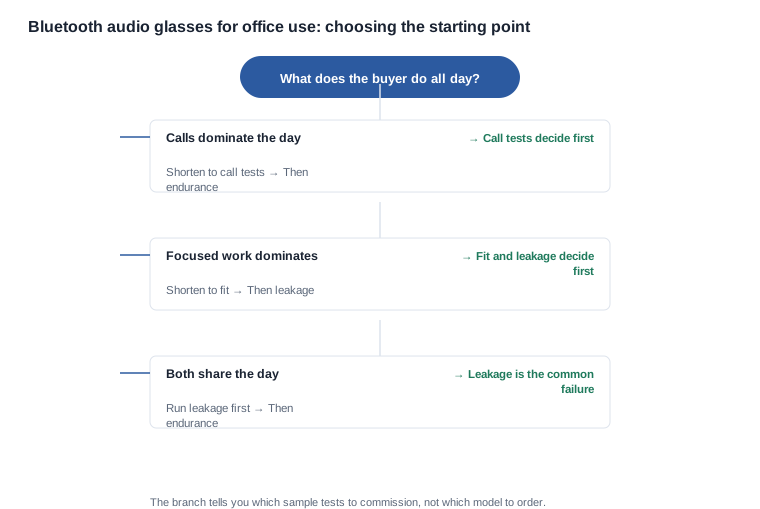
When calls dominate the day, the acoustic test comes first and the endurance test second. A frame that cannot be heard in room noise has already failed the requirement regardless of how long it lasts on a charge, so the call test in a noisy room is the one that eliminates models. The endurance test matters, but it is a planning question rather than a disqualifier: a buyer can charge the product at a desk, and a buyer who cannot have a call heard at a desk cannot do the job at all.
When focused work dominates, the sizing and leakage tests come first. The failure mode in a focused-work environment is the product that becomes uncomfortable to keep on across a long session and the product that is audible to the people around it. Both are invisible in the published rows, both are visible in a sample used for a full shift, and both are cheap to discover early.
When both share the day, leakage is the common failure and therefore the first test. It is the row that disqualifies the most models for office use, and it is the one where the result is most sensitive to the volume the end user actually runs, which makes it the result most worth measuring on the people who will use the product rather than on the buyer's own team.
A worked example: a mid-size services firm with a client-facing desk
This is a worked case rather than a client project. It is written so the order reads.
Assume a professional services firm of about four hundred people, with a client-facing floor in the open part of the office and a quieter internal floor. The firm wants open-ear audio frames for staff who spend their day on calls, and its procurement office has two internal constraints that sit on top of the commercial ones: every device on the corporate network has to be on a supported radio version, and every purchase above a threshold needs a compliance file before the order is released.
Step one, the working pattern. The firm surveys its own floor rather than assuming, and finds that two thirds of the day is calls, that the open floor is the noisy one, and that the internal floor is where people listen. That single survey reorders the sample programme: the call test in room noise comes first, because it is where two thirds of the failures will be, and the leakage test is scheduled second.
Step two, the fleet question. The firm checks its corporate device inventory before it checks any supplier, and finds that the fleet is mixed between two radio generations. That makes the radio version a hard filter rather than a preference, which removes the K01 and the K02 from the candidate list on a technical ground rather than a commercial one, and it makes the request for quotation shorter.
Step three, the compliance file. The firm's procurement office asks for the certificate evidence naming each candidate model, with the issuing body and the validity dates, at the same time as the request for quotation. The firm's reasoning is that a document requested after the order is a document that delays the release, and the cost of a delay sits with the firm rather than with the supplier.
Step four, the samples. The firm buys samples on the same commercial terms as the production order and runs the call test in a real meeting room rather than a quiet office, because a quiet office is where the product is easiest to pass and therefore where the test has the least discriminating power. It runs the test on more than one unit per model, because a single unit tells the firm about a single unit and it has a return policy that will be judged on the rate rather than the anecdote.
Step five, the commercial structure. The firm asks for the sample cost and the production price to be quoted separately, asks for a payment node released after the sample tests pass, and asks for the return terms and the warranty response time in writing. It also freezes the model list at this point, because every additional configuration adds a re-validation cost and a second accessory line that the firm's own stores would have to carry.
The result is a shortlist narrowed on a technical filter, a test programme aimed at the failure that matters, and a documentation request issued at the moment when it can still be closed. Nothing in that sequence needed a market estimate, and nothing in it depended on a published figure that the catalogue does not contain.
Six ways an office deployment fails quietly
The published runtime was read as a working day. Symptom: staff charge the product at midday because it does not last the shift, and the practice becomes a support issue. Root cause: a rated use figure without a test condition was treated as a measurement of the office workload. Prevention: quote the figure as a rating, and measure the workload across a real shift before committing to a single-sitting deployment.
The product was shortlisted on the electrical rows alone. Symptom: the leak test fails in the open floor in week one. Root cause: the two unpublished rows were never converted into a sample test, because everything in the published grid looked complete. Prevention: put the unpublished rows in the sample request itself, with acceptance criteria attached to the same email as the request.
The call test was run in a quiet room. Symptom: calls fail in the client's meeting room. Root cause: the test environment was chosen for convenience rather than for discrimination. Prevention: run the call test in the noisiest room the end users actually work in, and record the room rather than describing it.
The sizing question was answered from the catalogue. Symptom: staff remove the product partway through the day. Root cause: a weight from a different model, or a general expectation, was used in place of a measurement of the shipped configuration. Prevention: weigh a sample unit, and use it for the length of a shift rather than for a few minutes.
The device fleet was never checked. Symptom: a subset of staff cannot pair the product and the fault is reported as a product fault. Root cause: the radio version was treated as a specification detail rather than a fleet compatibility check. Prevention: obtain the device inventory before the shortlist is scored, and state the version in the listing.
The documentation request was issued after the order. Symptom: the compliance file is incomplete when the order has already been released. Root cause: the request was treated as paperwork to be collected rather than as a condition of the purchase. Prevention: attach the documentation request to the request for quotation, with the model designations named.
The limits of the published rows for an employer buyer
An office purchase cannot be completed from the specification sheet in this category, because the two questions that decide it — call quality in room noise and audio leakage — cannot be published from the data we hold. We will tell you which models carry the best-published runtime and interface rows, and we will not characterise acoustic performance that we cannot evidence.
There is a commercial reason to keep that narrowness. An office deployment fails at scale: a business customer who is told a product is built for calls and finds it is not does not return one unit, it returns the deployment and questions the supplier. An undefended acoustic claim in an office listing is therefore not a marketing risk, it is a contract risk, and the cheapest protection is to publish only what a sample can support.
The commercial terms to fix for an office channel
The sample order. An office programme needs several units per model and a testing protocol, so the sample cost, the shipping terms and the timeline should be quoted separately from the production price. A sample quoted as a discount on production is a sample that gets confused with the first production lot.
The acceptance criteria. The call rating, the leakage judgement and the shift-length result belong in the purchase agreement as acceptance criteria, with their conditions, so that a lot that fails them is a lot that can be refused.
The payment node. A node released after the sample tests pass, rather than after production completes, moves the risk to the correct side of the contract for a category where the decisive rows are visible only on a sample.
The returns and the warranty. An office channel returns in quantity rather than in single units, so the return window, the quantity band and who carries the freight all need to be agreed, and the warranty period needs a stated response time that the firm can pass on to its own staff.
What should not be negotiated. The compliance cost and the compliance lead time follow the testing body and the laboratory queue. The per-configuration re-validation cost compounds with every change, which is the reason to freeze the model list before the artwork is approved. And no commercial term produces an acoustic specification; that has to be measured on a sample or received in writing.
What to do next
- Establish the working pattern — calls, focused work or both — before the sample order.
- Check the corporate device fleet against the published radio versions.
- Put the certificate request, with model designations named, into the request for quotation.
- Buy samples on production terms and test in the noisiest room the end users work in.
- Write the acceptance criteria, the payment node and the return terms into the purchase agreement.
Tell us the working pattern, the quantity, the target markets and the device fleet, and we will narrow this to the models whose published rows fit and name the tests you need to run on the rest. The Bluetooth audio glasses collection page is the range reference, noise control and microphone pickup covers the acoustic gap, and smart glasses battery life covers why the runtime figures do not compare.
Related reading
- The acoustic gap behind every office decision — noise control and microphone pickup
- Why the runtime figures do not compare — smart glasses battery life
- The compliance request that opens an office programme — certification checklist
Tell us the working pattern, the quantity and the required configuration and we will come back with what is available and what is not.


