

A Bluetooth qualification is a public listing of a qualified design, identified by a Declaration ID and a Qualified Design ID. It is not a certificate, it is not a product approval, and it is not market access. The persistent commercial error in this category is not that buyers misunderstand the rules — it is that buyers assume a listing covers the product in front of them, when a listing covers a design, and a design can differ from a product in the chipset, the antenna, the transmit power or the firmware.
Our catalogue does not resolve that question, and it would be dishonest to pretend otherwise. We publish a Bluetooth version row for fourteen of our models and no Declaration ID, no Qualified Design ID and no listing reference for any of them. The English word Bluetooth does not appear in the catalogue text at all, and neither does any reference to the SIG, to a Declaration ID or to a qualified design. So from us, the answer to "which listing covers this product" is always a request rather than a reference — and this article is about how to make that request properly.
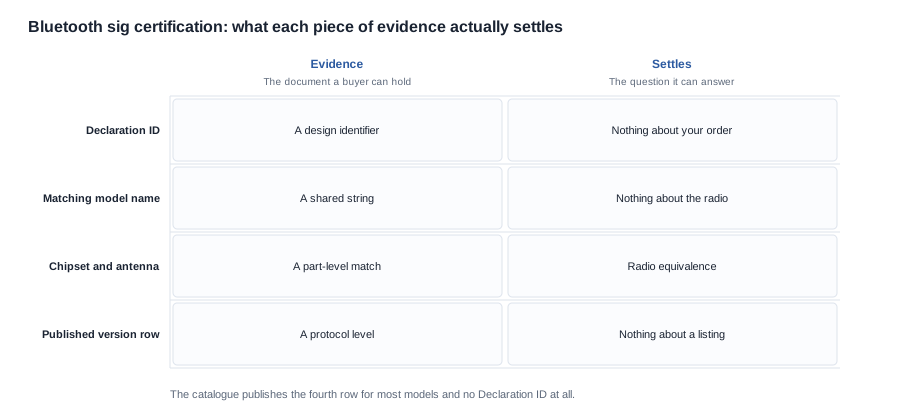
What a Bluetooth SIG qualification is made of, and the version row it does not replace
The three artefacts behind a listing
A qualification rests on three things, and a buyer needs all three before the listing can be matched to an order. The first is the Declaration ID, which identifies the declaration itself and is the reference that makes the entry findable in the public listing. The second is the Qualified Design ID, which identifies the design that was qualified rather than the product that was sold. The third is the underlying test report against the adopted Bluetooth specification, which the member holds and which is the document that actually supports the entry.
Underneath those sits a membership obligation. A company that adopts the Bluetooth specification qualifies a design against it, and doing so requires company-level membership with an annual commitment. That is why a qualification can be real for a supplier and still be unusable for a buyer: the buyer may need a design the supplier has never qualified, or a variant of a qualified design, and the answer to that request is not a fee for a new certificate but a new qualification against a new design.
The third artefact is the one most often skipped, and skipping it is what produces the bad surprises. A listing that names a Declaration ID but arrives without the test report behind it is a claim that the design passed, with nothing to inspect.
Why a published version row is not a qualification
Our catalogue publishes a Bluetooth version row for fourteen models: the AR glasses entry, the A07 children's audio model, the K02 and the LC-105-2, the LC-105-1 and the D17, the YKC02 and the D11, the G07 and the D12, the YK12 and the K01, and the ZH12 and the photochromic entry. It is a protocol-level specification fact, and it is useful — it tells a buyer what the product speaks and lets two products be compared on that axis.
It is also the single most common source of over-reading in this category. A version row says what the radio supports. It does not say that any design was qualified, it does not say who qualified it, it does not say against which version of the specification the qualification was run, and it says nothing about the antenna or the transmit power. Treating "V5.4" on a product page as evidence of a Bluetooth qualification is the error that turns into a finding at a customs inspection or in a customer due-diligence questionnaire.
What the catalogue does not publish
Two absences are worth stating plainly, because both shape what a buyer has to ask for. First, no Declaration ID, no Qualified Design ID and no listing reference is published for any model. Second, and more awkwardly for the camera range, eleven of our models publish no Bluetooth version row at all — the V03 and the V06, the MT5 and the L2 Utral, the CY05 and the MT6, the KY06 and the L1 Pro, the V03 Pro and the CY03, and the S7.
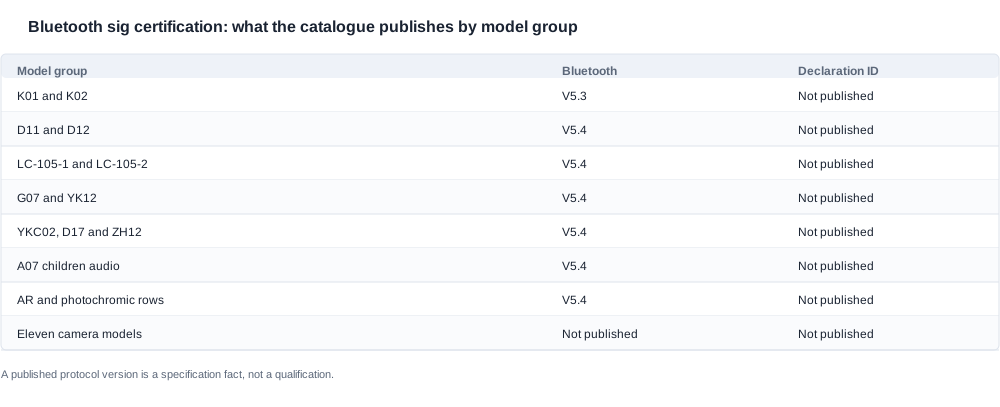
For those eleven, the protocol level itself is not a published fact. That is not a deficiency in the product; it is a gap in the specification sheet, and it is a gap you have to ask about rather than one you can read off. It also means the camera models are where the version-row argument cannot even be entered, so the whole question has to be settled at the level of the listed design.
We publish other things about these models that are not wireless facts: the V06 and the S7 carry an IP54 marking, the MT6 publishes a 158 g weight for the glasses body with a 1200 mAh folding charging case, and the catalogue publishes no capacitive touch row for any model in the range. Each of those is a genuine published specification, and each is also something a buyer should not mistake for a radio fact.

The reader, and the question they are actually carrying
Who this is for and what they need to decide
The reader is someone buying on the brand side, a channel buyer or an importer who has a shortlist of wireless products and has to decide which of them they can put on a market without a qualification gap. Some of them are opening a new programme and have to write the requirement into the specification before anything is quoted. Others already have a product in the channel and have been asked by a retailer's compliance team for the qualification evidence, and they need to work out which of their suppliers can actually produce it.
The question underneath is never "is Bluetooth certified". It is whether the listed design corresponds to the units in the cartons, and whether the party selling them is the party that holds the qualification. Those are two different checks, and a listing answers only the first if the second is assumed.
What the reader is managing is not a technical risk in the abstract. It is a document that has to exist when a customer's compliance team asks, on a timeline the customer sets and the buyer does not control. A supplier who cannot produce the evidence in a day is a supplier who will miss the questionnaire, and the consequence lands on the buyer's relationship with the retail customer rather than on the supplier's sales pitch.
The commercial backdrop to a qualification request
The reason two quotations for a wireless product can differ widely has little to do with the radio itself and a great deal to do with where in the product lifecycle the qualification was done. A design that has already been qualified can be reused across a product family and across a production run at no further regulatory cost. A design that has not been qualified has to be put through the test and the listing process before it can be sold, and that work is a fixed cost per design rather than a variable cost per unit.
That is the mechanism behind most of the price spread a buyer sees. The quotation for the unqualified product looks lower, not because the product is cheaper but because the qualification work is not in it yet. Comparing the two on unit price alone compares a product that can be sold with a product that cannot, and the buyer who takes the lower number inherits the schedule risk.
The second commercial feature is that a qualification attaches to a design, so a buyer who changes the chipset after qualification has purchased a radio cost and thrown the regulatory work away. The chipset decision is therefore a compliance decision, and it belongs in the specification discussion rather than in the engineering discussion that follows it.
The lines that can be tested before a deposit is released
The testable lines and the shape of a weak answer
Matching a listed design to an order is an evidence problem, and the table below sets that evidence out in the order it has to be gathered. Each line carries how it is measured, the line it has to meet and the shape a weak answer takes, so the questions can go into a supplier questionnaire unchanged. A response that cannot be answered in this form is itself the finding, because it shows which of the three levels the supplier has not reached.
| Line to test | How it is measured | The line it has to meet | How a weak answer shows up |
|---|---|---|---|
| Declaration ID on the document | Read the identifier from the declaration and search the public listing with it. | The identifier resolves to an entry that is public and findable without the supplier. | A reference described in prose that cannot be pasted into a listing search. |
| Qualified Design ID | Compare the design identifier against the design described in the order. | The design identifier is present and is not a product family label. | A Declaration ID with no separate design identifier behind it. |
| Listing date and currency | Read the publication date and the product status shown on the entry. | The entry is current and has not been withdrawn or made inactive. | An entry dated before the product revision the buyer is ordering. |
| Chipset in the qualified design | Ask which chipset the qualified design used and compare with the bill of materials. | The chipset in the listing is the chipset in the order. | A listing for a design using a different radio module. |
| Antenna type and placement | Ask how the antenna is built and where it sits in the temple. | The antenna is the one the qualified design used, or a change is requalified. | A claim that the antenna does not affect the design, made without evidence. |
| Transmit power | Ask the power class and whether it was configurable at qualification. | The power setting in the order is inside the qualified range. | A design qualified at a lower power and shipped at a higher one. |
| Firmware branch | Ask which firmware branch was qualified and what is shipped today. | The shipped firmware is inside the qualified scope, or the scope is requalified. | A firmware version that changed after the listing was published. |
| Protocol version | Compare the published version row with the qualified design. | The two are consistent, and the row is not treated as a qualification. | A version row presented in place of a declaration. |
| Adopter identity | Ask which legal entity holds the membership and made the declaration. | That entity is the one supplying the product or is named in the supply agreement. | A listing held by a company with no contractual relationship to the seller. |
| Test report behind the entry | Ask for the test report for the qualified design. | A document exists that names the design and the specification version. | A listing offered without the report that supports it. |
| Configuration and region variants | Ask whether colours, frequency bands or regional variants were qualified. | The variant in the order sits inside the qualified scope. | A regional variant shipped outside the scope of the listing. |
Three of these rows cannot be compared between suppliers without care, and treating them as like-for-like is where a specification gap gets invented. A declaration identifier issued under one naming regime is not comparable with an identifier issued under another. A test report against one version of the specification is not comparable with a report against a later version, because the specification moves and the report is dated to a moment in it. And an identifier for a design says nothing about the firmware, the antenna or the configuration a buyer will actually ship.
Why the camera models are the hardest case in our own range
Eleven camera models publish no Bluetooth version row, which makes them the awkward corner of the range for exactly the question this article is about. For an audio model the buyer can at least establish the protocol level from published material and then ask whether a design matching that configuration has been qualified. For a camera model there is no published protocol level to match against, so the request has to name the radio configuration directly and the response has to supply it.
The camera models also carry the additional burden of a firmware and data dimension. A product with an imaging sensor is a product whose radio is likely to be joined to an application, and a listing that covers the radio says nothing about that application, the pairing behaviour or the update path. Those belong in the cybersecurity evidence rather than in the qualification request, but a buyer who keeps the two files apart will end up with a radio answer and no operating answer.

Routing the qualification question through three checks
The request that produces a document rather than an assurance
Verification here is a document exercise with a physical and contractual check at the end, and it works best when it runs in a fixed order — before the configuration is frozen, before the deposit is released, and before the order is placed with a supplier who has not yet been asked to produce anything.
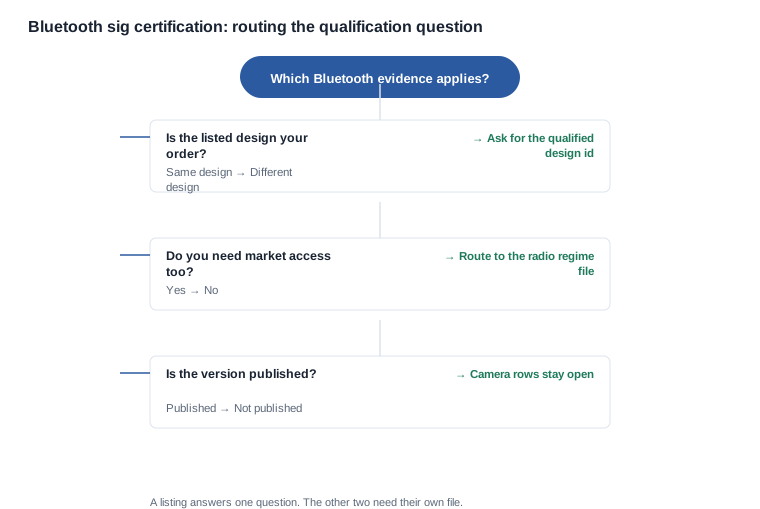
-
Ask for the declaration itself as a document, with the Declaration ID printed on it. A supplier who replies with a description of the qualification process has not answered, and is asked again in a form that requires a document.
-
Search the public listing with that identifier yourself. This is the one check in the whole chain that a buyer can complete alone, and it is skipped more often than any other because it takes two minutes and an internet connection.
-
Compare the Qualified Design ID with the configuration in your order, working through the chipset, the antenna and the transmit power rather than the model name.
-
Ask for the test report behind the listed design, and check that it names the design and the version of the specification the design was qualified against.
-
Ask which legal entity holds the membership and made the declaration, and confirm that entity is the one you are contracting with or is disclosed in the supply agreement.
-
Ask whether the specific variant you intend to order — colour, frequency band, region, firmware branch — falls inside the scope of the qualified design, and get the answer in writing rather than as a reading of the listing page.
-
Ask what happens to the listing if the radio configuration changes, and get a written commitment that the change is notified to you before it ships.
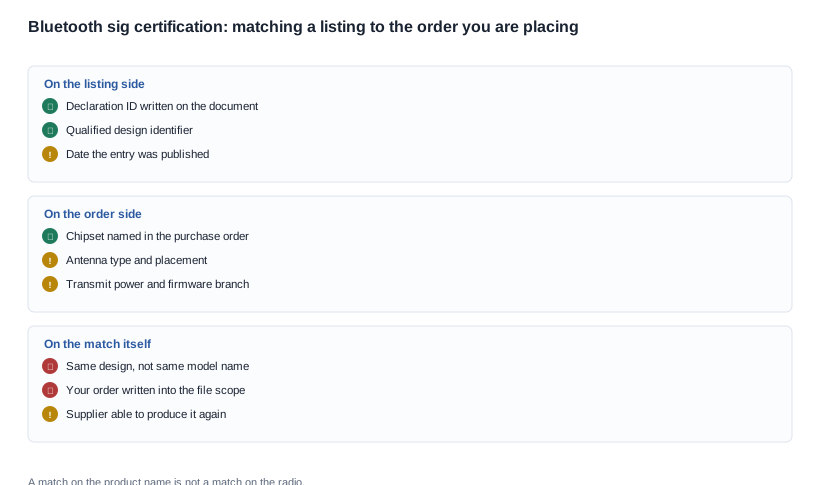
The checklist above is arranged by who holds the evidence rather than by supplier, because the levels fail independently. Listing-side documents fail by pointing at a design you are not buying. Order-side documents fail by being missing from the specification. Match-side documents fail by equating a shared product name with a shared radio.
The two-minute check that catches the most
If only one check gets made, make it the one that reads the model designation on the declaration against the model designation in the order and then searches the public listing with the identifier. It costs two minutes, it needs nothing from the supplier beyond the document, and it is the check that most often finds that a listing exists for a design the buyer has never seen. It is also the check that most often finds the opposite — that the listing exists, is current, and covers the design, and that the file was simply never assembled.

Where a qualification goes wrong in a sourcing programme
The listing that covers a sibling design. Two products share a marketing name and a housing, and one of them was qualified. The buyer assumes the qualification follows the name. The symptom is a finding during a retailer's conformity review, long after the units are in the channel. The cause is a specification written in product names rather than in radio configurations. The prevention is to make the chipset, the antenna and the firmware branch controlled items on the purchase order.
The version row read as a qualification. A product page publishes a protocol version, the buyer treats it as evidence, and the retailer asks for the declaration. The symptom is a delay of weeks while a document is assembled that nobody believed was missing. The cause is a loose use of the word certified. The prevention is to ask for the declaration in the first supplier questionnaire, when the cost of producing it is an email rather than a delay.
The firmware that moved after the listing. The design was qualified on a firmware branch, the branch was later refactored, and the listing still describes the earlier scope. The symptom is a question about whether the shipped software is the qualified software. The cause is a firmware release process that does not know a radio design has a compliance boundary around it. The prevention is a release note requirement that says whether the change touches qualified scope.
The listing held by somebody else. The qualification was made by an entity that has since been restructured, or by a design house that sells to the factory without the factory knowing which design was used. The symptom is a request that no one at your supplier can answer. The cause is a supply chain that passes the product without passing the compliance context. The prevention is to name the adopter in the supply agreement and to require notice when the declaration is withdrawn.
The range where nothing is published. Eleven camera models publish no Bluetooth version, no declaration and no listing reference. The symptom is a quotation that compares a fully evidenced audio model against a camera model whose radio position is simply unknown. The cause is a specification sheet that records what is easy to record. The prevention is to ask the question per model rather than per range, and to expect that some models will need the answer compiled for them.
Rows like that are unanswered questions, not defects in the radio. They are reasons to ask for the document earlier than feels necessary.
What the chipset choice is worth in a negotiation
The commercial conversation in this category has a short list of genuinely movable items and a longer list of fixed ones. The chipset is movable in the sense that it is a design decision, and it carries the qualification cost with it — so a buyer who expects to change the radio in a later product revision should expect to requalify, and should price that into the revision plan rather than discover it. The firmware freeze point is movable and is worth negotiating explicitly, because the cost of a qualification invalidation falls entirely on the buyer. The supplier's willingness to name the qualified design in writing is movable, and it is the cheapest of the three to obtain.
What is not movable is the membership itself, the test cost for a new design, and the time a qualification takes against a specification that moves underneath it. Argue hard about those and the negotiation is spent; the total cost of the programme is driven by how many designs you create and when you freeze them, not by what a single qualification costs.
The useful negotiation is about scope and reuse. A design qualified for one model that is reusable across a family is worth a great deal more than a design qualified for a single order, and the buyer who says so early gets a supplier who is willing to qualify against the family rather than against the sample.
One programme, two model families, and the limits of what we publish
A hypothetical decision, step by step
What follows is a worked scenario, not a customer story. No client is described and no figures are claimed; the models, the quantities and the markets are assumed so that each decision, and the reason behind it, can be followed in order.
The scenario. A buyer is opening a programme with two model families: an audio model for a retail channel and a camera model for an enterprise channel, with a first order in the low thousands of units and a second revision planned within the year.
Step one, the audio model. The published row gives a Bluetooth version, so the specification can name the protocol level. The request goes out asking for the declaration and the design identifier for that radio configuration. A supplier who returns a document naming a design moves forward; a supplier who returns a statement about its Bluetooth process does not, and is asked again.
Step two, the camera model. There is no published version row, so the request has to name the radio configuration directly and ask for the declaration covering it. The request also carries the imaging and application questions, which belong in the cybersecurity file and would otherwise be answered nowhere.
Step three, the reuse question. Both models are checked against the same supplier, and the buyer asks whether the camera model's design is covered by the same qualification as the audio model's, or whether it is a separate design with a separate cost. The answer determines whether the second revision inherits the first one's work or repeats it.
Step four, the freeze. Before the order is placed, the buyer asks what the supplier will and will not change in the radio configuration during the production window, and asks for the change to be notified before it ships. The cost of that clause is nothing. The cost of not having it is a requalification.
What we publish, and what we will not invent
We publish the Bluetooth version row where the catalogue carries one, and we mark clearly the models where it does not. We publish no Declaration ID, no Qualified Design ID and no listing reference for any model, because we do not hold them to publish and we will not present a published protocol version as a qualification.
What we can do for a specific model is confirm the radio configuration and the protocol features the product uses, so that a buyer can establish the scope of a qualification rather than assume it, and we will tell you plainly whether the catalogue row for that model exists or not. Where the answer sits with the party that made the declaration, we will say so instead of filling the gap with a typical value. A buyer who builds a tender file on an inferred declaration identifier finds the error in a customer questionnaire, where the correction costs far more than the question would have.
The next action for this week
If you are working on this now, the next step is short and specific. Send the models, the quantities and the target markets, and ask for the declaration, the design identifier and the test report for each radio configuration rather than for the range. We will tell you which of our rows exist, which models carry no published Bluetooth version, and where the evidence has to come from the party that made the declaration.
The Bluetooth SIG page sets out the membership and the listing structure. Bluetooth SIG certification explained covers the process, Bluetooth SIG certification requirements covers what a buyer has to obtain, and Bluetooth SIG certification who can do it covers the practical routes. For the rest of the file, the certification checklist page holds the wider set, the FCC compliance page covers the parallel on the radio side in the United States, the EU RED directive scope analysis article covers the European route, and smart glasses GPSR and the other rules and the RoHS and REACH regimes cover how a wireless file meets the rest of a market entry.
Send the model and the radio configuration, and we will tell you what our catalogue settles and what has to be requested.


