

Durability is the wrong first question for this product, and that is a practical point rather than a rhetorical one. A frame that carries an amplifier and a transducer has three subsystems, and the two that fail most often in service are not the ones a drop test examines. Asking how strong the frame is tells you nothing about the part of the product that decides whether the person using it still hears anything after eight months.
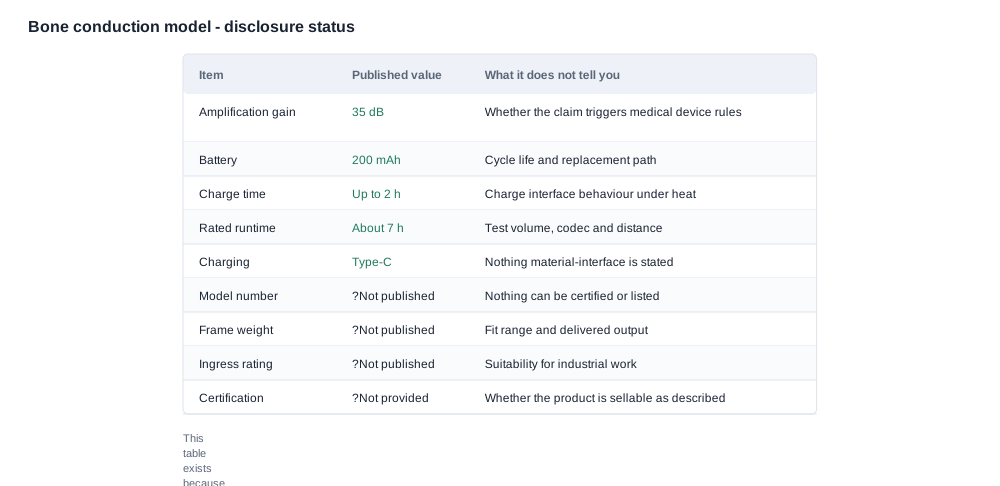
The published specification for this entry is short: an amplification gain of 35 dB, a 200 mAh cell, a charge time of two hours or less, a rated runtime of roughly seven hours and Type-C charging. There is no model designation attached to it. That single fact has a direct effect on the durability question, and it is worth stating at the outset, because a durability claim has to name something. A claim about durability that cannot name the product it applies to is not a weaker claim; it is not a claim at all.
This article is about what bone conduction glasses durability actually depends on, what evidence would make a durability statement defensible, and how a buyer can close the missing rows with a sample order and a written question list.
Bone conduction glasses durability: what fails first
The order of failure in this product is not the order most buyers assume. Here is the sequence, with the reason it happens and the evidence that would detect it.
The coupling path degrades quietly
The transducer is pressed against the temporal bone, and the delivered output depends on that contact. As the contact surfaces wear, change shape or lose their consistency, the coupling falls, and the person using the frame hears less. Nothing looks broken. There is no visible crack, no error, no indicator, and the product continues to report a normal operating state.
This is the failure mode that a warranty claim will not catch either, because the product is not broken in the sense the claim form understands. The buyer's evidence has to be a measured output, compared against a baseline, at a defined point in the product's life.
The contact geometry moves before anything breaks
Temple length, contact position and frame stiffness determine the coupling, and a frame that is used daily and stored in a case develops a geometry that is not the geometry it left the factory in. This is a slow failure and it is common: the shape changes, the coupling changes with it, and the reported symptom is that the product has become quieter.
This is why a durability programme for this category has to include a geometry check and not only a strength check. A cycle count on the hinge and temple joint does not detect a coupling drift, because the joint is still nominally within tolerance.
The electronics fail in the ordinary ways, and the data exists
The third subsystem is the battery and the electronics: a 200 mAh cell charged over Type-C, with roughly seven hours of rated use. This is the only subsystem where a supplier is likely to hold real engineering data, because the figures are standard product data and the cell is a purchased item with a test summary.
The reason the other two subsystems are so much less well documented is worth stating plainly, because it explains the shape of the gap rather than justifying it: the acoustic path in this category has no published reference methodology, so the measurements that would describe it are not standard practice and have not been standardised. The catalogue reflects that. Across the models it lists, it publishes a weight exactly once — 158 g for the MT6 glasses body, which includes its cell and camera and excludes its folding charging case — and it publishes an ingress rating exactly twice, on the V06 and the S7. For this entry it publishes neither, and the absence is informative: the rows exist in the catalogue's vocabulary, and this product does not carry them.
Three subsystems, one of them structural
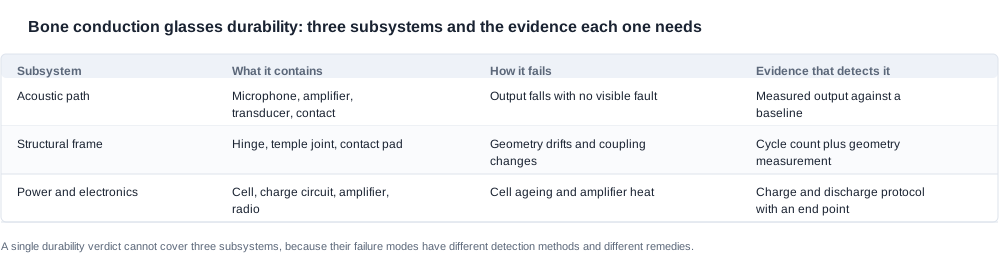
The three subsystems fail differently, and a durability programme that treats them as one produces a report that documents almost nothing.
The acoustic path
The signal chain is: microphone, amplifier, transducer, contact surface, skull. Every link in that chain is a place where output can fall without any part being visibly damaged.
What is not published for this product: the frequency response, the gain conditions, the measurement location, the microphone pickup distance, any noise figure, and any ageing or cycle data for the transducer. The absence of ageing data is the one that matters most for a durability programme, because ageing data is precisely the row that tells you whether the output stays constant over the service life the brand is going to claim.
The structural frame
The hinge, the temple joint, the contact pad and the interface between the pad and the electronics. This is the part a drop test and a hinge cycle count actually examine, and it is the part most likely to be in good order, because a frame is a mechanically simple object compared with an amplifier.
The structural rows that are not published: the frame weight, the temple length, the contact pad material, the hinge cycle rating, and any drop rating. A buyer should still ask for the cycle figure, because "the frame is strong" is a statement about a past test rather than a specification.
The power and electronics subsystem
The cell, the charging circuit, the interface, the amplifier and the radio. The published row covers the cell capacity, the charge ceiling, the runtime rating and the charging interface, and the catalogue publishes a charge time for every product it lists, so the absence of a charge figure is not a gap in this product.
What is missing is the durability-relevant half: cycle life, the replacement path, the behaviour at end of discharge, and the thermal behaviour of the amplifier during a long session. A 35 dB gain that runs continuously is a heat question as well as a battery question, and no thermal data is published.
Why the three need separate acceptance values
A single durability verdict cannot cover three subsystems, because their failure modes have different detection methods and different remedies. The structural subsystem can be verified by cycling and by inspection. The power subsystem can be verified by a charge-discharge protocol with a defined end point. The acoustic subsystem can only be verified by a measured output at a defined coupling condition.
A buyer who asks for "durability data" without specifying which subsystem is talking about will receive a drop test, a cycle count and a cell test summary, and will have verified almost none of what the product actually does.
Acceptance values for a durability claim
A durability claim becomes credible when three things are attached to it: the measurement, the pass condition and the failure consequence. Here is the set of rows that would have to exist for this product, and what each one settles.
The six rows a claim needs
| Claim a buyer will expect | What supports it | Current status for this entry |
|---|---|---|
| Survives daily use | Cycle count on the hinge, temple joint and contact pad | Not published |
| Output stays constant over time | Gain measurement before and after ageing | Not published |
| Performs across users | Delivered output at the extremes of the adjustment range | Not published |
| Survives the intended environment | Ingress rating with a test report | Not published |
| Battery holds up over its life | Rated cycle life with an end-point criterion | Not published |
| Can be sold as described | Conformity route for the claimed function | Not provided |
Every row on that list is empty, and that is the actual state of the durability story for this product. It is more useful to a buyer than a classification we could invent, because each empty row is a request that can be issued and answered.
The three acceptance values worth setting yourself
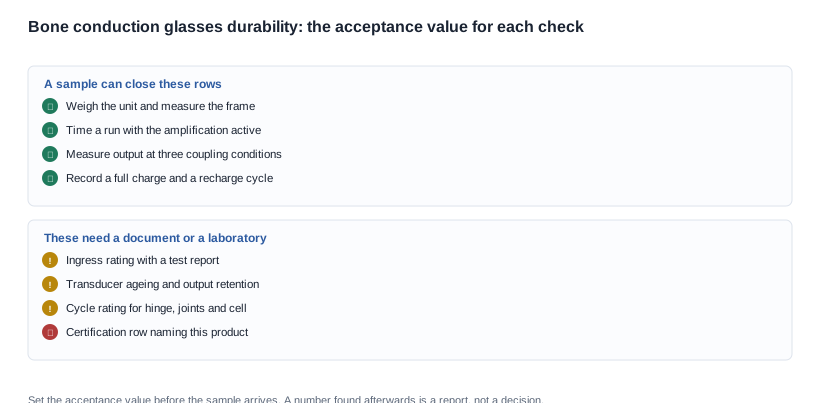
Three of those rows can be tested by a buyer with a sample, and the buyer should set the acceptance value before the sample arrives rather than after the first measurement.
The output retention value. Measure the delivered output at a defined coupling condition on a new unit, then repeat after a defined period of use. The acceptance value is a retention percentage, agreed in advance, with the measurement condition written next to it. Without the advance decision you will find a number and then decide it is acceptable, which is the mechanism by which a durability programme produces a report rather than a decision.
The geometry value. Measure temple length and contact position on the new unit and repeat after use. The acceptance value is a tolerance, and it has to be a tolerance in millimetres rather than an impression, because the coupling is what the tolerance protects.
The runtime value. Measure the runtime on the sample with the amplification stage running at working level, and compare it with the published rating of roughly seven hours. The acceptance value is the proportion of the published rating that must hold. This measurement also settles the test-condition question that the catalogue leaves open, because the number you record is a number with its condition attached.
How to choose between a durability claim and a warranty promise
A durability claim and a warranty promise are different instruments, and a buyer who treats them as interchangeable ends up with one of them empty. A durability claim is a statement about the product and it belongs in the specification, attached to evidence. A warranty promise is a statement about the relationship and it belongs in the contract, attached to a remedy.
The trade-off between them is where the cost sits. A durability claim with no evidence is a liability in a dispute, because the brand has set a standard it cannot demonstrate. A warranty with no durability evidence is a cost the brand carries without knowing which units will fail, which is why a warranty on a product with an unpublished service life has to be priced as an open exposure rather than as a calculated one.
How to choose between them is a function of who carries the cost of an early failure. In a channel where the brand owns the relationship with the end customer, the durability claim is the instrument that protects the brand, and the warranty is the instrument that protects the customer. In a wholesale arrangement where the distributor absorbs returns, the reverse holds and the warranty becomes the primary control.
Either way, the underlying evidence is the same, which is the practical point: a supplier who can produce the measurements can support either instrument, and a supplier who cannot support either is telling you something about the product rather than about the paperwork.
The test conditions that have to be written down
Three conditions turn a measurement into a specification, and every one of them has to be captured at the same time as the number.
The coupling condition. Where the transducer sat, how firmly it was held and how the frame was supported. A measurement without it is not comparable with a second measurement.
The input condition. The signal, the level and the source distance. A gain measurement without an input condition is a ratio with nothing to divide by.
The state of charge. Whether the cell started full, and at what point the run was called finished. This is the condition that separates a rated runtime from a measured one, and it applies to the roughly seven-hour figure in this catalogue as much as to any measured value.

The sample tests that close the missing rows
A sample order is the cheapest instrument available for closing the physical gaps, and the tests below are ordered so that each one either closes a row or proves that the row cannot be closed without a document.
The three measurements that close the most rows
Weigh the unit and measure the frame. This closes the weight row and the geometry row in one pass, and it produces the temple length and the contact position that the coupling depends on. Record the weight of the complete unit, because no charging case is published for this entry and the figure is therefore a straightforward frame-and-electronics number.
Run the power protocol. A full charge, a timed run with the amplification stage active, a recharge, and a repeat. This produces a measured runtime, a measured charge time and a measured behaviour at the end of discharge, and it tests the two rows the catalogue publishes rather than merely repeating them.
Take an output measurement at three coupling conditions. Looser, nominal and firmer. This produces the delivered-output range across the adjustment range, which is the row that a drop test and a cycle count will never produce, and it is the row that decides whether a single unit serves a channel.
The two tests that need a document, not a sample
Ingress and environment. No ingress rating is published, and the absence is not a low rating. If the intended deployment involves weather, dust or washdown, the only route to a defensible statement is a test report for this product, and the catalogue's own precedent is instructive: the V06 and the S7 carry IP54, which is a per-model figure on a per-model page.
Ageing and cycle life. No ageing data is published for the transducer, no cycle rating for the joints and no cycle life for the cell. These are laboratory rows, and they belong in a supplier request rather than in a sample protocol.

What to ask the supplier in writing
The physical checks above are the buyer's own work. Four requests are not, and they should be issued together rather than one at a time, because the supplier will schedule the laboratory work and a single-request approach slows that down.
- The cycle rating for the hinge, the temple joint and the contact pad, with the failure criterion stated. A cycle count without a criterion is a quantity rather than a service life, and the criterion is what makes it usable in a warranty conversation.
- The transducer ageing data: measured output at a defined coupling condition, before and after the ageing protocol.
- The ingress rating and the test report for this product, if the deployment involves weather, dust or washdown. The catalogue's own precedent is the V06 and the S7, which carry IP54 on their own pages.
- The cell cycle life with the end-point criterion, and the replacement path if the cell is not user-replaceable.
Ask these before you order the first production quantity, not after. A durability row that arrives with the first shipment is a row you cannot use in the listing, because the listing is written and printed before the shipment lands. The pitfalls in this category are almost always scheduling ones: the request is reasonable, the answer is plausible, and it arrives three weeks after the artwork was approved.
A review worked through
This is a hypothetical review rather than a client project, and it is written to show the sequence rather than to report a result.
Assume a buyer with one sample, a deployment in a training environment, and a listing draft already written. The buyer has set four acceptance values in advance: output retention of at least ninety per cent of the baseline at the end of the review period, a temple-length tolerance of one millimetre, a measured runtime of at least six hours with the amplification stage active, and a recharge behaviour that does not require the unit to be returned to a bench.
Day one is the baseline. The unit is weighed and measured, the contact position is recorded, and a full charge is timed. The measured charge time comes out close to the published ceiling of two hours or less, which confirms the row and tells the buyer that the published figure is an upper bound rather than a typical value.
Day two is the output measurement. Delivered output is measured at three coupling conditions, and the range between the loosest and the firmest is wide enough to matter. That single measurement is the most commercially valuable result of the review, because it tells the buyer that the listing cannot promise one level of output for everyone and that the wording has to describe a range.
Day three is the endurance run. The measured runtime with the amplification active is below the published rating of roughly seven hours, which is expected, because the published figure carries no test condition and the review supplies one. The buyer records the measured figure with its condition attached, which is the number the listing can defend.
Day six is the documents. One request, naming the product and the four rows. The answer supplies the cycle figures and the cell data, and does not supply an ingress rating. That converts the ingress question from a product limitation into a dated item, and the buyer can now decide whether the deployment can proceed without it.
The result is a listing with a narrowed output claim, a measured runtime with a condition, one environmental question scheduled, and a geometry tolerance that the quality team can check on incoming goods. None of those decisions needed a price negotiation, and every one of them needed the sequence above.
Two failure shapes worth naming in advance
Naming a failure in advance is a cheap way to avoid accepting a product into a programme with a known structural problem. Two shapes dominate this category.
The quiet degradation
The device keeps working, keeps charging, keeps reporting normally, and delivers less than it did. The report reaches the brand as a quality complaint rather than a defect, and it is usually closed without a root cause because no fault was found. The prevention is a periodic output measurement against a stored baseline, which is why the retention value above is worth more than any mechanical test.
The claim that outruns the evidence
The second shape is commercial rather than physical: a listing that promises a service life, an environmental tolerance or an output stability that no document supports. The catalogue cannot support such a claim for this entry, because the relevant rows are empty. A brand that writes it anyway is making a claim it will have to defend in a dispute, on evidence that was never collected.
Neither shape is a reason to avoid the product. Both are reasons to buy it against a written acceptance sheet, with the conditions recorded, rather than against a catalogue page.
What we can and cannot stand behind
This product's hardware is credible and its durability documentation is not yet available, and we will not present the second as though it were the first. We will publish the 35 dB amplification gain, the 200 mAh cell, the charge time of two hours or less, the rated runtime of roughly seven hours and the Type-C charging interface, because those are documented. We will not publish a durability class, an ingress rating, a cycle count, a frame weight, a temperature range, a certification status or a model designation, because the catalogue does not carry them for this entry.
We will also not attach a hearing-improvement claim to the amplification figure, and we will not describe the product as a hearing aid. We hold no clinical data, no test protocol and no regulatory assessment for this product, and the determination of how it must be described in a given market belongs to a legal adviser qualified in that market.
What we can do is tell you which of the six rows above a sample can close, which need a laboratory, and which need a decision from a compliance team, and we can tell you what the published bone conduction specification does and does not contain. The certification checklist sets out the document set that a launch programme has to assemble, and the medical device boundary guidance covers the claims side of the same decision.
Related reading
- The published rows for this entry — bone conduction glasses
- The document set a launch has to assemble — certification checks
- The claims side of the same decision — medical device boundary
Send us the intended environment, the expected service life and the deployment volume, and we will tell you which of the six rows we can evidence in writing and which have to come from a laboratory or a test house.


