
The conclusion first: we hold no verifiable market figure for bone conduction glasses, and for this category that absence matters less than it usually would, because the binding constraint on this market is regulatory rather than demand-shaped. A category where a seller's ability to describe the product legally is the gate does not behave like a category that grows on a curve. Demand you cannot legally serve is not demand.
Our published documentation for this platform is one line: an amplification gain of 35 dB, a 200 mAh cell, a charge time of two hours or less, a rated runtime of roughly seven hours and Type-C charging. There is no model number attached to it, no certification status and no disclosed customisation capability.
This article is therefore not a forecast, and it does not contain a market size, a growth rate or a segment share. It contains two things that are more useful to a buyer: a method for interrogating any market figure you are shown, including the ones we would show you if we had one, and a set of structural facts about this platform that are knowable today and that determine whether the product can be sold at all.
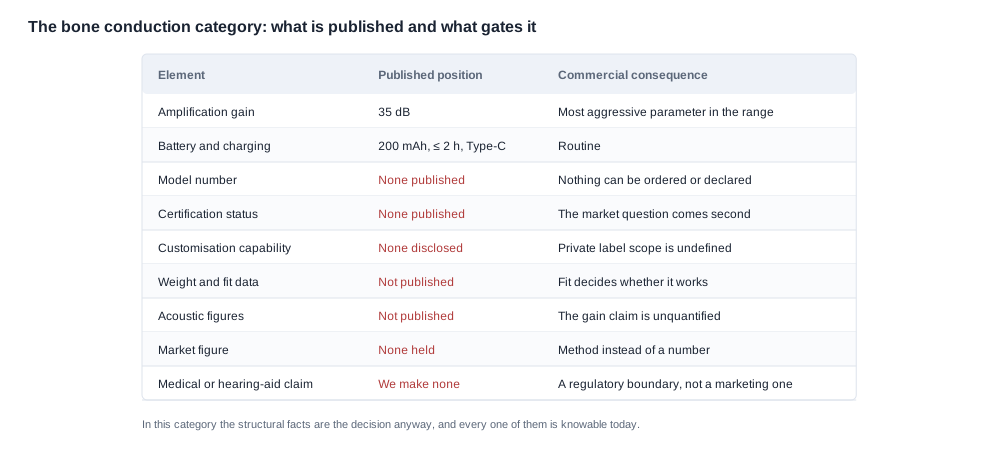
Bone conduction glasses market trends: the four questions
Any market figure offered to you in this category, ours or a competitor's, is answerable to four questions. A figure that survives all four is worth using. A figure that fails any one of them is not a forecast, it is a construction.
Is the figure revenue or shipments?
The two answer different questions and differ by a large factor. Revenue counts what a buyer paid; shipments count what was sent. A category that is genuinely early in its development, where the unit price is high and volumes are low, is one where the two diverge most. A figure quoted without stating which one it is cannot be checked against anything, including another figure from the same source a year later.
Does the figure include display-type products?
This is the single most important exclusion in this category. Almost every published estimate for the broader smart glasses market includes display-based products, which are a different product with a different price structure, a different channel and a different replacement cycle. A figure for the wider market that has not been adjusted for that inclusion describes a market that bone conduction glasses are not part of.
What is the time basis and the publication date?
A market figure is a statement about a period. A figure without a stated period cannot be compared with a figure without a stated period, because they may cover different years, different half-years and different definitions. The publication date matters separately: a report published after your own planning horizon can tell you what already happened, not what will.
Is there a hearing-assistance segment in the data at all?
This is the question that catches most figures offered in this category, and the honest answer to it, for a supplier who offers one, is usually that there is not. The hearing-assistance and ambient-amplification sub-category is small enough that segmenting it produces a number nobody could defend, so the common route is to take a wider smart-glasses figure and multiply. A buyer who has asked this question has established whether the number is a measurement or a multiplication, and that single question does more work than any market report.
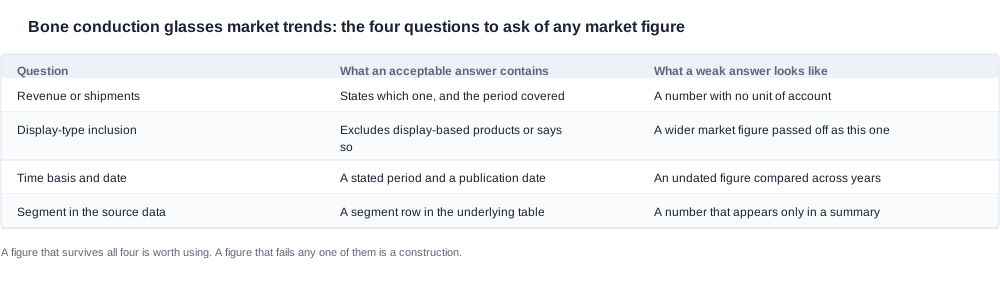

Why a market figure is not the decision
The temptation in a market article is to treat the market question as the primary one. In this category it is the second one, and the order is worth stating explicitly.
The first question is whether the product can be built as a private-label item
A product with no model designation cannot be ordered against, cannot be declared in a customs file and cannot be printed on artwork. Until that row exists, the market question is a question about a product that does not yet exist commercially, and no forecast changes it. This is knowable today, and it is a fact rather than a projection.
The second question is whether the intended claim is sellable
The 35 dB figure is the most aggressive parameter in this range, and it cuts both ways. It is a genuine differentiator against ordinary open-ear audio, and it is also what makes the compliance question material rather than administrative. A brand whose channel is a health channel and a brand whose channel is a gear channel are looking at two different products with the same hardware, and only one of them has a straightforward path to market.
The regulatory line is drawn differently in different markets. In the United States, the over-the-counter hearing aid framework defines a hearing aid as an air-conduction device for adults with mild or moderate hearing impairment, and places personal sound amplification products outside that definition, so a bone-conducted product is not a hearing aid by that definition. In Europe, the medical device rules and the general product safety framework both apply to how the product is described. Our medical boundary guidance covers where the line sits, and the open ear comparison sets out how this product differs from the audio range on function.
The third question is what the buyer has already seen
A market figure is a secondary source. A brand's own enquiry log is a primary one, and it is available without anyone's permission. The number of enquiries a company has actually received for this category, what those enquiries said they wanted, which channels have confirmed the need, and what a comparable product's return rate has been for a brand that has actually sold one, are all knowable, all free and all more decision-relevant than a forecast.
The two questions buyers ask first, and why they are the wrong ones
Two questions dominate the first call in this category, and both of them are worth redirecting rather than answering.
"How big is the market?" The honest answer is that we hold no verified figure for it, and the second-order answer is more useful: the question is answerable in a form that decides nothing, because a market that cannot be described legally is not addressable. A buyer who needs a number for a business case can have a different number, built from their own channel and their own enquiries, and it will be smaller and more useful than a segment figure. The questions to ask are not about the market but about the route: which destination markets, which claim, which channel, which volume.
"How fast is it growing?" Growth figures are the most fragile numbers in any category, because they compound every weakness in the underlying definition, and in a category where the underlying definition does not exist the fragility is total. A growth rate for a segment that is not measured is a rate applied to a number that was constructed.
Both questions are legitimate in a different order of the programme, once the compliance route is settled and the product has a model designation. That is not a way of avoiding them; it is a way of making them answerable.
Three structural facts knowable today
These are the facts that can be established from published material, without a subscription to anything, and they are the ones that should carry the weight in a decision.
The catalogue's own composition shows where the product sits
The catalogue lists 28 product entries, and their structure is informative even without a market figure. Eleven are camera models, eight are audio models, three are sport models and three are children's models, and three carry no model name at all — the AR entry, the AI electrochromic entry and the bone conduction entry that is the subject of this article.
That composition is a screening structure rather than a market statement. A buyer can use it to ask which part of the catalogue a new request belongs to and what kind of documentation that part carries, and it says something real about where this product sits: it is the only entry in the catalogue whose published specification is an acoustic performance figure rather than an electrical or imaging one.
The documentation for this platform is the thinnest in the catalogue
No model number, no certification status, no disclosed customisation capability, no frame weight, no acoustic figures beyond the ratio, no geometry data. For comparison, the catalogue publishes a weight once, for the MT6 glasses body at 158 g excluding its folding charging case, and an ingress rating twice, on the V06 and the S7. For this entry it publishes neither, and the absence is informative in the same way: those rows exist in the catalogue's vocabulary, and this product does not carry them.
How the rest of the catalogue documents itself
The way the other entries are documented is a useful reference point, because it shows what a completed product page looks like in this range and how far this one is from it.
The eight audio models publish a consistent set of rows: a radio version, a cell, a charge time, a charging method and a runtime. The K01 and the K02 carry V5.3 radios with 90 mAh × 2 cells; the D11 and the D12 carry V5.4 radios with 100 mAh cells over Type-C; the LC-105 pair, the G07 and the YK12 carry V5.4 radios with 55 mAh × 2 cells. Feature rows appear selectively and individually: the D11 carries a surround-sound row and a long-endurance row, the YK12 carries a surround-sound row and a slim-temple row, the G07 carries an ultra-thin and detachable-temple row, and the D12 publishes no feature row at all.
The point for a buyer is that the documentation is per product and per row, and it is complete or empty rather than partial. A page either carries the row or it does not, and the absence of a row on one page is not a statement about the other pages. That is the standard this entry is measured against, and it is a standard the catalogue has already demonstrated it can meet for the other twenty-seven entries.
The eleven camera models work the same way, with a pixel row, a cell, a charge time, a runtime, and in five cases a published charging case capacity; four of them publish no charging method row, and four others — the V03 Pro and the V06, and the V03 and the S7 — publish no charging-case row at all. Again: the rows are either there or they are not, and a buyer can rely on the presence of a row to mean the product has that characteristic.
The mechanism is documented elsewhere in the category, and the product is not
The bone-conduction mechanism itself is well established as a technology, and there is a large amount of general guidance on it available to any buyer. None of that general material is a specification for this product. The gap between a mechanism that is well understood and a product that is well specified is the gap a buyer has to close with a supplier, and it is worth being explicit about which side of that line any given document sits on. The bone conduction audio guidance is on the mechanism side.
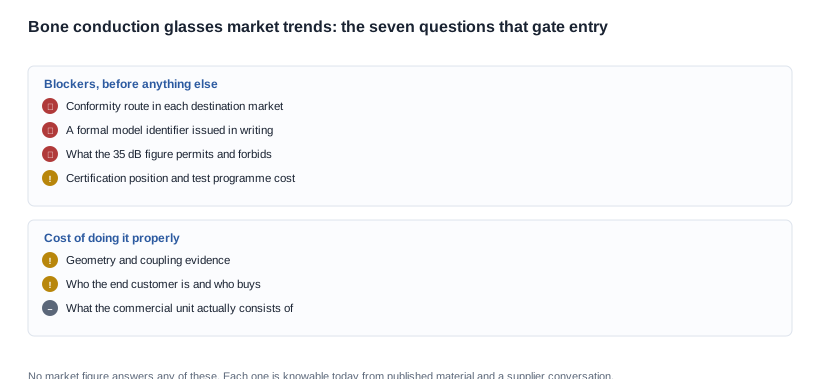

The seven questions that gate entry
None of these needs a market figure, and each of them has to be answered before a buyer can decide whether this category is worth entering at all.
- What is the conformity route for the claimed use, in each destination market? A legal determination, and the first conversation.
- Does a formal model identifier exist, or can one be issued? Nothing downstream works without it.
- What does the 35 dB figure permit and forbid in the listing wording? Write it down, and have it reviewed by someone qualified.
- What is the certification position, and what has a comparable test programme cost in time and money?
- Who is the end customer, and who makes the buying decision? A person who wants to hear their environment better and a relative buying for them are different customers, and the second one is the one a channel is sold to.
- What is the geometry and coupling evidence? A powered transducer has to press against the temporal bone, so the geometry determines whether the product works, and no geometry data is published.
- What does the entry actually consist of as a product? No model name, no certification row and no disclosed customisation capability means the commercial unit has to be defined before anything else can be.
The order matters and it is not the order of commercial attractiveness. Questions one and two are blockers; questions three to six are the cost of doing it properly; question seven is the work itself. A buyer who starts at question five, which is the most interesting one commercially, will have a marketing plan for a product that cannot be ordered.
How to choose where to start is straightforward: answer the blockers before you order anything, and treat the rest as a schedule. The red flags to watch for in a supplier conversation are a claim to have "covered this" already, a market figure offered in place of a document, and a willingness to discuss price while the model designation is still undefined. Each of those is a sign that a question has been deferred rather than answered, and the questions to ask in response are the same seven in the same order.

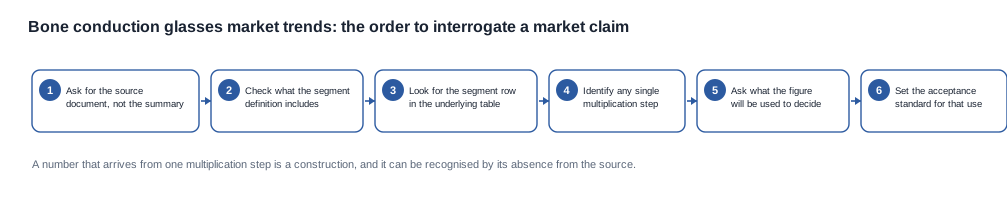
How to interrogate a supplier's market claim
The method is short, and it is worth applying to any market figure you receive in this category, including from a supplier whose products you like.
Ask for the document, not the summary
A summary of a report is not a report. The useful request is the underlying document, the page containing the segment definition and the methodology note. A supplier who will send the source is telling you the number is traceable; a supplier who will only paraphrase it is telling you something else.
Check the segment definition against the product
Take the figure and ask what is inside it. If the segment includes products that deliver the person's own audio rather than amplifying the environment, then the figure describes a different market, and the gap between the two is the part of the market your product would compete in.
Check the arithmetic for multiplication
A number that arrives from a single multiplication step is a construction, and it can be recognised because the source document will contain no segment for it. A buyer who finds that the hearing-assistance figure appears in a summary but not in the underlying segment table has established what the number is.
Ask what the figure is used for
A market figure is used to size an opportunity, to justify an investment, to set a target, or to reassure a channel. Each of those uses has a different tolerance for error, and the figure that is good enough for a strategy document is not good enough for a purchase order. The questions to ask are the same in every case; the acceptance standard is what changes.
A figure interrogated, step by step
This is a hypothetical exercise rather than a client project, and it is written to show the method rather than to report a result.
A supplier offers a market figure for the ambient-amplification glasses segment and says it is drawn from a published report. The buyer's due diligence starts with the document rather than the number.
The segment definition is checked first. The report's segment includes all open-ear audio products, which means it includes products that deliver the person's own audio. The figure therefore describes a larger market than the one the product competes in, and the buyer notes the inclusion without treating it as an error: it is a different question answered correctly.
The unit of account is checked next, and it is revenue. That is a reasonable choice for a sizing exercise and an unusable one for a target, and the buyer records which use the figure will be put to.
The source table is looked for. The hearing-assistance row is not in the underlying segment table, and the figure appears only in a summary slide. That settles the question the third of the four asks: the number is a construction, and a construction can be used for a strategy discussion but not for a purchase decision. The buyer says so plainly rather than dismissing the report, because the rest of it is probably sound.
The final step is the acceptance standard. The figure is set aside for the business case and the buyer returns to the seven gate questions, three of which are answered in the next two weeks and two of which are blocked on a legal determination.
The outcome is a business case with a smaller, clearly labelled number and a decision that rests on the compliance route rather than on the forecast. The counterfactual is the usual one: a number in the deck, no model designation, and a launch date that arrives before the paperwork.
What we will not publish as a market view
We would rather hand you a method and a set of structural facts than a number we cannot evidence, and in this category the structural facts are the decision anyway. The regulatory line, the missing model number, the missing certification status and the missing customisation capability are knowable today, and they determine whether this product can be sold before any forecast gets a say.
We will not publish a market size, a growth rate or a segment share for a category where we hold no verified figure, and we will not repeat a third-party figure we cannot trace to a segment definition. We will not describe this product as a hearing aid, as a treatment, or as a device that addresses hearing loss. We hold no clinical data for it, and the boundary is set out in our medical boundary guidance.
What we can do is answer the four market-figure questions with the same rigour we would apply to anyone else's figure, tell you which of the seven gate questions we can answer from documentation and which need a legal determination, and show you the catalogue's own composition so you can place this product in a range. The category is on our bone conduction glasses page.
Related reading
- How the mechanism actually behaves — bone conduction audio
- Where the regulatory line sits — medical boundary
- How this category compares with ordinary open-ear audio — open ear comparison
Tell us the destination markets, the intended use and the volume, and we will come back with the regulatory questions.


