

There are two things in this catalogue that are both called open-ear, and they are not two versions of the same product. One is an open-ear audio frame: temple speakers that play music and calls out loud so the surroundings stay audible. The other is a bone-conducted frame that amplifies the sound already present in the environment. A buyer who compares them on how the open ear feels is comparing on the wrong axis entirely, because the second one is not a better or worse version of the first. It is a different product, with a different customer and a different compliance exposure.
Bone conduction glasses open ear comparison is worth answering precisely, because the two get bundled together in buying conversations and then compared on a single scale that neither of them is measured on.
This article sorts them: what the open-ear audio range actually publishes, what the amplifying entry publishes, the three questions that separate them, why they need different document sets, and what we will and will not put in a comparison.
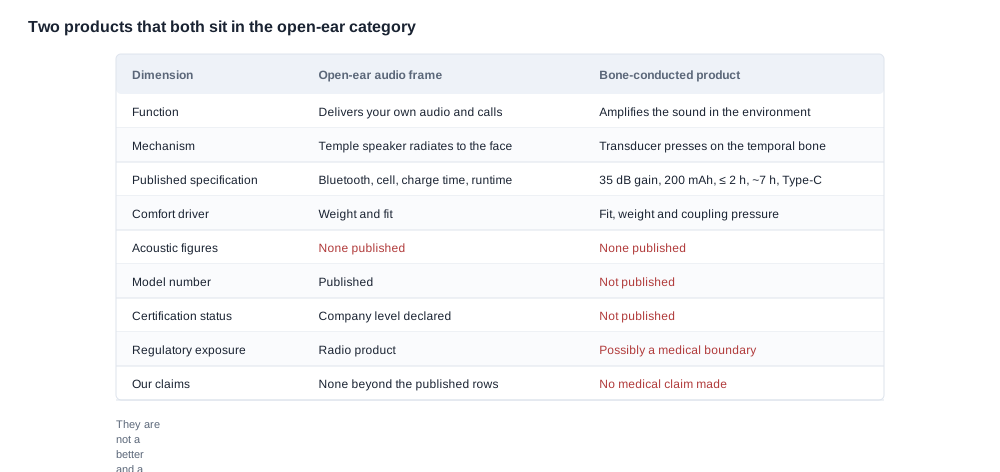
Bone conduction glasses open ear comparison: the wrong axis
The reason the two get merged is that both share the words "open ear", and both leave the ear canal unobstructed. Everything commercially important about them differs, and the differences are of a different kind from the ones a buyer is usually looking for.
One delivers audio, the other delivers amplification
Open-ear audio is an output method. A speaker sits in the temple and projects sound outward towards the face. The ear canal stays open, nothing is inserted, and the person still hears traffic, a colleague or a bird. The product delivers something that was already a signal, or something the person chose to play.
The bone-conducted entry amplifies what is already in the room. It describes how much the device increases the sound present around the person, and the catalogue publishes that as 35 dB. There is no playback of the person's own content in the product's function, and the product's purpose is a different one.
These are not two answers to the same question. One answers "can I hear my music and take calls while the world stays audible"; the other answers "can I hear the world better". A buyer who has one of those briefs and ends up with the other has not made a cheaper choice; it has made a different product.
How to choose the comparison a buyer should actually run
Before any comparison is run, the criteria have to be set, because a comparison without criteria produces a column of numbers and a conclusion that follows from whichever number the reader likes. The criteria for this one are narrow and worth stating: which brief, which customer, which regulatory route. The questions to ask are the three below, and the comparison itself follows from the answers rather than the other way round.
The first mistake to avoid is comparing before the brief is written. A comparison table assembled before anyone has written down what the product has to do tends to end up optimising for whichever dimension is easiest to measure, and in this category the easiest dimension to measure is the one with the least evidence behind it.
The comparison that gets made, and why it fails
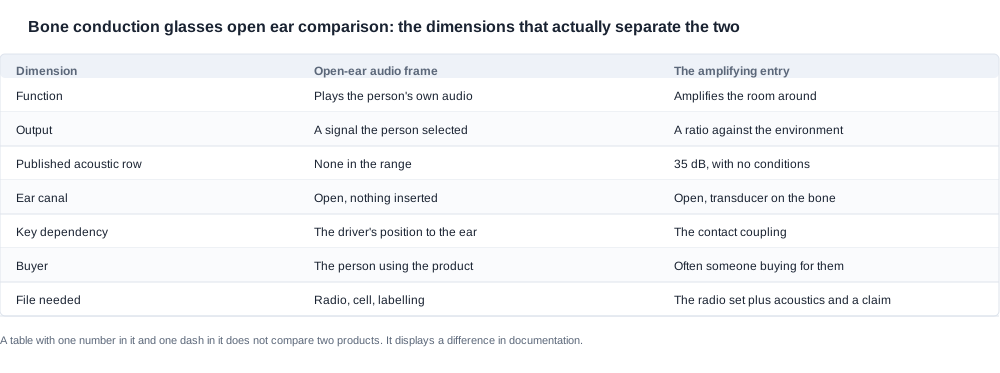
The comparison almost always ends up on loudness, and it fails for a specific reason. The open-ear audio range publishes no acoustic figures at all — no leakage measurement, no driver size, no frequency response, no microphone count, no pickup distance. The amplifying entry publishes exactly one acoustic figure, a 35 dB gain, and it is the only acoustic performance figure anywhere in the catalogue.
So a table with an amplifying product and an audio product side by side has one cell with a number in it and one cell with a dash. A table like that does not compare the two products; it displays the difference in how much each has been documented, and a reader who does not notice the difference will conclude that one is louder and the other is quieter, which neither product's documentation supports.
Where the real trade sits
Awareness and clarity are the same variable in opposite directions. A route that keeps the ear open lets the environment in; a route that maximises signal-to-noise ratio closes the canal or fights the noise floor. Neither of the two products in this catalogue is the answer to a "maximum clarity in a noisy environment" brief, and a buyer who has been treating them as interchangeable options in that scenario has been evaluating a category rather than a product.
What the open-ear audio range publishes
The audio range is eight models, and their published rows are consistent, which is what makes them comparable with each other.
The rows, and the structure within them
The K01 and the K02 publish a V5.3 radio, a 90 mAh × 2 cell, magnetic charging and roughly eight hours of rated use. The D11 and the D12 publish a V5.4 radio, a 100 mAh cell, Type-C charging and roughly seven hours. The LC-105-1 and the G07, and the LC-105-2 and the YK12 publish a V5.4 radio, a 55 mAh × 2 cell, magnetic charging and, in the case of the LC-105 pair, roughly eight hours, while the G07 and the YK12 publish roughly six hours.
Feature rows appear selectively, and they are the rows that make the models distinguishable. The D11 carries a surround-sound row and a long-endurance row. The YK12 carries a surround-sound row and a slim-temple row. The G07 carries an ultra-thin and detachable-temple row. The D12 publishes no feature row at all, which makes the D11 and the D12 the pair where the published difference is exactly one feature row. The K01, the K02, the LC-105 pair and the D12 carry no feature row.
This is the useful discipline for a buyer: a row on a product page is a fact about that product, and the absence of a row is a fact too. It is not a statement about the other pages, and it is not a defect in the product. Nothing in the catalogue supports the inference that a model with no feature row is therefore interchangeable with one that has.
What the audio range does not publish
No acoustic figure of any kind. No leakage level, no driver unit size, no frequency response, no microphone count, no pickup distance, no noise figure. The trade that open-ear audio always carries is leakage against low-frequency performance, and this range quantifies neither side of it. Our open-ear audio guidance covers the trade-offs in general terms.
No frame weight, no ingress rating, no model-wide certification row. Across the whole catalogue, a weight is published once, for the MT6 glasses body at 158 g excluding its folding charging case, and an ingress rating is published twice, on the V06 and the S7.
The honest state of the range
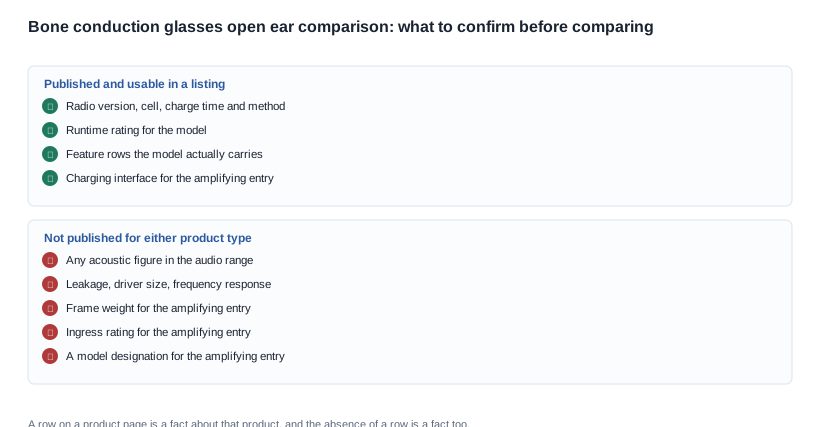
Eight products with consistent electrical rows and almost no acoustic evidence. A buyer choosing within this group is choosing on radio version, cell, charging method, runtime and the feature rows, and that is a legitimate basis for a shortlist. It is not a basis for a claim about sound, and a listing built on this group's published rows can describe what the product does electrically and can say which feature rows it carries.
What a listing for each group can actually say
The two groups support different sentences, and the difference is worth writing out because it is the practical test of whether a draft listing has merged them.
For an audio frame, a listing can state the radio version, the cell configuration, the charging method, the rated runtime, the feature rows the model carries, and the charging interface. It can describe the output method as open-ear. It cannot state a loudness, a leakage level, a driver size or a response curve, because none of them is published, and it cannot state that the product is louder or clearer than another model.
For the amplifying entry, a listing can state the published 35 dB amplification gain, the 200 mAh cell, the charge time of two hours or less, the rated runtime of roughly seven hours, the Type-C interface, and the fact that the ear stays open. It cannot state a level, a comparison against an audio frame, a clinical outcome, or anything that needs a model designation to exist.
A listing that contains sentences from both lists has merged the two products, and it is the single most common way this category gets into trouble — because the merged sentence is usually the loudness one, and the loudness one has no row behind it on either side.
What the amplifying entry publishes
The amplifying entry is a single catalogue page, and it is the shortest specification in the range.
One line, and one figure that is not like the others
A 35 dB amplification gain, a 200 mAh cell, a charge time of two hours or less, a rated runtime of roughly seven hours and Type-C charging. There is no model designation, no radio version, no frame weight, no ingress rating, no acoustic data beyond the gain, and no disclosed customisation capability.
The 35 dB figure is the only acoustic performance figure in the catalogue, and it is a ratio with no reference level, no input signal, no frequency band and no measurement location attached. The gain levels analysis sets out what a usable gain figure has to contain.
Its cell is larger than any cell in the audio range — 200 mAh against single cells of 100 mAh and paired cells of 55 mAh × 2 and 90 mAh × 2 — while its runtime sits inside the audio range's six-to-eight-hour band. That combination is an unanswered question rather than a contradiction, and it is a good example of the kind of arithmetic a buyer should do before accepting a number.
The coupling that the audio range does not have
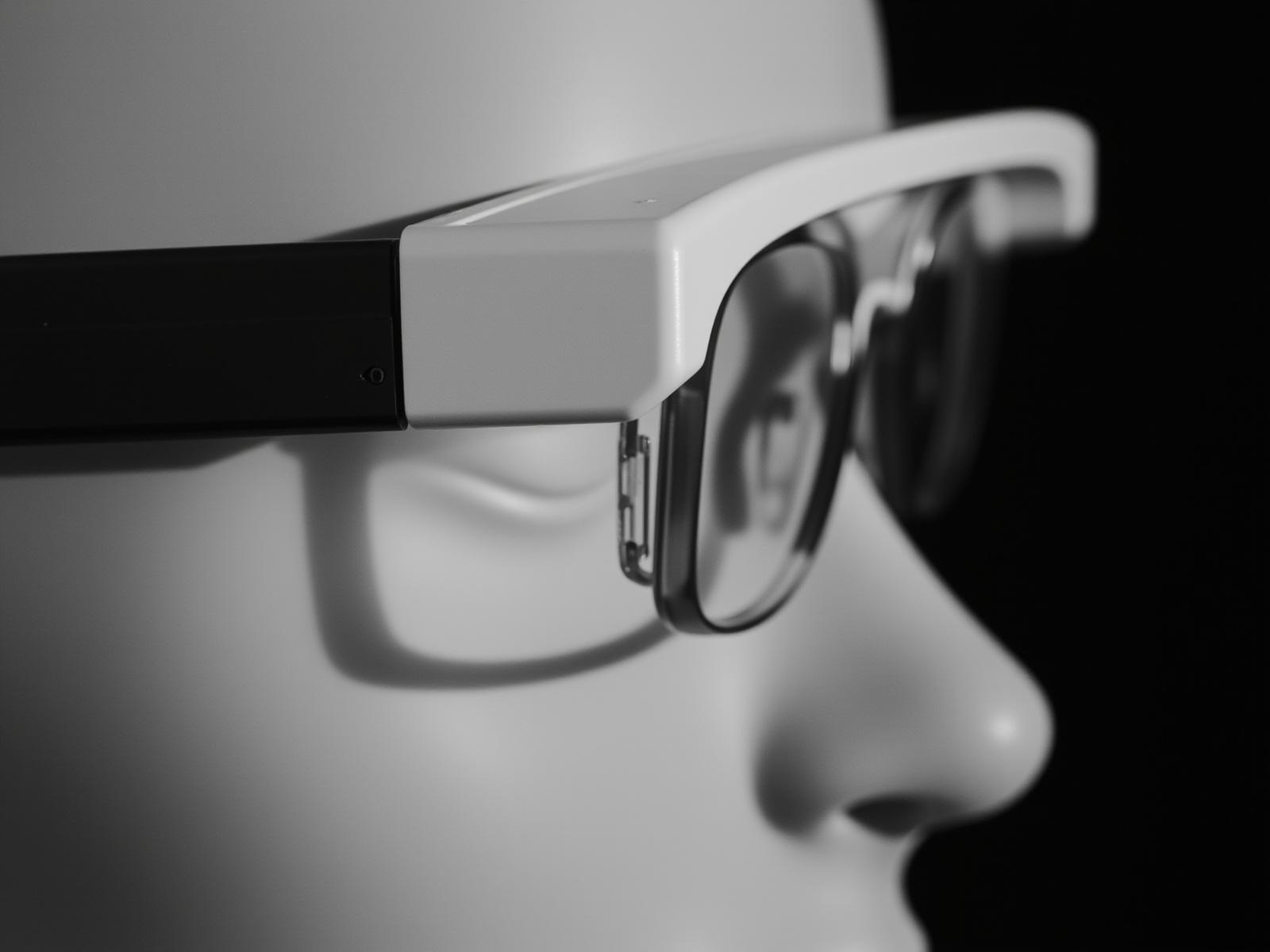
A bone-conducted transducer has to press against the temporal bone for the amplification to couple properly, which means the frame's geometry, the temple position and the contact pressure determine how well it works and how long it can be used. Feel and effectiveness are the same variable in this category, which is why a trial has to be done with the product running rather than with the frame on a table.
No weight, no temple length and no adjustment range are published for this entry, so there is no way to reason about the population the product serves. The bone conduction audio guidance covers the mechanism in more detail, and it is worth reading before any of this reaches a listing.
The three questions that separate them
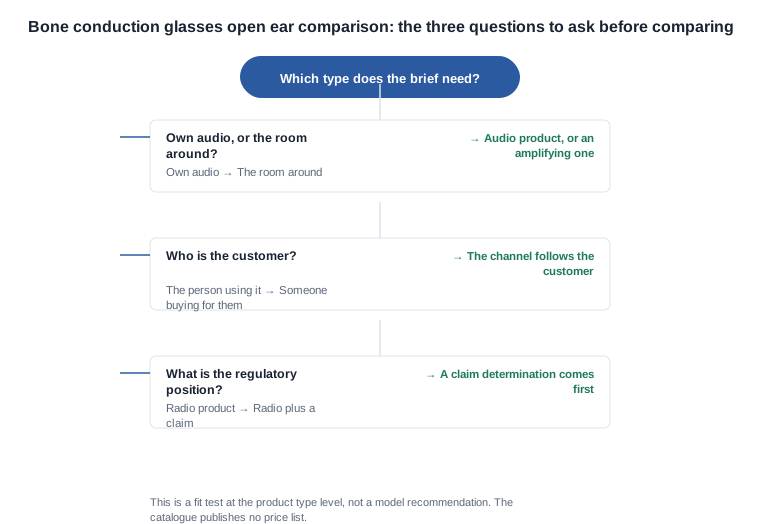
Three questions, asked in this order, will separate the two product types in any buying conversation. They are worth having written down, because the conversation usually starts with the specification and the specification is the part that is least informative.
Is the product delivering the person's own audio, or amplifying what is around them?
If the first, it is an audio product, it competes with the temple-speaker frames, and the relevant published rows are radio version, cell, charging method, runtime and the feature rows. If the second, it is an amplifying product, it competes with ambient-amplification devices, and the relevant published row is a gain figure that needs conditions.
This is a fit test at the product-type level, not a model recommendation. The published rows do not separate the models within either group on any dimension that a buyer can use, and we publish no price list, so there is no price tier and no value ranking here either. Deciding between the groups is a brief decision; deciding between the models inside a group is a separate conversation that needs rows this catalogue does not carry.
Who is the end user, and who makes the buying decision?
Open-ear audio frames sell to anyone. An amplifying product sells to people who want to hear their environment better, and that is a customer with a need rather than a preference. It brings a duty of caution and a claims discipline that does not exist for a music frame, and it also brings a different buyer: a relative or an employer buying for someone else, rather than the person using the product.
The channel and the customer are the same question in this category, and the difference between them is a marketing cost rather than a marketing detail. A gear channel and a health channel cannot be served by one listing, because the claims and the description differ.
What is the regulatory position?
An open-ear audio frame is a radio product. An amplifying product is a radio product that may also sit close to a medical device boundary, depending on how it is described and where it is sold.
In the United States, the distinction is drawn through the over-the-counter hearing aid framework, in which a hearing aid is defined as an air-conduction device for adults with mild or moderate hearing impairment, and a personal sound amplification product sits outside that definition. A bone-conducted product that claims to treat hearing loss is making a different claim from one that amplifies ambient sound.
We make no medical claim for this product and we hold no clinical data, no test protocol and no regulatory assessment for it. We do not describe it as a hearing aid, as a treatment, or as a device that addresses hearing loss. Any supplier or listing that does so on your behalf is making a claim you cannot support, and the consequence falls on the brand that carries the listing. The boundary is set out in our medical boundary guidance, and it is worth reading before this product reaches a health-oriented channel.
A comparison worked through, in three steps
This is a hypothetical exercise rather than a client project, and it is written to show the method.
A brand has a brief for a product that helps people hear their environment better in a training environment. The brief arrives with a comparison table, and the table puts an open-ear audio frame next to the amplifying entry with a row labelled "output level".
The first step is to remove the row that cannot be filled. Neither product has a published output level, and the amplifying entry's 35 dB is a gain rather than a level, so the row is deleted rather than estimated. The red flags to look for in a comparison table are any row that would require a number nobody can produce, and there are usually two or three of them.
The second step is to ask the three questions in order. The brief is about hearing the environment, which is the second product type. The customer is a person who wants to hear better, and the buyer is often someone else. The regulatory position is the one that needs a determination, so the file for the amplifying entry is the one that matters.
The third step is to check what the listing can say, using the two lists above. The result is a draft that describes the amplification gain as a published figure, describes the open ear, describes the cell and the charging, and stops there. The audio frame is removed from the comparison, not because it is a bad product but because it answers a different brief.
The outcome is a shorter listing and a slower launch, and the slowness is on the compliance side rather than the commercial side. The alternative — a table with a loudness row, an estimate in the empty cell, and a claim the documents cannot support — is the version that produces a dispute later, and the dispute is more expensive than the delay.
Why the two products need different files
A buyer who has merged the two products into one documentation project inherits the wrong document set, and the difference is not a detail of content.
The radio product file
A radio version, a cell, a charge time, a charging method, a runtime, the feature rows, the cell test summary, the radio conformity route, the labelling, the warnings and the packaging. The acoustic documentation is optional in the sense that a listing can be written without it, which is why audio products in this range ship with the electrical rows they have.
The amplifying product file
Everything the radio product needs, plus the acoustic documentation, plus a claim determination. The acoustic documentation does not exist for this entry and has to be commissioned. The claim determination is a legal question, and the technical file is built around the answer to it.
The structural gap underneath both
No model designation. For the audio models, a product name exists and the documentation can be attached to it. For this entry, the product has no name, which means no document can name it, no purchase order can be raised against it, no customs declaration can describe it, and no artwork can carry it. This is the difference between a product that is documented thinly and a product that cannot yet be named, and the second is a more fundamental problem than it appears.
What we will and will not compare
These two product types should not appear in the same comparison table, and a buyer who merges them is likely to end up with the wrong product for the use case and the wrong regulatory file for the market. We will not describe an amplifying product as an open-ear audio product, and we will not describe an open-ear audio frame as a hearing device. We will not publish a loudness comparison between them, because no common measurement exists, and we will not publish a price-tier comparison, because we publish no prices.
We will also not describe this product as a hearing aid or attach any hearing-improvement claim to the 35 dB figure, and we will not state a certification status, a weight, an ingress rating or a model designation that our documentation does not support.
What we will do is say which of the two fits the brief you actually have, be plain about the fact that our published documentation for the amplifying entry is a single row with no model number attached, and tell you which of the published rows you can use to write a listing that survives review. The category is covered on our bone conduction glasses page, and the common questions piece sets out what the documentation does not contain.
Related reading
- How the two audio approaches actually behave — open-ear audio
- The mechanism and its limits — bone conduction audio
- Where the claims boundary sits — medical boundary
Tell us the use case, the end user, the market and the volume, and we will come back with what is available and what is not.


