

Bone conduction glasses technology: where the difference sits
Bone conduction glasses technology smart glasses questions usually arrive from buyers who have already decided between the two technologies and then discover that deciding is the easy part. The physics difference is clear and the commercial consequences are large. What makes our position on this awkward is that we publish twelve open-ear audio platforms and exactly one bone conduction entry, without a model designation — so the comparison below is between a well-documented class and a single unnamed product.
The argument for the technology rests on three consequences of the transmission path, and all three are mechanical rather than electronic. Ambient sound is preserved, because the ear canal is not being used for the audio. Loudness is not the same as quality, because a transducer delivers vibration to a small contact area and perceived level depends on contact placement rather than on volume alone. And the product is hearing-adjacent, because a device that amplifies sound toward the wearer is making a claim that sits closer to assistive devices than to consumer audio — in the United States, over-the-counter hearing aids are defined by regulation as air-conduction devices, which means a bone conduction device with a hearing-assist claim follows a different route to market.
Each of those three consequences has a commercial effect that a buyer can price, and the price is not in the unit. The preservation of ambient sound is what makes a bone conduction product sellable into a channel that an earbud cannot enter. The contact dependence is what makes the fit, the seating and the support script load-bearing. The hearing adjacency is what makes the description of the product, rather than the product, the first decision in the programme.
The practical summary is that this is not a better-or-worse comparison but a fit comparison, and the fit is decided by the channel and the use case rather than by the specification. What follows is the evidence for that, and the four questions a buyer has to answer before the comparison means anything.
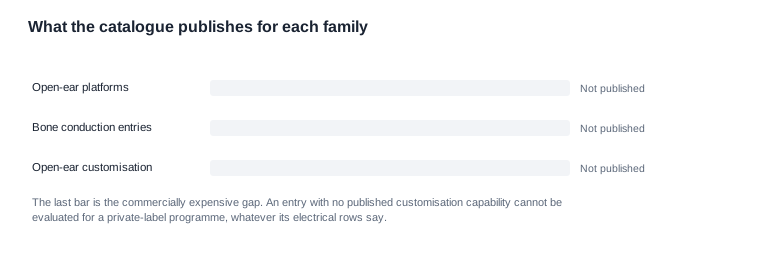
What each family publishes, and why the comparison is unfair
Comparing the two families on published rows is the natural first move, and it produces a result that is technically accurate and commercially useless. The table below is that comparison.
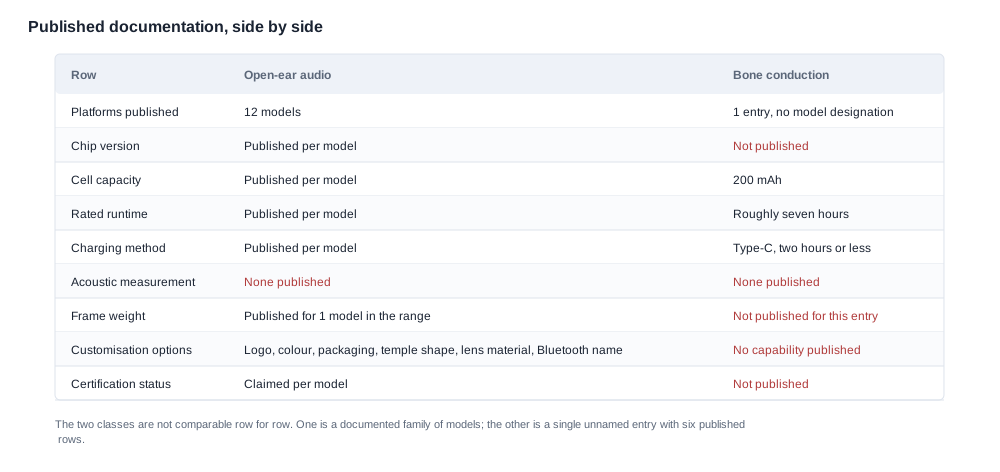
The open-ear column is the better documented one, and it is worth saying what it contains. K01 and K02 run V5.3 with 90 mAh × 2 and roughly eight hours of runtime. D11 and D12 run V5.4 with 100 mAh and roughly seven hours on Type-C. LC-105-1, LC-105-2, G07 and YK12 run V5.4 with 55 mAh × 2, magnetic charging, and roughly eight, eight, six and six hours respectively. YKC02 runs V5.4 with 70 mAh × 2. The sport audio platforms D17 and ZH12 sit on Type-C with approximately one-hour charging.
The bone conduction column is the one entry: a 35 dB amplification gain, a bone conduction transducer, a 200 mAh cell, a charge time of two hours or less, roughly seven hours of rated runtime and Type-C charging, and no model designation.
The unfairness is in the two columns below the specification. Neither class publishes acoustic measurements — no driver size, no frequency response, no leakage figure and no pickup distance for any model in the range, which means the audio performance of an open-ear platform cannot be compared with the audio performance of a bone conduction one from any published source, in either direction. A unit weight is published for one model in the whole range only, so twenty-seven of twenty-eight models carry no weight figure at all. And the two classes differ sharply on customisation: the audio class lists logo, colour, packaging, temple shape, lens material and Bluetooth name, while the bone conduction entry discloses no customisation capability at all, which is a considerably larger gap than an empty table cell.
The consequence for a buyer is specific. A comparison that only uses the published rows will conclude that the open-ear family is safer to sell, which is often correct, and will not tell the buyer whether bone conduction is the right product for the channel they are in. That question needs the use case, and it is answered below.

Choosing between the two platform families
The four questions in the decision tree below are the ones a buyer should be able to answer before requesting a quotation, because each one changes what is being bought rather than what is being paid.
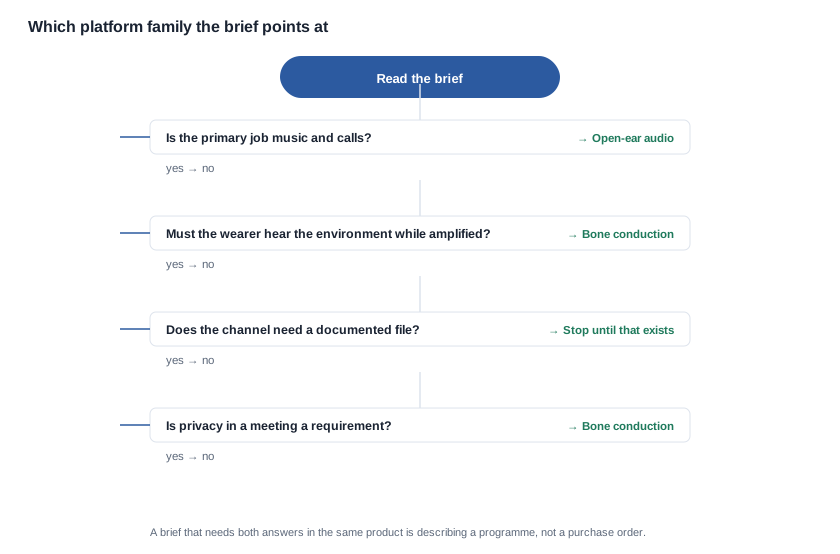
Is the primary job music and calls? If yes, the open-ear family is the right starting point. The bone conduction path attenuates the low frequencies that carry the character of music, and a customer buying a music product will describe the result as thin. The one exception is a customer who cannot wear an earbud at all — a safety regulation, a hearing aid, a comfort issue — and in that case the constraint rather than the preference decides the answer.
Must the wearer hear the environment while amplified? If yes, this is the argument for the technology, and it is a strong one. The ear canal is not occupied, so the wearer hears traffic, machines, colleagues and alarms while a signal is delivered to the skull. In an industrial, outdoor or security context this is the difference between a product that works and a product that makes the user deaf to the environment.
Does the channel need a documented file? If yes, stop until that file exists. Our catalogue records the certification status of this entry as not provided, and no model designation is published for it. A channel that requires a resolvable compliance document cannot be entered with a product whose designation and file status are unknown, and the buyer should resolve that before a programme is scheduled rather than discovering it in the artwork review.
Is privacy in a meeting a requirement? If yes, bone conduction is the only mechanism in our range that satisfies it, because it emits no sound into the room. This is a legitimate and specific buying reason, and it is the one most often left out of the brief even when it is the reason the product was considered.
A brief that needs two of these answers pointing in different directions is describing a programme rather than a purchase order, and the right next step is to split it into two products rather than to look for a compromise model that satisfies both.
Where bone conduction wins, and where it does not
The use-case matrix below is the most useful single artefact in this article for a buyer, because it maps the channel decisions to the platform families rather than to the published specification.
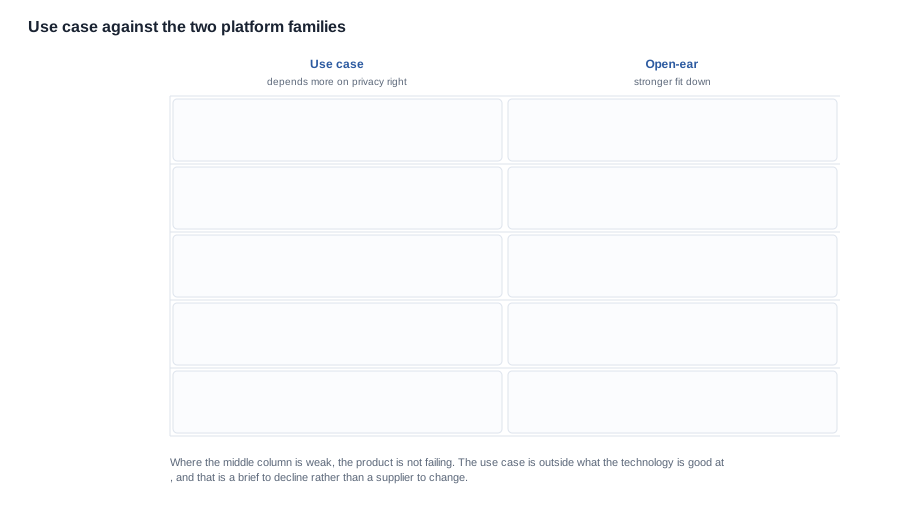
Open office calls is a strong fit for open-ear and a moderate fit for bone conduction. The open ear is an advantage in a quiet office, and bone conduction adds nothing a customer would pay for. The privacy case, which is the strongest bone conduction argument, applies to a private meeting rather than to an open floor.
Street and construction site is a moderate fit for open-ear and a strong fit for bone conduction. Ambient noise is the environment the technology was built for, and an earbud at that noise level is either unsafe or unusable.
Cycling and running is similar. There is a genuine benefit to keeping the ear open in traffic, and the two families are not equivalent there.
Confidential meeting audio is the reverse: a weak fit for open-ear and a strong fit for bone conduction, because no sound is emitted into the room. It is also the use case where a buyer must be most careful with the copy, because a device that keeps the ear open also keeps the conversation audible to the wearer, and a product sold on privacy has to deliver on it.
Beach and pool use is a weak fit for both, for different reasons. Neither class publishes an ingress rating for this entry, the open-ear sport platforms are the ones that carry a published marking, and a bone conduction frame that transmits through a temple contact in salt water is a durability question that no published row answers.
The honest reading of the matrix is that a weak fit is a reason to decline a brief, not a reason to change suppliers. A buyer who is being asked for a beach-use bone conduction product is being asked for something neither published family supports.
Who is choosing, and what they are comparing against
The reader is a brand product manager or a channel buyer who has been asked to decide whether the range needs a bone conduction product, usually because a customer, a retailer or a competitor's listing has made the question visible. The specific difficulty is that the decision looks like a specification comparison and is actually a channel decision, and the specification comparison is the easier and less useful of the two.
Three fears shape the timing. The first is that the documentation is thin and the product will be unsellable; in practice the entry can be sold, and what limits it is the file, not the product. The second is that the product will disappoint customers, which is true in a specific way — it sounds different, and different reads as worse to a buyer whose reference frame is an earbud. The third is the compliance question, which is the one a buyer has to answer for their own market before any listing copy is written.
What a buyer is comparing against is rarely another bone conduction product. It is more often the open-ear product in the same range, or the earbud the customer currently uses, and both comparisons are the wrong comparison for a channel that needs the ear left open. Making the comparison explicit is the first task: against which product, for which customer, in which environment, doing which task. A buyer who has decided how to evaluate the two families on use case, rather than on published rows, can shortlist suppliers in an afternoon; a buyer comparing specifications will still be comparing them in a month, and will reach a worse answer.
The other half of the buyer's job is to decide what they are not buying. A brand that adds a bone conduction product to a range of open-ear platforms is building two support scripts, two listings and two sets of copy review. A brand that adds it as a single variant inside an existing listing is building one of everything, and one of everything is what produces a product that a customer cannot tell apart from the one next to it, at a different price.
The third decision is what the buyer's own due diligence will look like, because in this category it cannot be a specification check. There are four tests, and they apply to both families. Does the supplier publish a method behind any figure they quote? Does the compliance file name the model the brand is ordering? What is the acceptance criterion for a production lot, written in a mechanism rather than in a satisfaction? And what does the support script do with a product whose output varies with how it is worn? A buyer who has answers to those four has a workable programme; a buyer with a catalogue comparison and a price list has neither.
The trade-offs are worth stating to whoever signs. Choosing open-ear buys a simpler programme and gives up the one use case where bone conduction has no substitute. Choosing bone conduction buys access to a channel the earbud cannot reach and takes on a documentation and support load that has to be funded rather than assumed. The total cost of the second option is not the unit price, and a buyer who prices it as the unit price will make the decision on the wrong number.
The cost and schedule difference between the two families
The two families do not cost the same to take to market, and the difference is much larger than the difference in unit price.
For a documented open-ear platform, a buyer can work from published rows. The chip version, the cell capacity, the rated runtime, the charging method and the model designation are available, and the compliance file can be attached to a specific model because the model exists and is named. The diligence is a check rather than an investigation, and the schedule is dominated by the production lead time.
For the bone conduction entry, the diligence is an investigation. The model designation is not published, the certification status is recorded as not provided, the customisation capability is undisclosed, and no acoustic measurement exists for any model in either class. The schedule is dominated not by production but by the questions that have to be answered before artwork and before a file can be assembled, and by the compliance route in the target market.
The practical budgeting rule is to treat the two as different categories of work rather than as two products in a range. An open-ear addition is a range extension with a documentation check. A bone conduction addition is a category entry with a compliance position, a new listing, a new support script and a field acceptance programme, because the coupling-dependent behaviour of the product cannot be supported by a generic process.
The commercial terms that differ with it are the same ones in every category entry: the model designation on the order, the documentation package arriving with the order, the artwork scope, the sample order, the delivery structure, as well as the acceptance criteria for the production lot In this category the last of these is the one most often missing, and it is the one that decides whether a lot can be refused.
A worked comparison: three briefs and three answers
Below is an example put together to show how the checks stack up in order. It is not an account of an order that was placed.
Assume a brand with a range of open-ear audio platforms, sold through online marketplaces and a specialist retailer, considering whether to add a bone conduction product.
Brief one: a cycling accessory brand, needing a product for riders in traffic. The end user is a cyclist, the competitor set is earbuds and open-ear frames, and the binding requirement is that the rider hears traffic. Bone conduction is the stronger fit on the requirement, and the brand already understands open-ear as a category. The decision is to evaluate the bone conduction entry, with the file status resolved early, because a cycling channel asks for a compliance document. The conditions attached to the evaluation are that the copy makes no outcome claim, that the seating instruction is in the box, and that a field test happens in the target environment before the listing is written.
Brief two: an enterprise reseller selling meeting audio to corporate customers. The requirement is privacy in a meeting, and the buyer is a reseller whose customers are procurement departments. This is a strong bone conduction fit and a weak open-ear fit. But the decision is not to buy a product; it is to decline, because the reseller's customers will expect a documented file, the certification status for this entry is not provided, and no model designation is published. The reseller is told what the missing rows are and what would have to be supplied, and the enquiry goes on hold rather than being closed.
Brief three: the brand's own open-ear line, whose customers keep asking for a stronger, more private alternative. This is the hardest brief, because the product that is needed is not the product that exists. The brand's own line is the comparison the customer will make, and bone conduction sounds worse than the brand's own product to almost every listener. The decision is to test the bone conduction entry in a separate listing with a separate expectation-setting, in a segment where the use case is calls in noise rather than music, and to see whether the returns behaviour is different before committing a range slot.
Three briefs, three different answers, and none of them is a specification comparison. The specification comparison would have produced the same answer for all three, which is precisely why it was not the right tool.
What our catalogue does not publish for either family
We publish what we hold and publish the absences with the same prominence, because a buyer checking a claim should be able to check ours first.
For the bone conduction entry, we publish a 35 dB amplification gain, a bone conduction transducer, a 200 mAh cell, a charge time of two hours or less and a rated runtime of roughly seven hours and Type-C charging We publish no model designation, no certification status, no customisation capability, no acoustic measurement, no microphone specification, no frame weight and no ingress rating for it, and we will not estimate any of them.
Across the open-ear platforms, we publish the electrical detail listed above, and we publish no acoustic measurements for any of them either — no driver size, no frequency response, no leakage figure and no pickup distance. Only one model in the whole range has a published unit weight, so twenty-seven of twenty-eight do not carry one. We publish no CE, FCC or RoHS position for any model in the range, the catalogue text contains no reference to any of the three, there is no per-model certification row, and no certificate number is published for any of the twenty-eight.
We will not describe the bone conduction product as a hearing aid and we will not make a medical claim on it. We will not present a maximum output capability as a result the wearer receives. And we will not claim that one family sounds better than the other on the basis of published rows, because neither family publishes the rows that would support that comparison.
Actions for a buyer comparing platforms
Rewrite the brief as a channel decision. Say which customer, which environment and which task, and the platform question answers itself. A brief written as a specification comparison answers to a specification comparison, which is the wrong one.
Check the file before the product. For this entry the model designation and the certification status are the two things a channel will ask for, and both are currently unpublished. Resolve them or plan the programme around their absence.
Decide what you are not buying. A second product in a range is a second listing, a second support script and a second set of copy review, and the cost of not deciding that is the cost of discovering it in the first returns cluster.
Ask for the acoustic rows before you write the copy. Neither family publishes them, which means both listings have to be written narrower than the marketing instinct wants. That is not a problem to solve later; it is a constraint to plan for.
Build a one-page comparison checklist and reuse it. Four criteria — channel fit, file status, acoustic documentation, support load — applied identically to every candidate. It is what stops the third quotation in the quarter from being evaluated more generously than the first.
Set the acceptance criteria before the purchase order. A lot that cannot be refused against a written criterion is a lot that has to be discussed, and the discussion always costs more than the criterion.
The mechanism and its limits are covered under bone conduction audio technology, the head-to-head comparison is in open-ear versus bone conduction, and the open-ear family is on the Bluetooth audio glasses range.
Where this comes from
- Bone conduction audio technology and its limits
- Open-ear versus bone conduction
- Bluetooth audio glasses range
- Bone conduction glasses in the range
Send us the brief and the channel, and we will tell you which of our platforms match the requirement and which of our documentation rows are still missing.


