

Bone conduction glasses technology: two conclusions before quotation
On the published evidence, this entry is not a candidate for a buyer who needs an amplified product with a documented regulatory position. The 35 dB figure is an electronics gain published without a frequency range, an input level or a measurement point; the entry carries no model designation; and its certification status is not published to us. Those are three separate gaps, and none of them closes through negotiation. They close through a supplier who holds the documentation, or they do not close at all.
For a buyer who can write their own acceptance criteria and measure their own samples, the entry is workable, and the specification you write becomes the durable asset instead of the datasheet you were sent. That is the advanced position in this category: you are not shopping for a product, you are authoring the acceptance standard and then testing a supplier against it.
Who signs the order, and what they are actually approving
The buyer in this category is usually a brand-side product lead or a sourcing manager, and they are typically approving a new specification rather than a new purchase. Two or three quotations are already on the desk, each thinner than the one before, and the decision is not which document looks best but which supplier will put a measurable condition behind the number that matters.
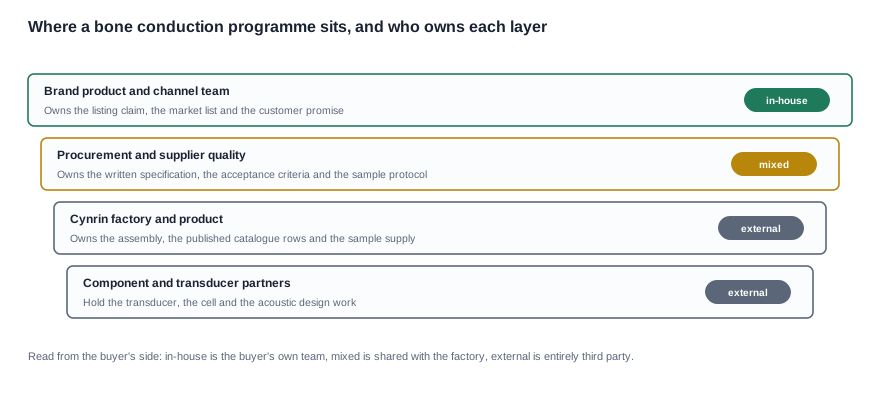
Three situations recur. The first is a brand adding an amplified listening line to an existing open-ear programme, where the incremental cost is a claim review and a documentation chain rather than a new product. The second is a channel buyer sourcing a single amplified SKU for a specialist retailer, where one missing row — the model designation — blocks every downstream document. The third is a product team that has been shown a demonstration unit and wants to know whether the behaviour survives a sample, a production lot and a listing.
What the buyer is afraid of is not the wrong gain figure. It is that the demonstration unit and the delivered unit differ, that a claim on the listing cannot be defended when a channel reviewer asks, and that the paperwork names a configuration nobody has heard of. All three are cheap to settle at the specification stage and expensive to settle after artwork approval.
Why two quotations for the same entry diverge so widely
Bone conduction is not a commodity category, and the divergence between two quotations for the same entry is rarely a unit-price argument. It is a programme argument. One quotation is for a catalogue configuration that exists today; the other is for a specified configuration that has to be built, measured and documented against your acceptance criteria. Those are different transactions and the gap between them is not margin.
The cost sits in a small number of places. The transducer is the largest single component and the one whose type, gain and response determine what the product can do at all. The housing geometry is the second, and it is a design decision rather than a part: the transducer has to hold a consistent position against the skull, and geometry that transmits well is geometry that presses. The amplifier and its power draw compete with the cell. The acoustic design work around the transducer is invisible in a quotation but is what turns a component into a product.
Compare the entry with the open-ear class in the same range and a useful signal appears. This entry publishes a 200 mAh cell with roughly seven hours of rated runtime. The open-ear class publishes cells from 55 mAh paired units up to 100 mAh with roughly six to eight hours of rated runtime. A larger cell delivering a similar rated runtime points to the load rather than the cell as the binding constraint — which is an inference you should confirm with the supplier rather than accept, and which is exactly why the runtime row without a stated condition is useless for comparison.
Your negotiating space sits in the programme lines rather than the unit line: the number of configurations, the per-market documentation, the sample and measurement effort, the artwork rounds, the split between pilot and production, and the definition of what constitutes a defective lot. The unit price of a catalogue configuration is a small number and the supplier knows it. The programme lines are larger and they are the ones that move.

The rows that decide the order, and the thresholds to hold
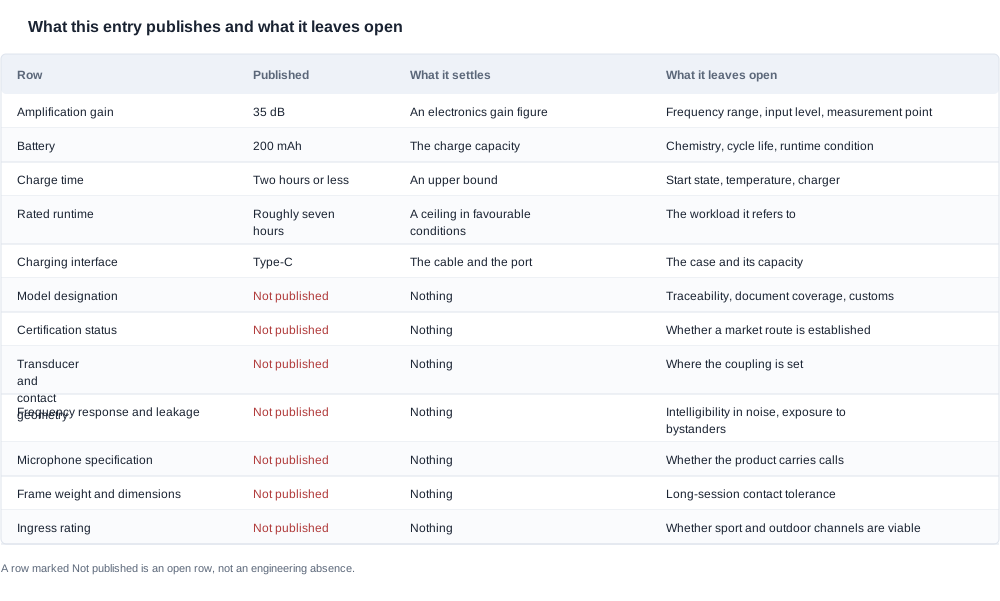
The published position is thin, and it is thin in a way that is easy to mistake for a data problem rather than a category position. What follows is what exists, what it settles, and what it leaves open.
Gain. The published figure is 35 dB of amplification gain. How to measure it: ask what the input reference level is, what weighting is applied, over what frequency range the figure applies, and whether it is measured at the transducer, at the skull surface, or at the ear canal. The threshold to hold: two numbers, one with a frequency and an input level attached and one for the full speech band, and a written statement of whether the value is typical or maximum. How the figure is usually inflated: quoting the maximum gain of the amplifier chain and presenting it as the delivered level, or quoting a wideband figure where the gain inside the speech band is materially lower. A gain figure without conditions is not a specification — it is a number, and it is the most aggressive number in our catalogue.
Leakage. How to measure it: with a sound meter, at a stated reference distance, with the gain at the setting used in the intended use case. The threshold to hold: a figure at that distance and setting, plus the boundary condition — whether leakage rises with gain, and by how much. How it is usually inflated: reporting leakage at the lowest setting, or reporting it without a distance. Leakage decides two separate things at once: whether the wearer can still perceive the environment, and whether people nearby are exposed to an amplified signal. In an industrial or open-plan channel the second question is an occupational one, and no published figure exists for this entry.
Transducer and contact geometry. How to measure it: run the same source through the product on several head shapes and record where the contact sits and whether the delivered level changes. The threshold to hold: a written description of transducer type and position, plus a demonstration that the coupling does not depend on a particular head. How it is usually inflated: showing the best-case wearer in the demonstration and describing it as the general result. In this technology the coupling is part of the acoustic specification, which is why a fit question here is not a comfort question.
Runtime under amplification load. How to measure it: run the product at the gain setting the channel will actually ship with, from a full charge, with the radio connected, and record the time to the point where output becomes unusable. The threshold to hold: a figure with the load, the gain setting and the radio state stated, and ideally a second figure at a lower setting. How it is usually inflated: quoting the idle or unamplified runtime, or quoting a runtime measured with the product in standby. The published figure of roughly seven hours carries no stated condition, and this entry publishes no separate unamplified figure against which it can be read.
Microphone and call function. How to measure it: if the channel sells the product for calls, establish whether it takes calls at all, then measure pickup in a defined noise field. The threshold to hold: an explicit yes or no on call function before any comparison is built, plus a pickup figure if the answer is yes. How it is usually inflated: listing the product in a phone-and-music bundle on the assumption that every smart glasses platform carries a microphone. No microphone specification is published for this entry, and we will not estimate whether it does.
Model designation. How to measure it: read it off the quotation and off the packaging. The threshold to hold: a formal model string, on the quotation, on the documentation and on the units. How it is usually inflated: letting a supplier refer to a product by a development code or by its category name. A product without a designation cannot be named on a declaration of conformity, cannot be filed in a channel SKU list, and cannot be traced when a quality claim arrives.
Certification status. How to measure it: ask for the certificate numbers with the issuing body and the validity dates, per model. The threshold to hold: numbers you can look up in the issuing body's own register. How it is usually inflated: attaching a certificate for a sibling model. That is the single most common substitution in this category, and the reason the model string check is a stop condition rather than a query.
Ingress rating. How to measure it: read the marking, and ask which configuration it covers. The threshold to hold: a rating that names the model, or an explicit statement that there is none. How it is usually inflated: inheriting the sport model's IP54 marking from a sibling entry. No ingress rating is published for this entry.
One warning applies to all of the above: these numbers are not directly comparable across suppliers, and the reason is almost always the measurement method rather than the product. A gain quoted at the transducer is not comparable with a gain quoted at the ear canal; a leakage figure measured at ten centimetres is not comparable with one measured at a metre; a runtime quoted with the radio connected is not comparable with one quoted in standby. Until the conditions are stated, two numbers in the same row are two different measurements.

Turning a supplier's answer into a record you can file
Verification here is documentary, and it is fast once you know the order to ask in. Each step below assumes the previous one passed, and a failure at any step tells you what the next step would have told you.
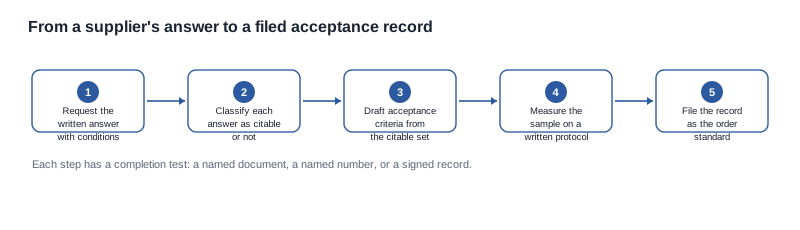
Step one: request the answer in writing, with its conditions. Ask for the gain, the runtime, the leakage and the transducer description as written sentences that include their conditions, not as figures in a table. A supplier who answers in prose with conditions is telling you they have measurements; a supplier who answers with figures alone is telling you the figures came from a marketing sheet. Cost: one email. Value: it converts an unverifiable claim into a checkable one.
Step two: classify every answer as citable or not. Citable means the answer contains the number and the condition that make it usable in a specification. Not citable means the number exists without the conditions, or the answer is a refusal. Put both lists in the file, because the second list is what tells you what you have to measure yourself. For this entry, our own published rows fall into both lists: the cell, the charge time and the interface are citable, and the gain, the runtime and the absence of a designation are rows you must qualify or measure.
Step three: draft the acceptance criteria from the citable set only. If a criterion cannot be written from a citable row, either specify how it will be measured on the sample, or remove it from the purchase order. A criterion with no method is a dispute waiting for a returns season.
Step four: measure the sample on a written protocol. Write the protocol before the first reading, because a protocol designed afterwards is a description. The minimum protocol for this category is: a fixed source played at a fixed level, a leakage reading at a stated distance, a runtime run at the shipping gain setting with the radio connected, and a session on at least three head shapes recording where the contact sits and what changes after the fourth hour. Record it as your measurement, with your protocol attached.
Step five: file the record as the order standard. If the criteria sit in an email they are not binding; if they sit in the purchase order they are the acceptance standard, and a lot that fails them is a lot you can refuse at inspection rather than in the field.
What this record is designed to catch
The gain figure gets laundered into marketing copy. The symptom is a listing that says "35 decibels of amplification" with no condition attached, and a reviewer with a sound level meter who finds it meaningless. The root cause is that the copy was written from the catalogue row rather than from the acceptance record. The prevention is to fix the wording before the product page exists, and to say "amplification gain of 35 dB" rather than anything that describes what the customer hears.
Two runtime figures are compared without conditions. The symptom is a specification sheet that ranks this entry against a competitor on endurance. The root cause is that one figure was measured under an amplified load and the other was not. The prevention is to require the load condition on both sides of any comparison, and to withdraw the comparison if either side cannot state it.
The paperwork names a different configuration. What reaches you first is a warranty claim, a customs query, or a marketplace rejection that nobody can close. The root cause is a family-level document being treated as coverage for a specific entry. The prevention is to make the exact model string a condition of the purchase order and to check the string on the units at receipt.
A regulatory position is assumed from a sibling model. The symptom is a market where the product is challenged after launch, and a withdrawal conversation that lands on the supply chain. The root cause is that the open-ear models in the same range were treated as carrying the category position for this entry. The prevention is to establish the position for this entry on its own claim, in each destination market, before artwork is approved.
The sample behaves and the production lot does not. The symptom is a field consistency problem after launch. The root cause is that no change-control obligation was attached to the transducer, the housing geometry, the cell or the firmware. The prevention is to put those four items on the change-control list with a notice obligation, and to make a substitute cell invalidating the battery transport documentation.
What a programme in this category can and cannot negotiate
Negotiable, and worth spending the capital on. The sample quantity and the sample cost, including whether the measurement unit can be bought rather than returned. The number of configurations and the per-configuration minimum. The artwork round count, which is a schedule item and a cost item. Whether the pilot and the production run can be split into separate deliveries with separate payment nodes. The documentation package, in particular whether model-specific documents are issued per configuration rather than per family. The warranty definition, if it is written against a failure criterion rather than a time period. And the acceptance window, which is the single most valuable clause in this category: define a lot as accepted or rejected at inspection against the criteria in the record, with the measurement method attached, instead of leaving it to a returns conversation after the product is in the channel.
Not negotiable, and worth saying so early. Certification cost and certification time are fixed per product family and are a queue at the test laboratory; pressing on either produces a longer schedule rather than a shorter one. Tooling is a one-off cost that is normally amortised over the first order, so the useful questions are over what volume it is amortised and what happens to it if the programme stops. The acoustic design work around the transducer is not a commercial variable at all — the product either couples or it does not. And the regulatory determination is not a supplier variable: it belongs to the party placing the product on a market, and a supplier that offers to make that determination for you is offering something it is not positioned to give.
The documents to request before the deposit. The written answers to the eight rows above with their conditions. The model designation, on the quotation and on the packaging. The certificate numbers with issuing body and validity dates, per model, or a written statement that none exist. The battery transport test summary for the fitted cell. The material documentation for the cell and the frame. And the measurement protocol, in writing, agreed before the sample ships.
The clauses to write into the purchase order. The exact model designation, attached to the order. The acceptance criteria with their measurement method, as an annex. A notice obligation before any change of transducer, housing geometry, cell or firmware. A re-issue obligation for the documentation package when a configuration changes. A warranty defined against an agreed failure criterion. And a clause stating which party carries the regulatory determination in each destination market, because the answer is not the same in every market and it is not the factory's to transfer.
A worked scenario: a European brand taking the entry to a channel
This is a constructed scenario, not a client project, and it is written to show the order of the decisions rather than to report an outcome.
Assume a European brand selling into three markets, currently running an open-ear audio line, considering a private-listening product for a segment of its retail channel where open-ear leakage has produced returns. The constraint that matters is not the gain. It is that the brand's own compliance lead has already refused two supplier documents in the last cycle because they quoted a gain figure without conditions, and the brand does not want to repeat that.
Step one: the claim. The brand writes the product claim in one sentence and it describes an amplified open-ear listening product with no hearing-related wording. The compliance lead confirms the description sits on the audio side of the boundary, and notes that the determination still has to be established market by market before launch. This step costs a paragraph and it removes the largest single risk in the category.
Step two: the request. The brand asks the supplier for the eight rows in writing with conditions attached, using the published-rows table as the request list. The response is partial, which is itself informative: the cell, the charge time and the interface come back as published rows, the gain comes back with a frequency and an input level, and the model designation, the certification status and the leakage figure come back as refusals or as gaps.
Step three: the record. The brand classifies the response, writes the acceptance criteria from the citable set, and defines the two rows it will measure itself — leakage at a stated distance, and runtime at the shipping gain setting with the radio connected. It attaches the protocol to the purchase order as an annex.
Step four: the sample. The brand runs the protocol on a sample across three head shapes and records the observations, including where the contact sits and how the output changes after a long session. It records its own measurement, with its own protocol, and it keeps that document.
Step five: the commercial structure. The brand negotiates the split between a pilot delivery and a production delivery, ties the second payment node to the documentation package, and writes the acceptance clause so that a lot can be refused at inspection against the criteria in the annex.
The result is a narrower programme than the supplier's demonstration suggested, a claim the brand's compliance lead accepts, and a document set that can actually be used at inspection. The decisive decisions were made before the sample order, and the gain figure was never the thing that decided the outcome.
The rows we can stand behind, and the ones we leave open
We publish the rows we hold and mark the rest as open, and we would rather show you ten empty fields than ten plausible values. For this entry the published rows are the 35 dB amplification gain, the 200 mAh cell, the charge time of two hours or less, roughly seven hours of rated runtime and Type-C charging. We do not publish the model designation, the transducer type or position, the frequency response, the leakage figure, the microphone specification, the frame weight, the ingress rating, the customisation capability, the certification status, or the conditions behind any of the published numbers, and we will not estimate them.
We make no hearing-aid claim, no hearing-protection claim and no medical claim for this product or any other in our range, and we will decline a brief that asks us to. The regulatory determination for a destination market belongs to the party placing the product on that market, and we will supply whatever the technical file genuinely holds and say plainly where it holds nothing. The boundary itself is set out under medical device boundary, and the mechanism behind the published gain figure is described under bone conduction audio technology.
Three things to send us before the next supplier call
Send the use case and the claim in one line each. Private listening in a shared environment, or amplified calls in a noisy workplace, or something else entirely. The answer changes the model shortlist, and it changes which rows are decisive.
Send the market list and the destination markets. The frameworks that reach a radio product differ by market, and the position has to be established in each one rather than inherited from a sibling model.
Send the volumes and the configuration count. We will tell you which configurations exist, which documentation covers them, and which rows of the published specification you will still have to establish on your own units. The range is listed under bone conduction glasses range, the evaluation route is under sample evaluation, and the alternative audio architecture is under open-ear audio specifications.
Related reading
- Bone conduction audio technology
- Medical device boundary compliance
- Bone conduction glasses range
- Sample evaluation
Send us the use case, the markets and the volumes, and we will say which rows you still have to establish yourself.


